

TL;DR:
- Scotch whisky’s flavor results from over 300 chemical compounds influenced by ingredients, process, and barrels.
- Tasting involves understanding flavor families like fruity, smoky, spicy, and their chemical roots, plus proper technique.
- Region, cask type, and aging shape individual Scotch’s taste, making each bottle unique and dynamic.
Scotch whisky has a reputation for being gloriously confusing. You pick up a bottle from Islay, then one from Speyside, and they taste nothing alike. Even two 12-year-old single malts from neighbouring distilleries can leave you questioning everything you thought you knew. The truth is, over 300 compounds shape every dram you pour, and most enthusiasts barely scratch the surface of what’s actually happening in the glass. This guide cuts through the complexity. We’ll cover what builds Scotch flavour from the ground up, how production and barrels shape character, and how to taste with real intention so every bottle you open tells you something new.
Table of Contents
- What defines Scotch flavour?
- How Scotch gets its taste: ingredients, process, and barrels
- Types of Scotch: single malt vs blended and why it matters
- How to taste Scotch like an enthusiast
- A collector’s truth: why no two Scotches truly taste the same
- Explore and collect: find your next unforgettable Scotch
- Frequently asked questions
Key Takeaways
| Point | Details |
|---|---|
| Scotch taste complexity | Scotch whisky’s taste comes from over 300 compounds interacting during production and ageing. |
| Cask influence | Bourbon and sherry casks impart distinct flavour notes like vanilla or dried fruit. |
| Tasting skills matter | Using proper tasting methods helps uncover new layers and enjoy each Scotch more fully. |
| Personal preference rules | Your ideal Scotch is shaped by your own palate, not just region, age, or category. |
What defines Scotch flavour?
Ask ten people what Scotch tastes like and you’ll get ten different answers. Smoke. Honey. Dried fruit. Christmas cake. Leather. That’s not inconsistency — that’s the full range of Scotch’s seven recognised flavour families at work.
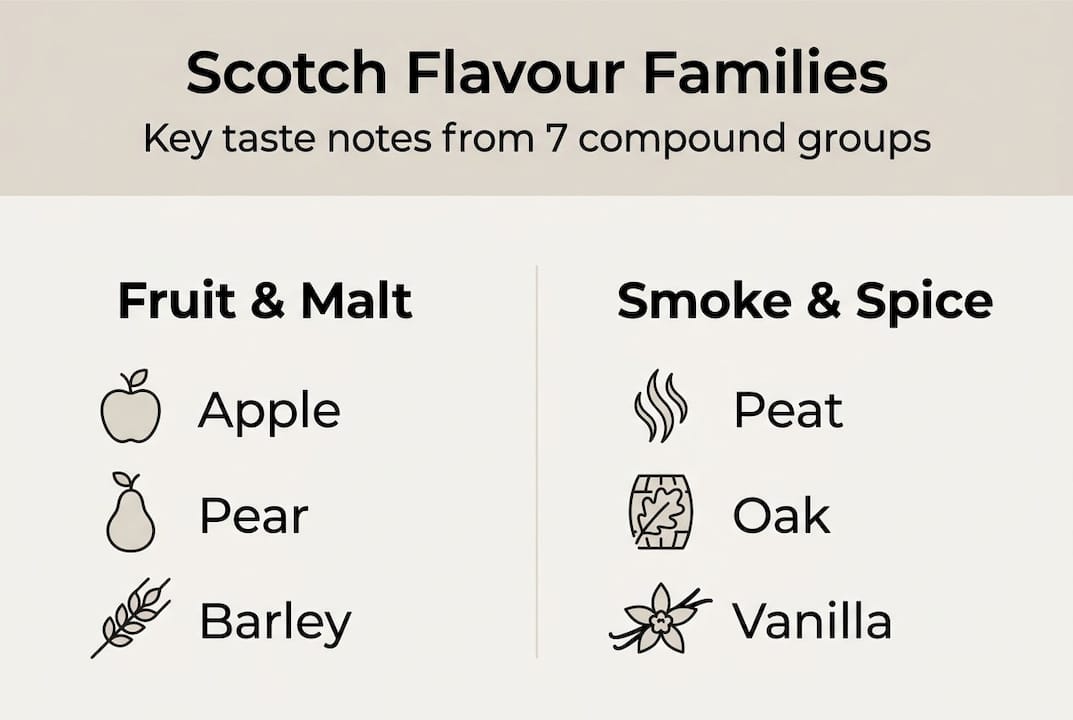
Those families are: fruity/esters, floral, malty/cereal, smoky/peaty, woody/tannic, spicy, and sweet. Every Scotch you’ll ever drink sits somewhere across this map, often blending three or four of these families in one glass. Understanding them gives you a framework rather than a fog.
Here’s a quick breakdown of each family and what you’re likely to pick up:
| Flavour family | Classic tasting notes |
|---|---|
| Fruity/esters | Green apple, pear, banana, citrus peel |
| Floral | Heather, rose water, lavender, cut grass |
| Malty/cereal | Biscuit, porridge, fresh bread, barley |
| Smoky/peaty | Campfire, iodine, tar, smoked meat |
| Woody/tannic | Oak, pencil shavings, dark chocolate, espresso |
| Spicy | White pepper, ginger, cinnamon, clove |
| Sweet | Vanilla, toffee, caramel, honey |
These notes don’t appear randomly. They’re the product of chemistry, and flavour profile basics are rooted in specific compounds that develop at each stage of production. Esters form during fermentation and bring fruit. Phenols come from peat smoke and bring that unmistakable earthiness. Lignin compounds from oak barrels break down over years to deliver vanilla and caramel.
The Scotch Whisky Research Institute has identified 300+ chemical compounds that contribute to flavour in a finished whisky. That’s a staggering level of complexity.
“The flavour of Scotch whisky is one of the most complex of all spirits, shaped by an intricate web of hundreds of interacting chemical compounds.”
What makes Scotch genuinely fascinating is that no bottle contains just one of these families. A classic Speyside might lead with fruit and floral notes but finish with a warm spice. A coastal Highland can start malty and land somewhere quietly smoky. These combinations are why experienced collectors keep coming back.
How Scotch gets its taste: ingredients, process, and barrels
Scotch doesn’t arrive at its flavour by accident. There’s a deliberate, often centuries-old sequence of steps that contribute to key flavour signatures, and understanding that sequence makes tasting far more meaningful.
Here’s the stepwise journey from barley to bottle:
- Barley selection — The base grain brings cereal and malt notes. Specific varieties, and how they’re grown, influence the sugar content and therefore the fermentation character.
- Malting and peating — Barley is germinated and dried using a kiln. If peat is burned during drying, phenolic compounds absorb into the grain. More peat equals more smoke in the final whisky.
- Mashing — Ground malt is mixed with hot water to extract fermentable sugars. Water source matters here, with Highland spring water and Islay peat-filtered water each leaving their mark.
- Fermentation — Yeast converts sugars to alcohol over 48 to 96 hours. Longer fermentation produces more fruity esters, which is why some distilleries deliberately extend this stage.
- Distillation — Pot still distillation concentrates flavour. Still shape directly affects which compounds carry over. Taller stills produce lighter, more floral spirit. Shorter, fatter stills give heavier, richer character.
- Cask maturation — At least three years in oak. This is where the magic accelerates.
Cask choice might be the single biggest driver of your Scotch experience. Here’s how the two most common cask types compare:
| Cask type | Key flavour contributions |
|---|---|
| Ex-bourbon (American oak) | Vanilla, caramel, coconut, subtle spice |
| Ex-sherry (European oak) | Dried fruit, walnut, Christmas spice, dark chocolate |
Bourbon-barrel aged Scotch yields vanilla and caramel while sherry casks add that rich, indulgent depth. If you’ve ever opened a Glenfarclas or GlenDronach and noticed rich plum and spiced orange, that’s European oak sherry influence. If Glenlivet or Glen Grant read as lighter and sweeter with a biscuity base, that’s ex-bourbon barrels at work.

For readers exploring production factors across regions, knowing the cask history of a bottle before you buy can completely reshape your expectations.
Pro Tip: Add a few drops of still water to your dram and wait 90 seconds before nosing again. Dilution opens up mid-range aromas that high alcohol concentration can actually suppress.
Types of Scotch: single malt vs blended and why it matters
Once you understand process, the next question is category. Single malt and blended Scotch are fundamentally different in construction, and that difference shapes your entire tasting experience.
Here’s what each style typically brings to the glass:
- Single malt: Made from 100% malted barley at one distillery. Tends to be more layered, regionally expressive, and structurally complex. Every bottle carries the distinctive fingerprint of its distillery and cask history.
- Blended malt: A marriage of single malts from multiple distilleries, without grain whisky. Often crafted for depth and coherence across batches.
- Blended Scotch: Combines malt and grain whiskies. Typically smoother, more consistent, and accessible. Johnnie Walker and Chivas Regal are built around this style.
Neither is superior. They serve different moments and different palates. A blended Scotch can be a masterclass in balance, while an exploration of the single malt spectrum reveals just how wildly regional character can diverge.
Consider this: pour a non-peated Speyside single malt beside a heavily peated Islay single malt and they’ll taste like they come from different spirits categories entirely. Both are 100% single malt Scotch whisky. That contrast tells you more about flavour geography than any chart.
“Peated single malts are polarising by design. The best of them reward patience and an open nose far more than immediate judgement.”
For collectors building a selection with genuine range, exploring rare and flavourful single malts alongside quality blends gives you the fullest picture of what Scotch actually is. Don’t write off blends as lesser. Some of the most technically impressive Scotch expressions are blends.
How to taste Scotch like an enthusiast
Knowing what to look for is useless if you’re tasting on autopilot. Proper tasting methodology transforms a casual drink into genuine discovery.
Follow this sequence every time you open something new:
- Choose the right glass — A tulip-shaped glass, like a Glencairn, concentrates aromas at the rim. Avoid tumblers for serious tasting; they let aromatics scatter before they reach your nose.
- Observe the colour — Hold the glass to light. Deep amber suggests sherry influence or long maturation. Pale gold typically points to ex-bourbon or a younger spirit.
- Nose before you sip — Keep your mouth slightly open and bring the glass slowly to your nose. Don’t plunge your face in. Start low and move up. Let aromas register in layers rather than all at once.
- Take your first sip small — Let it coat your tongue, then breathe out through your nose. This retro-nasal breathing reveals flavours your taste buds alone would miss.
- Identify the palate — Is the arrival sweet or dry? Does fruit come first, or spice? Note the texture too. Oily, thin, creamy, grippy — these are real descriptors with real meaning.
- Assess the finish — How long does the flavour linger? Does it evolve? A finish that shifts from sweet to peppery over 30 seconds tells you something important about the distillery’s distillation choices.
- Add water and repeat — Even 3 to 5 drops changes everything. Compare your notes.
Pro Tip: Wrap your hands around the glass for two minutes before nosing. Gentle warmth releases volatile aromatics that a cold glass suppresses, and you’ll pick up notes you’d otherwise miss entirely.
Learning to master Scotch tasting techniques takes time, but the investment pays off every time you open a bottle. And remember: older doesn’t automatically mean better. An 18-year-old Scotch will have more oak character, but it may have traded away the lively fruit that made a 12-year expression sing. Use our single malt tasting guide as a reference when exploring new bottles.
A collector’s truth: why no two Scotches truly taste the same
Here’s the honest reality that most flavour guides won’t tell you: categorisation is a starting point, not a destination. Peat, casks, and age interact in genuinely non-linear ways, and distillery variation is unavoidable. Two bottles from the same expression, different bottling years, can be remarkably different.
The collectors we admire most aren’t chasing a definitive ‘best Scotch’. They’re building fluency. They know that what excites their palate on a warm afternoon is different from what they reach for on a cold evening. They understand that a batch variation isn’t a flaw — it’s evidence of a living, breathing production process.
The most productive habit you can develop is recording your own notes rather than relying entirely on expert scores. Your perception of smoke, your sensitivity to tannin, your preference for fruit over spice — these are the real filters that determine whether a bottle is right for you. Consulting a collector’s region guide is smart, but your own record of what moved you is smarter still. Chase curiosity. The bottles that surprise you will always outperform the ones that confirm expectations.
Explore and collect: find your next unforgettable Scotch
With a clearer sense of Scotch’s flavour mechanics, you’re now in the ideal position to choose with intention rather than guesswork.

At Uisuki, we’ve curated a selection that covers the full range of Scotch character, from approachable blends to boundary-pushing single malts. If you’re exploring blended styles, the Ardnamurchan MacLean’s Nose is a superb starting point. For something with genuine barrel complexity, our barrel-aged single malts reward every technique you’ve just read about. Ready to explore further? Browse the full collection and let your new tasting skills lead the way.
Frequently asked questions
Why does Scotch taste smoky?
Scotch tastes smoky because peat smoke adds phenols to the barley during the kilning stage of malting, with intensity depending on how much peat is burned and how long the barley is exposed to it.
What flavours should I expect from Scotch aged in sherry casks?
Sherry casks add dried fruit, nuts, and warming spice to the whisky, making it noticeably richer and sweeter compared to Scotch matured in ex-bourbon barrels.
Is older Scotch always better tasting?
Not necessarily. With extended ageing, oak dominance suppresses fruit and increases tannin, which some palates love and others find overpowering — it comes down to what flavour profile suits your taste.
Do regions really change how Scotch tastes?
Absolutely. Regions shape taste profiles based on local tradition, water sources, peat character, and climate, which is why an Islay Scotch and a Speyside Scotch can taste almost like different spirits entirely.