

Standing in a bottle shop, staring at a label that reads ‘non-chill filtered, first-fill sherry butt, 58.4% ABV’ can feel like reading a foreign language. Whisky conversations at tastings are no different, with terms like ‘hogshead’, ‘cask strength’, and ‘peated’ thrown around as if everyone already knows them. The good news is that once you understand the vocabulary, every bottle tells a richer story and every buying decision becomes sharper. This guide covers the essential whisky terms you need, from grain to glass, so you can shop, taste, and collect with genuine confidence.
Table of Contents
- Production basics: From barley to barrel
- Maturation and casks: Unlocking flavour
- Styles, regions and unique terms
- Expert nuances: Worth knowing as a collector
- Tasting and serving: How to talk (and order) like a pro
- Discover unique whiskies with your new knowledge
- Frequently asked questions
Key Takeaways
| Point | Details |
|---|---|
| Master essential terms | Understanding whisky terminology boosts your confidence when tasting, buying, or collecting. |
| Production shapes flavour | How a whisky is made, matured, and finished determines its taste and character. |
| Label details matter | Knowing regional, style, and maturation terms lets you choose bottles to suit your preferences. |
| Collect with expertise | Advanced concepts like cask finishing and non-chill filtering help identify truly special whiskies. |
Production basics: From barley to barrel
Every whisky starts as a grain, and the journey from raw ingredient to spirit involves a precise sequence of steps. Understanding these core production terms gives you a foundation for reading any label or tasting note.
Here is what each stage means:
- Malting: Barley is soaked in water and allowed to germinate, activating enzymes that convert starch to sugar. The grain is then dried, sometimes over peat smoke.
- Mashing: The dried, ground malt (called grist) is mixed with hot water to extract fermentable sugars, producing a liquid called wort.
- Fermentation: Yeast is added to the wort, converting sugars to alcohol over 48 to 120 hours. Longer fermentation generally produces more fruity, complex flavours.
- Distillation: The fermented liquid (called wash, at roughly 8% ABV) is heated in a still. Alcohol vapour rises, cools, and condenses into a stronger spirit.
- New make spirit: The clear, unaged spirit that comes off the still. It is the raw material that will become whisky after years in a cask.
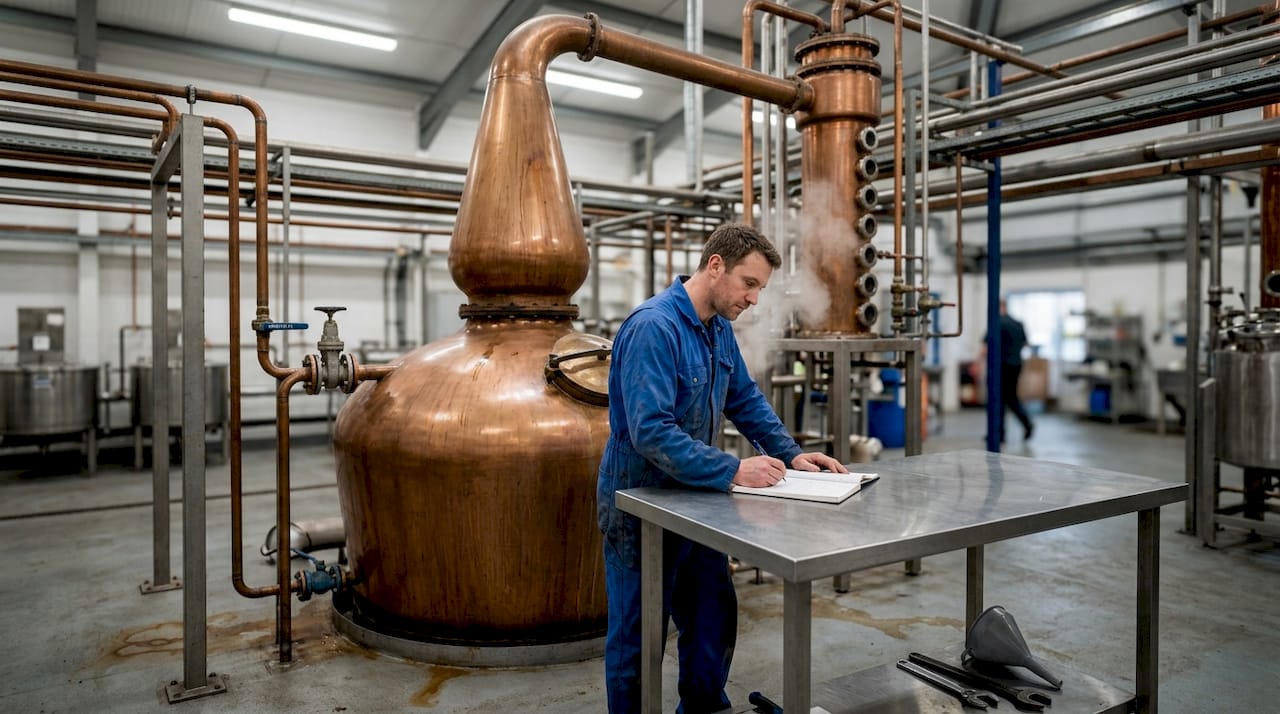
The type of still matters enormously. Pot stills, the traditional copper onion-shaped vessels used in Scotch and Irish production, retain more flavour compounds and produce a heavier, richer spirit. Column stills (also called continuous or Coffey stills) run non-stop and produce a lighter, cleaner spirit, which is standard for grain whisky and most bourbons. You can read more about whisky production differences to see how these choices shape the final dram.
| Stage | Key term | What it produces |
|---|---|---|
| Malting | Grist | Dried, ground malt |
| Mashing | Wort | Sugar-rich liquid |
| Fermentation | Wash | Low-strength beer-like liquid |
| Distillation | New make spirit | Clear, high-strength spirit |
Pro Tip: Ask about the distillery’s cut points. Distillers divide the spirit run into ‘heads’ (harsh, discarded), ‘hearts’ (the prized middle cut kept for maturation), and ‘tails’ (oily, also discarded). A tighter hearts cut means a cleaner, higher-quality spirit in your glass.
Understanding how Scotch whisky is made also reveals why small production decisions, like fermentation length or still shape, create such dramatic differences between distilleries.
Maturation and casks: Unlocking flavour
Once new make spirit enters a cask, time and wood take over. Casks contribute more than 60% of a whisky’s final flavour, colour, and aroma, making them the single most important variable after distillation. The types of whisky casks used, and their history, shape everything you taste.
Key cask terms to know:
- First-fill: A cask used for whisky maturation for the first time after previously holding another spirit (bourbon or sherry). These casks impart the strongest flavour.
- Refill: A cask used for a second or subsequent time. It gives a subtler influence, letting the distillery character shine through.
- Ex-bourbon cask: Typically American oak barrels that previously held bourbon. They contribute vanilla, caramel, coconut, and light spice notes.
- Ex-sherry cask (butt or puncheon): European or American oak casks from Spanish sherry production. They add dried fruit, chocolate, nuts, and rich spice.
- Cask strength: Whisky bottled directly from the cask without dilution, usually 50 to 60% ABV. This preserves the full intensity of flavour.
- Angel’s share: The 1 to 2% per year lost to evaporation through the cask walls during maturation. Over a 12-year maturation, a cask can lose 15 to 20% of its contents.
“The cask is not just a container. It is an active ingredient, breathing with the seasons and slowly transforming raw spirit into something extraordinary.”
| Cask type | Size (litres) | Typical flavour contribution |
|---|---|---|
| Barrel (ex-bourbon) | 200 | Vanilla, caramel, light oak |
| Hogshead | 250 | Vanilla, gentle spice |
| Butt (ex-sherry) | 500 | Dried fruit, chocolate, spice |
| Puncheon | 500 | Rich fruit, toffee, oak |
A hogshead is simply a barrel that has been broken down and rebuilt with extra staves to increase its capacity. Smaller casks mature whisky faster because there is more wood contact per litre of spirit.
Pro Tip: When browsing bottles, check the label for cask type. Ex-bourbon means expect lighter, sweeter notes. Ex-sherry means richer, darker fruit. Knowing this lets you predict flavour before you buy. Explore cask influence on flavour for a deeper look, or read about what whisky maturation means to understand the full process. The whisky glossary at Chivas is also a handy reference.
Styles, regions and unique terms
With cask knowledge in hand, decoding bottle styles and regional specialties becomes straightforward. The whisky terms glossary from Boss Hunting is a useful starting point, but here is what you really need to know.
Core style definitions:
- Single malt: Made from 100% malted barley at a single distillery, distilled in pot stills. Scotland and Japan are the benchmark producers.
- Single grain: Made from grains other than malted barley (or a mix) at a single distillery, usually in column stills. Lighter in style.
- Blended Scotch: A mix of single malt and single grain whiskies from multiple distilleries. Think Johnnie Walker or Chivas Regal.
- Bourbon: American whisky made from a grain mash of at least 51% corn, aged in new charred American oak barrels.
- Rye whisky: Made with at least 51% rye grain. Spicier and drier than bourbon, popular in cocktails.
Scotland’s regions each have a distinct personality. Single malt, single grain, and regional styles follow similar logic across Scotland and Japan.
| Region | Typical profile |
|---|---|
| Speyside | Fruity, floral, honeyed, light peat |
| Islay | Heavy peat, smoke, brine, medicinal |
| Highlands | Varied: heather, fruit, light smoke |
| Lowlands | Light, grassy, gentle, triple-distilled |
| Campbeltown | Briny, oily, complex, slightly peated |
One spelling note worth knowing: ‘whisky’ is used in Scotland, Canada, Japan, and Australia, while ‘whiskey’ is the spelling in Ireland and the United States. It is not a typo either way.
Pro Tip: The region on a label is a reliable shortcut to flavour. If you love smoke, head straight to Islay. If you prefer something lighter and approachable, Lowlands or Speyside is your starting point. Use our whisky buying checklist to narrow your choices, and read about peated whisky flavour origins if smoke is your thing.
Expert nuances: Worth knowing as a collector
Once you move beyond entry-level bottles, you will encounter a second layer of terminology that separates casual drinkers from serious collectors. These terms appear on premium labels and matter for both flavour and investment value.
Key advanced terms:
- Non-chill filtered: Most commercial whiskies are chilled and filtered to prevent cloudiness when water or ice is added. Non-chill filtered whiskies skip this step, retaining more flavour compounds (called congeners) and a richer mouthfeel.
- Congeners: The chemical compounds produced during fermentation and maturation that create flavour and aroma. Esters bring fruitiness, aldehydes add nuttiness, and phenols deliver smoke.
- Cask finishing: A whisky matured in one cask type is transferred to a second cask for a shorter period (weeks to months) to add a new layer of flavour. Finishing casks can transform a whisky’s profile in just a few months.
- Peat and PPM: Peat is partially decomposed organic matter burned to dry malted barley, imparting smoky phenols. PPM (parts per million) measures phenol content. Lightly peated sits below 15 PPM; heavily peated Islay malts can exceed 50 PPM.
- Terroir: Borrowed from wine, this term refers to the influence of local environment, water, barley variety, and climate on a whisky’s character. It is increasingly used by Australian and Japanese distilleries.
“Finishing casks can transform a whisky’s profile in just a few months, adding complexity that would otherwise take years of primary maturation.”
For collectors, whisky label details](https://uisuki.com.au/blogs/news/why whisky label details) like ‘non-chill filtered’ and PPM ratings are signals of quality and authenticity. Understanding [peated whisky in depth will also help you navigate the smokier end of the market with confidence.
Tasting and serving: How to talk (and order) like a pro
Knowing how to describe what is in your glass is just as important as knowing what went into making it. These key tasting terms are the ones you will use most at tastings, bars, and bottle shops.
Essential tasting vocabulary:
- Nose: The aromas you detect before tasting. Always nose a whisky before sipping.
- Palate: The flavours experienced on your tongue and throughout your mouth while drinking.
- Finish: The lingering flavours and sensations after swallowing. A long finish is generally a sign of quality.
- Neat: Whisky served at room temperature with nothing added, no ice, no water.
- On the rocks: Served over ice. Note that ice dilutes and chills the whisky, which can mute some aromas.
- Dram: A Scottish term for a measure of whisky. Informally, it means any pour.
- Legs (or tears): The streaks of liquid that run down the inside of the glass after swirling. Thicker, slower legs suggest higher ABV or glycerol content.
- ABV: Alcohol by volume, the percentage of alcohol in the bottle. Understanding ABV in whisky helps you anticipate strength and flavour intensity. You can also read about whisky proof explained and [barrel proof meaning](https://uisuki.com.au/blogs/news/what is barrel proof whisky) for the American equivalents.
How to properly taste a whisky (step by step):
- Pour a measure into a tulip-shaped glass and let it rest for one to two minutes.
- Nose the glass gently from a few centimetres away. Identify the first aromas: fruit, vanilla, smoke, floral?
- Take a small sip and let it coat your entire palate before swallowing.
- Note the flavours: sweet, spicy, fruity, peaty, oaky?
- Pay attention to the finish. Does it fade quickly or linger for 30 seconds or more?
- Add a few drops of still water and repeat. Water often opens up new aromas and softens the alcohol.
The role of ABV in whisky](https://uisuki.com.au/blogs/news/role of abv in whisky) is also worth understanding, particularly when comparing cask strength expressions to standard bottlings. The [Chivas whisky glossary covers additional serving terms if you want to go further.
Discover unique whiskies with your new knowledge
Knowing your way around a whisky label changes everything about how you shop. You can now spot a first-fill sherry butt, recognise a non-chill filtered cask strength expression, and understand exactly why an Islay single malt smells like a bonfire on a beach.

At Uisuki, we stock bottles that reward exactly this kind of knowledge. The Hobart Whisky Bourbon Matured Single Malt is a brilliant example of cask finishing in action, with bourbon maturation followed by a rum finish at 56.4% ABV. If you are exploring American styles, the Jack Daniel’s Bold and Spicy puts your rye and spice vocabulary to immediate use. Browse the full range and put your new terminology to work.
Frequently asked questions
What is the difference between whisky and whiskey?
Whisky is the spelling used in Scotland, Canada, Japan, and Australia, while whiskey is used in Ireland and the United States. Both terms cover similar spirits but often reflect different production traditions and regional styles.
What does cask strength mean?
Cask strength means the whisky is bottled directly from the cask without dilution, resulting in a higher ABV, usually between 50 and 60%. This preserves the full intensity of flavour from the barrel.
Why does peat matter in whisky?
Peat adds a signature smoky flavour during the malting stage, especially in Islay malts, with intensity measured in PPM. The higher the PPM, the more pronounced the smoke in the finished whisky.
What is the Angel’s Share in whisky ageing?
The Angel’s Share is the portion of whisky lost to evaporation through the cask walls during maturation, typically 1 to 2% per year. Over a long maturation, this loss concentrates the remaining spirit and contributes to its complexity.