

TL;DR:
- Irish whiskey is a light, smooth spirit made primarily from malted and unmalted barley, aged in used barrels. Bourbon is a fuller-bodied, sweeter whiskey from at least 51% corn, aged in new charred oak barrels. Their distinct production methods give each spirit unique flavors and character.
Irish whiskey is defined as a spirit distilled and aged in Ireland from a mash of cereal grains, while bourbon is an American whiskey made from at least 51% corn and aged in new charred oak barrels. The two styles sit at opposite ends of the whiskey flavour spectrum. Irish whiskey delivers light, smooth, fruit-forward character, while bourbon is fuller-bodied and rich with vanilla, caramel, and toasted oak. Understanding the difference between these two styles sharpens your palate and makes every pour more rewarding.
How are Irish whiskey and bourbon made differently?
The production process is where Irish whiskey and bourbon part ways most dramatically. Each style follows a distinct set of rules that directly shapes what ends up in your glass.
Ingredients
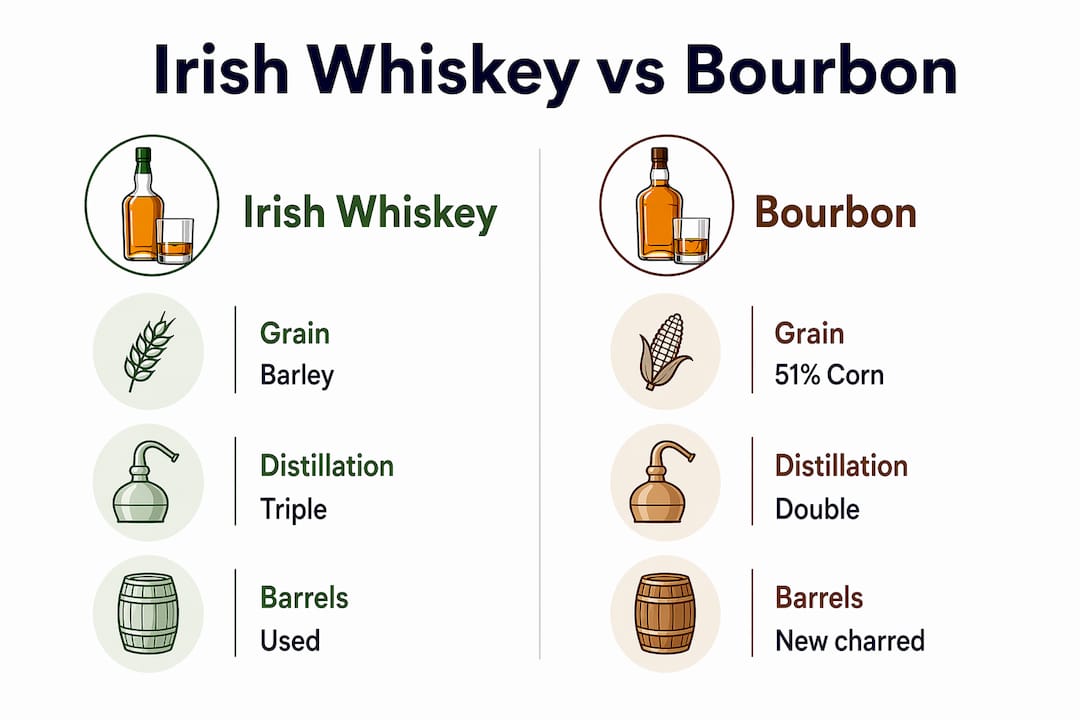
Bourbon must contain at least 51% corn in its mash bill, with the remainder typically made up of rye, wheat, and malted barley. That corn base is the foundation of bourbon’s characteristic sweetness. Irish whiskey, by contrast, uses malted and unmalted barley as its primary grain. This grain difference alone produces a noticeably lighter, more delicate spirit before distillation even begins.
Distillation
Irish whiskey is most commonly triple distilled, a process that removes more heavy congeners and produces a cleaner, smoother spirit. Bourbon is typically double distilled, which retains more of those heavier compounds and contributes to its fuller body. Triple distillation is not a legal requirement for Irish whiskey, but it remains the dominant practice and the reason Irish expressions feel so approachable on the palate.
Ageing and barrels
This is where the flavour gap widens most. Bourbon law requires ageing in new charred oak barrels, typically at a level 3 or level 4 char. That char acts as both a filter and a flavour agent, pulling vanilla and caramel compounds from the wood into the spirit. Irish whiskey, on the other hand, matures in used barrels, most commonly ex-bourbon or ex-sherry casks. Used casks impart subtler wood influence, allowing the grain character and fruit notes to come forward rather than being dominated by oak.
Geography
Bourbon must be produced in the United States, and while it can technically be made anywhere in the country, Kentucky produces the vast majority of the world’s supply. Irish whiskey must be distilled, aged, and bottled in Ireland. These geographical requirements are legally enforced and are not simply marketing claims.
Pro Tip: When comparing the two styles side by side, start with the Irish whiskey first. Its lighter profile will not overwhelm your palate before you move to the richer bourbon.
What are the main flavour differences between the two styles?
The flavour gap between Irish whiskey and bourbon is real, consistent, and traceable directly back to production. Once you know what to look for, you will taste it every time.
Bourbon’s flavour profile
Bourbon’s sweetness comes from two sources: the corn mash bill and the interaction with new charred oak barrels. The new charred oak imparts signature vanilla and caramel notes that define the bourbon flavour profile. Beyond sweetness, expect toasted oak, dried fruit, baking spice, and sometimes a peppery finish. The char level on the barrel acts as a filter for sulphur compounds while simultaneously releasing wood sugars into the spirit. That combination produces the dessert-like richness bourbon is known for.
Irish whiskey’s tasting notes
Irish whiskey tasting notes typically include green apple, pear, honey, light citrus, and a creamy mouthfeel. Triple distillation removes more of the heavy congeners that create weight and heat, leaving a spirit that feels smooth even at standard proof. The use of ex-bourbon and ex-sherry casks adds gentle vanilla or dried fruit notes without overwhelming the grain character. The result is a spirit that rewards slow sipping and works well for drinkers who find heavily oaked whiskeys too intense.
How proof affects your experience
ABV plays a significant role in how you perceive both styles. Higher-proof bourbons above 55% ABV deliver a more intense finish but can be too strong for casual drinkers approaching the category for the first time. Irish blends typically sit in the 40–46% ABV range, making them more accessible without sacrificing complexity. A few drops of water in a high-proof bourbon opens up the aroma and softens the heat, a technique worth trying before you reach for ice.
Using a flavour wheel helps you map specific notes rather than relying on vague impressions. Identifying whether you are tasting vanilla, caramel, or toasted wood in a bourbon, or green apple versus honey in an Irish whiskey, builds the vocabulary to choose bottles you will actually enjoy.
Key tasting contrasts at a glance:
- Bourbon: vanilla, caramel, toasted oak, baking spice, dried fruit, peppery finish
- Irish whiskey: green apple, pear, honey, light citrus, cream, gentle vanilla from cask
What are the legal definitions for Irish whiskey and bourbon?
Both styles are protected by law, and those laws directly determine what ends up in the bottle.
Bourbon regulations
US federal regulations require bourbon to be made from a mash of at least 51% corn, distilled to no more than 160 proof (80% ABV), entered into the barrel at no more than 125 proof (62.5% ABV), and aged in new charred oak containers. There is no minimum age requirement for standard bourbon, but straight bourbon must be aged for a minimum of two years. Bourbon age statements reflect the youngest whiskey in the blend. Many premium bourbons blend multiple barrels aged 4–8 years to maintain consistent flavour across batches.
Irish whiskey regulations
The Irish Whiskey Act and subsequent EU regulations require Irish whiskey to be distilled in Ireland from a mash of cereal grains, aged in wooden casks on the island of Ireland for a minimum of three years, and bottled at a minimum of 40% ABV. The three-year minimum is one year longer than the straight bourbon requirement. That extra time in used casks allows the spirit to develop complexity without the aggressive wood extraction that new barrels produce.
Pro Tip: Check the age statement on any bottle you buy. For bourbon, the stated age is the youngest whiskey in the blend. For Irish whiskey, the minimum is three years, but expressions aged eight years or more show noticeably more depth.
| Requirement | Bourbon | Irish whiskey |
|---|---|---|
| Primary grain | Min. 51% corn | Malted/unmalted barley |
| Barrel type | New charred oak | Used oak (ex-bourbon, ex-sherry) |
| Minimum age | 2 years (straight) | 3 years |
| Country of origin | United States | Ireland |
| Minimum bottling ABV | 40% | 40% |
How can you best enjoy and serve both spirits?
Knowing how to serve each style makes a real difference to what you taste. Small adjustments to glassware, temperature, and mixing unlock the full character of both.
Glassware and temperature
A Glencairn glass concentrates aromas for both styles and is the best choice for neat tasting. Avoid wide-mouthed tumblers when you want to assess flavour. Serve both spirits at room temperature for tasting. Chilling a whiskey closes down the aroma compounds and flattens the experience.
Tasting sequence and technique
- Nose the glass before sipping. Bourbon will show vanilla and caramel immediately. Irish whiskey will offer lighter fruit and floral notes.
- Take a small sip and let it sit on the palate for a few seconds before swallowing.
- Add a few drops of still water to high-proof bourbons to open up the mid-palate.
- Taste Irish whiskey first in a comparison session to avoid palate fatigue from bourbon’s intensity.
Cocktails and food pairings
Irish whiskey cocktails include the Irish Coffee, the Whiskey Sour made with a blended Irish expression, and a simple highball with ginger ale. The lighter profile of Irish whiskey makes it a natural partner for seafood, soft cheeses, and apple-based desserts. Bourbon suits richer pairings: dark chocolate, smoked meats, pecan pie, and aged cheddar. Classic bourbon cocktails include the Old Fashioned, the Manhattan, and the Mint Julep. Each of these drinks is built around bourbon’s sweetness and oak character, which hold up well against sugar and bitters.
Common beginner mistakes
Many casual drinkers assume all whiskey tastes the same. The differences between whiskey types are significant enough that a drinker who dislikes bourbon may genuinely love Irish whiskey, and vice versa. Another common mistake is adding too much ice, which dilutes the spirit before you have had a chance to assess it properly. Start neat, then adjust.
Key takeaways
Irish whiskey and bourbon are legally distinct spirits shaped by different grains, distillation methods, barrel types, and ageing rules, producing flavour profiles that are reliably different in every glass.
| Point | Details |
|---|---|
| Grain defines the base | Bourbon uses min. 51% corn; Irish whiskey uses malted and unmalted barley. |
| Barrels drive flavour | New charred oak gives bourbon vanilla and caramel; used casks keep Irish whiskey lighter. |
| Distillation shapes texture | Triple distillation makes Irish whiskey smoother; double distillation gives bourbon more body. |
| Legal minimums matter | Bourbon straight requires 2 years; Irish whiskey requires a minimum of 3 years. |
| Proof guides accessibility | Irish blends at 40–46% ABV suit beginners; high-proof bourbons above 55% ABV suit experienced drinkers. |
Two spirits worth knowing well
I have spent years tasting across both categories, and the thing that still surprises people is how different these two spirits actually are once you slow down and pay attention. Most casual drinkers lump all brown spirits together until they taste a well-made Irish single malt alongside a Kentucky straight bourbon. The contrast is immediate and striking.
What I find most interesting about Irish whiskey right now is the category’s evolution. It went from near extinction in the 1970s to a genuinely diverse range of expressions spanning approachable blends and complex single malts. That growth reflects a successful premium repositioning that has attracted both new drinkers and seasoned collectors. The best Irish expressions today are not just smooth. They are genuinely complex.
Bourbon, on the other hand, rewards patience and a willingness to explore proof levels. A 46% ABV entry-level expression and a cask-strength release from the same distillery can taste almost like different spirits. If you find bourbon too sweet or too woody, try a higher-rye mash bill expression. The spice cuts through the sweetness and changes the experience entirely.
My practical advice: buy one bottle from each category, taste them side by side on the same evening, and use a flavour wheel to write down what you actually taste rather than what you expect to taste. That single exercise will teach you more about the comparison of whiskey styles than any amount of reading.
— Brendan
Premium whisky worth adding to your collection
Uisuki stocks a curated range of whiskies for drinkers who want to move beyond the basics and into genuinely interesting bottles.

The Hobart Whisky Bourbon Matured Rum Finished Single Malt is a standout example of what happens when bourbon barrel maturation meets single malt complexity. Bottled at 56.4% ABV, it carries the vanilla and caramel character of bourbon cask ageing alongside the fruit and grain depth of a well-made single malt. For drinkers who love what bourbon barrels do to a spirit but want something beyond a straight American whiskey, this bottle is worth serious attention. Uisuki ships across Australia with free shipping thresholds and offers personalised sourcing for rare and hard-to-find bottles.
FAQ
What is the main difference between Irish whiskey and bourbon?
Irish whiskey uses malted and unmalted barley and is typically triple distilled, producing a lighter, smoother spirit. Bourbon is made from at least 51% corn and aged in new charred oak barrels, giving it a sweeter, fuller-bodied profile.
Does Irish whiskey have to be triple distilled?
Triple distillation is not a legal requirement for Irish whiskey, but it is the dominant practice. It removes more heavy congeners and produces the smooth, clean mouthfeel the category is known for.
How long must bourbon and Irish whiskey be aged?
Straight bourbon must be aged for a minimum of two years. Irish whiskey must be aged for a minimum of three years in wooden casks on the island of Ireland.
Which is better for beginners: Irish whiskey or bourbon?
Irish whiskey is generally more approachable for beginners. Its lighter body and lower congener levels make it easier to sip neat, while high-proof bourbons above 55% ABV can be intense for new drinkers.
Can you use Irish whiskey and bourbon interchangeably in cocktails?
The two spirits are not interchangeable without changing the character of the drink. Bourbon’s sweetness and oak weight suit cocktails like the Old Fashioned and Manhattan, while Irish whiskey’s lighter profile works better in highballs and the Irish Coffee.