

TL;DR:
- Bourbon and scotch differ mainly in taste due to their grains and aging barrels. Bourbon offers sweetness from corn and new charred oak, while scotch displays a wider flavor spectrum from malted barley and reused casks. Age influences flavor complexity, but balance and cask choice remain the key factors shaping their distinct profiles.
Bourbon and scotch differ most fundamentally in taste because of their grain base and the barrels used for ageing. Bourbon delivers sweetness through vanilla, caramel, and toasted oak, driven by its corn-heavy mash bill and mandatory new charred oak barrels. Scotch, built on malted barley and aged in reused casks, spans a far wider spectrum, from the honeyed florals of Speyside to the intense smoke of Islay. The bourbon vs scotch taste divide is not just a matter of preference. It reflects two entirely different sets of production laws, ingredients, and traditions. Understanding those differences gives you a real framework for choosing what to pour.
What ingredients and production laws shape bourbon and scotch flavour?
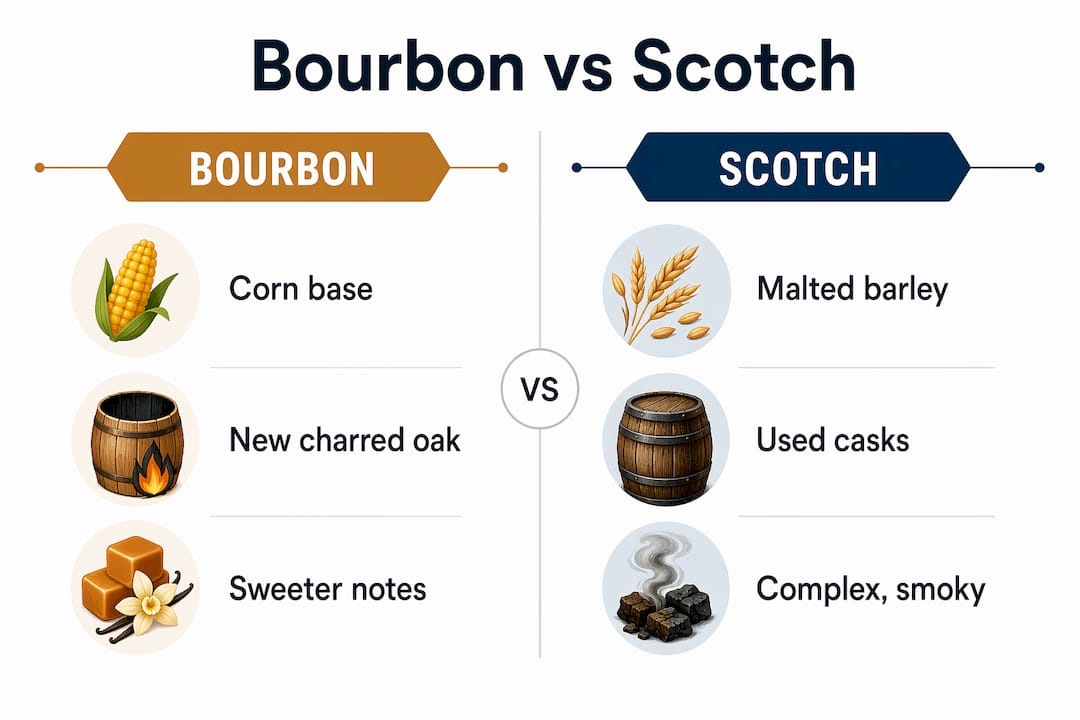
The grain bill is the first and most decisive factor in how each whisky tastes. Bourbon must contain at least 51% corn, which delivers a naturally sweet foundation. That corn character is then amplified by the legal requirement to age in new, charred American oak barrels, which push vanilla, caramel, and toffee notes deep into the spirit.
Scotch takes a different path entirely. Scotch uses malted barley as its primary grain, which produces a drier, more complex base with biscuity, malty textures. The Scotch Whisky Association governs production standards, and those rules allow distillers to age in reused casks, including ex-bourbon barrels, sherry butts, and port pipes. Each cask type leaves a different flavour fingerprint on the final whisky.
Distillation method also plays a role. Bourbon typically uses column stills, which produce a cleaner, higher-proof spirit that lets the barrel do most of the flavour work. Scotch, particularly single malt, uses pot stills, which retain more congeners and create a richer, more textured spirit before the wood even gets involved.
Here is a side-by-side look at the key production differences:
| Factor | Bourbon | Scotch |
|---|---|---|
| Primary grain | Corn (minimum 51%) | Malted barley |
| Barrel requirement | New, charred American oak | Reused casks (ex-bourbon, sherry, port) |
| Distillation style | Column still (typically) | Pot still (single malt) |
| Governing standard | US Federal Standards of Identity | Scotch Whisky Association regulations |
| Minimum ageing | Two years (straight bourbon) | Three years |
The practical result is that bourbon tastes consistent in its sweet, oaky character across most expressions. Scotch, by contrast, can taste radically different depending on the region and cask used.
How do ageing and barrel choices influence the flavour difference between bourbon and scotch?
The barrel is where the real flavour transformation happens, and the rules around barrel use explain most of the taste gap between these two styles. New charred oak barrels give bourbon its signature vanilla, caramel, and oak character with a reliability that makes bourbon one of the most consistent whisky categories in the world. The charring process caramelises the wood sugars and creates a filter layer that smooths out harsh spirit compounds.
Scotch distillers work with casks that have already given their first flavour hit to another spirit or wine. An ex-bourbon cask lends gentle vanilla and coconut notes to a Scotch. A sherry butt adds dried fruit, Christmas cake, and nutty richness. A port pipe brings red berry sweetness and a deep colour. This flexibility is why scotch flavour profiles range so widely from one bottle to the next.
Peat is the other major variable in scotch. Distilleries on Islay dry their malted barley over burning peat, which infuses the grain with phenolic compounds before distillation even begins. Peated Islay scotches carry intense smoky, medicinal, and sea brine notes that have no equivalent in bourbon. Speyside and Lowland scotches, by contrast, are rarely peated and tend toward fruit, honey, and floral notes instead.
Pro Tip: If you want to understand how dramatically cask choice shapes flavour, try the same distillery’s expression in both an ex-bourbon and a sherry cask finish. The difference is often more striking than comparing two entirely different whiskies.
Age duration matters, but not in the way most people assume. A longer time in barrel does not automatically mean better or smoother whisky. It means more wood influence, which can be a positive or a negative depending on the cask quality and the spirit’s character. The whisky ageing process is about balance between spirit and wood, not simply time served.
What are the typical tasting notes for bourbon and scotch?
Bourbon tasting notes follow a recognisable pattern across most expressions. The core descriptors are caramel, vanilla, brown sugar, toasted oak, toffee, and baking spices like cinnamon and nutmeg. Bourbon is generally sweeter and warmer than scotch, with a full-bodied mouthfeel that comes from the corn base and the new oak contact. Wheated bourbons, which substitute wheat for rye in the secondary grain, lean softer and creamier. High-rye bourbons push toward spice and pepper.
Scotch tasting notes depend heavily on region and cask. A practical breakdown looks like this:
- Islay scotch: Intense peat smoke, iodine, sea salt, and medicinal notes. Bold and polarising for new drinkers.
- Speyside scotch: Orchard fruit, honey, vanilla, and gentle spice. The most approachable regional style for most people.
- Highland scotch: Heather, dried fruit, malt, and a light earthiness. Wide variation across distilleries.
- Lowland scotch: Light, grassy, floral, and delicate. Often described as the most gentle of the Scotch styles.
- Campbeltown scotch: Briny, oily, and slightly smoky with a distinctive coastal character.
The mash bill variations in bourbon create meaningful taste differences too. Rye-forward bourbons like those from Kentucky’s traditional distilleries deliver a spicy, dry finish that contrasts sharply with the soft, round sweetness of wheated expressions. Proof also shifts the experience. A 46% ABV bourbon will taste noticeably different from a barrel-proof version of the same whisky, with the higher-proof expression showing more intensity and heat.
Pro Tip: When tasting whisky for the first time, add a few drops of still water to open up the aromas. This is especially useful with higher-proof expressions where alcohol heat can mask the more delicate flavour compounds.
Learning to read whisky tasting notes takes practice, but the vocabulary becomes intuitive quickly once you connect the descriptors to actual sensory experiences in the glass.
How can beginners explore the taste differences between bourbon and scotch?
The best starting point for any new whisky drinker is choosing expressions that are approachable without being boring. Beginners should focus on bourbons in the 80–90 proof range for balance and accessibility. That translates to roughly 40–45% ABV, where the sweetness and oak character are clear without the alcohol heat dominating the experience.
For scotch, start with non-peated or lightly peated expressions from Speyside or the Lowlands. These styles show the malt character and cask influence without the confronting smoke that can put new drinkers off the category entirely. Once you have a reference point for clean malt flavour, peated scotches become far more interesting rather than simply overwhelming.
A few practical steps for building your palate:
- Use a tulip-shaped glass or a Glencairn glass to concentrate aromas at the rim.
- Nose the whisky before tasting. Identify one or two aromas before the liquid touches your palate.
- Take a small sip and let it sit on your tongue for a few seconds before swallowing.
- Note the finish. Does it linger with warmth and spice, or does it fade quickly with fruit and sweetness?
- Try a flight of three or four whiskies side by side rather than tasting them in isolation.
Age is not a definitive indicator of smoothness. A younger bourbon with a balanced proof can be more approachable than an older, heavily oaked expression. Trust what you actually taste rather than what the label implies about quality. The best whiskies for beginners are the ones that make you want to pour another glass, regardless of age statement or price point.
Pro Tip: Avoid barrel-proof or cask-strength bottles when you are just starting out. Expressions above 55% ABV can numb the palate quickly and make it harder to identify the flavours you are trying to learn.
How do flavour profiles affect bourbon and scotch in cocktails versus neat?
Flavour determines function when it comes to mixing versus sipping. Tasting whisky neat lets complex scotch flavours fully express, particularly in peated or heavily sherried expressions where dilution or sweetness from a mixer would mask the most interesting notes. A heavily peated Islay scotch in a cocktail is largely a waste of the whisky’s character.
Bourbon’s natural sweetness and vanilla-forward profile make it the ideal base for classic cocktails. The Old Fashioned works because bourbon’s caramel and oak notes hold up against the bitters and sugar without being overwhelmed. The Manhattan benefits from bourbon’s sweetness balancing the vermouth’s bitterness. Lighter, fruitier scotches from Speyside or the Lowlands work well in highballs, where the carbonation lifts the floral and fruit notes rather than suppressing them.
Proof matters in cocktails too. A higher-proof bourbon at 50% ABV or above will cut through ice dilution and mixer volume better than a standard 40% expression. For neat drinking, that same high-proof bourbon may benefit from a few drops of water to open the nose and soften the alcohol edge.
Key takeaways
Bourbon’s sweetness and scotch’s complexity both trace back to the same source: the grain used and the barrel chosen for ageing.
| Point | Details |
|---|---|
| Grain drives the base flavour | Corn gives bourbon sweetness; malted barley gives scotch a drier, more complex foundation. |
| Barrel rules create the signature | New charred oak locks in bourbon’s vanilla and caramel; reused casks give scotch its wide flavour range. |
| Region shapes scotch dramatically | Islay delivers smoke and brine; Speyside offers fruit and honey; Lowlands stay light and floral. |
| Beginners should start approachable | Choose 80–90 proof bourbons and non-peated scotches to build palate confidence before exploring extremes. |
| Cocktail suitability follows flavour | Bourbon’s sweetness suits classic mixed drinks; complex peated scotches are best enjoyed neat. |
Brendan’s take: stop chasing smoothness and start chasing flavour
The single biggest mistake I see new whisky drinkers make is treating “smooth” as the goal. Smoothness is not the absence of flavour. It is the balance between flavour and alcohol heat. A whisky that tastes like nothing is not smooth. It is just empty.
When I first started comparing bourbon and scotch seriously, I kept reaching for the same style because it felt safe. Bourbon’s sweetness is genuinely comforting, and there is nothing wrong with that. But the moment I tried a well-made Speyside single malt aged in a sherry cask, I realised I had been limiting myself to one corner of a very large room.
The other myth worth killing is that older always means better. I have tasted 12-year-old bourbons that outperformed 20-year expressions from the same distillery because the younger whisky had better balance. Wood is not inherently good. Too much of it turns a whisky into a tannin bomb.
My honest advice: buy one bourbon and one non-peated scotch at the same time and taste them back to back. The contrast is more instructive than any article, including this one. You will immediately understand why the production differences matter, because you will taste them directly. After that, the scotch vs bourbon comparison stops being an abstract debate and becomes a personal preference you can actually articulate.
— Brendan
Whiskies worth tasting from both sides of the spectrum
Whether you are drawn to bourbon’s caramel warmth or scotch’s layered complexity, having the right bottle in hand makes all the difference.

Uisuki.com.au carries a curated selection of whiskies that sit at the crossover point between these two styles. The Hobart Whisky Bourbon Matured Rum Finished Single Malt is a compelling example: an Australian single malt aged in bourbon barrels and finished in rum casks, delivering the vanilla and caramel notes bourbon drinkers love alongside the malt complexity scotch enthusiasts seek. For those wanting to explore the blended scotch category, the Ardnamurchan Macleans Nose Blended Scotch at 46% ABV offers a well-balanced introduction to Highland character. Browse the full range at Uisuki.com.au to find expressions that match your palate, whether you are just starting out or adding to a serious collection.
FAQ
What is the main taste difference between bourbon and scotch?
Bourbon tastes sweeter, with vanilla, caramel, and oak notes from its corn base and new charred barrel ageing. Scotch offers a broader range, from fruity and floral to smoky and peaty, depending on region and cask type.
Why does bourbon taste sweeter than scotch?
Bourbon must be made from at least 51% corn and aged in new, charred American oak barrels, both of which drive sweetness and vanilla character into the spirit. Scotch uses malted barley and reused casks, producing a drier and more varied flavour profile.
What scotch should a bourbon drinker try first?
A Speyside single malt aged in an ex-bourbon cask is the most natural bridge for bourbon drinkers, as it shares vanilla and fruit notes without the smoke that can be off-putting for newcomers to scotch.
Does age make bourbon or scotch taste better?
Age adds wood influence but does not guarantee better flavour. Younger bourbons at balanced proof can be more approachable than heavily oaked older expressions, and the same principle applies to scotch.
Can you use both bourbon and scotch in cocktails?
Bourbon suits classic cocktails like the Old Fashioned and Manhattan because its sweetness holds up well against bitters and vermouth. Lighter scotches work in highballs, but heavily peated expressions are best enjoyed neat to preserve their complexity.