

Rarity can boost a whisky’s value by up to 200%, yet most collectors mistakenly believe age alone determines worth. Understanding what truly drives collectible whisky prices requires examining multiple interconnected factors including scarcity, brand heritage, quality indicators, and market dynamics. This guide reveals the essential elements Australian collectors must evaluate to make confident purchasing and investment decisions in today’s volatile whisky market.
Table of Contents
- Introduction To Whisky Collectibility
- Rarity And Limited Editions
- Provenance And Brand Reputation
- Age, Maturation And Quality Indicators
- Market Demand, Auction Influence And Price Volatility
- Common Misconceptions About Whisky Value
- Framework For Evaluating Collectible Whisky Value
- Conclusion And Practical Buying Tips For Australian Collectors
- Enhance Your Whisky Collection With Uisuki
- Frequently Asked Questions
Key takeaways
| Point | Details |
|---|---|
| Rarity drives premium pricing | Limited production runs and discontinued releases create competition among collectors, significantly increasing value. |
| Provenance authenticates worth | Verified distillery heritage and brand reputation influence price confidence and collector demand. |
| Quality extends beyond age | Maturation methods, packaging condition, and unopened bottles affect value more than age statements alone. |
| Market sentiment fluctuates prices | Auction results, global demand trends, and investor interest create significant price volatility. |
Introduction to whisky collectibility
Collectible whisky represents bottles that appreciate beyond their initial retail price due to specific characteristics that appeal to enthusiasts and investors. The global market for collectible spirits has grown substantially, with Australian collectors showing particular interest in both international and domestic rare releases.
Value development occurs through complex interactions between intrinsic whisky qualities and external market forces. A bottle’s collectibility emerges from factors including production scarcity, distillery reputation, maturation excellence, and evolving collector preferences. Understanding these dynamics helps you navigate whisky collectibility value trends effectively.
Collectors typically focus on several categories:
- Single malt Scotch from heritage distilleries
- Japanese whiskies with limited distribution
- Australian craft distillery releases
- Bourbon and rye with unique provenance
- Discontinued expressions from closed distilleries
Each category develops value differently based on regional preferences, historical significance, and market accessibility. Australian collectors benefit from geographic proximity to emerging local distilleries while maintaining access to established international markets through specialised retailers.
Rarity and limited editions
Scarcity fundamentally drives collectible whisky value by creating competition among buyers for finite bottle quantities. When distilleries produce small batches or single cask releases, each bottle becomes proportionally more sought after. This supply constraint pushes prices upward as demand exceeds availability.

Limited edition whisky releases often command immediate premiums due to announced production caps. Distilleries might bottle only 500 to 5,000 units for special releases, compared to standard expressions with ongoing production. Discontinued whiskies gain additional value as remaining stock depletes without replenishment possibility.
Examples of rarity impact include:
- Single cask bottlings selling at 300% premium over standard releases
- Closed distillery whiskies appreciating 400% over two decades
- Anniversary editions with strict allocation creating waitlists
- Regional exclusive releases commanding international shipping premiums
Market dynamics intensify when multiple collectors pursue the same rare bottle. Auction houses report bidding wars that push final prices well beyond pre-sale estimates, particularly for whiskies with documented scarcity. This competition effect multiplies value beyond the whisky’s intrinsic quality.
Pro Tip: Research production numbers before purchasing limited editions. Genuine scarcity drives value, but some “limited” releases produce tens of thousands of bottles, limiting future appreciation potential.
Provenance and brand reputation
Distillery heritage significantly influences collectible whisky pricing through established reputation and perceived quality assurance. Established distilleries see secondary market price premiums of 40-70% over comparable newer distilleries. Brands like Macallan, Glenfiddich, and Ardbeg command consistent collector interest due to centuries of production excellence and market recognition.
Brand reputation creates psychological value that affects buyer confidence and willingness to pay premium prices. Collectors trust heritage brands to maintain quality standards, making these bottles safer long-term investments. This trust translates directly into higher resale values and auction performance.
Whisky provenance matters to collectors because it verifies authenticity and ownership history. Documented storage conditions, original packaging, and retailer receipts substantially increase value by reducing counterfeit risk. Bottles with gaps in provenance documentation sell at discounts reflecting authentication uncertainty.
Australian distilleries like Starward and Sullivans Cove have recently gained international collectible status through award recognition and quality consistency. These emerging brands demonstrate that provenance extends beyond age, incorporating innovation and regional character. Whisky provenance traceability affects both taste perception and investment confidence.
“Heritage distilleries maintain premium pricing through proven quality and collector confidence built over generations of production excellence.”
Verified provenance protects collectors from sophisticated counterfeits entering the secondary market, particularly for high-value bottles where fraud incentives increase proportionally with price.
Age, maturation and quality indicators
Age statements in whisky correlate with value but represent only one quality dimension among many. Older whiskies typically command higher prices due to extended maturation costs, evaporation losses, and flavour complexity development. However, age alone doesn’t guarantee collectibility or superior taste.
No-age-statement (NAS) whiskies can achieve significant collectible value when rarity, brand reputation, or critical acclaim compensate for age transparency absence. Some NAS releases incorporate older component whiskies while maintaining pricing flexibility and blending creativity. Age statement whiskies worth considering balance maturation time with production costs.
Packaging quality substantially affects collectible value through preservation of contents and presentation appeal. Unopened bottles maintain higher values than opened counterparts, with original boxes and accompanying materials adding 15-30% premiums. Unique packaging designs from special releases become collectible elements themselves.
| Factor | Impact on value | Collector priority |
|---|---|---|
| Age statement 25+ years | Very high | Primary for traditional collectors |
| Premium NAS with acclaim | Moderate to high | Growing among younger collectors |
| Original packaging intact | 15-30% premium | Essential for resale value |
| Unopened bottle condition | 40-60% over opened | Critical for investment focus |
Why age matters in whisky extends beyond flavour to encompass scarcity, as older stock becomes progressively rarer. Distilleries face opportunity costs holding whisky for decades rather than selling earlier, translating into higher retail prices that establish collectible value baselines.
Pro Tip: Evaluate packaging condition carefully before purchasing collectible whiskies. Damaged boxes, faded labels, or low fill levels significantly reduce resale value regardless of whisky age or brand prestige.
Market demand, auction influence and price volatility
Collector demand drives significant price fluctuations in collectible whisky markets, with Australian enthusiasts increasingly participating in global investment trends. Auction houses report 30-50% annual price variation for specific bottles based on collector sentiment shifts and market speculation.
Auction results create feedback loops affecting future valuations. When rare bottles achieve record prices at Sotheby’s or Bonhams, similar expressions immediately increase in perceived value across secondary markets. This auction influence extends beyond individual bottles to entire distillery portfolios and regional categories.
Global market trends substantially impact Australian collectors:
- Asian demand spikes, particularly from Chinese collectors, drove Japanese whisky prices up 400% between 2019 and 2025
- American bourbon interest increased international secondary market activity by 200% over five years
- European collectors rotating focus between Scottish regions creates regional price volatility
- Cryptocurrency wealth generation introduced new collector demographics with different buying patterns
Market sentiment responds to factors including economic conditions, investment alternative performance, and cultural trends. During economic uncertainty, tangible assets like collectible whisky often see increased interest as portfolio diversification tools. Conversely, market corrections can trigger rapid devaluation of speculative holdings.
| Year | Average auction price increase | Volume of lots sold | Volatility index |
|---|---|---|---|
| 2024 | 12% | 8,400 | Moderate |
| 2025 | 18% | 9,800 | High |
| 2026 | 9% (projected) | 10,500 (projected) | Moderate |
Price volatility creates both opportunity and risk for collectors. Strategic purchases during market dips can yield substantial returns, while speculative buying at market peaks risks capital loss. Successful collectors monitor auction results, track market sentiment indicators, and time purchases strategically.
Common misconceptions about whisky value
Many collectors believe only extremely old whiskies hold significant value, but this oversimplifies collectibility drivers. Rarity and provenance often outweigh age, with 15-year limited releases sometimes commanding higher prices than 30-year standard expressions. Age contributes to value but doesn’t solely determine it.
Another frequent misconception equates purchase price with authentic value. Without verified provenance and authentication, expensive bottles may prove worthless if counterfeit or improperly stored. Price paid represents perceived value at transaction time, not guaranteed resale worth or authenticity confirmation.
Collectors sometimes assume only Scottish whiskies maintain collectible status internationally. Japanese distilleries like Yamazaki and Hakushu achieve premium prices globally, while Australian producers gain recognition through quality awards. American bourbon and rye categories show strong collectible markets, particularly for limited craft distillery releases.
Key misconceptions to avoid:
- Believing all old bottles automatically appreciate regardless of condition or provenance
- Assuming distillery closure guarantees value increase without considering original production volume
- Expecting linear appreciation without accounting for market cycles and sentiment shifts
- Neglecting authentication importance when purchasing from secondary markets
- Overlooking storage condition impact on both whisky quality and collectible value
Verification becomes critical before significant purchases. Bottle condition assessment should examine fill levels, capsule integrity, label condition, and packaging authenticity. Provenance documentation including original receipts, storage history, and ownership chain substantially reduces counterfeit risk and supports accurate valuation.
Framework for evaluating collectible whisky value
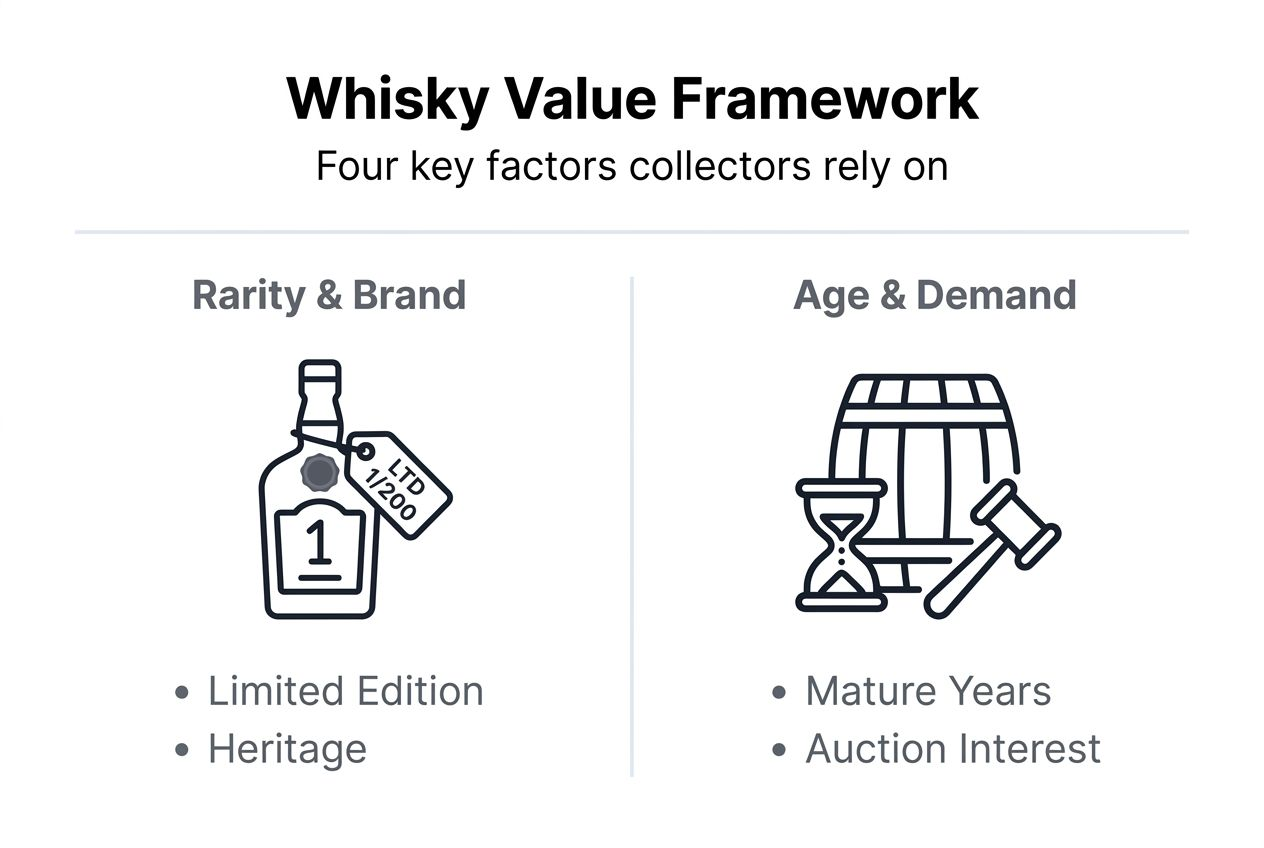
The Four Pillars model provides systematic assessment of collectible whisky worth by examining rarity, provenance, quality indicators, and market sentiment together. The Four Pillars model shows >85% correlation with top auction prices when assessing these factors comprehensively. This framework helps collectors move beyond subjective impressions toward objective valuation.
Systematic evaluation process:
- Assess rarity by researching production numbers, availability, and discontinuation status
- Verify provenance through documentation review, retailer reputation, and ownership history
- Evaluate quality indicators including age, maturation details, packaging condition, and critical reviews
- Analyse market sentiment via recent auction results, collector forum discussions, and pricing trends
Case study application demonstrates framework effectiveness. A 21-year Tasmanian single malt from a respected distillery with 800-bottle production shows high rarity scores. Verified purchase from reputable retailers establishes provenance. Original packaging and unopened condition confirm quality indicators. Recent auction results showing 150% appreciation over three years reflect strong market sentiment. Combined assessment suggests solid investment potential.
| Pillar | Evaluation criteria | Weight in decision |
|---|---|---|
| Rarity | Production volume, availability, discontinuation | 30% |
| Provenance | Authentication, storage history, retailer reputation | 30% |
| Quality indicators | Age, packaging, condition, reviews | 25% |
| Market sentiment | Auction trends, demand signals, investment interest | 15% |
Authentication tips include examining bottle details against distillery specifications, verifying label printing quality, checking capsule and cork condition, and requesting provenance documentation. Professional appraisal services offer authentication for high-value purchases, providing insurance and resale confidence.
Regular framework application trains your evaluation instincts, enabling faster assessment of opportunities and risks. Systematic approach reduces emotional purchasing and improves long-term collection quality and value.
Conclusion and practical buying tips for Australian collectors
Collectible whisky value emerges from interconnected factors including rarity, provenance, quality indicators, and market dynamics rather than age alone. Successful collecting requires systematic evaluation using frameworks like the Four Pillars model, combined with continuous market monitoring and authentication diligence.
Australian collectors should prioritise purchases from trusted sellers such as Uisuki to ensure provenance verification and authentication confidence. Established retailers provide documentation, storage assurance, and recourse unavailable through informal secondary markets.
Practical recommendations:
- Research production numbers before purchasing limited editions to confirm genuine scarcity
- Maintain detailed records of purchases including receipts, storage conditions, and packaging
- Monitor auction results quarterly to track market trends and valuation changes
- Diversify holdings across regions, distilleries, and age profiles to manage risk
- Apply evaluation frameworks consistently rather than making emotional impulse purchases
Market conditions in 2026 show moderate volatility with continued strong interest in Japanese and Australian whiskies. Strategic purchases during market corrections offer better value than buying at sentiment peaks. Patient collectors who apply systematic evaluation typically achieve superior long-term returns.
Enhance your whisky collection with Uisuki
Navigating collectible whisky markets requires both knowledge and access to verified, authentic bottles. Uisuki serves Australian collectors through curated selections of premium, limited-edition, and rare whiskies with guaranteed provenance.
Our expert team provides personalised guidance on investment-worthy bottles, emerging collectible trends, and authentication verification. Whether you’re establishing a collection or seeking specific rare releases, Uisuki offers the expertise and inventory to support your whisky journey confidently. Explore our collection today to discover authenticated bottles that align with your collecting goals and investment strategy.
Frequently asked questions
What is the most important factor in collectible whisky value?
Rarity combined with verified provenance typically drives the highest value impact. Production scarcity creates competition among collectors, while authentication through provenance documentation ensures buyer confidence. Age and brand reputation matter significantly, but without rarity and provenance, even old whiskies from prestigious distilleries may underperform in secondary markets.
Can younger whiskies be valuable collectibles?
Yes, younger whiskies achieve collectible status through extreme rarity, acclaimed quality, or unique production characteristics. Limited single cask releases, discontinued expressions, and award-winning craft distillery bottles command premium prices regardless of age. Market demand and scarcity often outweigh maturation time in determining collectible value for these special releases.
How can I verify a whisky’s provenance before buying?
Request original purchase receipts, examine packaging for tampering signs, verify bottle details against distillery specifications, and purchase from established retailers with authentication guarantees. Professional appraisal services offer verification for high-value bottles. Documentation of storage conditions and ownership history substantially increases confidence and reduces counterfeit risk.
Do Australian whiskies have collectible value internationally?
Australian whiskies increasingly command international collector interest, particularly expressions from award-winning distilleries like Sullivans Cove and Starward. Limited releases and unique maturation characteristics create global demand. International auction results show Australian single malts achieving premium prices, demonstrating growing recognition beyond domestic markets. Quality consistency and innovation drive this expanding collectible status.