

TL;DR:
- Combining distillery direct channels, specialist retailers, and verified secondary sources helps collectors find rare Australian whisky. Verifying provenance through receipts, batch records, and photos is essential before purchasing, especially on the secondary market. Building relationships with distillery ambassadors and retailers increases access to limited releases and private consignments.
The fastest way to source high-quality Australian whisky is to combine distillery direct channels, specialist retailers, and verified secondary-market sources, then confirm provenance before any money changes hands. That single habit separates collectors who land rare bottles from those who miss them.
Start here:
- Check distillery websites and join their members’ clubs or waitlists
- Search specialist retailers for detailed listings (ABV, provenance notes, photos)
- Register with auction platforms and collector networks for secondary-market access
- Confirm Australia Post delivery windows (metropolitan orders typically arrive within five days, regional up to ten)
- Request documented provenance, including original receipts and batch numbers, before committing
Table of Contents
- How to source Australian whisky: the main channels
- How do you find limited releases before they sell out?
- How do you verify a bottle’s authenticity before buying?
- What are the shipping rules and timelines for whisky in Australia?
- How do you judge whether an Australian whisky is priced fairly?
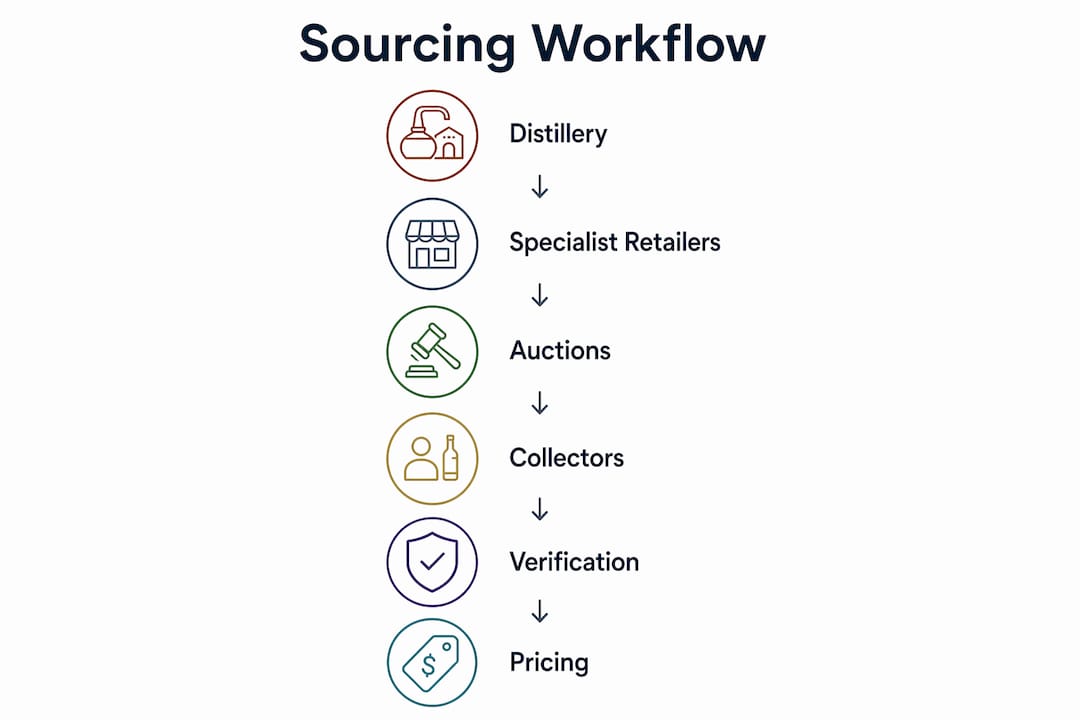
- A 6-step sourcing workflow you can follow today
- Key takeaways
- The soft skills that actually land rare bottles
- Uisuki makes sourcing rare Australian whisky straightforward
- Useful sources and further reading
How to source Australian whisky: the main channels
Australia’s whisky scene is concentrated in premium and ultra-premium ranges, with Tasmania as the benchmark region and a fast-growing mainland craft sector across Victoria and New South Wales. Knowing which channel reliably supplies which type of bottle saves a lot of wasted searching.
Distillery direct
Buying straight from the source gives you the cleanest provenance and first access to new releases. Most distilleries maintain an online shop alongside a physical cellar door. Lark Distillery, for example, sells direct online with Australia Post delivery, typically under five days for metropolitan addresses and up to ten for regional areas. Many distilleries also run members’ clubs that unlock pre-release allocations, limited cask bottlings, and priority purchase windows before stock hits retail.

Specialist retailers and curated online shops
A credible specialist listing tells you the ABV, price, tasting notes, and provenance in one place, with photos. That level of detail is the baseline you should expect. Platforms like Uisuki curate Australian and international bottles with exactly this information, and they offer a sourcing request service for bottles not currently in stock.
Auctions and private sales
Auction houses and private-sale channels are where aged and limited-edition bottles surface. Expect buyer’s premiums on top of the hammer price, which vary depending on the platform. Always request lot photos and provenance documentation before bidding. Award-winning releases from distilleries like Sullivans Cove and Bakery Hill regularly trade at strong premiums on the secondary market.
Bottle shows, tastings and collector networks
Regional whisky shows and tasting events are underrated sourcing channels. Private trades and one-off bottles often circulate through these networks before they ever reach a public listing. Online collector groups on Facebook and Discord serve the same function between events.
Pro Tip: Set a release calendar reminder for distilleries you follow. Most limited drops sell out within hours of announcement, so being on the mailing list is the difference between getting an allocation and missing it entirely.
How do you find limited releases before they sell out?
Collectors who consistently land rare bottles use a layered approach rather than relying on a single channel. Combining distillery club membership with active retailer monitoring and auction alerts is the most reliable method.
- Join distillery clubs and waitlists first. Membership access at distilleries like Archie Rose, which uses individual malt stream processing to produce genuinely distinct limited releases, often means you hear about drops before anyone else.
- Subscribe to specialist retailer newsletters and RSS feeds. Set up browser alerts for specific bottle names so you catch restocks immediately.
- Monitor auction platforms and set lot alerts. Search lot descriptions for cask numbers, age statements, and batch codes rather than just brand names.
- Attend bottle shows and join regional collector groups. Private trades happen here that never appear online.
- Engage a bulk supplier or broker for B2B access. Wholesale and bulk suppliers can access private-label or limited-run bottlings that never reach mainstream retail, though this route typically requires documented credentials and minimum order commitments.
Pro Tip: Use Google Alerts with specific bottle names and distillery release terms. Pair that with retailer back-in-stock notifications and you will rarely miss a drop you were tracking.
How do you verify a bottle’s authenticity before buying?
Provenance is everything in the secondary market. A bottle without a clear chain of custody is a risk, regardless of how good the price looks.
Core provenance checks:
- Original purchase receipt or invoice from a retailer or distillery
- Batch number and cask number matching distillery records
- Consistent label printing (font, colour, alignment) with known authentic examples
- Capsule and seal intact with no signs of re-sealing or tampering
- Fill level appropriate for the bottle’s stated age and storage conditions
Remote photo request template: When buying from a private seller or remote auction, ask for these images before committing:
- High-resolution front label (full frame, no glare)
- Side-on fill level shot showing the meniscus clearly
- Close-up of the neck, capsule, and cork condition
- Back label with batch stamps and any regulatory text
- Base of the bottle showing any embossing or mould marks
Inconsistent label fonts or colours, a fill level that seems too low for a young bottle, or a seller who resists providing photos are all reasons to walk away. For high-value purchases, third-party authentication from a specialist is worth the cost. The Uisuki guide to buying whisky online safely covers additional verification steps specific to the Australian market.
Pro Tip: Cross-reference the batch number with the distillery directly. Most Australian distilleries will confirm whether a batch number is genuine if you contact them, and it takes five minutes.
What are the shipping rules and timelines for whisky in Australia?
Alcohol delivery in Australia is regulated at the state level, and the rules vary. Before purchasing from an interstate retailer, check that the seller is licensed to ship to your state and that your address can accept alcohol deliveries.
- Age verification: You must be 18 or over to purchase and receive alcohol. Carriers and retailers use signature-on-delivery and ID checks to confirm this. Have ID ready.
- Carriers and timelines: Australia Post handles most retailer shipments. Metropolitan delivery typically runs within a few days; regional areas may take longer. Some retailers use private couriers for fragile or high-value orders.
- Insurance: For bottles valued above a few hundred dollars, request insured shipping with a declared value. Standard shipping does not cover the full replacement cost of a rare bottle.
- Signature requirements: Always opt for signature-on-delivery. Leaving alcohol unattended at a doorstep creates both a loss risk and a compliance issue.
- State restrictions: Some states have specific rules around alcohol delivery acceptance. Check your state’s liquor licensing authority before ordering interstate.
For a detailed breakdown of carrier options and packaging requirements, the whisky delivery guide for Australia covers the full picture.
How do you judge whether an Australian whisky is priced fairly?
Price on the secondary market is driven by a handful of factors: scarcity, age statement, award history, original retail price, fill level, and documented provenance. Tasmanian distilleries like Lark, Sullivans Cove, and Bakery Hill have built award histories that push certain releases well above their original retail price. Mainland producers like Starward and Archie Rose command premiums on experimental and single-barrel releases.
| Factor | Effect on price |
|---|---|
| Award wins (e.g. World Whisky of the Year) | Significant secondary premium |
| Limited cask or single-barrel release | Higher scarcity, higher floor price |
| Fill level below 90% | Discount expected; affects collectibility |
| Documented provenance (receipts, batch records) | Supports or increases valuation |
| Buyer’s premium at auction (typically 15–25%) | Adds directly to total acquisition cost |
A practical rule: take the last known auction result for a comparable bottle, add the buyer’s premium, then set your maximum bid below that total so you retain room for resale or insurance. If a bottle is priced well below recent auction results with no explanation, treat it as a red flag rather than a bargain.
A 6-step sourcing workflow you can follow today
- Define your target profile. Decide on style (peated Tasmanian single malt, wine-cask mainland, experimental grain), age range, and a firm price ceiling before you start looking.
- Check distillery channels and join waitlists. Register for members’ clubs at your target distilleries and set retailer alerts for specific expressions.
- Monitor auctions and set bidding limits. Search by cask number and batch code, not just brand. Set a hard maximum bid that accounts for the buyer’s premium.
- Verify provenance and condition. Use the photo request template above and confirm batch numbers directly with the distillery where possible.
- Arrange insured shipping. Confirm the retailer or seller uses a tracked, signature-required service. For high-value bottles, request a declared-value insurance option.
- Document the purchase. Keep the original receipt, provenance notes, and shipping records. This chain of custody protects your investment and supports future resale.
Sourcing request template for a specialist retailer:
Pro Tip: When approaching a bulk supplier or broker for B2B or private-cask access, lead with your credentials and volume intent. Chain-of-custody documentation is frequently decisive for authentication and valuation, so ask for it upfront rather than after you have agreed on a price.
Key takeaways
Sourcing rare Australian whisky reliably requires combining distillery direct access, specialist retailer relationships, and secondary-market vigilance, with provenance verification at every step.
| Point | Details |
|---|---|
| Use multiple channels | Distillery clubs, specialist retailers, and auctions each surface different bottles — use all three. |
| Verify provenance first | Request receipts, batch numbers, and condition photos before any purchase, especially on the secondary market. |
| Plan for shipping logistics | Australia Post delivers most orders within 5–10 days; always request insured, signature-required shipping for valuable bottles. |
| Watch for pricing red flags | A price well below recent auction results without explanation is a warning sign, not a deal. |
| Use Uisuki for hard-to-find bottles | Uisuki.com.au offers a specialist sourcing service with provenance checks and documented listings for rare Australian releases. |
The soft skills that actually land rare bottles
The collectors who consistently find the best Australian whisky are not just faster at clicking “add to cart.” They have built relationships. A distillery ambassador who knows your name will mention an upcoming allocation before it goes on the website. A retailer you have bought from three times will flag a private consignment before it is listed publicly.
The mainland producers expanding into experimental territory are worth cultivating specifically. Victoria and New South Wales distilleries are releasing wine-cask finishes and grain experiments that Tasmania has not attempted, and the collector community around them is still small enough that relationships form quickly.
A sourcing request to a specialist retailer, sent with a clear brief and a realistic budget, often yields results that months of independent searching do not. The retailer has trade relationships and access to consignment stock that never surfaces in public listings. That is not a workaround. It is how the market actually works.
Uisuki makes sourcing rare Australian whisky straightforward
Tracking down a specific limited release across distillery waitlists, auction platforms, and private networks takes time most collectors do not have. Uisuki.com.au cuts through that by combining a curated in-stock selection with a dedicated sourcing service for bottles that are not on the shelf.
Every listing on Uisuki includes ABV, tasting notes, provenance details, and photos, the same trust signals you would expect from a distillery’s own product page. Shipping is handled with tracked, insured delivery across Australia, and the team verifies condition and documentation before dispatch. Customer reviews and a transparent returns policy are part of the package.
Use the sourcing request template from this guide to brief the team directly. Include your target expression, condition requirements, price ceiling, and delivery state, and Uisuki will search its trade network on your behalf. Browse the current Australian whisky range or submit a sourcing request to get started.
Useful sources and further reading
- Uisuki: Australian whisky brands, styles, and where to start — regional style overview covering Tasmanian and mainland producers
- Uisuki: how to buy whisky online in Australia safely — verification steps and buyer protections
- Uisuki: whisky delivery options Australia — carrier options, timelines, and packaging guidance
- Uisuki: best single malt whiskies for Australian collectors — curated target list with valuation context
- Uisuki: where to buy rare whisky, collector’s guide — rare-bottle marketplaces and auction channel guidance
- Forbes Australia: the rebirth of Australian whisky — industry overview covering Tasmanian benchmarks and mainland growth
- Albert Review: best Australian whisky brands — brand examples and regional supply context
- Archie Rose: Australian malt whisky — production detail on experimental mainland releases
- Spirit Spring: bulk Australian single malt whisky — wholesale and B2B sourcing, chain-of-custody documentation