

TL;DR:
- Describing whisky involves identifying its dominant note, mouthfeel, and lingering finish with specific aroma and flavor details.
- Practicing the five-step tasting method improves sensory perception and personal vocabulary through structured observation.
The simplest way to describe any whisky is this: name the dominant note, say how it feels in your mouth, and note what lingers after you swallow. From there, add one aroma detail and one flavour detail to round out the picture. That’s it. You don’t need a sommelier’s vocabulary or years of practice to say something useful about a dram.
A quick framework to memorise:
- Dominant note: the single strongest impression (e.g., vanilla, peat, dried fruit)
- Mouthfeel/body: how it feels (oily, thin, creamy, drying)
- Finish: what stays and for how long (short, medium, long; warming, bitter, sweet)
- Supporting aroma: one specific smell beyond the dominant note (e.g., toasted oak, orange peel)
- Supporting flavour: one taste detail (e.g., dark chocolate, brine, honey)
The Scotch Whisky Association recommends a tulip-shaped glass like the Glencairn to concentrate aromas, and that single choice makes a real difference to what you can detect. ABV matters too: a cask-strength whisky at 60% will hit differently than one bottled at 40%, and knowing that helps you calibrate your expectations before the first sniff.
Table of Contents
- How to describe whisky using a 5-step tasting method
- What are the main whisky flavour families?
- How do you describe mouthfeel and body?
- How do you describe intensity, balance, and the finish?
- How do you write clear whisky tasting notes?
- Short drills to sharpen your descriptive skills
- Common adjective traps and what to write instead
- Where can Australians practise and learn?
- Key takeaways
- Why the stepwise approach works better than you’d expect
- Ready to practise with a curated dram?
- Further reading and sources
How to describe whisky using a 5-step tasting method
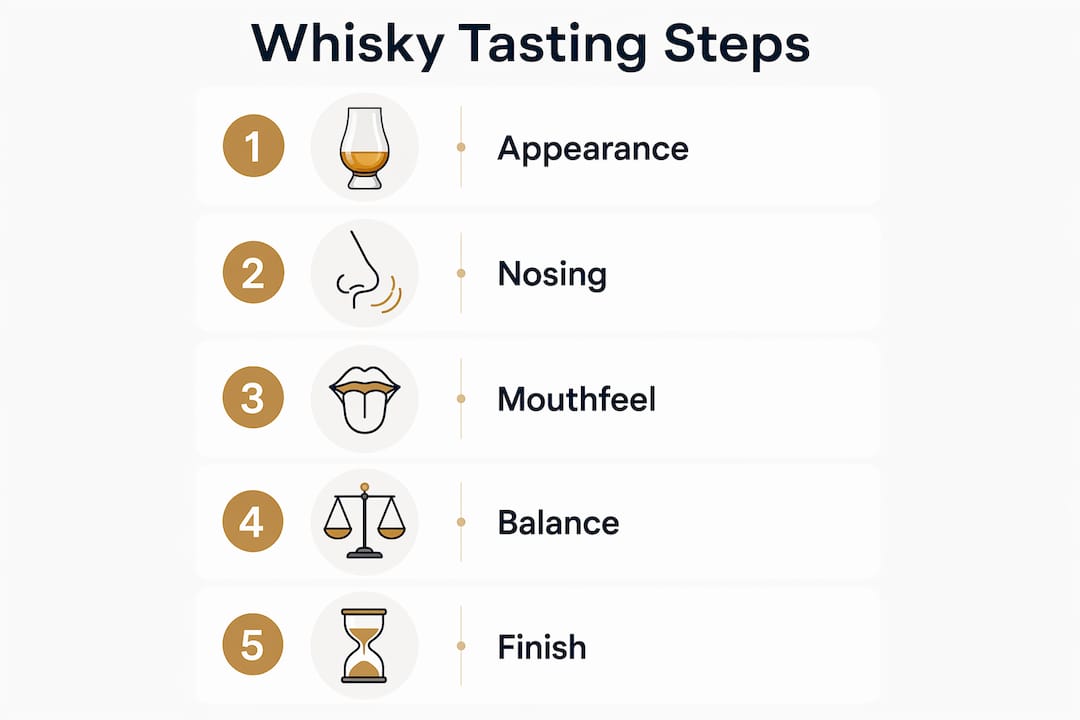
Professional tasting follows a five-step sequence: appearance, nosing, palate, finish, and assessment. Run through each step every time and it becomes second nature within a few sessions.
- Appearance. Pour a small measure into your Glencairn. Hold it against a white background. Note the colour (pale gold, amber, deep mahogany) and swirl gently to observe the “legs” — the streaks running down the glass. Thicker legs suggest higher ABV or viscosity, often from richer cask maturation.
- Nosing. Hold the glass a few centimetres below your nose, not pressed against it. Inhale gently with your mouth slightly open to avoid the alcohol sting. Swirl and nose again; new aromas often emerge on the second pass. About 80% of flavour perception comes from smell, so this step earns its time.
- Palate. Take a small sip, about a teaspoon, and let it coat your whole mouth before swallowing. Notice the initial hit, the mid-palate development, and whether the flavour shifts.
- Finish. After swallowing, breathe out slowly through your nose. This retro-nasal technique forces volatile compounds into your nasal cavity and reveals aromatic notes you’d otherwise miss entirely.
- Assessment. Pause for 30–60 seconds. Ask: did the flavours evolve or stay flat? Was the overall impression balanced? Would you add water?
| Step | Pour / sip size | Timing |
|---|---|---|
| Appearance | 25ml pour | 30 seconds |
| Nosing | — | 1–2 minutes |
| Palate | ~5ml sip | 30 seconds |
| Finish | — | 30–60 seconds |
| Assessment | Optional 2–3 drops water | 1 minute |
Pro Tip: Add 2–3 drops of room-temperature still water after your first neat assessment. Still water at room temperature reduces the alcohol’s numbing effect and releases masked aromas — sparkling or chilled water disrupts the flavour rather than opening it up.
What are the main whisky flavour families?
Whisky descriptors cluster into recognisable families. Knowing these families stops you reaching for vague words like “nice” and gives you a structured place to start.
- Sweet: vanilla, caramel, toffee, honey, butterscotch, brown sugar
- Fruity: fresh apple, ripe pear, dried apricot, dark cherry, orange marmalade, banana
- Floral: heather, rose, jasmine, lavender, cut grass
- Spicy: black pepper, cinnamon, clove, ginger, nutmeg
- Peaty/smoky: campfire ash, medicinal iodine, tar, seaweed, bonfire
- Woody/vanilla: toasted oak, cedar, coconut, sandalwood, dark chocolate
- Briny/coastal: sea salt, oyster shell, kelp, damp rock
- Cereal/malty: porridge, biscuit, fresh bread, barley husk
The key to better notes is adding specificity within each family. “Fruity” tells nobody much. “Dried apricot with a hint of orange marmalade” tells someone exactly what to expect. The same logic applies to sugar: “sweet” is weak; “brown sugar with a caramel edge” is useful. For peat, distinguish between campfire (light, pleasant smoke) and medicinal/iodine (intense, coastal) — they are very different drinking experiences.
| Family | Precise descriptors | Food/aroma analogy |
|---|---|---|
| Sweet | Vanilla, toffee, honey, butterscotch | Crème brûlée, honeycomb |
| Fruity | Fresh pear, dried apricot, dark cherry | Fruit cake, ripe stone fruit |
| Floral | Heather, rose, cut grass | Spring garden, Earl Grey tea |
| Spicy | Black pepper, cinnamon, ginger | Gingerbread, mulled wine |
| Peaty/smoky | Campfire, medicinal, tar | Bonfire, antiseptic |
| Woody/vanilla | Toasted oak, coconut, dark chocolate | Woodshop, vanilla cake |
| Briny/coastal | Sea salt, kelp, oyster shell | Rock pool, ocean breeze |
| Cereal/malty | Porridge, biscuit, barley | Fresh bread, digestive biscuit |

Production choices drive which families dominate. Malt whisky from pot stills tends toward fruity and floral notes; grain whisky from column stills leans lighter and cereal-forward. Sherry casks push dried fruit and spice; ex-bourbon barrels deliver vanilla and coconut. Maturation in a warm, humid environment accelerates wood extraction, which is why some Australian single malts carry a more pronounced oak character than their age might suggest. For a deeper look at how production shapes flavour, Uisuki’s guide to different whisky profiles is worth bookmarking.
How do you describe mouthfeel and body?
Mouthfeel often tells you more about a whisky’s distillation and cask history than a single flavour note can. Body and texture are two separate things, and beginners often conflate them.
Body refers to weight: light, medium, or full. A light-bodied whisky feels almost watery; a full-bodied one coats the mouth like cream. Texture is the tactile quality: oily, creamy, silky, thin, drying, or astringent.
- Oily: a coating sensation that lingers; common in pot-still Irish whiskeys and some Highland Scotches
- Creamy: smooth, almost dairy-like; often from sherry or wine cask maturation
- Drying: a puckering, mouth-drying sensation; usually from tannins in heavily charred or new oak
- Astringent: sharper than drying; can signal over-extraction from wood or a very young spirit
- Thin: little coating; common in lighter grain whiskies or heavily filtered expressions
- Warming: a gentle heat spreading from throat to chest; normal at higher ABV
ABV directly affects texture. A cask-strength bottling at 58% will feel thicker and more viscous than the same whisky diluted to 40%. Adding water doesn’t just reduce burn — it genuinely changes the mouthfeel, sometimes revealing a creaminess that was masked by alcohol heat.
Pro Tip: Try the “Kentucky Chew” — swish a small sip around your mouth for 10–15 seconds so the liquid reaches every taste surface. This technique, associated with American bourbon tradition, is excellent for detecting subtle textures like oiliness or astringency that a quick sip misses entirely.

How do you describe intensity, balance, and the finish?
Intensity is how loud the whisky is. A subtle whisky whispers its notes; a punchy one announces them. Neither is better — they suit different moments. When writing a note, words like delicate, gentle, bold, concentrated, or assertive all communicate intensity without resorting to vague praise.
Balance is about whether the elements work together or whether one shouts over the rest. A well-balanced whisky lets sweetness, oak, and spice take turns rather than one dominating from start to finish. When oak overwhelms everything else, the whisky tastes “woody” in a negative sense. When alcohol heat drowns the fruit, it reads as “hot” or “harsh.” Good balance means you can identify multiple elements without any single one blocking the others.
The finish is where quality often reveals itself. A short finish fades within seconds; a medium one lingers for half a minute; a long finish keeps evolving for a minute or more, sometimes shifting from sweet to dry to spicy in sequence. A long, evolving finish is generally associated with well-matured spirit and quality cask influence. For more on what the finish signals, Uisuki’s explainer on whisky finish covers the mechanics clearly.
Here’s a short example note that puts intensity, balance, and finish together:
How do you write clear whisky tasting notes?
A structured tasting note moves from appearance through nose, palate, finish, and a brief assessment. You don’t need to write an essay — even a phone note with five short phrases is more useful than nothing.
One-line template (for casual settings): [Dominant note] on the nose, [mouthfeel] on the palate, with a [length + character] finish.
Example: “Vanilla and dried fruit on the nose, creamy on the palate, with a long, warming finish.”
Expanded template:
- Appearance: colour, clarity, legs
- Nose: dominant aroma, secondary notes, any surprises after swirling
- Palate: initial flavour, mid-palate development, texture/body
- Finish: length (short/medium/long), how flavours evolve
- Assessment: balance, intensity, overall impression, would you add water?
Sample note — peat-forward style: Appearance: deep gold with slow legs. Nose: campfire smoke upfront, then medicinal iodine and a hint of sea salt. Palate: bold and oily, with smoked barley and a touch of dark chocolate. Finish: very long, dry, and smoky with a faint sweetness emerging at the end.
Sample note — sherried/dessert style: Appearance: rich amber, fast legs. Nose: Christmas cake, dark cherry, and toasted oak. Palate: full-bodied and creamy, with dried fruit, cinnamon, and a hint of espresso. Finish: medium-long, sweet and spicy, fading to dark chocolate.
For group tastings, keep notes brief and concrete. Avoid metaphors that only make sense to you — “smells like my grandmother’s kitchen” is memorable to you, useless to everyone else. For a deeper look at structuring notes, Uisuki’s guide to whisky tasting notes has worked examples worth reading alongside these templates.
Short drills to sharpen your descriptive skills
Comparing two whiskies side by side is the fastest way to build vocabulary, because contrast forces you to find words for differences you’d otherwise overlook.
- Side-by-side drill. Pour two contrasting drams (e.g., a peated Scotch and a sherried one). Spend five minutes on each using the 5-step method. Write at least three differences between them. Repeat weekly.
- Pantry aroma drill. Gather vanilla extract, a strip of orange peel, a small piece of oak chip (available at homebrew shops), black pepper, and a pinch of sea salt. Smell each separately, then try to identify the same notes in a whisky. This builds the sensory memory that makes tasting vocabulary stick.
- Retro-nasal practice. Take a small sip, hold it for five seconds, then exhale slowly through your nose before swallowing. Record what you detect that you didn’t catch on the nose alone.
- Kentucky Chew drill. Swish a 5ml sip for a full 10–15 seconds. Focus only on texture: oily, drying, creamy, thin? Write one texture word before moving to flavour.
Two-week micro practice plan:
| Day | Task |
|---|---|
| 1–2 | Pantry aroma drill; smell five items and write one word for each |
| 3–4 | Nose one whisky using the 5-step method; write a one-line note |
| 5 | Side-by-side drill with two contrasting drams |
| 8 | Retro-nasal and Kentucky Chew practice on the same dram |
| 10 | Write an expanded note using the full template |
| 13 | Share notes with a friend or tasting group; compare and discuss |
Common adjective traps and what to write instead
Vague adjectives are the single biggest weakness in beginner tasting notes. They feel safe but communicate nothing.
- “Smooth” tells the reader about the absence of harshness, not about actual flavour. Replace with a texture word: creamy, silky, oily, or velvety. If it genuinely is smooth, say “no heat or astringency” — that’s specific.
- “Nice” or “pleasant” are opinions, not descriptions. Replace with the note that made it pleasant: “warm vanilla and honey” or “bright citrus with a clean finish.”
- “Complex” sounds impressive but means nothing without evidence. If you want to use it, follow it immediately with the elements that create the complexity: “complex, with dried fruit, spice, and a savoury edge competing for attention.”
- “Smoky” is a family, not a descriptor. Push further: campfire, ash, medicinal, rubber, tar, or seaweed. Each signals a different style and origin.
- “Fruity” needs a type: fresh green apple, ripe banana, dried fig, dark cherry. The difference between fresh and dried fruit alone tells you a great deal about cask influence and age.> “Never again pick up a whisky and just drink it. The question might absolutely be a simple one: Do I like it? Do I not like it? Or, what is the peated level like? What is the floral level like? What memories have I got with this?” The rule is simple: if you can’t picture the specific thing you’re describing, neither can your reader. Prefer concrete references over abstract praise, and avoid elaborate metaphors until you can back them with at least two supporting notes.
Quick do-not-use list for shared tasting notes: smooth, nice, pleasant, complex (without evidence), interesting, different, strong, light (without context), good.
Where can Australians practise and learn?
Australia has a genuinely active whisky community, and getting in front of other tasters accelerates learning faster than solo sessions.
- Retail tasting nights: Many specialist bottle shops in Sydney, Melbourne, Brisbane, and Perth run regular in-store tastings. These are low-cost, beginner-friendly, and let you try multiple expressions without committing to a full bottle.
- Whisky societies and clubs: The Whisky Society of Australia and various state-based groups hold regular events. Search locally — most capital cities have at least one active club that welcomes newcomers.
- The Scotch Whisky Association tasting toolkit is freely available online and provides a structured introduction to regional styles and sensory vocabulary. It’s a solid reference to read alongside this guide.
- Uisuki educational content: Uisuki publishes a growing library of guides covering whisky flavour profiles and tasting vocabulary, written specifically for the Australian market. These are worth working through in order if you’re building knowledge from scratch.
- Climate note for Australian tasters: Australia’s warmer climate means bottles stored at home can mature slightly faster once opened. Keep opened bottles upright, away from direct sunlight, and consume within a few months for best results. Shipping times within Australia vary by state, so factor that in when ordering temperature-sensitive expressions.
For a broader vocabulary reference, Uisuki’s whisky terminology guide covers over 50 terms and is a practical companion to the flavour families covered above.
Key takeaways
Describing whisky well comes down to one repeatable habit: name what you smell, say how it feels, and record what lingers — then practise until the vocabulary becomes automatic.
| Point | Details |
|---|---|
| Use the one-line framework | Name the dominant note, mouthfeel, and finish length every time you taste. |
| Follow the 5-step method | Appearance, nose, palate, finish, assessment — in that order, every session. |
| Pour and sip safely | A 25ml pour and ~5ml sips keep sessions focused and responsible. |
| Specificity beats volume | One precise descriptor (“dried apricot”) is worth more than five vague ones (“fruity, nice, complex”). |
| Uisuki for practice drams | Uisuki’s curated single malts and blends give you contrasting expressions to practise side-by-side tasting at home. |
Why the stepwise approach works better than you’d expect
Most beginners assume they need a trained palate before they can say anything useful about a whisky. That assumption is backwards. The vocabulary comes from the practice, not before it. The five-step method works precisely because it gives your brain a structure to hang observations on — without it, sensory impressions blur together and disappear before you can name them.
What I find genuinely underestimated is the mouthfeel step. Beginners rush past texture to get to flavour, but texture is often where the most interesting information sits. An oily, full-bodied whisky from a pot still tells a different production story than a thin, grain-forward blend, and that story is worth knowing. The Kentucky Chew and retro-nasal techniques aren’t gimmicks — they physically expose more of your sensory apparatus to the spirit, and the difference in what you detect is immediate.
The other thing worth saying: there are no wrong answers here. Glenfiddich’s own guidance makes this point directly — your palate is the authority. If you get dark chocolate where someone else gets coffee, you’re both right. The goal is specificity and consistency, not conformity. Use the templates, run the drills with friends, and compare notes. The disagreements are half the fun.
Ready to practise with a curated dram?
Reading about whisky flavour is one thing. Tasting a well-chosen bottle while running through the 5-step method is where the vocabulary actually sticks.

Uisuki stocks a carefully selected range of bottles suited to exactly this kind of learning. The Hobart Whisky Bourbon Matured Rum Finished Single Malt is a particularly good practice dram: it layers sweet vanilla from the bourbon cask with a rum-influenced richness, giving you multiple distinct flavour families to work through in one glass. It’s an Australian single malt, which means no long international shipping wait. Browse Uisuki’s full range at uisuki.com.au and pick two contrasting bottles to run your first side-by-side drill.
Further reading and sources
These are the primary sources used throughout this guide, each worth visiting for deeper exercises and methodology detail.
- TasteSCOT — How to taste whisky properly: Detailed five-step method with timing, water guidance, and retro-nasal technique explained clearly.
- The Whisky School — How to taste whisky like a pro: Covers the science of smell and flavour perception; useful for understanding why nosing dominates the process.
- Scotch Whisky Association tasting toolkit: Industry-standard reference for glass selection, regional characteristics, and structured sensory vocabulary.
- Glenfiddich — A guide to whisky tasting: Practical advice on side-by-side tasting and building palate confidence; includes Malt Master guidance.
- The Glenlivet — Whisky tasting guide: Structured note-writing guidance with appearance-to-finish framework.
- The Whiskey Wash — Kirsty McKerrow on tasting like a pro: Accessible breakdown of common tasting terms including peaty, oaky, feinty, and spicy, with expert commentary from Dr Gordon Steele.
- Uisuki — Whisky flavour categories: your complete tasting guide: Australian-focused flavour category guide with practical tasting context.