

TL;DR:
- Distillation method is the key factor shaping whisky flavor, aroma, and character.
- Pot stills produce complex, full-bodied spirits, while column stills create lighter, neutral ones.
- Double and triple distillation techniques influence smoothness, complexity, and flavor profiles.
Choosing a whisky from the hundreds of bottles available can feel overwhelming, even for seasoned collectors. The label tells you the region and the age, but rarely explains why one dram tastes rich and oily while another is delicate and floral. The answer almost always lives inside the still. Distillation method is the single most powerful variable a distillery controls, shaping congener (flavour compound) levels, ABV at the heart cut, and the overall character of the final spirit. In this guide, we break down every major distillation method, compare their outcomes side by side, and give you a practical framework for choosing bottles with real confidence.
Table of Contents
- Key factors in whisky distillation
- Pot still distillation: Tradition meets flavour
- Column stills and continuous innovation
- Triple distillation and hybrid approaches
- Decoding flavour: Choosing whisky by distillation method
- A new way to appreciate distillation
- Explore unique whiskies crafted by distillation method
- Frequently asked questions
Key Takeaways
| Point | Details |
|---|---|
| Distillation shapes flavour | Still design and distillation method have a profound effect on a whisky’s complexity and style. |
| Pot vs column differences | Pot stills highlight rich, traditional characters while column stills deliver consistency and lighter spirit. |
| Advanced methods explained | Triple distillation and hybrid stills offer new ways to balance smoothness, efficiency and depth. |
| Flavour-driven bottle choices | Knowing the distillation method helps you select whiskies that match your taste preferences and collection goals. |
Key factors in whisky distillation
Before comparing methods, it helps to understand the levers that every distillery pulls. Distillation separates alcohol and flavour compounds from a fermented wash (called the beer or wash) through heat and condensation. The choices made along the way determine everything.
Several core variables shape the outcome:
- Reflux: Vapour that condenses inside the still and falls back down, stripping heavier compounds and producing a lighter spirit.
- Lyne arm angle: A downward angle increases heaviness; an upward angle encourages reflux and lightness.
- Condenser type: Shell-and-tube condensers cool vapour quickly, retaining sulphur compounds and weight. Worm tubs cool slowly, producing richer, meatier spirit.
- Heart cut ABV: The distiller selects only the purest middle portion of the run. The ABV at which cuts are made directly affects whisky flavour profiles.
- Congeners: Compounds like esters, acids, and aldehydes are the building blocks of aroma and taste.
“The shape and design of pot stills and columns dictate the spirit’s character.” Taller stills with narrow necks create lighter, more elegant spirits, while short, squat stills retain heavier, oilier compounds.
Small changes compound dramatically. A distillery that angles its lyne arm upward and uses a shell-and-tube condenser will produce a completely different spirit than one using the same still shape with a worm tub and a downward angle. This is why two distilleries using the same barley can taste worlds apart.
Pro Tip: Most reputable distilleries publish still specifications on their websites. Checking still height, lyne arm angle, and condenser type before buying is exactly what the pros do to anticipate a whisky’s style before opening the bottle.
Pot still distillation: Tradition meets flavour
The pot still is the oldest distillation technology in whisky making, and it remains the heart of single malt production worldwide. It operates as a batch process: the still is charged with wash, heated, and vapour rises through the neck. The distiller separates the run into three sections: foreshots (harsh, discarded), hearts (the keeper), and feints (also mostly discarded). Only the hearts go into maturation.
Single malts from Scotland, Ireland, and Australia almost exclusively use pot stills because the process retains a broader range of congeners. Pot stills deliver hearts at 60 to 80% ABV, with rich congeners shaping the complexity that collectors prize.
Factors that influence pot still outcomes include:
- Still height: Taller stills like those at Glenmorangie force vapour to travel further, stripping heavy compounds and producing a delicate, floral character.
- Still shape: Onion-shaped stills retain more weight; lantern-shaped stills yield lighter spirit.
- Number of distillations: Most Scottish single malts are double-distilled; Lowland and Irish expressions often run three times.
- Cut points: Wider cuts retain more flavour complexity but also more impurities.
- Fermentation length: Longer fermentation creates more fruity esters before distillation even begins.
Explore the whisky distillation process more deeply if you want to see exactly how ABV and cut points interact to shape what ends up in your glass.
Pro Tip: To really feel the influence of still design, taste a Glenmorangie tasting set alongside a shorter-still Speyside like Glenfarclas. The contrast in body and floral lift is immediate and educational.
Column stills and continuous innovation
If the pot still is tradition, the column still (also called a continuous still or Coffey still) is efficiency. Invented in the 1830s, it transformed whisky production by allowing continuous distillation rather than individual batches.
A column still has two main sections working together:
- The analyser: Wash enters at the top and flows downward over perforated trays while steam rises from the bottom, stripping alcohol from the liquid.
- The rectifier: Alcohol-rich vapour passes through this second column, where it condenses and re-vaporises across multiple plates, purifying progressively.
- Countercurrent flow: Hot vapour and cold liquid move in opposite directions, maximising contact and separation.
- Output control: By adjusting the number of plates and the temperature gradient, distillers tune the final ABV and flavour character.
- Continuous feed: Unlike a pot still, raw wash enters and finished spirit exits simultaneously, making large-scale production viable.
Column still distillation enables remarkable efficiency, producing spirit at purity levels of 94 to 96% ABV, with a tunable character that suits blending perfectly.
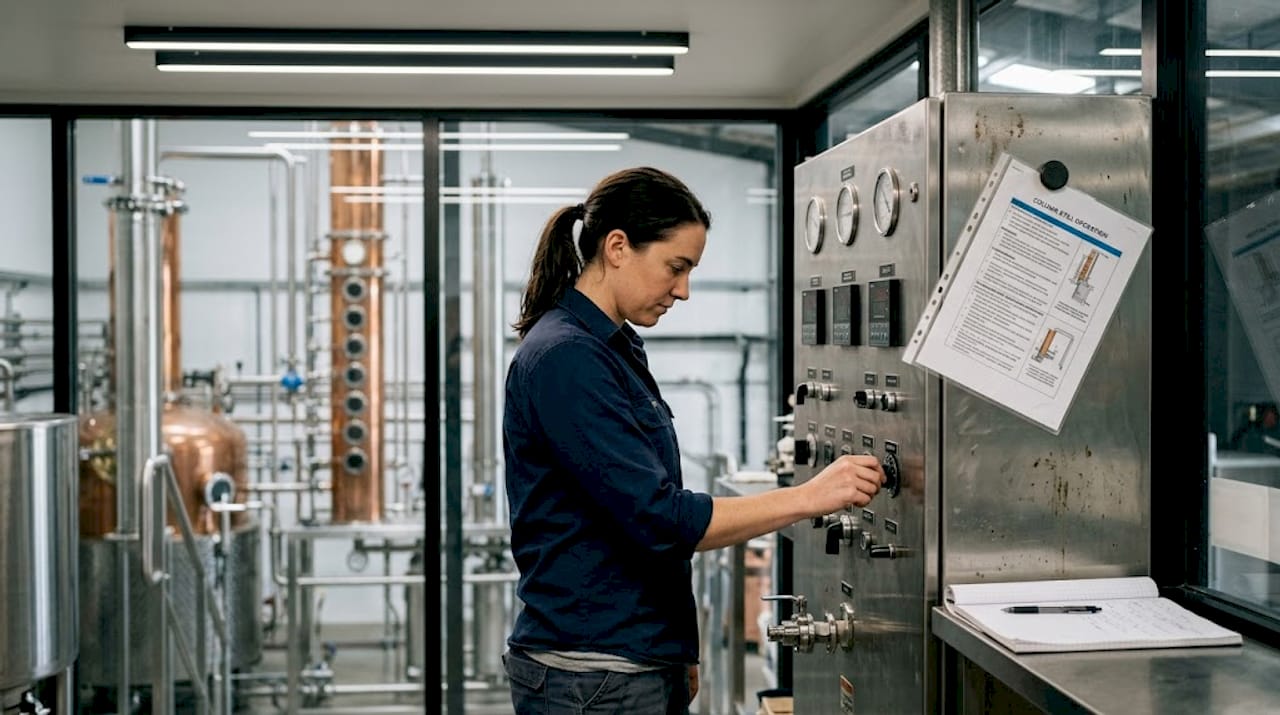
| Feature | Pot still | Column still |
|---|---|---|
| Process type | Batch | Continuous |
| Heart ABV | 60 to 80% | 85 to 96% |
| Flavour profile | Rich, complex, oily | Light, clean, neutral |
| Primary use | Single malts | Grain whisky, blends |
| Efficiency | Lower | Very high |
One fascinating exception: Japanese distillers using vintage Coffey stills intentionally retain more flavour compounds by running them at lower ABV, producing grain whiskies with unexpected character and depth.
Triple distillation and hybrid approaches
Double distillation is the norm in Scotland, but some regions and distilleries push further. Triple distillation, standard in Lowland Scotch and most Irish whiskey, runs the spirit through three pot stills. Each pass strips more congeners and raises the ABV, producing a noticeably smoother, lighter result.
Triple distillation yields spirit at 78 to 82% ABV, while hybrid stills blend the efficiency of column distillation with the character retention of pot distillation.
Here is how common methods compare:
| Method | ABV range | Flavour character | Known distilleries |
|---|---|---|---|
| Double pot still | 60 to 75% | Rich, complex, full-bodied | Glenfarclas, Springbank |
| Triple pot still | 78 to 82% | Smooth, lighter, delicate | Auchentoshan, Redbreast |
| Hybrid still | Variable | Balanced, versatile | Nikka, some Australian craft |
| Column (low ABV) | 85 to 90% | Characterful grain | Nikka Coffey Grain |
Distilleries using hybrid approaches include:
- Boubon doublers: A second pot-still vessel used after the column to add roundness and character.
- Nikka’s Coffey stills: Run at lower temperatures to preserve more esters than conventional column stills.
- Some Australian craft distilleries: Combining small pot stills with short column sections to create unique house styles.
For a deeper look at this subject, the triple distillation guide is worth reading alongside notes on how cask influence amplifies or softens what the still delivers.
Pro Tip: If you consistently prefer smoother, lighter whiskies, look specifically for triple-distilled expressions. The difference in texture is noticeable even to newer palates.
Decoding flavour: Choosing whisky by distillation method
Now that you know the mechanics, here is how to use distillation knowledge as a practical buying tool. Distillation choices directly translate into lighter, fruitier, or heavier, more complex whiskies. Matching method to preference is the shortcut experienced collectors use.
Match your flavour goals to distillation method:
- Want peat and smoke: Reach for double pot-distilled Islay Scotch. The retained congeners carry phenols (smoky compounds) more intensely.
- Want fruity and floral: Look for tall-still pot distilleries like Glenmorangie or Tomatin where high reflux strips weight and amplifies esters.
- Want smooth and easy: Triple-distilled Lowland Scotch or Irish whiskey delivers exactly that.
- Want complexity without heaviness: Hybrid or Japanese Coffey grain expressions sit in a unique middle ground.
- Building a collection: Diversify across all four method types to represent the full flavour spectrum.
Distillation is only one part of the picture. For collectors, whisky flavour profiling offers a structured way to cross-reference palate notes with production choices. Pair that knowledge with an understanding of cask influence on flavour, since a first-fill sherry cask will dramatically alter even the lightest triple-distilled spirit.
Regional context matters too. The regional variety in whisky reflects centuries of distilling tradition, geography, and water source, all of which interact with still design in ways that make each region genuinely distinct.
A new way to appreciate distillation
Here is something most articles on this topic miss: obsessing over still type alone will lead you astray more often than it guides you right. We have tasted pot-still single malts that were lighter and more delicate than some column-distilled grain whiskies, simply because of the cask programme and house style decisions made afterwards.
Glenmorangie is the clearest example. Its famously tall stills produce one of the lightest new-make spirits in Scotland, yet its cask maturation choices, especially its pioneering private wood programme, create bottles of extraordinary richness and depth. The still sets the canvas; the cask and the blender paint the picture.
Savvy collectors treat distillation method as the starting point in their research, not the conclusion. Cross-reference still type with house style, cask selection, and regional tradition before committing to a bottle. Our guide on exploring flavour profiles is one of the best places to build that multi-layered perspective. The collectors who develop this broader view consistently make better, more satisfying purchases.
Explore unique whiskies crafted by distillation method
Put your new knowledge to work by tasting the distillation difference firsthand.

At Uisuki, we have curated bottles that let you experience every major distillation style. The Hobart Bourbon Matured Single Malt showcases what Australian pot still craft can achieve at 56.4% ABV. For a masterclass in hybrid continuous distillation, the Ichiro’s Malt and Grain World Blend combines pot and Coffey still spirits beautifully. And the Ardnamurchan MacLeans Nose Blend demonstrates how Scottish pot still character anchors a well-crafted blend. Browse the full selection at Uisuki and shop with the confidence your new expertise deserves.
Frequently asked questions
What is the main difference between pot and column still distillation?
Pot stills favour complexity; columns favour consistency. Pot stills deliver richer, more complex flavours through batch processing, while column stills produce lighter, cleaner spirits at much higher efficiency.
Does triple distillation make whisky smoother?
Yes. Triple distillation targets 78 to 82% ABV, removing more heavy congeners with each pass and producing a noticeably smoother, lighter whisky. This is common in Lowland Scotch, Irish whiskey, and some Japanese expressions.
How does distillation ABV affect whisky flavour?
Lower heart ABV cuts preserve more congeners and esters, creating richer, more aromatic whiskies. Higher ABV cuts produce cleaner, lighter spirit with fewer flavour compounds.
Why do some regions favour pot stills over column stills?
Pot stills are seen as authentic and are deeply tied to regional heritage, particularly in Scotland and Ireland, where traditional production methods are legally protected and shape iconic local styles.