

TL;DR:
- Expert evaluation focuses on appearance, nose, palate, finish, and balance to determine whisky quality.
- Scores and medals provide context but do not guarantee personal enjoyment or value.
- Developing personal tasting skills and understanding labels helps make informed whisky purchasing decisions.
You’ve done everything right. You read the reviews, checked the score, paid a premium price, and cracked open a bottle that promised to be exceptional. Then the first sip lands flat. That frustration is more common than you’d think, and it points to a real gap in how most whisky buyers make decisions. Scores and medals are useful starting points, but they can’t tell you what you will enjoy. This guide walks you through the exact methods experts use to evaluate whisky quality, so your next purchase is driven by genuine knowledge rather than marketing gloss.
Table of Contents
- What makes a whisky ‘quality’? Key factors explained
- Preparation: What you need to evaluate whisky properly
- Step-by-step: How to taste, score and describe whisky quality
- Interpret results: What scores, awards and age statements actually mean
- Why personal evaluation matters more than ever
- Ready to discover quality whisky for yourself?
- Frequently asked questions
Key Takeaways
| Point | Details |
|---|---|
| Trust your palate | Your tasting notes and enjoyment are more important than any label or rating. |
| Tools and setup matter | Using the right glassware and environment leads to more accurate whisky assessments. |
| Interpret awards wisely | Awards and scores are helpful, but only as a starting point for exploring whisky. |
| Age statements aren’t everything | Non-age statement whiskies can offer surprising complexity and value. |
What makes a whisky ‘quality’? Key factors explained
The word ‘quality’ gets thrown around constantly in whisky marketing, but it means different things depending on who’s talking. For a distillery, quality might mean consistency and technical precision. For a collector, it could mean rarity and provenance. For an enthusiast like you, it usually comes down to one thing: does it deliver a rewarding experience?
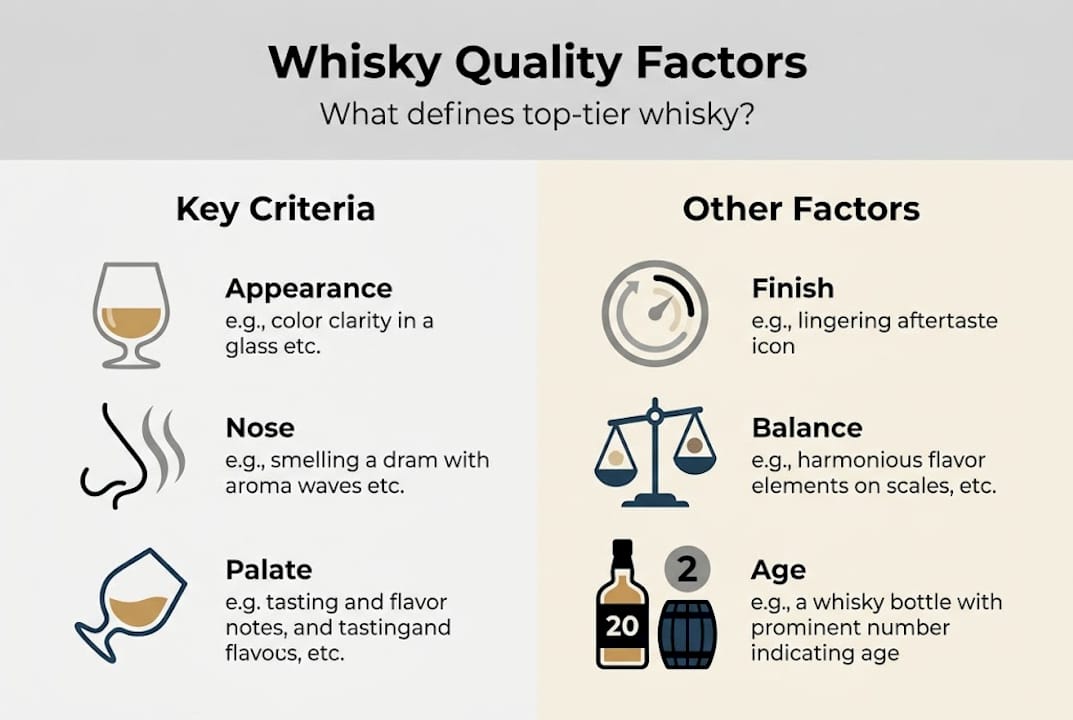
Professional evaluators break quality down into five core categories:
- Appearance: Colour depth, clarity, and the behaviour of ‘legs’ (the streaks that form when you swirl the glass) give early clues about body and age.
- Nose: The aromas you detect before tasting. This is where complexity is often most apparent, from fruit and floral notes to oak, smoke, and spice.
- Palate: The actual taste experience, including texture, sweetness, bitterness, and how flavours develop across the tongue.
- Finish: How long and how pleasantly the flavour lingers after swallowing. A long, evolving finish is generally a marker of quality.
- Balance: Whether all the elements work together harmoniously, rather than one note dominating or clashing with others.
These expert whisky criteria form the backbone of virtually every serious tasting framework. Understanding them shifts you from passive consumer to active evaluator.
Now, about those scores. Professional scoring systems use 100-point scales with clear bands: 95 to 100 is exceptional, 90 to 94 is outstanding, and 85 to 89 is very good. That sounds reassuring, but here’s the catch: a score of 91 from one publication and a score of 91 from another may reflect entirely different palate preferences, tasting conditions, and scoring philosophies.
| Scoring tier | 100-point range | What it signals |
|---|---|---|
| Exceptional | 95 to 100 | Benchmark quality, rare |
| Outstanding | 90 to 94 | Strong complexity, recommended |
| Very good | 85 to 89 | Solid, worth exploring |
| Good | 80 to 84 | Enjoyable, everyday drinking |
| Below average | Under 80 | Significant flaws noted |
Medal systems (Gold, Silver, Bronze) add another layer of confusion. A Gold medal from a small regional competition carries far less weight than one from a globally recognised event. Scores also rarely account for value. A whisky scoring 88 at $60 might offer far better value than one scoring 92 at $250. Knowing this context is what separates informed buyers from impulse buyers.
Preparation: What you need to evaluate whisky properly
Once you know what to look for, it’s crucial to have the right setup for a fair assessment. The environment you taste in shapes what you perceive, often more than people realise.
Start with the right glass. A tulip-shaped glass, such as a Glencairn or a copita, concentrates aromas at the rim and allows you to nose the whisky properly. Wide-mouthed tumblers are fine for casual drinking but scatter volatile compounds before they reach your nose.
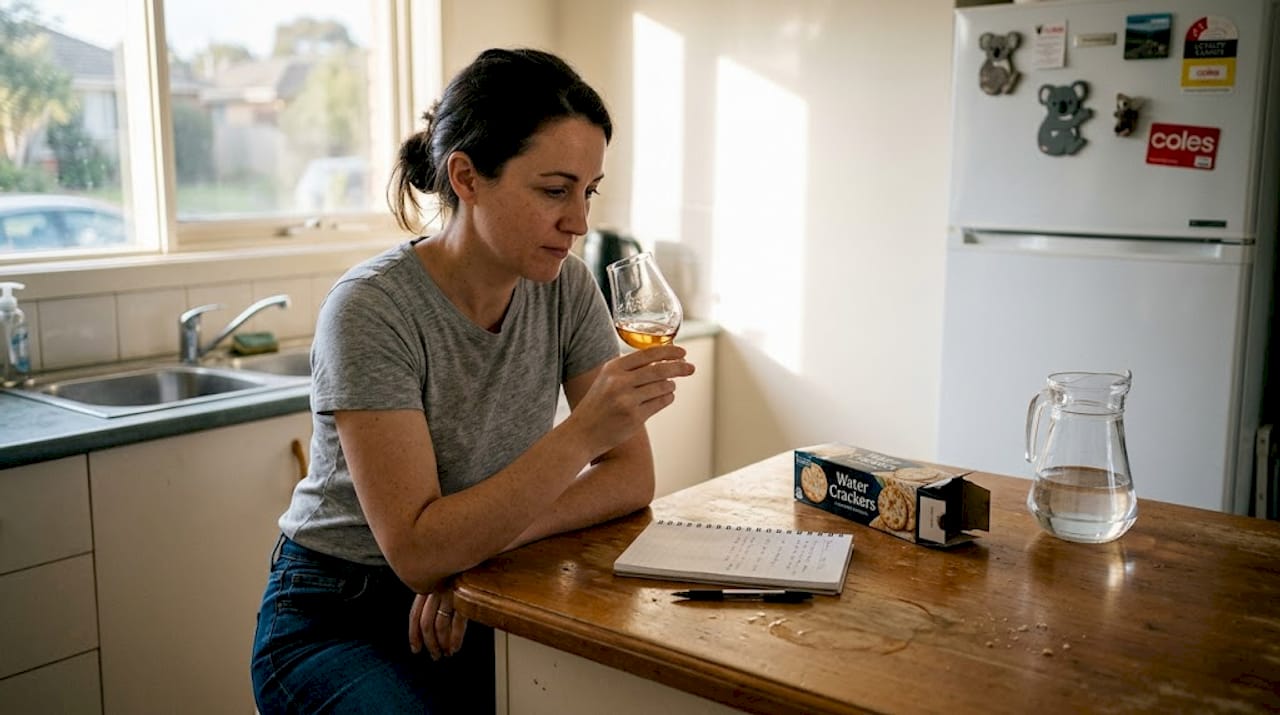
Lighting matters too. Natural or neutral white light helps you assess colour accurately. Warm amber lighting can make a pale whisky look richer than it is.
Here’s a simple blind tasting setup guide:
| Item | Why it matters | |—|—|—| | Glencairn or tulip glass | Focuses aromas | | Still water (room temperature) | For dilution and palate cleansing | | Plain crackers or bread | Resets the palate between samples | | Covered or labelled samples | Removes label bias | | Notebook or scoring sheet | Records impressions objectively |
Blind tasting is particularly powerful. Professional competitions eliminate bias through structured blind processes, and you can replicate this at home by having someone else pour and cover the bottles. You’ll be surprised how differently you perceive a whisky when the label isn’t staring back at you.
The role of water in whisky evaluation is also significant. Have a small jug of still, neutral-tasting water on hand. Avoid sparkling water, as carbonation interferes with aroma perception.
Other practical tips:
- Avoid strong perfumes, colognes, or scented candles in the tasting space.
- Don’t eat spicy or heavily flavoured food for at least an hour beforehand.
- Taste at room temperature, not straight from a cold cellar.
- Limit sessions to four or five whiskies to avoid palate fatigue.
Pro Tip: Nose each whisky with your mouth slightly open. This reduces the harshness of alcohol vapour and lets subtler aromas come through more clearly.
Step-by-step: How to taste, score and describe whisky quality
With your tools ready, it’s time to follow the systematic process the experts use. This isn’t about being precious or overly technical. It’s about slowing down and paying attention.
- Pour and rest. Add roughly 30ml to your glass and let it sit for two to three minutes. This allows the most volatile alcohol notes to dissipate.
- Assess appearance. Hold the glass up to the light. Note the colour (pale gold, amber, deep mahogany), clarity, and how the legs move down the glass after swirling.
- Nose without water. Bring the glass slowly to your nose and inhale gently. Don’t bury your nose in the glass. Note your first impressions: fruit, grain, wood, smoke, floral, or savoury?
- Take your first sip. Let the whisky coat your entire mouth before swallowing. Focus on texture (oily, thin, creamy) and the initial flavour hit.
- Add water. A few drops to a small splash can transform the experience. 20% dilution suppresses ethanol and reveals hidden aromatic notes that were masked at full strength.
- Nose again. After dilution, nose the whisky once more. New aromas often emerge at this stage.
- Taste again with water. Notice how the palate has changed. Are there new fruit or floral notes? Has the texture shifted?
- Assess the finish. After swallowing, how long does the flavour last? Is it warming, drying, or bitter? Does it evolve over 30 to 60 seconds?
For scoring, use this reference when comparing whisky styles:
| Evaluation stage | What to note | Medal equivalent |
|---|---|---|
| Appearance | Colour, clarity, legs | Baseline |
| Nose | Complexity, balance, intensity | Contributes to Silver/Gold |
| Palate | Flavour range, texture, development | Core scoring zone |
| Finish | Length, complexity, pleasantness | Distinguishes Gold from Double Gold |
| Overall balance | Harmony of all elements | Final medal determination |
Pro Tip: Write your tasting notes before looking up any scores or reviews. Your uninfluenced first impression is the most honest data point you have.
Interpret results: What scores, awards and age statements actually mean
After tasting and scoring, you need to make sense of how your findings compare with what’s on the bottle and in the retail world.
Let’s start with awards. World Whiskies Awards use blind tasting elimination rounds, awarding only one Gold, Silver, or Bronze per category, and their ‘World’s Best’ title carries genuine prestige. But not every competition operates this way. Some events award Gold medals to a large proportion of entrants, making the accolade less meaningful.
A Gold medal on a bottle tells you a whisky performed well in a specific judging context. It does not guarantee you will enjoy it, nor does it reflect how it compares to whiskies that weren’t entered.
Age statements are another area where buyers often misread the signal. An age statement tells you the minimum time the youngest whisky in the bottle spent in cask. Older doesn’t automatically mean better. A 12-year-old whisky from a quality distillery can outperform a poorly managed 25-year-old. Understanding age statement whiskies helps you see age as one data point, not a quality guarantee.
Non-age statement whiskies (NAS) carry no minimum age declaration. This gives distillers flexibility to blend across age ranges for consistency, but it also removes a key reference point for buyers. Some outstanding whiskies are NAS. Some are disappointing. Your tasting skills are the best tool for navigating this category.
Key things to watch for when reading labels:
- Cask type: Ex-bourbon, ex-sherry, and virgin oak each impart distinct flavour profiles.
- ABV: Higher ABV (above 46%) often indicates non-chill filtered whisky, which preserves more flavour compounds.
- Distillery vs bottler: Independent bottlings can offer exceptional value and unique expressions.
- Competition year: A medal from five years ago may not reflect the current batch.
Scores vs medal tiers each have blind spots. Scores rarely capture value for money, and medals rarely capture nuance. Use both as filters, not final verdicts, and let your own tasting notes carry equal weight. The impact of whisky awards on collector decisions is real, but the most confident buyers treat them as context rather than instruction.
Why personal evaluation matters more than ever
Here’s something the whisky industry doesn’t advertise: score inflation is real. As competition for shelf space intensifies, brands invest heavily in entering awards and commissioning favourable reviews. A score of 90 today may not represent the same standard it did a decade ago.
This doesn’t mean scores are useless. It means you need your own reference point. When you develop a personal tasting vocabulary and a consistent evaluation method, you stop being a passive recipient of other people’s opinions and start building genuine expertise.
We’ve seen Australian collectors make far better purchasing decisions once they trust their own palates. A whisky that scores 88 but hits every note you love is a better buy than a 94-rated bottle that leaves you cold. Understanding whisky awards and how they work gives you context. Your own evaluation gives you conviction. The goal isn’t to dismiss expert opinion but to add your own alongside it. That combination is what makes a genuinely informed whisky buyer.
Ready to discover quality whisky for yourself?
You’ve now got the framework to evaluate any whisky with confidence, from nosing technique to decoding what a Gold medal actually means in context.

At Uisuki, we curate every bottle with exactly this kind of informed buyer in mind. Whether you’re after a classic age-statement Scotch, a rare Japanese expression, or an exciting Australian single malt, our selection is built around genuine quality rather than hype. Explore quality whiskies from trusted distilleries across Scotland, Japan, Australia, and the USA, and put your new evaluation skills to work on your next bottle. Your palate is ready.
Frequently asked questions
What are the main criteria for judging whisky quality?
Appearance, nose, palate, finish, and balance are the essential criteria used by experts. Professional scoring systems assess all five categories to arrive at an overall quality rating.
Does adding water improve whisky evaluation?
Yes. Adding a small amount of water can reveal more aromas and reduce alcohol burn, helping you notice hidden flavours. 20% dilution suppresses ethanol and opens up the whisky’s aromatic profile.
How reliable are whisky awards and ratings?
Awards highlight quality within categories but reflect judges’ tastes. Blind elimination processes reduce bias, but results are still subject to individual palate preferences, so use them as a guide rather than an absolute verdict.
What is a non-age statement (NAS) whisky?
NAS whiskies do not state a minimum age and can still be high quality depending on the blend and production. The NAS category scores variably, so personal tasting is the most reliable way to assess them.
Is a higher score always better?
Not always. Scores vs medal tiers both have limitations, and neither captures personal taste or value for money. A lower-scored whisky that suits your palate perfectly is always the better choice for you.