

Many whisky enthusiasts mistakenly believe triple distillation simply means stronger alcohol. In reality, this refined production method creates smoother, lighter spirits by removing impurities through three careful distillation passes. Understanding how triple distillation works helps you appreciate flavour profiles, evaluate whisky quality critically, and make smarter purchasing decisions for your collection.
Table of Contents
- Understanding Triple Distillation: Definition And Process
- Historical And Regional Significance Of Triple Distillation
- How Triple Distillation Affects Whisky Flavour And Aroma
- Common Misconceptions About Triple Distillation
- Comparing Double And Triple Distillation: Pros, Cons And Tradeoffs
- Practical Implications For Whisky Enthusiasts And Collectors
- Discover Exceptional Whiskies With Uisuki
Key takeaways
| Point | Details |
|---|---|
| Triple distillation process | Three passes through stills increase purity and smoothness by removing harsh congeners. |
| Historical origins | Pioneered in 18th-century Ireland, this technique remains prevalent in Irish whiskey production today. |
| Flavour impact | Creates lighter, smoother profiles with reduced harsh compounds but may sacrifice some flavour complexity. |
| Quality misconception | More distillation passes don’t automatically mean better whisky; quality depends on grain, fermentation, and ageing. |
| Practical value | Knowing distillation methods helps enthusiasts evaluate labels critically and select whiskies matching their taste preferences. |
Understanding triple distillation: definition and process
Triple distillation means passing the spirit through copper pot stills three times rather than the standard two passes used in most whisky production. Each distillation cycle concentrates alcohol content whilst removing unwanted compounds, progressively refining the spirit’s character and purity.
The process typically unfolds in three distinct stages:
- First distillation transforms fermented wash into low wines, separating alcohol from water and solids
- Second distillation further refines the low wines, creating a cleaner intermediate spirit
- Third distillation produces the final new-make spirit with enhanced purity and smoothness
During each pass, distillers carefully manage temperatures around 60-70% ABV to retain peak flavour whilst removing harsh elements. The copper stills catalyse chemical reactions that eliminate sulphur compounds and other undesirable congeners. This extended contact with copper creates a noticeably cleaner spirit compared to double-distilled alternatives.
Irish whiskey distilleries commonly employ this method, though some Scottish Lowland producers also favour triple distillation for their house styles. The technique increases production time and energy costs but delivers distinctive smoothness highly valued by many whisky lovers.
Pro Tip: The “cut points” where distillers separate heads, hearts, and tails during each distillation run dramatically impact final spirit quality, often more than the distillation count itself.
Historical and regional significance of triple distillation
Irish distillers pioneered triple distillation during the 18th century, seeking methods to optimise spirit purity and production efficiency. By the 1760s, this approach had become deeply embedded in Irish whiskey tradition, distinguishing it from Scottish practices that typically employed double distillation.
The technique flourished in Ireland for several compelling reasons:
- Larger pot stills allowed efficient third distillation without excessive fuel costs
- Soft Irish water complemented the lighter spirit profile triple distillation produced
- Market demand favoured smooth, approachable whiskey suitable for broader consumption
- Cultural pride in production excellence drove technical innovation
Whilst Scotland generally embraced double distillation, certain Lowland distilleries adopted triple distillation to create distinctively delicate Scotch whiskies. Auchentoshan remains the most prominent Scottish example, maintaining this traditional method to produce characteristically light, smooth single malts.
Regional preferences reflect deeper production philosophies. Irish distillers historically prioritised smoothness and accessibility, viewing triple distillation as essential to achieving their desired house style. Scottish producers more often valued robust flavour complexity that double distillation preserved.
Today, triple distillation continues defining Irish whiskey’s global identity whilst remaining relatively rare in other whisky-producing regions. This geographical concentration makes triple-distilled expressions particularly distinctive for collectors seeking regional authenticity and historical production methods.
How triple distillation affects whisky flavour and aroma
The additional distillation pass fundamentally reshapes whisky’s sensory profile by removing compounds that contribute harshness and heavy flavours. Triple distillation eliminates up to 30% more congeners than double distillation, including fusel oils and heavier alcohols that create rough edges on the palate.
This enhanced purification delivers several distinctive characteristics:
- Smoother mouthfeel with reduced burn or astringency
- Lighter body allowing subtle flavours to emerge clearly
- Cleaner finish with less lingering oiliness
- Delicate aroma profiles featuring floral and fruity notes
- Reduced presence of robust, earthy characteristics
The tradeoff involves flavour intensity and complexity. Congeners that create harshness also contribute depth, character, and distinctive regional signatures. Removing these compounds produces elegant smoothness but may sacrifice the bold, complex profiles many whisky enthusiasts prize in heavily peated or sherry-cask expressions.

Triple-distilled whiskies typically showcase refinement over robustness. They excel at highlighting subtle grain character, delicate wood influences, and nuanced fruit notes that heavier spirits might mask. This makes them particularly appealing for sipping neat, where smoothness becomes paramount.
Maturation in oak casks can reintroduce complexity that distillation removed. Extended ageing allows triple-distilled spirits to develop sophisticated flavour layers whilst maintaining their signature smoothness. Premium examples demonstrate that purity and complexity aren’t mutually exclusive when production and maturation work in harmony.
Pro Tip: If you prefer smooth, approachable whiskies perfect for introducing friends to quality spirits, triple-distilled expressions offer an excellent starting point without sacrificing sophistication.
Common misconceptions about triple distillation
Several persistent myths surround triple distillation, leading enthusiasts to make unfounded assumptions about whisky quality and character. Clearing these misconceptions helps you evaluate spirits more accurately.
Triple distillation doesn’t automatically create higher alcohol content in the finished bottle. Final ABV depends on distillation cut points, dilution before bottling, and cask strength decisions, not merely the number of distillation passes. Most triple-distilled whiskies are bottled at standard 40-46% ABV, identical to double-distilled alternatives.
Key misconceptions include:
- More distillation equals better quality: Quality stems from raw materials, fermentation expertise, cask selection, and maturation conditions, not distillation count alone
- Triple distillation always means lighter whisky: Production choices like grain selection, fermentation length, and cask type significantly influence final character
- It’s a modern innovation: This centuries-old technique predates most contemporary whisky production methods
- Only Irish whiskey uses it: Whilst predominantly Irish, some Scottish, Japanese, and craft distilleries employ triple distillation
- It removes all flavour: Properly executed triple distillation preserves desirable flavour compounds whilst removing harsh elements
The assumption that higher distillation count universally improves whisky ignores the artistry behind balancing purity with character. Some of the world’s most celebrated whiskies use double distillation precisely because it retains flavour complexity their producers value.
Judging whisky quality solely by distillation method oversimplifies a nuanced craft. Focus instead on how distillation choices align with the distiller’s intended style and your personal flavour preferences.
Comparing double and triple distillation: pros, cons and tradeoffs
Each distillation approach offers distinct advantages depending on desired whisky characteristics and production priorities. Understanding these tradeoffs helps you appreciate why distillers choose specific methods for their house styles.
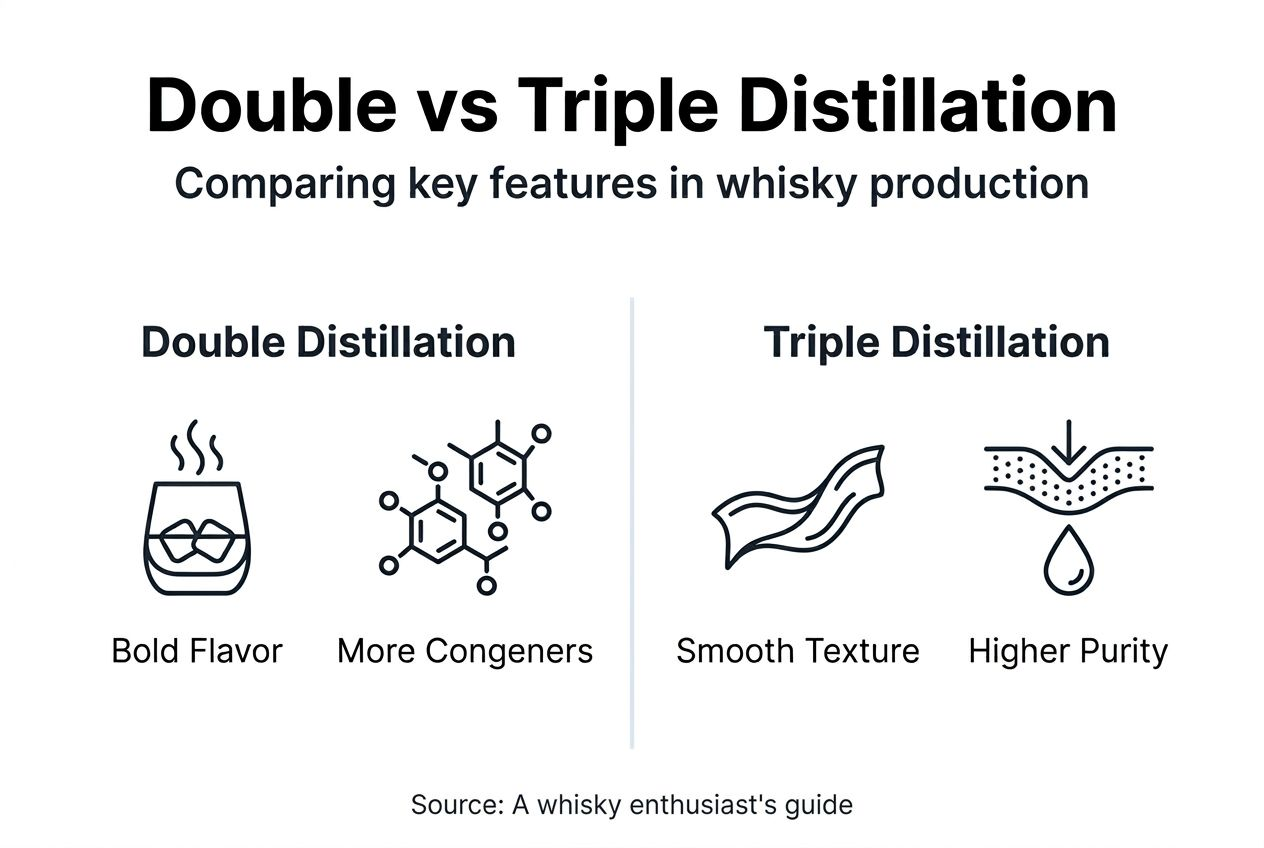
| Aspect | Double distillation | Triple distillation |
|---|---|---|
| Flavour profile | Robust, complex, fuller body | Smooth, lighter, delicate |
| Congener levels | Higher, more flavour compounds | Lower, cleaner spirit |
| Production time | Shorter, more efficient | Longer, more labour intensive |
| Energy costs | Lower fuel consumption | Higher due to extra pass |
| Flavour complexity | Preserves more character | May reduce some depth |
| Smoothness | Can be harsher initially | Smoother from distillation |
Double distillation suits producers prioritising bold flavour and production efficiency. The method preserves heavier congeners that contribute robust character, making it ideal for heavily peated Scotch or richly sherried expressions. Energy and time savings also reduce production costs, potentially lowering retail prices.
Triple distillation benefits distillers seeking signature smoothness and purity. The extra pass creates approachable spirits perfect for consumers who find traditional whisky too harsh. This smoothness can command premium pricing, particularly when marketed as a traditional Irish technique.
The choice ultimately reflects brand identity and market positioning. Irish whiskey producers maintain triple distillation to honour heritage and deliver expected smoothness. Most Scotch distillers favour double distillation to preserve the robust character associated with their regional styles.
Pro Tip: When building your collection, include both double and triple-distilled examples from similar regions to directly compare how distillation method influences flavour within comparable production contexts.
Practical implications for whisky enthusiasts and collectors
Understanding triple distillation empowers you to make informed decisions when tasting, evaluating, and purchasing whisky. This knowledge translates directly into smarter collecting strategies and enhanced appreciation.
Recognise triple distillation’s flavour signatures during tastings. Expect smoother mouthfeel, lighter body, and cleaner finishes in triple-distilled expressions. When these characteristics appear, you’ll understand their production origins rather than attributing them solely to ageing or cask influence.
Key practical applications include:
- Critical label evaluation: Question marketing claims emphasising distillation count as a quality indicator without supporting production details
- Price assessment: Understand that triple distillation’s higher production costs may justify premium pricing for authentic examples
- Investment decisions: Recognise that rarity and traditional methods can enhance collectibility, particularly for limited Irish releases
- Taste preference alignment: Match distillation style to your palate, choosing triple-distilled bottles if you favour smoothness over boldness
- Portfolio diversification: Include triple-distilled examples to represent this significant production tradition in comprehensive collections
Be wary of distilleries using triple distillation as a marketing gimmick without genuine commitment to quality. Some producers triple-distill purely for label appeal whilst cutting corners elsewhere. Authentic triple distillation requires proper equipment, expertise, and time that inferior producers might skimp on.
Distillation method combines with numerous other factors determining whisky value, including cask quality, ageing duration, brand reputation, and market demand. Price fluctuations reflect these complex interactions rather than distillation count alone.
Use your understanding to engage meaningfully with fellow enthusiasts and distillery representatives. Asking informed questions about cut points, still shapes, and production philosophy demonstrates serious interest and often yields fascinating insights unavailable to casual consumers.
Discover exceptional whiskies with Uisuki
Now that you understand how triple distillation shapes whisky character, explore Uisuki’s curated collection featuring premium triple-distilled Irish whiskeys alongside distinguished double-distilled Scotch, Japanese, and Australian expressions. Our expert selection includes rare bottles and new arrivals carefully chosen for enthusiasts and collectors seeking authentic quality.

Whether you prefer the smooth elegance of triple distillation or the robust complexity of traditional methods, Uisuki delivers exceptional whiskies with convenient shipping across Australia. Apply your newfound knowledge to select bottles that match your taste preferences and collection goals, backed by detailed product information and expert guidance.
FAQ
What types of whisky typically use triple distillation?
Irish whiskey predominantly employs triple distillation as a defining production characteristic. Some Scottish Lowland distilleries, particularly Auchentoshan, also use this method to create distinctively light single malts. Occasional craft distillers worldwide experiment with triple distillation for signature smoothness.
Does triple distillation make whisky stronger in alcohol content?
No, final bottle strength depends on distillation cut points, dilution, and bottling decisions rather than distillation count. Most triple-distilled whiskies are bottled at standard 40-46% ABV, identical to double-distilled alternatives.
How does triple distillation affect the flavour profile compared to double distillation?
Triple distillation creates noticeably smoother, lighter whiskies by removing up to 30% more harsh congeners than double distillation. This produces cleaner finishes and delicate flavours but may reduce the robust complexity many enthusiasts prize in bolder expressions.
Is triple distilled whisky always better or of higher quality?
Absolutely not. Quality depends on grain selection, fermentation expertise, cask quality, maturation conditions, and overall production care. Triple distillation simply represents a stylistic choice favouring smoothness over bold complexity, neither inherently superior nor inferior to double distillation.