

TL;DR:
- Single malt Scotch whisky must be produced at one distillery from malted barley and matured in Scotland for at least three years.
- Peat levels, measured in PPM, influence the smoky and earthy flavor profile of malt whiskies.
- Regional styles shape tasting notes, but quality depends on production nuances like still design and cask choice.
Many whisky enthusiasts use the term “malt whiskey” loosely, yet few realise just how much precision sits behind those two words. There is a meaningful difference between a single malt Scotch, a blended malt, and the growing wave of international malt expressions now arriving from Japan, Ireland, and Australia. Collectors who skip past these distinctions often end up with bottles that don’t match their expectations, or worse, miss out on genuinely remarkable drams. This guide cuts through the confusion, covering exactly what malt whiskey is, how it is made, what peat and region contribute to flavour, and how to read the modern whisky landscape with real confidence.
Table of Contents
- Defining malt whiskey: Legal requirements and categories
- Inside the production process: From barley to cask
- The impact of peat: Smoke, flavour, and spirit character
- Regional styles and tasting notes across whisky regions
- Single malt’s global reach and modern complexities
- Our take: Why understanding malt whiskey nuance matters more than ever
- Take your malt whiskey journey further with Uisuki
- Frequently asked questions
Key Takeaways
| Point | Details |
|---|---|
| Strict legal definition | Malt whiskey is tightly regulated and must be made from 100% malted barley at a single distillery for at least three years. |
| Production shapes flavour | Distinct stages—malting, mashing, fermentation, distillation, and maturation—all contribute to a whisky’s final taste. |
| Peat and region matter | Peat levels and regional origin create a huge spectrum of flavour—from light and fruity to deeply smoky. |
| Global single malt variety | Malt whiskey is now produced worldwide, but only Scotch offers strict regional protection for collectors. |
Defining malt whiskey: Legal requirements and categories
With those misunderstandings in mind, let’s define exactly what malt whiskey is and isn’t. Single malt Scotch whisky is a legally defined category under the Scotch Whisky Regulations 2009, and the rules are stricter than most people expect. To qualify, a whisky must be produced at a single distillery in Scotland, made exclusively from malted barley, distilled in pot stills, and matured in oak casks not exceeding 700 litres for a minimum of three years. It must also be bottled at no less than 40% ABV.
The word “single” trips people up constantly. It does not mean a single barrel, a single batch, or a single year of production. It means a single distillery. A bottle of 12-year-old Glenfarclas, for example, may contain whisky from dozens of casks, all drawn from the same site.
Here’s how the main categories compare:
| Category | Barley type | Distillery source | Still type |
|---|---|---|---|
| Single malt | Malted only | One distillery | Pot still |
| Blended malt | Malted only | Multiple distilleries | Pot still |
| Single grain | Any grain | One distillery | Column still |
| Blended Scotch | Mixed | Multiple distilleries | Mixed |
Key legal requirements for single malt Scotch:
- Produced at a single distillery in Scotland
- Made entirely from malted barley
- Distilled using pot stills
- Matured in Scotland in oak casks for at least three years
- Bottled at a minimum of 40% ABV
NAS (No Age Statement) expressions are another source of confusion. These bottles carry no age declaration, but they still meet all the legal requirements above. Understanding age statements in whisky helps collectors appreciate that NAS does not mean young or inferior. Some distilleries use NAS to blend older and younger casks creatively, and the results can be outstanding. For a deeper look at this topic, no age statement whisky is worth exploring before dismissing any bottle on age alone.
Pro Tip: When buying a blended malt, look for named component distilleries on the label or in the producer’s tasting notes. Transparency here is a strong indicator of quality intent.
Inside the production process: From barley to cask
Once you’ve grasped what qualifies as malt whiskey, it’s time to understand exactly how it is crafted. The production process follows five core stages, and each one shapes the final spirit in ways that experienced collectors learn to taste.
- Malting – Barley is steeped in water, allowed to germinate (activating enzymes that convert starch to sugar), then kilned to halt germination. Peat smoke may be introduced during kilning, imparting phenolic compounds measured in PPM.
- Mashing – The dried, ground barley (now called grist) is mixed with hot water to extract fermentable sugars, producing a liquid called wort.
- Fermentation – Yeast is added to the wort. Over 48 or more hours, the yeast converts sugars to alcohol, producing a beer-like liquid called wash at roughly 6 to 9% ABV.
- Distillation – The wash is distilled twice (sometimes three times) in copper pot stills. Still shape, neck height, and cut points all influence the spirit’s character.
- Maturation – New make spirit goes into oak casks, where it develops colour, complexity, and flavour over years or decades.
The variables at each stage are enormous. Yeast strain affects fruity ester production. Wooden washbacks encourage different fermentation characters compared to stainless steel. Tall, elegant stills produce lighter, more floral spirits. Shorter, squat stills retain heavier, oilier compounds. Cask choice, whether ex-bourbon, ex-sherry, or something more unusual, then layers in additional flavour. Learning about whisky cask influence is one of the most rewarding rabbit holes a collector can go down.
| Variable | Lighter style | Heavier style |
|---|---|---|
| Still shape | Tall, lanky | Short, squat |
| Fermentation time | Shorter | Longer |
| Cask type | Ex-bourbon | Ex-sherry or virgin oak |
| Cut points | Narrow | Wide |
Pro Tip: Ask distilleries or retailers about fermentation time. Longer fermentation typically produces more fruity, complex new make spirit, which carries through to the final bottling.
The impact of peat: Smoke, flavour, and spirit character
A defining element in malt whiskey’s style, especially in Scotland, is the use of peat. Peat is partially decomposed organic matter, compressed over thousands of years in boggy ground. When burned during kilning, it releases phenolic smoke that binds to the malt, carrying through distillation and into the final spirit.
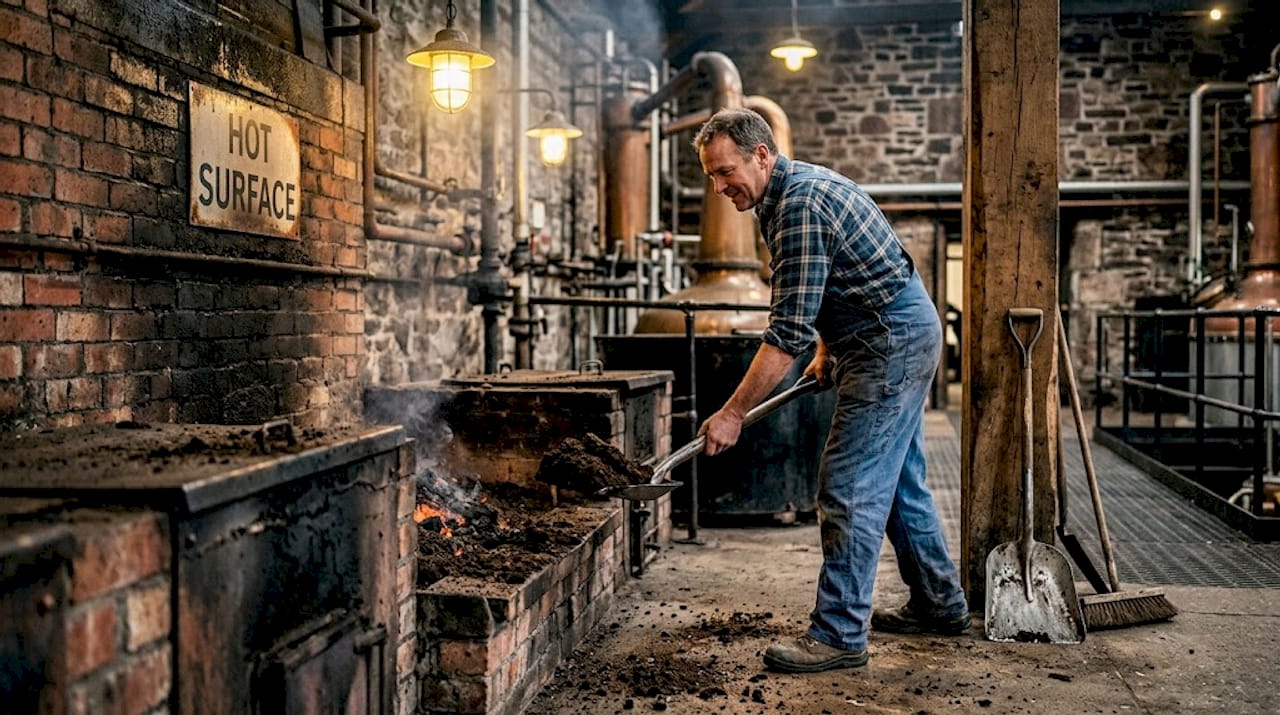
Peat levels are measured in PPM (parts per million) of phenolic compounds in the malt itself. It’s important to understand that PPM measures the malt, not the bottled whisky. Distillation and maturation reduce these numbers significantly, so a malt kilned at 50 PPM may yield a spirit perceived at considerably lower levels.
| Peat level | PPM range | Example |
|---|---|---|
| Unpeated | Under 5 PPM | Glengoyne |
| Light | 3 to 15 PPM | Springbank |
| Medium | 15 to 35 PPM | Bowmore (~25 PPM) |
| Heavy | 35 to 50 PPM | Laphroaig (~40 to 45 PPM), Ardbeg (~50 PPM) |
| Extreme | Over 300 PPM | Bruichladdich Octomore |
Historically, peat was a practical fuel used because it was abundant in Scotland’s remote regions. Today, it is a deliberate flavour choice. Islay remains the heartland of heavily peated Scotch, with distilleries like Ardbeg, Lagavulin, and Laphroaig producing expressions that are smoky, medicinal, and intensely maritime.
“Peat is not just smoke. It carries iodine, tar, brine, and earth. The character depends as much on where the peat was cut as on how much was burned.”
For collectors, peat level is a useful entry point but not the whole story. Exploring diverse single malt types reveals how distilleries in the same region can produce wildly different expressions depending on their approach to peat, fermentation, and cask selection.
Peated expressions to consider exploring:
- Islay: Ardbeg, Laphroaig, Lagavulin, Caol Ila
- Highland: Ardmore, Clynelish (lightly coastal/waxy)
- Campbeltown: Springbank (lightly peated)
- Island: Talisker (pepper and sea spray)
Regional styles and tasting notes across whisky regions
Now that peat’s role and impact are clear, let’s explore how region shapes the malt whiskey experience. Scotland’s whisky regions are not legally binding flavour categories, but they do reflect genuine tendencies shaped by climate, water source, local tradition, and geography. Regional tasting profiles give collectors a useful starting framework.
| Region | Classic profile | Notable distilleries |
|---|---|---|
| Speyside | Fruity, elegant, orchard fruit, honey | Glenfarclas, Macallan, Glenfiddich |
| Highlands | Diverse: waxy, coastal north, fruity central | Dalmore, Glenmorangie, Oban |
| Islay | Peaty, smoky, maritime, medicinal | Ardbeg, Laphroaig, Bowmore |
| Lowlands | Light, floral, citrus, gentle | Auchentoshan, Glenkinchie |
| Campbeltown | Oily, briny, funky, complex | Springbank, Glengyle |
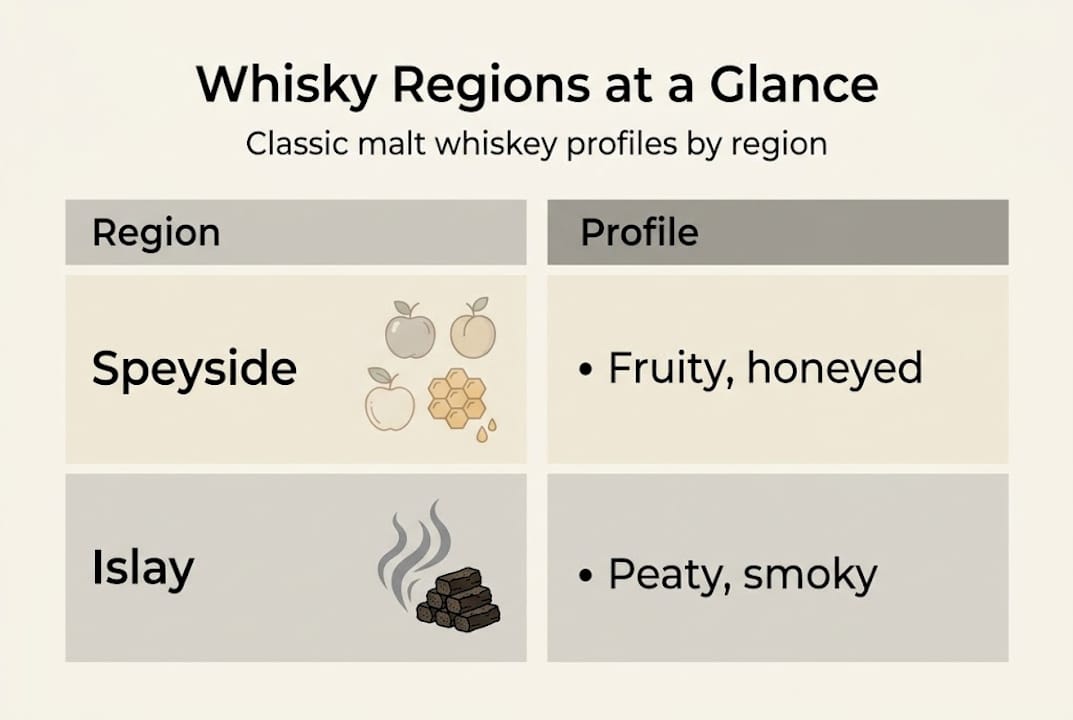
These profiles are tendencies, not guarantees. A Speyside distillery can produce a heavily sherried, dark, and rich expression that feels nothing like its neighbours. Cask selection, distillation style, and maturation environment all add layers that can push a whisky well outside its regional stereotype.
For collectors building a tasting vocabulary, regional exploration is one of the most structured ways to develop palate awareness. A guide to single malt Scotch types can help you map your preferences, while a master whisky regions guide gives you the confidence to shop and taste with genuine intent. For those chasing rarer expressions, rare single malts from lesser-known distilleries often offer the most surprising discoveries.
Key tasting notes by region to look for:
- Speyside: Green apple, pear, vanilla, dried fruit, gentle spice
- Highlands: Heather, honey, toffee, coastal brine (northern), stone fruit
- Islay: Iodine, tar, smoked fish, sea salt, dark chocolate
- Lowlands: Cream, lemon zest, fresh grass, soft malt
- Campbeltown: Damp rope, brine, old leather, rich malt
Single malt’s global reach and modern complexities
Looking beyond Scotland, the world of malt whiskey is evolving rapidly. Global single malts now exist from Ireland, Japan, Australia, India, Taiwan, and beyond, but they lack Scotch’s strict geographical indication (GI) protection. This matters enormously for collectors.
Scotch’s GI status means that only whisky produced, matured, and bottled in Scotland can legally be called Scotch whisky. Japanese, Irish, and Australian single malts may follow similar production methods, but they operate under their own national regulations, which vary in strictness and transparency.
What this means practically for collectors:
- Japanese single malt can be exceptional, but labelling standards have historically been less rigorous than Scotland’s. Understanding Japanese whisky qualities helps you identify genuine expressions versus blends that include imported spirit.
- Irish single malt is a growing category with a distinct triple-distilled, unpeated character.
- Australian single malt is one of the most exciting emerging categories, with distilleries using unique local grains, native botanicals, and innovative cask programmes.
Reading labels carefully is essential. Look for distillery name, country of origin, age statement or NAS declaration, ABV, and whether the bottler is also the distiller. Marketing language like “crafted” or “artisan” tells you nothing about production standards. Legal definitions and transparent labelling tell you everything.
Pro Tip: For non-Scotch single malts, research the distillery’s own production standards rather than relying on regional reputation. Some of the world’s most technically impressive whiskies now come from outside Scotland.
Our take: Why understanding malt whiskey nuance matters more than ever
Having covered every facet of malt whiskey, here’s a perspective seasoned by years of collecting and tasting. The conventional wisdom that region or age defines quality is increasingly outdated. Experienced collectors know that a 10-year-old from a distillery with exceptional cask management will outperform a 25-year-old from a site with mediocre wood policy almost every time.
The real signals of quality are production nuance: still shape, cut points, fermentation length, cask provenance, and bottler integrity. These are the factors that separate a memorable bottle from a forgettable one. Understanding whisky age statement value in this context helps collectors stop chasing numbers and start chasing character.
The collectors who get the most from their whisky journey are those who approach each bottle with what we’d call curated curiosity. They ask why a whisky tastes the way it does, not just whether it fits a regional profile. That mindset leads to better purchases, richer tasting experiences, and a collection that genuinely reflects personal taste rather than marketing trends.
Take your malt whiskey journey further with Uisuki
Inspired to taste the difference? Here’s where to find genuinely interesting malt whiskies. At Uisuki, we curate single malts from Scotland, Japan, Ireland, and Australia, with a particular focus on bottles that reward the kind of deeper knowledge you’ve just built. Whether you’re after a classic regional expression or something more unexpected, we stock options that go well beyond the supermarket shelf.

For something close to home, the Hobart Whisky Bourbon Matured Rum Finished single malt is a stunning example of Australian craft. If Japan is calling, Ichiro’s Malt and Grain Limited Edition is a collector favourite. Explore the full range at Uisuki and find your next great dram.
Frequently asked questions
What is the basic difference between single malt and blended malt whisky?
Single malt whisky comes from one distillery using only malted barley, while blended malt whisky combines single malts sourced from multiple distilleries.
Why are peat levels (PPM) important in malt whisky?
Peat levels measured in PPM indicate how smoky or earthy a whisky may taste, but final perception in the glass depends heavily on distillation style and the length of maturation.
Does single malt always mean higher quality?
Production choices such as still shape, cut points, and cask type drive quality far more than whether a whisky carries a single malt label.
How long must Scotch single malt be matured before bottling?
Single malt Scotch must mature in oak casks in Scotland for at least three years before it is legally permitted to be bottled and sold.