

Developing a refined whisky palate requires more than just drinking expensive bottles. Without a systematic approach, you risk missing subtle nuances that separate exceptional drams from ordinary ones. A comprehensive whisky appreciation checklist transforms your tasting experience by providing structured criteria to evaluate appearance, aroma, palate, and finish while tracking your journey through detailed notes. This guide equips Australian whisky enthusiasts and collectors with professional evaluation techniques used by master distillers, enabling you to confidently assess quality, identify regional characteristics, and build a collection that truly reflects your developing preferences.
Table of Contents
- 1. Evaluating Whisky Appearance And Its Clues
- 2. Mastering Whisky Aroma With The Scotch Whisky Flavour Wheel
- 3. Exploring The Palate: Taste, Texture And Development
- 4. Recording Notes And Optimising Your Whisky Tasting Environment
- 5. Appreciating Regional And Maturation Influences On Whisky Character
Key takeaways
| Point | Details |
|---|---|
| Systematic evaluation enhances tasting | A structured checklist covering appearance, aroma, palate, and finish reveals nuances you might otherwise miss. |
| Proper glassware amplifies aroma detection | Tulip-shaped glasses concentrate volatile compounds, improving your ability to identify specific scent notes. |
| Regional origin shapes flavour profiles | Understanding how Scotland, Japan, Australia, and America produce distinct characteristics enriches appreciation. |
| Detailed note-taking accelerates learning | Recording observations systematically improves recall and helps you track preferences over time. |
| Environment significantly impacts perception | Neutral, scent-free surroundings prevent interference with whisky aromas during evaluation. |
1. Evaluating whisky appearance and its clues
Appearance assessment forms the foundation of professional whiskey evaluation systems, revealing insights before you even nose the glass. This initial visual inspection examines three critical elements: colour, clarity, and viscosity.
Colour provides immediate clues about cask type and maturation duration. Lighter golden hues typically indicate bourbon cask maturation or younger spirits, while deeper amber and mahogany tones suggest sherry cask influence or extended ageing. Master distillers use colour comparison to maintain batch consistency, making this a reliable quality indicator.
Clarity assessment reveals filtration methods and potential quality markers:
- Brilliant transparency indicates chill filtration, which removes fatty acids for aesthetic appeal
- Slight haziness can signal non-chill filtration, preserving flavour compounds many collectors prefer
- Cloudiness when water is added demonstrates high oil content, often associated with fuller mouthfeel
- Sediment in older bottles represents natural precipitation and doesn’t indicate defects
Viscosity observation, commonly called examining the ‘legs’ or ‘tears’, occurs when you swirl the glass gently. Thick, slow-moving legs suggest higher alcohol content or residual sugars, signalling a potentially richer mouthfeel. Thin, fast legs indicate lighter body and lower alcohol concentration. This simple visual cue sets expectations for the tasting experience ahead.
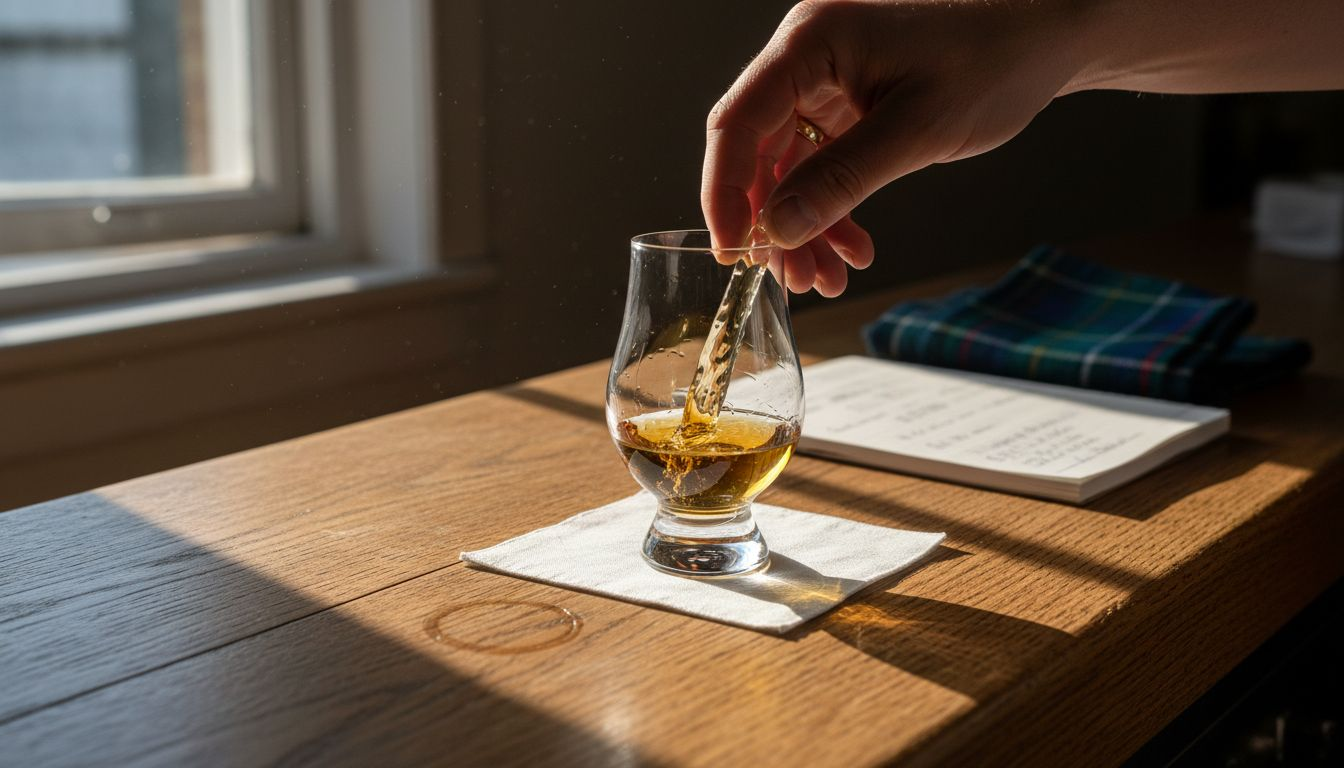
Pro Tip: Hold your glass against a white background under natural light to accurately assess colour depth and clarity without distortion from artificial lighting or coloured surfaces.
Comparing whisky styles through expert tasting techniques begins with mastering these visual evaluation fundamentals before progressing to more complex sensory assessments.
2. Mastering whisky aroma with the scotch whisky flavour wheel
Aroma evaluation represents the most complex and informative aspect of whisky assessment, revealing layers of complexity that define exceptional drams. The Scotch Whisky Flavour Wheel provides a systematic framework, organising aromas into eight primary categories that branch into increasingly nuanced sub-notes.
Your nose can detect over one trillion volatile compounds, but focusing on 32 primary whisky aromas enhances perception without overwhelming your senses. Start with broad impressions before identifying specific notes:
- Begin nosing with your mouth slightly open to prevent alcohol vapour overwhelming delicate aromas
- Identify primary category first: fruity, floral, cereal, peaty, woody, winey, sulphury, or feinty
- Progress to secondary descriptors within that category
- Note intensity levels for each aroma detected
- Rest between nosing sessions to prevent olfactory fatigue
Tulip-shaped glasses like the Glencairn concentrate aromatic compounds at the rim, maximising your ability to detect subtle notes. Whisky flavour profiling becomes significantly easier when you use appropriate whisky glasses designed specifically for nosing.
| Aroma Category | Common Descriptors | Typical Source |
|---|---|---|
| Fruity | Apple, pear, citrus, dried fruit | Fermentation esters, cask influence |
| Woody | Vanilla, oak, coconut, spice | Cask maturation compounds |
| Peaty | Smoke, medicinal, tar, ash | Peat smoke during malting |
| Winey | Sherry, port, dried fruit, nuts | Wine cask finishing |
Pro Tip: Add a few drops of water to release additional aromatic compounds trapped by high alcohol content, particularly effective with cask strength expressions above 55% ABV.
Developing your aromatic vocabulary takes practice, but systematic application of the flavour wheel accelerates learning. Return to the same whisky multiple times to discover how your perception evolves as your palate becomes more sophisticated.
3. Exploring the palate: taste, texture and development
Palate evaluation captures how whisky develops throughout your mouth, assessing both taste components and physical sensations. This stage reveals whether the aromatic promises translate into flavour delivery and how well the spirit achieves balance.
Take a small sip and let it coat your entire palate before swallowing. Your tongue detects five basic tastes, sweetness, saltiness, sourness, bitterness, and umami, whilst texture sensations provide additional quality indicators. Professional tasters focus on several key elements:
- Sweetness levels from malt sugars, caramel, or cask influence
- Spice presence indicating pepper, cinnamon, or ginger notes
- Balance between competing flavour elements
- Texture ranging from light and delicate to rich and oily
- Development as flavours evolve from entry through mid-palate to finish
Mouthfeel assessment reveals whisky quality through physical sensations. Oily texture suggests non-chill filtration and higher fatty acid content, delivering fuller body. Dryness or astringency might indicate tannin extraction from oak, whilst warming sensations reflect alcohol strength and spice compounds.
The whisky palate experience unfolds in stages. Initial entry flavours give way to mid-palate development, where complexity emerges and balance becomes apparent. The finish, how long flavours persist after swallowing, serves as a crucial quality marker. Premium whiskies typically deliver longer, more complex finishes that evolve rather than disappearing abruptly.
Pro Tip: Chew the whisky gently before swallowing to release additional flavour compounds and fully assess texture, a technique professional tasters call ‘chewing’ the spirit.
Balance represents the holy grail of whisky appreciation. Exceptional drams harmonise sweetness, spice, fruit, oak, and other elements without any single component dominating. When you detect this equilibrium alongside pleasant texture and lengthy finish, you’ve identified a quality expression worth remembering.
4. Recording notes and optimising your whisky tasting environment
Maintaining detailed tasting records accelerates your appreciation journey whilst creating a valuable reference for future purchases. Recording personalised tasting notes improves recall and pattern recognition, helping you identify preferences across different styles and regions.
Structured note-taking follows a consistent format covering all evaluation stages:
- Record basic information: distillery, age statement, ABV, cask type, and date tasted
- Document appearance observations: colour depth, clarity, and viscosity
- List aroma impressions from broad categories to specific notes
- Describe palate experience including taste, texture, and development
- Note finish length and evolving flavours
- Assign an overall rating or preference score for future comparison
Your tasting environment profoundly impacts perception accuracy. Ambient odours can skew aroma detection, making environmental control essential for reliable evaluations. Strong scents from perfumes, cleaning agents, cooking, or even scented candles interfere with your ability to detect subtle whisky nuances.
Optimal tasting conditions include:
- Clean, neutral air free from competing odours
- Good natural lighting for accurate colour assessment
- Comfortable temperature between 18-22°C
- Quiet surroundings allowing concentration
- Palate cleansers like plain water and unsalted crackers
Consistent testing conditions enable meaningful comparisons between different whiskies. When you taste multiple expressions, progress from lightest to heaviest, lowest to highest ABV, and unpeated to heavily peated. This sequence prevents powerful flavours overwhelming delicate ones.
Understanding how to taste whisky naturally includes timing considerations. Avoid tasting immediately after consuming strong foods, coffee, or mints, as residual flavours distort perception. Your palate performs best when fresh and unstimulated.
Digital note-taking apps offer convenience, but many collectors prefer handwritten journals for the tactile connection and ease of sketching flavour wheels or intensity scales. Whichever method you choose, consistency matters more than format. Detailed whisky tasting notes become invaluable references when building your collection or recommending drams to fellow enthusiasts.
5. Appreciating regional and maturation influences on whisky character
Understanding how geography and ageing shape whisky profiles deepens appreciation and informs collecting decisions. Regional origin significantly influences chemical composition through ingredients, production methods, and climate conditions unique to each area.
Scotland’s distinct regions produce characteristic profiles: Islay delivers intense peat and maritime influence, Speyside offers fruity elegance, Highland provides diverse styles from floral to robust, and Lowland typically yields lighter, gentler expressions. Japanese whisky often emphasises precision and balance, whilst American bourbon brings corn sweetness and new oak vanilla. Australian distilleries leverage rapid maturation from warmer climates, producing whiskies with accelerated cask interaction.
| Region | Climate Impact | Typical Flavour Profile |
|---|---|---|
| Scotland (Islay) | Cool, maritime | Peat smoke, seaweed, medicinal notes |
| Japan | Temperate, humid | Delicate, balanced, subtle complexity |
| Australia | Warm, variable | Rapid oak influence, intense fruit, spice |
| USA (Kentucky) | Hot summers, cold winters | Vanilla, caramel, corn sweetness, bold oak |
Whisky undergoes significant chemical transformations during maturation as the spirit interacts with oak casks. This process extracts colour compounds, tannins, and flavour molecules whilst allowing oxidation and evaporation. The ‘angel’s share’, whisky lost to evaporation, concentrates remaining liquid and intensifies character.
Maturation variables affecting final profile include:
- Cask type: bourbon, sherry, port, wine, or virgin oak each impart distinct characteristics
- Previous cask contents: residual flavours transfer to maturing spirit
- Cask size: smaller casks increase surface contact, accelerating maturation
- Warehouse location: temperature fluctuations and humidity levels influence extraction rates
- Maturation duration: longer ageing generally increases complexity but risks over-oaking
Master distillers monitor colour consistency across batches as a quality control measure, understanding that visual appearance correlates with flavour development. When you compare whiskies by region, these maturation differences become apparent through systematic tasting.
Collectors benefit from understanding regional collecting value when building portfolios. Limited releases from emerging Australian distilleries or rare Japanese expressions often appreciate significantly, whilst established Scottish single malts provide reliable quality benchmarks. Climate impact on ageing means a 10-year Australian whisky may exhibit maturation characteristics similar to a 15-year Scottish equivalent due to temperature acceleration.
Find your perfect whisky and elevate your collection
Now that you’ve mastered systematic whisky appreciation, it’s time to apply these skills to discovering exceptional drams. Uisuki.com.au offers carefully curated selections spanning premium Australian, Scottish, Japanese, and American expressions, each chosen for distinctive character and quality.

Explore matured single malts like Hobart Whisky bourbon matured rum finished, showcasing Australian innovation through unique cask finishing. Discover limited editions such as Ichiro’s malt and grain, representing Japanese blending mastery. Sample distinctive Scottish expressions like Ardnamurchan Maclean’s Nose, balancing tradition with contemporary craftsmanship. Your refined appreciation checklist transforms browsing into confident selection, ensuring every addition to your collection delivers the complexity and character you’ve learned to identify. Free shipping on qualifying orders brings premium whiskies directly to your door, ready for systematic evaluation using your new expertise.
FAQ
What is the best glassware for whisky tasting?
Tulip-shaped glasses like the Glencairn represent the gold standard for whisky appreciation, as they improve aroma perception by concentrating volatile compounds at the rim. The tapered design directs aromatic molecules toward your nose whilst the wide bowl allows proper swirling. Professional tasters and distilleries worldwide favour this shape for consistent evaluation. Alternative options include copita glasses, traditional sherry nosing glasses, or ISO standard tasting glasses, all sharing the tulip profile. Avoid wide-mouthed tumblers for serious tasting, as they disperse aromas rather than concentrating them. Investing in proper whisky glasses immediately elevates your appreciation capabilities.
How should I record my whisky tasting notes?
Use structured templates covering appearance, aroma, palate, and finish to maintain consistency across all tastings. Structured note-taking improves recall and enables meaningful comparison between different expressions over time. Include basic details like distillery, age, ABV, and cask type alongside your sensory observations. Rate each whisky using a consistent scale, whether numerical scores or descriptive categories. Many collectors find that handwritten journals provide better retention than digital notes, though apps offer convenient searching and sorting. The key is developing a personal system you’ll actually use consistently. Review your notes before purchasing similar styles to identify patterns in your preferences. Detailed tasting notes become invaluable references as your collection grows.
Why does the tasting environment matter?
Your surroundings profoundly impact aroma detection accuracy because competing scents interfere with whisky evaluation. Strong perfumes, cooking odours, cleaning products, or scented candles can completely mask subtle whisky notes you’re trying to identify. Neutral, clean air environments yield the most accurate and repeatable tasting results. Even seemingly mild background scents alter perception in ways you might not consciously notice. Temperature also matters, as overly warm rooms increase alcohol vapour harshness whilst cold environments suppress aromatic compounds. Professional tasting panels maintain strict environmental controls for precisely this reason. Creating optimal conditions doesn’t require expensive equipment, just attention to eliminating olfactory distractions and maintaining comfortable temperature.
How does water addition affect whisky tasting?
Adding small amounts of water releases aromatic compounds trapped by high alcohol content, particularly beneficial for cask strength expressions above 55% ABV. Water breaks down alcohol clusters that can overwhelm delicate flavour molecules, allowing them to volatilise and reach your nose. Start with just a few drops, as you can always add more but cannot remove excess water. Some whiskies transform dramatically with water addition, revealing hidden complexity, whilst others lose balance. Experiment systematically by tasting neat first, then with progressive water additions, noting how the profile evolves. Room temperature spring water works best, avoiding chlorinated tap water that introduces off-flavours. Many collectors keep a pipette or dedicated water dropper for precise additions during evaluation sessions.
What’s the difference between finish length and finish quality?
Finish length measures how long flavours persist after swallowing, typically categorised as short (under 30 seconds), medium (30-60 seconds), or long (over 60 seconds). Finish quality assesses whether those lingering flavours are pleasant, balanced, and evolving or harsh, one-dimensional, and fading abruptly. Premium whiskies generally deliver both extended length and high quality, with flavours that develop through multiple stages rather than simply repeating the palate. A long finish isn’t automatically superior if the flavours turn bitter or astringent. Conversely, a shorter finish can satisfy if the flavours remain harmonious and leave you wanting another sip. Professional evaluations weight both factors when assessing overall quality, recognising that exceptional whiskies create memorable, evolving finish experiences that justify their premium positioning.