

TL;DR:
- Technique becomes central to whisky appreciation as enthusiasts focus on proper setup, nosing, and tasting habits. Proper environment, glassware, and breathing time enhance sensory perception, while etiquette guides respectful tasting and recording practices. Australian whisky’s unique profiles require open-mindedness, and premium bottles reward refined appreciation with detailed evaluation and responsible collection.
There is a moment in every whisky lover’s journey when technique stops being an afterthought and becomes the whole point. Good etiquette is not about snobbery or following rigid rules for its own sake. It is about getting the most out of every pour, building credibility in tasting groups, and deepening your genuine connection to the spirit. Whether you have been collecting for a decade or you are working your way through your first serious shelf, there are habits that sharpen perception and habits that quietly undermine it. The tips in this article cover the full picture, from setting up your tasting space to maintaining a digital tasting journal.
Table of Contents
- Setting the stage: preparation and environment
- The essentials of professional whisky tasting
- Navigating group tastings and public events
- Spotting and appreciating a whisky’s finish
- Modern etiquette: recording, sharing, and collecting
- What real whisky appreciation means in Australia
- Take your appreciation further with premium selections
- Frequently asked questions
Key Takeaways
| Point | Details |
|---|---|
| Start light, finish strong | In tastings, begin with lighter whiskies and save peated, high-ABV drams for last. |
| Preparation maximises flavour | Setting, glassware, and letting whisky breathe all deepen your appreciation. |
| Tasting etiquette matters | Savour slowly, cleanse your palate, and respect the preferences of others at events. |
| Keep a tasting journal | Documenting impressions sharpens your palate and helps build a refined collection. |
Setting the stage: preparation and environment
The environment you taste in shapes everything that follows. Most collectors invest serious thought into the whisky itself but give almost no attention to the room. That is a missed opportunity, because even a magnificent dram can be lost in the wrong conditions.
Start with lighting. A white background or a piece of white card held behind the glass lets you properly assess the whisky’s colour, which tells you a great deal about cask history and approximate age. Warm, amber-tinted room lighting will skew this assessment, so position yourself near natural light or use a daylight bulb.
Scent is equally important. Your nose is the primary instrument in whisky appreciation, and anything competing with the glass will dilute what you detect. Avoid rooms where cooking smells linger, and give yourself at least half an hour without strong fragrances like perfume or coffee before a serious tasting. Some enthusiasts even rinse their glassware with a small splash of the whisky being tasted to neutralise any residual detergent.
Glassware deserves its own moment of attention. The Australian whisky climate already concentrates flavours in ways that Scotch distillers never anticipated, so choosing the right glass magnifies rather than muffles this complexity. A tulip-shaped copita glass, the style used by most professional nosers, channels volatile compounds directly to the centre of your nose. A wide tumbler disperses them before they arrive. For tastings involving Australian single malts, this difference is particularly pronounced.
Speaking of Australian spirits, it is worth noting that the Australian climate accelerates maturation and extraction, which increases ABV in the cask. Many local distillers prefer larger cask formats to achieve better balance. This means an eight-year-old Australian whisky can carry flavour complexity closer to a fifteen-year-old Scotch, but the alcohol can also be more assertive if the bottle is opened and poured immediately.
Let your whisky breathe. A practical rule used by professionals is one minute of breathing time per year of age. A twelve-year-old whisky benefits from roughly twelve minutes open in the glass before nosing. This is not ceremonial. Ethanol is volatile and disperses quickly, revealing the more delicate aromatic compounds underneath.
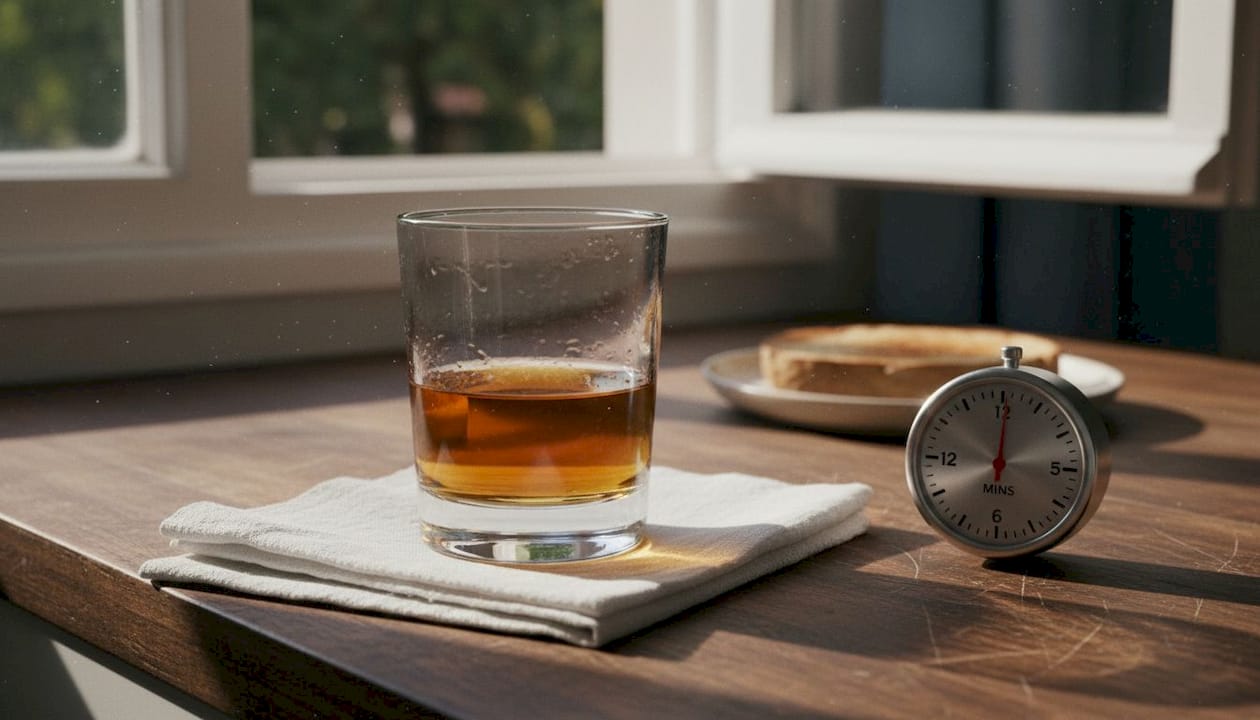
Pro Tip: Keep a neutral cracker or a piece of plain bread near your tasting area. It is not just for palate cleansing during group tastings. Taking a small bite and waiting thirty seconds before your first nose can reset your sensory baseline remarkably well.
The essentials of professional whisky tasting
With your setting prepared, it is time to step through the core etiquette of a professional whisky tasting. Approached in the right order, each stage of the process builds on the last.
- Observe the colour. Hold the glass against your white background and tilt it to assess both depth and gradient. Observing colour against a white background helps you assess cask influence; deeper amber and mahogany tones are characteristic of sherry cask maturation. Read more about this in our guide to whisky cask influence.
- Swirl gently. A slow, controlled swirl coats the glass and releases aromatics. Observe the legs or tears that slide down the inside of the glass as an indication of viscosity and alcohol content.
- Nose with your mouth slightly open. This is the step most newcomers get wrong. With your mouth closed, you saturate the olfactory sensors quickly and the picture blurs. Keeping your lips slightly parted allows ethanol to escape and lets you detect subtler notes.
- Take the first sip. Let it coat your entire palate before you swallow. Small sips allow you to coat the palate, assess body and texture, and track how flavours evolve across the tongue from tip to sides to back.
- Exhale through your nose after swallowing. The retronasal passage connects your throat to your nose, and this technique unlocks an entirely separate dimension of aroma that you cannot access any other way.
- Consider adding a few drops of water. The neat versus water debate is genuinely contested among serious collectors. Neat preserves the whisky as the distiller bottled it. A few drops of water at cask strength or high ABV can, however, chemically release compounds that remain bound at full strength. Try both approaches and taste whisky like an expert to find your preference.
“The body is assessed across the full tongue. A whisky should be held for several seconds before swallowing, allowing you to feel weight, texture, and the first hints of finish.”
To master whisky tasting notes, practise describing what you detect in simple sensory terms before reaching for vocabulary from tasting sheets. Your own honest impressions are far more useful than borrowed language that does not quite fit.
Pro Tip: Nose the empty glass after you have finished a pour. The residual film on the inside of the glass often reveals dried fruit, floral, or cereal notes that were obscured by alcohol when the whisky was still present.
Navigating group tastings and public events
Once you understand personal etiquette, the next step is ensuring a respectful and effective group tasting. A poorly ordered tasting is one of the most common and most correctable mistakes enthusiasts make.
The golden rule is to progress from light and low ABV through to high ABV and heavily peated whiskies. Starting with a big, smoky Islay malt before a delicate Highland single malt is not just inefficient. It effectively ruins the lighter pour for everyone at the table. Use water and plain crackers between drams to cleanse the palate, and allow at least two to three minutes between pours for your senses to recover.
Key etiquette points for group tastings:
- Pour modest measures. Roughly 15ml per person is standard for a tasting pour and allows everyone to assess multiple whiskies without the session becoming fatiguing.
- Do not share tasting notes until everyone has had a chance to nose and taste independently. Collective suggestion is powerful, and hearing someone announce “dark chocolate and smoke” before you nose can anchor your perception before it has formed.
- Voice opinions as personal impressions rather than objective verdicts. “I find this quite astringent on the finish” is constructive. “This is a poor finish” shuts down dialogue.
- Respect different preferences openly. A collector who loves heavily peated Islays and one who prefers gentle Japanese blends are both right about what they enjoy.
The data below, drawn from evaluate whisky quality guidance, shows how order affects group perception:
| Tasting order | Effect on palate | Recommended? |
|---|---|---|
| Light to full-bodied | Gradual build, each dram distinct | Yes |
| High ABV first | Palate fatigue, mutes lighter notes | No |
| Peated before unpeated | Smoke overwhelms delicate aromas | No |
| Random order | Inconsistent impressions | Only in informal settings |
Avoid starting with peated whiskies entirely if the group includes novice tasters. Phenolic smoke compounds are particularly persistent on the palate and can linger for ten to fifteen minutes, which is enough to skew impressions of every subsequent pour.
Spotting and appreciating a whisky’s finish
After covering group dynamics, it is crucial to master the etiquette of finish evaluation. This is the area that genuinely separates collectors from casual drinkers, and it is also among the most discussed elements when people trade or purchase premium bottles.
The finish is the flavour that remains after you swallow. It is not simply “how long the taste lasts,” though duration matters. Quality finish also means complexity and evolution. A great finish might start with oak spice, shift to dried stone fruit, and settle into a long, warming cocoa note. A poor finish drops off abruptly or turns harsh and astringent.
Finish length can be categorised as follows, and these benchmarks are widely accepted in collector circles:
| Finish length | Duration | Typical whisky category |
|---|---|---|
| Short | Under 8 seconds | Entry-level blends |
| Medium | 12 to 15 seconds | Mid-range single malts |
| Long | 20 seconds or more | Premium and aged expressions |
| Exceptional | 30 seconds or more | Rare and cask-strength releases |
When you are evaluating finish in a tasting note or discussing a bottle with another collector, be specific. Phrases like “long, warming finish with lingering vanilla oak” communicate something real. “Good finish” tells nobody anything. More guidance on evaluating this dimension is available in our overview of understanding whisky finish.
Key signals that indicate a high-quality finish:
- Flavour transitions smoothly rather than cutting off abruptly
- Warmth is pleasant, not harsh or burning
- Secondary notes emerge a minute or more after swallowing
- The finish matches and completes the flavour profile rather than contradicting it
Modern etiquette: recording, sharing, and collecting
With finish evaluation in hand, collectors should also master the etiquette of documenting their experiences and growing their collection responsibly. This is where serious enthusiasts separate themselves from those who simply drink well.
A tasting journal is the foundation. The format matters less than the consistency. Here is a practical structure that works whether you prefer a notebook or a dedicated app:
- Date and context. Note where you tasted, who was present, and the conditions. A dram enjoyed at a coastal dinner will read differently to the same bottle tasted at home on a winter evening.
- Appearance. Colour description, clarity, legs.
- Nose. List your initial impressions, then what emerges after two to five minutes. Note how this evolves.
- Palate. Body (light, medium, full), texture (oily, dry, silky), and flavour development.
- Finish. Duration and character, using the timing benchmarks from the previous section.
- Overall impression. A score or a plain-language summary. Both are valid.
A personal tasting journal creates benchmarks that make you a sharper reviewer over time. When you revisit the same bottle or distillery years later, the record becomes genuinely valuable.
Online sharing etiquette has its own conventions. When posting tasting notes publicly, acknowledge the subjectivity of your impressions. Saying a whisky “smells of sulphur” without context can harm a producer’s reputation unfairly. If the sulphur is present, note whether it is characteristic of the style or an unexpected fault. Context matters.
In collecting and trading circles, transparency about bottle provenance is essential. Always disclose the fill level, whether the seal has been broken, and how the bottle has been stored. A bottle stored upright in direct sunlight loses value, both financially and in terms of liquid quality. Guides to identifying authentic whisky help collectors navigate provenance with confidence.
Pro Tip: Photograph the label, capsule, and fill level of every bottle when it enters your collection. This takes thirty seconds and gives you a baseline record that is invaluable for insurance, trading, or simply remembering when you opened a bottle.
What real whisky appreciation means in Australia
Here is the honest perspective we have developed after years of sourcing and discussing whisky with Australian collectors: the etiquette rules above are tools, not laws. The moment they become a performance rather than a practice, they stop serving you.
Australia has a genuinely exciting relationship with whisky that the traditional rulebook was never designed to accommodate. Our distilleries in Tasmania, Victoria, and Western Australia are producing single malt expressions that have no direct European equivalent. The flavour profiles are different. The maturation timelines are compressed. The cultural context is ours, not Scotland’s.
Rigid adherence to Old World tasting protocols can actually make you worse at appreciating new Australian releases. If you always expect a twenty-year-old Speyside profile and apply that framework to a six-year-old Tasmanian peated malt, you will miss what the whisky is actually doing well.
The best collectors we know combine disciplined technique with genuine open-mindedness. They use the structured nosing approach because it works. They maintain tasting journals because the record improves their palate over time. But they also trust their own impressions, drink with curiosity rather than authority, and recognise that a relaxed pour shared with good company has its own form of etiquette.
The Australian whisky scene rewards this approach. Embrace the framework where it helps, set it aside when it gets in the way, and always let the liquid lead.
Take your appreciation further with premium selections
Refining your etiquette is most rewarding when the whisky in your glass genuinely deserves the attention. That is the philosophy behind every bottle we curate at Uisuki.

Whether you are ready to explore an aged single cask release like the extraordinary Glenglassaugh 48yo Pedro Ximenez, add a rare Japanese expression such as Ichiro’s Malt and Grain Limited Edition to your collection, or introduce a fellow enthusiast to Australian craft distilling through the Old Kempton premium gift set, our curated selection is built for collectors who take their appreciation seriously. Every bottle is selected with the same attention to detail this article asks you to bring to the glass.
Frequently asked questions
Why avoid starting a tasting with peated whiskies?
Peated whiskies release persistent phenolic smoke compounds that overpower your palate, making it much harder to detect the subtler aromatics in lighter drams that follow. Starting with smoke effectively compromises every subsequent pour in a structured tasting.
Is it rude to add water or ice to premium whisky?
Adding a few drops of water is generally accepted and can genuinely open up flavour compounds, particularly in cask-strength expressions. Ice, however, suppresses aroma and flavour, so most experts recommend avoiding ice when the goal is serious appreciation rather than casual enjoyment.
How long should you let whisky breathe before tasting?
The widely accepted guideline is one minute per year of age for premium expressions. This allows ethanol to disperse from the surface and lets more delicate aromatic compounds become accessible.
What is ‘finish’ in whisky and why does it matter?
The finish is the flavour that remains on the palate after swallowing. Long, complex finishes that exceed twenty seconds are characteristic of premium and aged expressions and are a key benchmark when evaluating quality in collector and trading circles.