

TL;DR:
- Verify Australian whisky authenticity through digital tools, labels, and excise stamps before purchasing.
- Check labels meticulously for spelling errors, font consistency, quality paper, and security features.
- Purchase from licensed retailers or verified sources to reduce health risks and counterfeit chances.
You’ve just spent several hundred dollars on a bottle of single malt. It looks right. The label seems fine. But something feels off, and now you’re second-guessing every detail. For Australian whisky enthusiasts, this doubt is more than uncomfortable — counterfeit spirits are a genuine health and financial risk. Australia’s growing appetite for premium whisky has made it an increasingly attractive target for fakes, some carrying dangerous substances like methanol. This guide gives you practical, evidence-based steps to verify authenticity before you ever open a bottle, from label inspection to digital batch validation.
Table of Contents
- What you need to spot authentic whisky in Australia
- Step-by-step label inspection for authenticity
- Physical bottle and closure checks
- Liquid and digital verification: Batch, barcodes, provenance
- Buying from safe sources: Retailer and price checks
- Why most whisky guides overlook Australian safety and provenance
- Explore authentic Australian whisky with confidence
- Frequently asked questions
Key Takeaways
| Point | Details |
|---|---|
| Always check the label | Inspect labels for errors, print quality, and excise stamps to spot fakes quickly. |
| Verify bottle closure and physical signs | Examine cap tightness, seal wear, and branding to ensure tamper-free authenticity. |
| Use digital tools for batch checks | Scan barcodes and batch numbers for provenance using brand apps or official sites. |
| Only buy from reputable sources | Choose licensed Australian retailers and avoid deals well below market price. |
| Prioritise safety over taste | Never sample bottles if unsure of authenticity; health risks outweigh curiosity. |
What you need to spot authentic whisky in Australia
Before you inspect a single bottle, you need the right tools and mindset. Authenticity checking is not guesswork. It is a structured process, and having the correct equipment makes the difference between a confident purchase and an expensive mistake.
Here is what to have on hand:
- A smartphone with the brand’s official app installed
- A UV lamp (useful for checking holograms and security features)
- A magnifying glass for fine print and label texture
- A notepad or photo app to document provenance
- Access to the distillery’s official website
One of the most reliable first steps is digital verification. You can scan barcodes, QR codes, or serial numbers using brand apps or official sites to retrieve batch details, bottling dates, and distillery information. In Australia specifically, look for state excise stamps or holograms on the packaging. These are not decorative. They are legally required markers of a legitimately imported or locally produced spirit.
Where you buy matters enormously. For Australian buyers, licensed retailers in three-tier systems (producer to distributor to retailer) significantly reduce counterfeit risk compared to informal or unverified sellers. Understanding the basics of sourcing whisky in Australia can help you identify which channels are genuinely trustworthy.
| Verification method | Reliability | Tools needed |
|---|---|---|
| Barcode or QR scan | High | Smartphone, brand app |
| UV hologram check | High | UV lamp |
| Excise stamp inspection | High | Naked eye |
| Price comparison | Medium | Internet access |
| Retailer licence check | High | ABCB or state authority |
Pro Tip: Before purchasing any premium bottle, photograph the front label, back label, base, and closure. This creates a provenance record that protects you during resale or insurance claims.
For more guidance on navigating the Australian market, the whisky shopping tips from experienced collectors are worth reviewing before you spend big.
Step-by-step label inspection for authenticity
With your toolkit ready, the next step is a meticulous label inspection. This is where most fakes reveal themselves, because replicating a premium label with perfect accuracy is genuinely difficult.
Follow these steps in order:
- Check spelling across every word on the label, including fine print
- Assess font consistency — fakes often mix typefaces subtly
- Feel the paper quality. Authentic labels use thick, textured stock with precise edges
- Look for batch numbers and bottling dates. Missing or vague details are a red flag
- Verify distillery name, region, and age statement against official records
- Examine ink saturation. Faded or blotchy printing suggests low-quality reproduction
- Hold the label under UV light to check for security features
Authentic labels use high-quality paper with precise printing, and any spelling errors, font inconsistencies, or missing batch numbers are immediate warning signs. The importance of label details for collectors goes beyond aesthetics. Labels are legal documents of provenance.
Never taste a whisky if you have any doubt about its authenticity. The financial loss is recoverable. The health risk is not.
Pro Tip: If you can access multiple bottles of the same expression, compare them side by side. Subtle differences in label placement, ink colour, or paper texture between bottles from the same batch are a serious warning sign.
| Label feature | Authentic | Suspicious |
|---|---|---|
| Paper quality | Thick, textured, precise | Thin, smooth, uneven edges |
| Font | Consistent, sharp | Mixed styles, blurry |
| Batch number | Present and traceable | Missing or vague |
| Distillery details | Full and verifiable | Generic or abbreviated |
For collectors interested in going deeper, appraising rare whisky and identifying rare whisky both cover label assessment in greater detail.
Physical bottle and closure checks
After the label check, examine physical attributes starting with the bottle and closure. This step catches tampering that labels alone cannot reveal.
Follow these steps:
- Inspect the capsule or wax seal for tightness. It should not move, spin, or feel loose
- Check for glue residue around the neck or base of the capsule, which suggests resealing
- Look for age-appropriate wear on older bottles, including micro-cracks on capsules and slight oxidation
- Examine the cork or stopper for correct branding. Many premium distilleries stamp or emboss their name directly on the cork
- Assess the glass quality. Authentic bottles are heavy, uniform, and free from bubbles or distortion
A loose or spinning cap is one of the clearest signs of tampering. Counterfeiters often refill genuine bottles, and the resealing process almost always leaves traces if you know what to look for.
Here are the key tampering red flags to watch for:
- Capsule that rotates freely on the bottle neck
- Visible glue marks or residue near the seal
- Mismatched wear between bottle and label (e.g., pristine label on a visibly aged bottle)
- Cork branding that does not match the stated distillery
- Uneven or asymmetrical glass moulding
For a useful reference on how genuine bottles compare across expressions, the whisky comparison tips available on Uisuki cover several Australian and international examples.
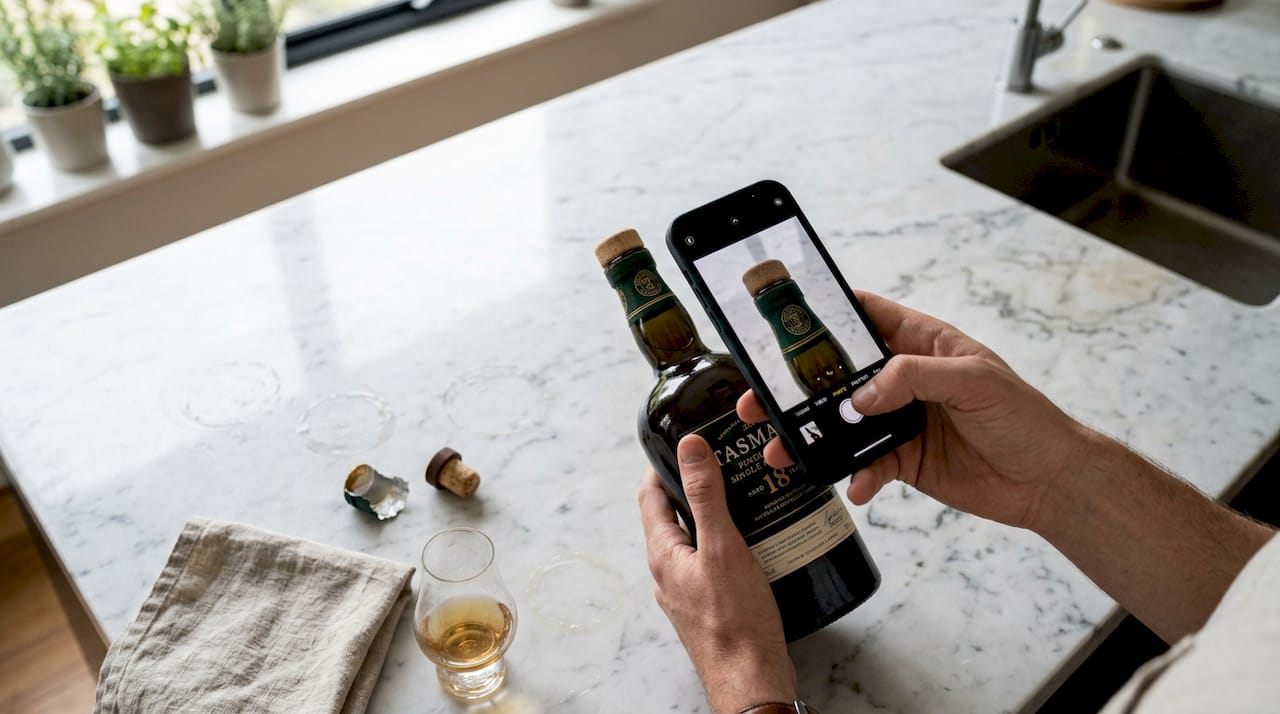
Pro Tip: Photograph the closure before opening any premium bottle. If you ever need to make an insurance claim or prove provenance during resale, that image is invaluable evidence.
Liquid and digital verification: Batch, barcodes, provenance
Once the physical bottle is confirmed, move on to the liquid and digital verification process. This is where you cross-reference what you see inside the bottle with traceable data.
Start with a visual liquid check:
- Hold the bottle up to natural or bright artificial light
- Look for clarity. Genuine whisky should appear clean, consistent, and free of floating particles
- Tilt the bottle slowly and watch for excessive bubbles or unusual viscosity
- Check colour consistency from top to bottom
Authentic whisky is filtered and appears clean and consistent when held to light. Cloudiness, sediment, or unusual colour gradients are cause for concern.
Next, move to digital verification:
- Open the brand’s official app and scan the barcode or QR code
- Cross-reference the batch number on the official distillery website
- Search auction records for the same batch to confirm market presence
- Check Australian excise records if the bottle is an import
Key fact: According to Sotheby’s authentication data, 92% of counterfeit bottles fail a structured seven-point visual inspection before any chemical testing is needed.
| Verification step | Time required | Difficulty |
|---|---|---|
| Liquid clarity check | Under 1 minute | Easy |
| Barcode or QR scan | 2 minutes | Easy |
| Batch number lookup | 5 minutes | Moderate |
| Auction record search | 10 minutes | Moderate |
Understanding whisky age statements also helps here. Batch numbers and age statements should align with the distillery’s known production history.
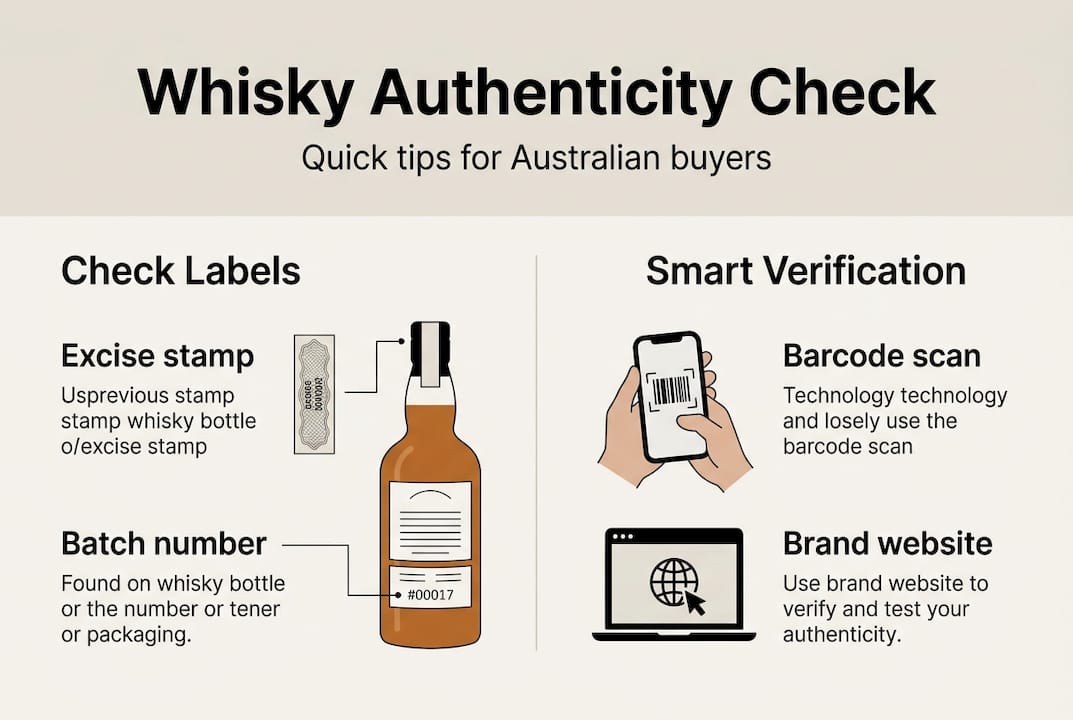
Pro Tip: Save your barcode scan results and batch lookup screenshots. These form part of your provenance file and add real value if you ever sell or insure the bottle.
Buying from safe sources: Retailer and price checks
To finish, ensure your buying strategy minimises counterfeit risks with smart retailer and price checks. The verification steps above are most effective when the bottle comes from a trustworthy source in the first place.
Never purchase whisky from unlicensed sellers, informal online marketplaces, or any source that cannot provide clear purchase documentation. Secondary markets carry real risk, particularly for high-demand expressions. If you do buy from auction or private sale, demand macro-level photographs of the label, closure, and base, along with full provenance documentation.
Characteristics of a reputable Australian whisky retailer:
- Holds a current retail liquor licence
- Operates within the producer-distributor-retailer supply chain
- Provides receipts with batch and product details
- Has verifiable customer reviews and a physical or established online presence
- Offers returns or authenticity guarantees on premium bottles
When a deal looks too good, it almost certainly is. Offers priced 40% below market value are a strong indicator of counterfeit product. For premium bottles, use third-party authenticators before completing any transaction.
| Source | Advantages | Risks |
|---|---|---|
| Licensed retailer | Guaranteed provenance, legal recourse | Higher price point |
| Reputable auction house | Rare finds, documented history | Requires careful due diligence |
| Private or informal sale | Potentially unique bottles | High counterfeit risk, no recourse |
| Online marketplace | Convenience | Unverifiable provenance |
For guidance on giving or receiving premium bottles, the gift premium whisky tips article covers how to vet sources when purchasing as a gift. And for ongoing sourcing whisky advice, understanding the Australian supply chain is the most reliable long-term protection.
Pro Tip: For any bottle valued above $300, engage a specialist authenticator before purchase. The fee is minor compared to the cost of a convincing fake.
Why most whisky guides overlook Australian safety and provenance
Most authenticity guides are written for global audiences, which means they skip the details that matter most to Australian buyers. They cover labels and closures well enough, but they rarely address Australian excise requirements, local licensing frameworks, or the specific health risks posed by methanol in counterfeit imports.
Australia’s whisky market has grown significantly over the past decade, and that growth has attracted counterfeit product from overseas. Methanol poisoning from fake spirits is not a theoretical risk. It has caused deaths in several countries, and Australia is not immune to contaminated imports entering through informal channels.
Our view is straightforward. Demand provenance photographs before every premium purchase. Use digital validation tools every time, not just when something feels suspicious. And treat excise stamps as a minimum standard, not a final tick of approval. The collectors’ guide we’ve put together reflects years of working with Australian enthusiasts who learned these lessons the hard way. Standard global guides are a starting point. Australian buyers need to go further.
Explore authentic Australian whisky with confidence
Once you’re confident in your verification process, here’s where to find genuine bottles. At Uisuki, every bottle in our catalogue comes with full provenance documentation and is sourced through verified, licensed supply chains. We work directly with distilleries and authorised distributors so you never have to second-guess what’s in the bottle.
Whether you’re after a locally crafted expression like the Hobart Bourbon Matured Single Malt, a sought-after Japanese release like Ichiro’s Malt Limited Edition, or something rare from our broader Australian whisky selection, you’ll find bottles you can trust. Authenticity is not a bonus at Uisuki. It’s the baseline.
Frequently asked questions
Can fake whisky be dangerous to drink?
Yes, counterfeit whisky poses serious health risks including methanol poisoning, which can cause blindness or death. Never taste a bottle if you have any doubt about its authenticity.
How can I check a whisky’s provenance online?
Scan the barcode or QR code using the brand’s official app, then verify batch details directly on the distillery’s website for traceable, reliable authenticity confirmation.
Are Australian excise stamps effective against counterfeits?
Yes, state excise stamps and holograms are recognised safeguards in Australia, particularly when combined with purchasing from a fully licensed retailer.
What is the best way to buy genuine premium whisky?
Purchase from licensed retailers in three-tier systems and engage a third-party authenticator for any bottle valued above a few hundred dollars to ensure both provenance and safety.