

TL;DR:
- Whiskey is a broad category of distilled grain spirits, with Scotch being a legally defined subset produced only in Scotland. All Scotch is whiskey, but not all whiskey is Scotch, due to strict regulations on geography, aging, and ingredients. The Scotch Whisky Regulations 2009 guarantee its origin, minimum three-year aging, and specific production standards, making it a reliable marker of quality and tradition.
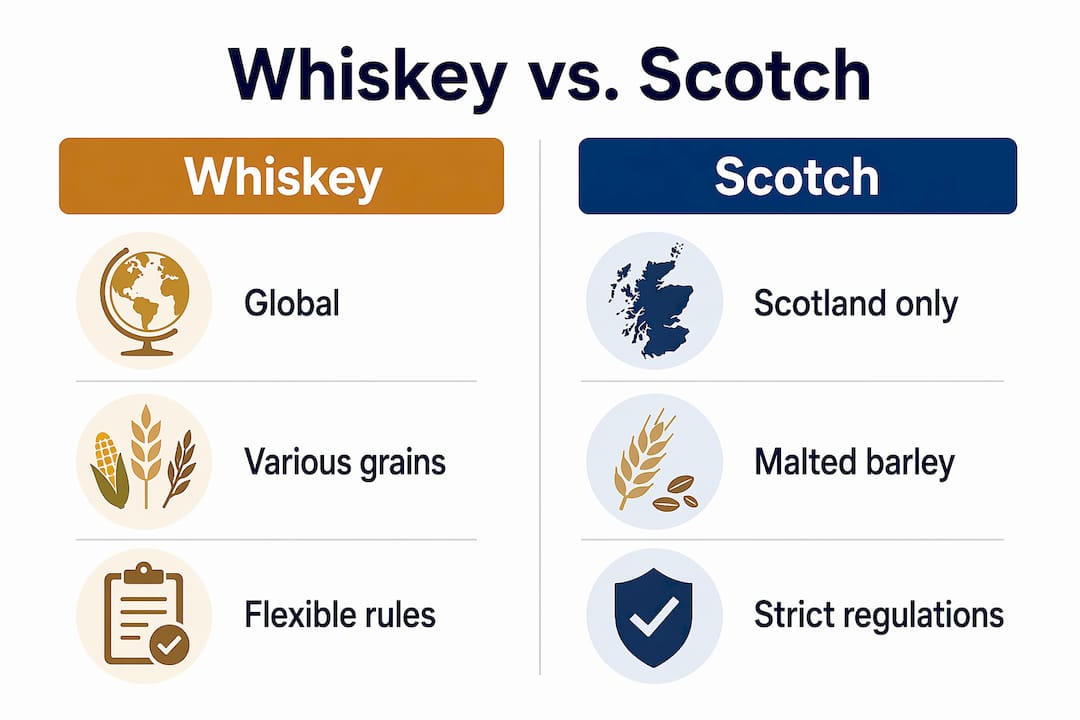
Whiskey is a broad, global category of distilled grain spirits, and Scotch is a legally defined subset produced exclusively in Scotland. All Scotch is whiskey, but not all whiskey is Scotch. That single distinction answers the question “are whiskey and scotch the same” and sets up everything else worth knowing. The Scotch Whisky Regulations 2009 impose strict rules on geography, ageing, and ingredients that no other whiskey category faces. Understanding those rules transforms how you read a label, choose a bottle, and appreciate what’s in your glass.
Are whiskey and Scotch the same? The legal answer
Scotch is a protected geographical indication, meaning every step of its production must occur within Scotland. This is the same legal logic that protects Champagne from France or Parmigiano-Reggiano from Italy. A spirit made identically to Scotch but distilled in, say, New South Wales is simply not Scotch, regardless of how it tastes.
The Scotch Whisky Regulations 2009 set out five non-negotiable requirements:
- Geography: Distilled and matured entirely in Scotland.
- Ageing: Matured in oak casks for a minimum of 3 years.
- Strength: Bottled at no less than 40% ABV.
- Additives: Only water and caramel colouring are permitted. No flavourings, no sweeteners.
- Age statements: Any age statement on the label must reflect the youngest whisky in the blend.
General whiskey regulations around the world are far more flexible. American bourbon must use a new charred oak barrel and contain at least 51% corn, but it carries no minimum ageing requirement beyond “straight” classifications. Irish whiskey requires three years of ageing but allows triple distillation and a wider grain mix. Japanese whisky has historically operated under even looser domestic rules, though that is changing.
The practical implication is significant. “Scotch” on a label is a legal guarantee, not a marketing claim. When you buy a bottle labelled Scotch, you know exactly where it came from and how long it aged.
Pro Tip: When comparing bottles, check whether the label says “Scotch whisky” or simply “whisky.” If it says Scotch, the Regulations 2009 apply. If it just says whisky, the rules depend entirely on the country of origin.
How do ingredients and production methods differ?
The difference between Scotch and whiskey starts with the grain. Scotch relies predominantly on malted barley, where the barley is soaked, germinated, and then dried to activate enzymes that convert starch to sugar. Other whiskeys use a much wider grain palette. Bourbon is built on corn. Rye whiskey centres on rye grain. Many blended whiskeys combine wheat, corn, and barley in varying proportions.

Distillation method is the next major fork in the road. Most Scotch whiskies are distilled twice in copper pot stills, which retains more grain character and body. Irish whiskeys typically undergo triple distillation, producing a lighter, smoother spirit. American bourbon uses column stills for continuous distillation, creating a higher-proof, grain-forward new make spirit.
Cask selection shapes the final character more than most drinkers realise. Scotch matures in oak casks, most commonly ex-bourbon barrels imported from Kentucky or ex-sherry butts from Spain. These used casks add layers of vanilla, dried fruit, spice, and wood without overwhelming the base spirit. Bourbon, by contrast, must use new charred oak barrels, which deliver intense vanilla and caramel notes quickly. The variety of maturation casks available to Scotch producers creates a spectrum of flavours that more tightly regulated styles cannot match.
Scotland’s cool, damp maritime climate also plays a quiet but powerful role. Slower, gentler maturation in Scotland’s climate reduces the rate of evaporation (known as the “angel’s share”) and allows complex flavour compounds to develop gradually over many years. A 12-year-old Scotch and a 12-year-old bourbon aged in Tennessee’s heat have experienced very different maturation journeys, even if both spent the same number of years in wood.
Pro Tip: If you want to understand cask influence directly, try the same Scotch distillery’s expression finished in ex-bourbon versus ex-sherry casks side by side. The difference is striking and educational.
What are the flavour profiles across Scotch regions and other whiskeys?
Scotch flavour is not one thing. The five recognised Scotch regions, Highland, Lowland, Speyside, Islay, and Campbeltown, each produce distinctly different styles. Peat smoke is iconic to Islay, but it is far from universal across Scotland.
Here is how the regional profiles break down:
- Islay: Heavy peat smoke, iodine, seaweed, and brine. Producers here make some of the most intensely smoky spirits in the world.
- Speyside: Light, sweet, and fruity. Speyside is home to more distilleries than any other region and produces approachable, often floral expressions with notes of apple, pear, and honey.
- Highland: Broad and varied. Expect heather, dried fruit, malt, and occasional coastal influence depending on location.
- Lowland: Delicate and grassy. Triple-distilled expressions from this region are among the lightest Scotches available, making them excellent entry points.
- Campbeltown: Briny, oily, and slightly smoky with a distinctive maritime character.
Peatiness is overemphasised by beginners. Many people try one heavily peated Islay Scotch and assume all Scotch tastes like a campfire. A Speyside single malt or a Lowland expression would surprise them entirely.
Bourbon sits at the opposite end of the flavour spectrum. Its new charred oak requirement pushes vanilla, caramel, and toasted wood to the front. Irish whiskey tends toward light, clean, and slightly sweet, with a smoothness that comes from triple distillation. Japanese whisky often sits between Scotch and Irish in style, with delicate fruit, floral notes, and careful balance. Exploring the full range of whisky profiles across these styles reveals just how wide the whiskey family really is.
Why do “whisky” and “whiskey” have different spellings?
The spelling difference is geographic, not qualitative. “Whisky” without the ‘e’ is used in Scotland, Canada, and Japan. “Whiskey” with the ‘e’ is used in Ireland and the United States. The divergence traces back to the 19th century, when Irish distillers added the ‘e’ to distinguish their product from Scotch whisky in export markets. American producers followed the Irish convention.
Consumers commonly assume the spelling signals quality or style superiority. It does not. The spelling is purely a marker of origin and historical branding. A Canadian whisky and an American whiskey can taste remarkably similar despite their different spellings.
The practical takeaway for shoppers is straightforward:
- Whisky (no ‘e’): Scotland, Canada, Japan.
- Whiskey (with ‘e’): Ireland, USA.
- No quality hierarchy exists between the two spellings.
- Spelling helps you identify origin, which in turn helps you anticipate flavour profile and production style.
Knowing this shortcut makes reading a back label faster and more useful. When you see “Scotch whisky,” you know the spirit is Scottish, aged at least three years, and made without artificial flavourings. When you see “Irish whiskey,” you can reasonably expect a lighter, triple-distilled spirit. The spelling is a quiet but reliable guide.
Key takeaways
Scotch is a legally protected subset of whiskey, defined by geography, ageing, and strict production rules that no other category must follow.
| Point | Details |
|---|---|
| Scotch is a subset of whiskey | All Scotch is whiskey, but whiskey made outside Scotland is never Scotch. |
| Legal protection matters | The Scotch Whisky Regulations 2009 guarantee origin, minimum ageing, and ingredient standards. |
| Grain and distillation differ | Scotch uses malted barley and double distillation; other whiskeys use varied grains and methods. |
| Scotch flavour is not one style | Five regions produce profiles ranging from smoky Islay to delicate, floral Speyside. |
| Spelling signals origin, not quality | “Whisky” means Scotland, Canada, or Japan; “whiskey” means Ireland or the USA. |
Scotch, smoke, and the assumptions worth dropping
I have poured a lot of Scotch for people who were convinced they would hate it. The assumption is almost always the same: “I tried a peated one once and it tasted like an ashtray.” That single experience had closed the door on an entire world of spirits.
The truth is that Scotch’s regional diversity is its greatest strength. A Speyside single malt can be as approachable as a good dessert wine, all stone fruit and honey with barely a whisper of smoke. A Lowland expression can be lighter than many Irish whiskeys. The category rewards curiosity far more than it rewards loyalty to a single style.
What I find genuinely underappreciated is how much the legal framework actually helps the drinker. The Scotch Whisky Regulations 2009 are not just bureaucratic rules. They are a quality floor. When you pick up a bottle labelled Scotch, you know it spent at least three years in oak in Scotland, that nothing artificial was added, and that the age statement on the label is honest. That level of transparency is rare in the spirits world.
My honest recommendation is to start with a different types of whiskey comparison before committing to a single style. Try a Speyside, an Islay, and a bourbon side by side. The contrast is more educational than any article, including this one.
— Brendan
Premium Scotch and whiskey worth exploring
Understanding the difference between Scotch and whiskey is one thing. Tasting that difference is another entirely.

Uisuki.com.au carries a curated selection of whiskies from Scotland, Japan, Australia, and the USA, chosen for flavour diversity and quality. For Australian enthusiasts wanting to experience unique maturation techniques firsthand, the Hobart Whisky Bourbon Matured Rum Finished Single Malt is a standout. It demonstrates exactly how cask selection shapes a spirit’s character. For those curious about blended styles across borders, the Ardnamurchan Macleans Nose Blended Scotch offers genuine regional Scotch character at an accessible price point. Browse the full range at Uisuki.com.au to find the style that suits your palate.
FAQ
Are whiskey and Scotch the same thing?
No. Scotch is a legally defined type of whisky produced exclusively in Scotland under the Scotch Whisky Regulations 2009. All Scotch is whiskey, but whiskey made outside Scotland is never Scotch.
What is the minimum ageing requirement for Scotch?
Scotch must mature in oak casks within Scotland for a minimum of three years. Any age statement on the label must reflect the youngest whisky in the blend.
Does all Scotch taste smoky and peaty?
No. Peat smoke is characteristic of Islay Scotch, but many Scotches from Speyside, Lowland, and Highland regions are unpeated, with light, fruity, or floral profiles instead.
What does the spelling difference between “whisky” and “whiskey” mean?
“Whisky” without the ‘e’ is used in Scotland, Canada, and Japan. “Whiskey” with the ‘e’ is used in Ireland and the USA. The difference reflects geographic origin and historical branding, not quality.
How does Scotch differ from bourbon?
Scotch uses malted barley, ages in used oak casks, and must be produced in Scotland. Bourbon uses at least 51% corn, must age in new charred oak barrels, and is produced in the USA. Both are whiskeys, but their production rules and flavour profiles are distinct.