

TL;DR:
- Scotch whisky is primarily made from malted barley, with other cereals like wheat and maize permitted in certain styles. The grains influence the spirit’s flavor and texture, with malted barley producing richness and complexity, while wheat and maize yield lighter, sweeter spirits. Most Scotch sold globally is blended, combining grain and malt whiskies from multiple distilleries to create a balanced flavor profile.
Scotch whisky is defined by its grain: malted barley is the foundation of every legally recognised style, from single malt to blended Scotch. Under the Scotch Whisky Regulations 2026, only cereal grains, water, and yeast are permitted in production. No added sugars, no synthetic enzymes, no flavourings. Single malt must use 100% malted barley by law, while grain whisky introduces wheat or maize alongside a smaller proportion of malted barley. Understanding which grains go into your dram tells you a great deal about what you will taste in the glass.
What grain is Scotch whisky made from?
Scotch whisky is made from malted barley as its core grain, with other cereals permitted depending on the style. Single malt Scotch must be produced from 100% malted barley, water, and yeast at a single distillery. That requirement is not a tradition. It is a legal obligation under the Scotch Whisky Regulations 2026.
Grain whisky follows a different recipe. It uses malted barley alongside other cereals, most commonly wheat or maize. The malted barley is not there for flavour alone. It provides the enzymes needed to break down starches in the other grains so fermentation can occur. Without it, the mash would not convert properly.
The grains permitted in Scotch whisky production are:
- Malted barley — mandatory in all styles; the only grain permitted in single malt
- Wheat — the most common secondary grain in grain whisky, producing a light, clean spirit
- Maize (corn) — used in some grain whisky recipes for a sweeter, fuller body
- Other cereals — permitted in grain whisky under regulation, though wheat and maize dominate
Legal protections prohibit the use of synthetic enzymes, added sugars, or artificial flavourings. These rules preserve the traditional character and identity of Scotch whisky. Every bottle you open carries that guarantee.
Pro Tip: If you want to understand what you are tasting, check the label for “single malt” or “single grain.” Single malt means pure malted barley. Single grain means a blend of malted barley and at least one other cereal.
How do the grains affect the flavour of Scotch whisky?
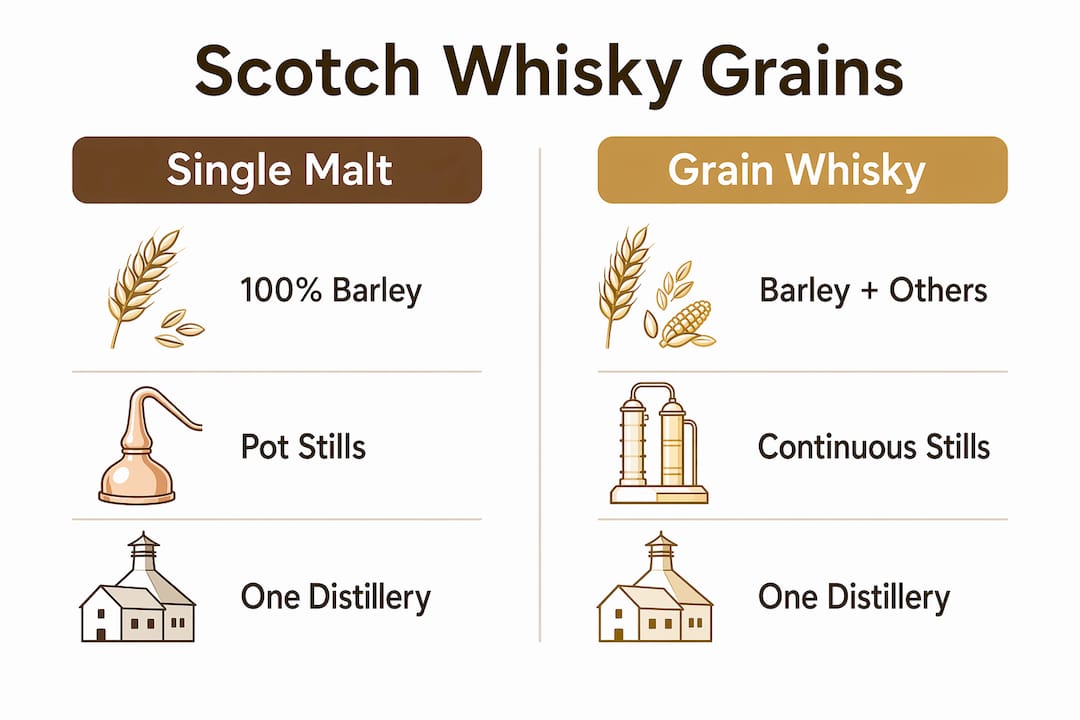
Grain choice is fundamental in defining whisky texture, sweetness, and weight before maturation in oak even begins. This is the part most drinkers overlook. They focus on the cask or the region, but the grain sets the foundation.
Malted barley produces a rich, oily spirit with fruity and biscuit-like notes. It carries more natural complexity than wheat or maize because the malting process itself, where barley is soaked, germinated, and dried, develops flavour compounds that survive distillation. Wheat and maize yield lighter, sweeter, and cleaner spirits. That is why grain whisky is often described as smooth and approachable rather than deeply layered.
The distillation method reinforces these differences. Pot stills, used for malt whisky, retain more congeners, the flavour compounds that give spirit its character. Continuous column stills, used for grain whisky, strip the spirit to a higher purity. The result is a lighter, more neutral base that blenders can shape with malt whisky additions.
“Malted barley produces a rich, oily spirit with fruity, biscuit-like notes, whereas wheat and maize produce lighter, sweeter, cleaner spirits. The distillation method amplifies this: pot stills preserve complexity, column stills refine it away.”
The practical flavour differences, ranked from richest to lightest, follow this order:
- Malted barley in pot stills — biscuit, dried fruit, oily texture, natural complexity
- Malted barley in column stills — cleaner than pot still malt but retains some cereal character
- Wheat in column stills — soft, sweet, light, with vanilla and cream notes
- Maize in column stills — sweeter still, with a fuller body and subtle corn sweetness
Understanding this order helps you predict what a whisky will taste like before you open the bottle.
What is the difference between single malt, single grain, and blended Scotch?
The word “single” on a Scotch label refers to the distillery of origin, not the number of grains used. This is one of the most common misunderstandings among people new to whisky. A single grain Scotch can contain two or three different cereals and still carry that label legally.
The three main categories differ in grain composition, still type, and production scale:
| Category | Grains used | Still type | Distillery source |
|---|---|---|---|
| Single malt | 100% malted barley | Pot still | One distillery |
| Single grain | Malted barley plus wheat or maize | Continuous column still | One distillery |
| Blended Scotch | Malt and grain whiskies combined | Both | Multiple distilleries |
About 90% of Scotch whisky sold globally is blended Scotch. That figure reflects how central grain whisky is to the industry. A typical blended Scotch contains 60–70% grain whisky and 30–40% malt whisky. The grain whisky provides volume, consistency, and a lighter base. The malt whisky provides depth, aroma, and character.
Single grain Scotch is the least understood category. It is made at one distillery using continuous stills, and it must include malted barley alongside other permitted cereals. The result is a lighter, often sweeter whisky that stands apart from both single malt and blended Scotch in flavour profile.
Pro Tip: Single grain Scotch is worth trying if you find single malt too heavy. The lighter body and natural sweetness from wheat make it an excellent entry point for new drinkers.
For a deeper look at how these categories compare, the blended vs single malt breakdown on Uisuki covers the key differences in plain language.
Why is malted barley mandatory in Scotch whisky production?
Malted barley is not optional. It is a biochemical necessity and a legal requirement in every style of Scotch whisky. The malting process activates enzymes, specifically amylases, that convert grain starches into fermentable sugars. Without those sugars, yeast has nothing to work with and fermentation cannot proceed.
In single malt production, 100% malted barley supplies both the enzymes and the fermentable sugars. In grain whisky production, approximately 10% malted barley is typical in the recipe. That small proportion provides enough enzymatic activity to convert the starches in the larger volume of wheat or maize. The ratio is carefully controlled because too little malted barley means incomplete conversion and a lower yield.
The regulatory reasons reinforce the biochemical ones. The Scotch Whisky Regulations 2026 specify that:
- Only cereal grains, water, and yeast may be used in production
- Synthetic enzymes are prohibited, making malted barley the only legal enzyme source
- No added sugars or flavourings are permitted at any stage
- The spirit must mature in oak casks in Scotland for a minimum of three years
These rules exist to protect the authenticity of Scotch whisky as a product of place and process. They also explain why you will never find a Scotch made without malted barley, regardless of how much wheat or maize appears in the recipe. The role of malted barley in whisky production goes well beyond flavour. It is the engine that makes fermentation possible.
The proportion of malted barley in grain whisky recipes is closely guarded by distilleries. Even a small shift in that ratio changes fermentation efficiency and the character of the final spirit. This is why grain whisky recipes are treated as proprietary information despite the relatively simple ingredient list.
Key takeaways
Scotch whisky is always made with malted barley, which is the only grain permitted in single malt and the essential enzyme source in grain and blended Scotch styles.
| Point | Details |
|---|---|
| Malted barley is mandatory | Every style of Scotch whisky must include malted barley by law under the Scotch Whisky Regulations 2026. |
| Single malt uses only barley | Single malt Scotch is produced from 100% malted barley at one distillery using pot stills. |
| Grain whisky adds wheat or maize | Grain whisky recipes typically include around 10% malted barley alongside wheat or maize for a lighter spirit. |
| Blended Scotch dominates globally | About 90% of Scotch sold worldwide is blended, combining 60–70% grain whisky with 30–40% malt whisky. |
| Grain choice shapes flavour | Malted barley delivers richness and complexity; wheat and maize produce lighter, sweeter, cleaner spirits. |
Grain, character, and why it matters more than most drinkers realise
Most conversations about Scotch whisky focus on the region or the cask. Speyside versus Islay. Sherry versus bourbon wood. These are real and meaningful differences. But the grain comes first, and I think it deserves far more attention than it gets.
When I taste a heavily peated single malt and then a well-made blended Scotch from the same region, the contrast is not just about smoke. The grain base shapes the texture, the weight, and the way the spirit sits on the palate. A malt-heavy blend feels different in the mouth than one built on a lighter wheat grain whisky, even when the cask influence is identical.
The thing that surprises most people I talk to is how much quality sits in the grain whisky category. Single grain Scotch is genuinely underrated. Distilleries put real craft into those column still spirits, and the best examples have a finesse that rivals many single malts at a fraction of the price.
My advice for anyone curious about grain influences: start by tasting a single grain Scotch alongside a single malt from the same region. The difference in texture and sweetness will tell you more about grain’s role than any description could. Once you understand that, blended Scotch starts to make a lot more sense as a craft product rather than just a commercial one.
— Brendan
Premium Scotch whiskies worth exploring
Understanding the grains behind Scotch whisky makes choosing a bottle far more satisfying. You know what you are looking for before you even read the tasting notes.

Uisuki carries a curated selection of single malt and blended Scotch whiskies for drinkers who want quality with context. The Ardnamurchan Macleans Nose Blended Scotch Whisky 46% ABV 700ml is a fine example of malt and grain whisky working together with real intention behind the blend. For those drawn to pure malted barley character, the Hobart Whisky Single Malt shows what a single grain source can achieve with careful maturation. Both bottles reward the drinker who understands what went into making them.
FAQ
What grain is Scotch whisky made from?
Scotch whisky is made from malted barley as its primary grain. Single malt uses 100% malted barley, while grain whisky adds wheat or maize alongside a smaller proportion of malted barley.
Is Scotch whisky always made from barley?
Malted barley must be present in every style of Scotch whisky by law. Single malt uses only malted barley, and grain whisky requires malted barley to provide the enzymes needed for fermentation, even when wheat or maize makes up the bulk of the recipe.
What is the difference between single malt and single grain Scotch?
Single malt Scotch is made from 100% malted barley at one distillery using pot stills. Single grain Scotch is made at one distillery using continuous column stills, and it includes malted barley plus other cereals such as wheat or maize.
Why does grain whisky use wheat or maize instead of just barley?
Wheat and maize produce a lighter, sweeter, and more neutral spirit than malted barley. This makes grain whisky an ideal base for blended Scotch, where the malt whisky component adds the depth and complexity.
How much of Scotch whisky sold globally is blended?
About 90% of Scotch whisky sold globally is blended Scotch. A typical blend contains 60–70% grain whisky and 30–40% malt whisky, with the grain component providing consistency and the malt component providing character.