

TL;DR:
- Understanding the production choices behind Scotch whisky reveals that flavor arises from raw materials, peat levels, fermentation, still design, and cask history. These factors create twelve dominant flavor families, such as fruity, smoky, and woody, which evolve through nose, palate, and finish; region offers guidance but does not determine taste. Cask type and length of maturation influence character more than age, with variations in cask history producing a wider range of profiles than aging alone.
Scotch whisky gets a lot of assumptions thrown at it. Smoky means quality. Older means better. Islay means the same thing every time. None of that holds up once you start paying attention to how Scotch is actually made and why it tastes the way it does. The scotch whisky characteristics you encounter in any given bottle are the direct result of specific production choices: raw materials, peat levels, fermentation length, still geometry, and cask history. Understanding those connections transforms whisky from a beverage you consume into one you genuinely read. And that’s a far more satisfying experience.
Table of Contents
- Key takeaways
- Scotch whisky characteristics: the flavour families
- How production shapes flavour
- Regional tendencies and what they actually mean
- How cask and age shape character
- How to taste scotch whisky systematically
- My take on what actually matters
- Explore Scotch at Uisuki
- FAQ
Key takeaways
| Point | Details |
|---|---|
| Flavour is production, not magic | Every aroma and taste in Scotch traces back to a deliberate production decision made at the distillery. |
| Twelve flavour families frame it all | Scotch sits within around a dozen dominant flavour families, from fruity and floral to smoky, woody, and medicinal. |
| Region is a guide, not a guarantee | Regional tendencies give useful starting points, but cask history and distillery technique shape flavour far more reliably. |
| Cask drives most of the flavour | Ex-bourbon and ex-sherry casks account for a substantial share of mature Scotch whisky’s final character. |
| Older whisky isn’t always better | Extended wood contact can suppress fruitiness and introduce bitterness, making age a style marker rather than a quality rating. |
Scotch whisky characteristics: the flavour families
Most people approach Scotch expecting flavours to announce themselves clearly. The reality is more layered than that. Over 300 flavour-active compounds are present in Scotch whisky, but drinkers perceive them through roughly a dozen dominant flavour families. Knowing those families gives you a framework to make sense of what’s happening in the glass rather than reaching for vague descriptors like “nice” or “strong.”
The twelve main families you’ll encounter are:
- Fruity: Apple, pear, citrus, stone fruit, tropical notes
- Floral: Heather, rose, meadow grass, light blossom
- Malty: Biscuit, cereal, fresh bread, grain
- Nutty: Almond, walnut, hazelnut, toasted oak
- Spicy: Pepper, ginger, cinnamon, clove
- Smoky/peaty: Bonfire, wood ash, tar, seaweed
- Medicinal: Iodine, antiseptic, hospital-like
- Sulfury: Struck match, rubber, meaty (often a distillation marker)
- Oily: Waxy, fatty, coastal texture
- Sweet: Honey, vanilla, caramel, toffee
- Sour: Green apple, acidic fruit, lactic
- Woody/tannic: Dry oak, sawdust, dark chocolate bitterness
These categories work across three sensory phases: nose, palate, and finish. The nose catches volatiles that evaporate quickly. The palate brings texture and mid-range compounds. The finish reveals what’s left after swallowing, often the heavier wood or smoke elements. A whisky might show light florals on the nose and shift to rich spice on the palate. That movement is part of what makes Scotch genuinely interesting to taste.
Flavour profile is analytical, not a quality rating. A heavily medicinal, peaty Scotch isn’t better or worse than a delicate floral Lowlander. They’re targeting different experiences. Knowing this removes the pressure of having “correct” opinions and lets you focus on what you actually enjoy.
Pro Tip: When nosing a new whisky, hold the glass at chest height and gradually raise it to your nose. This prevents the ethanol from overwhelming your senses and lets you pick out subtler aroma notes first.
How production shapes flavour
Understanding where flavours come from is the quickest way to read a bottle before you’ve even opened it. Every stage of Scotch whisky production contributes something specific to the final character.
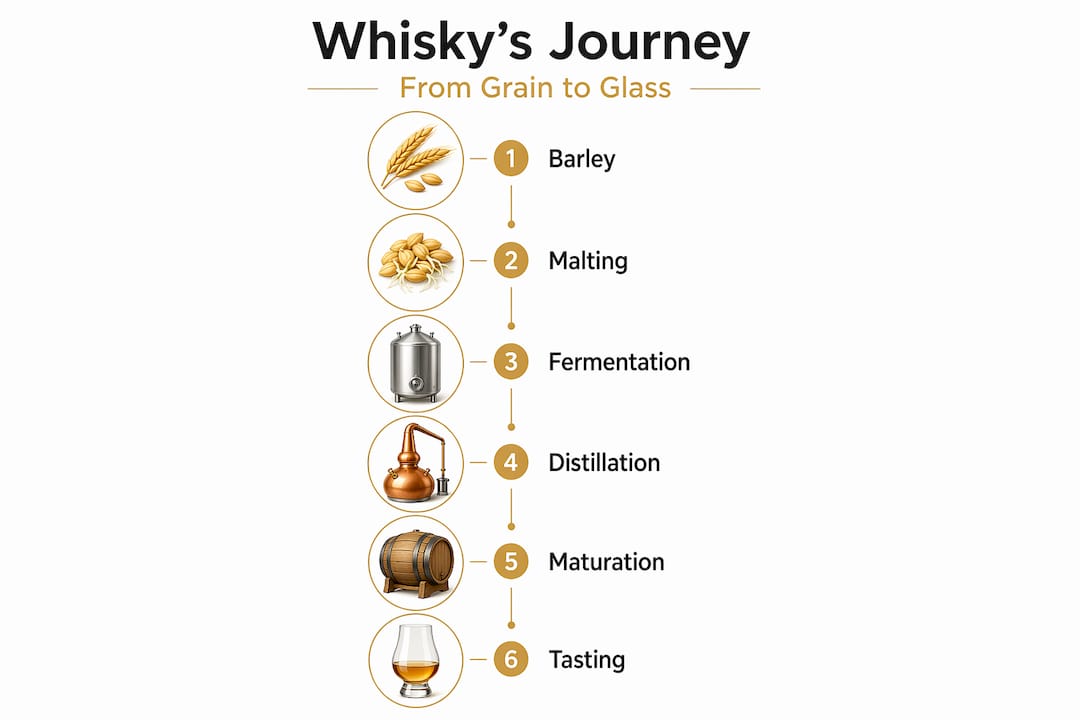
1. Raw materials Single malt Scotch is made exclusively from malted barley. The legal production requirements mandate malted barley only, pot still distillation to a maximum of 94.8% ABV, and maturation in oak casks of no more than 700 litres for a minimum of three years. The barley provides the malty backbone: that cereal, biscuit quality that underpins many expressions.
2. Peat kilning Peat smoke intensity is measured in parts per million phenol (ppm). Unpeated malt sits between 0 and 2 ppm, while super-heavily peated malts exceed 50 ppm. The key nuance here is that malt ppm and spirit ppm are not the same thing. Distillation and maturation both reduce phenol levels, which is why the ppm figure on a label describes the malt specification, not exactly what you taste in the glass.
3. Fermentation This stage is often underestimated. Longer fermentation produces more esters, including ethyl acetate, which reads as apple-like, and isoamyl acetate, which presents as banana. Distilleries that run long ferments tend toward fruitier, lighter spirit characters. Shorter ferments push the spirit toward heavier, more cereal-driven notes.
4. Distillation still shape Tall, slender pot stills with long lyne arms produce lighter, fruitier spirits because heavier congeners fall back into the still before reaching the condenser. Squat, wide stills allow more of those heavier compounds through, resulting in richer, oilier spirit. Distillers also choose cut points carefully: taking spirit from earlier or later in the run changes weight and flavour complexity significantly.
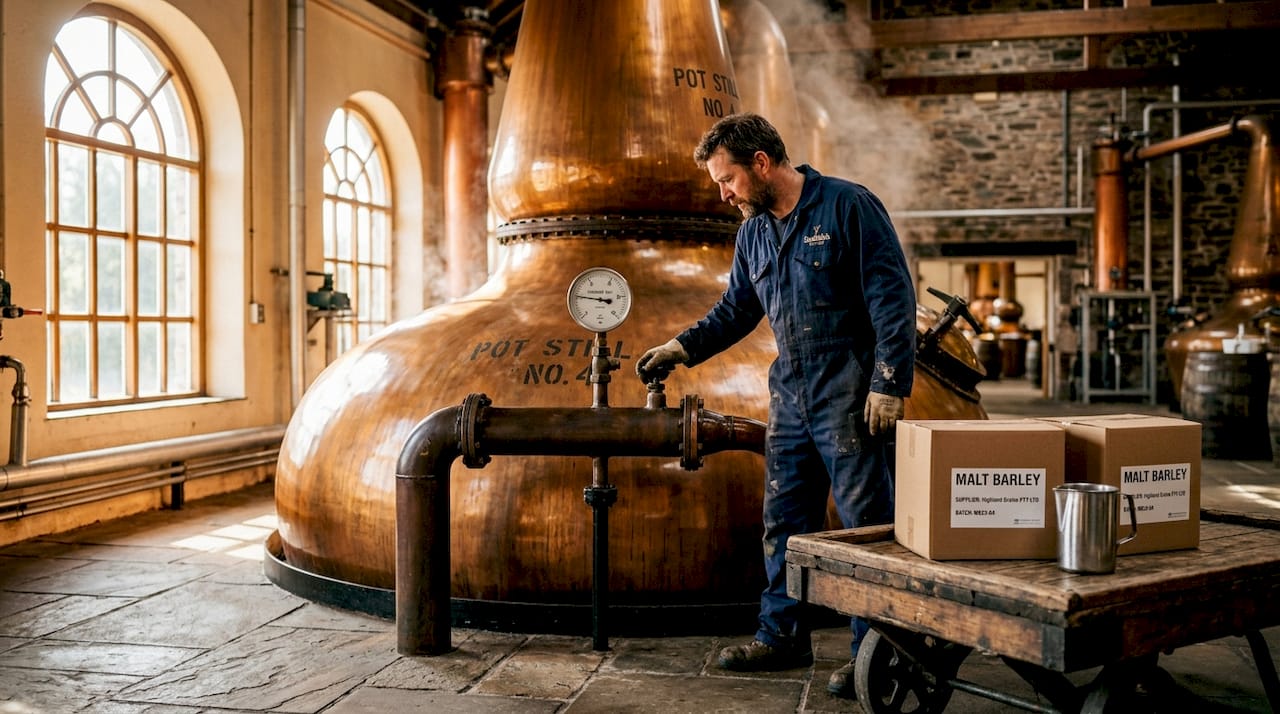
5. Maturation Cask choice ties the whole thing together. Ex-bourbon and ex-sherry casks are the two dominant styles, with ex-bourbon contributing vanilla, coconut, and caramel, and ex-sherry adding dried fruit, spice, and richness. The wood is porous and breathes with the seasons, slowly drawing spirit in and out, leaching compounds from the timber while allowing gradual oxidation.
Pro Tip: If you want to see how dramatically cask type changes a whisky’s character, try a side-by-side tasting of two expressions from the same distillery. One matured in ex-bourbon, one in ex-sherry. The difference is often more striking than comparing two entirely different distilleries.
Regional tendencies and what they actually mean
Scotland’s five recognised regions each carry flavour associations, and they’re worth knowing. But they work best as starting points rather than firm predictions. Regional flavour tendencies are probabilistic, meaning they describe what’s likely, not what’s certain. Production choices and cask selection can push any distillery well outside its regional norm.
| Region | Typical flavour profile | Notable nuance |
|---|---|---|
| Speyside | Fruity, sweet, gentle, floral | Home to many approachable expressions; excellent for beginners |
| Islay | Smoky, peaty, medicinal, maritime | Significant exceptions exist, including unpeated Islay expressions |
| Highland | Diverse, often robust, sometimes peated | Widest stylistic range of any region |
| Lowland | Light, floral, delicate, grassy | Triple distillation common; digestif style |
| Campbeltown | Maritime, oily, sometimes peated | Small region with a distinctive coastal character |
Speyside is where most people start. It’s a reliable entry point if you prefer approachable, fruity styles. Glenlivet and Glenfiddich built global audiences on that accessible sweetness. Islay has the strongest identity of any region, largely because peated whiskies make a strong sensory impression. But it’s worth knowing that not every Islay distillery produces heavily peated spirit. Bunnahabhain, for instance, makes largely unpeated expressions despite sitting on the same island as Ardbeg and Laphroaig.
The Highland category is the most challenging to generalise. It covers an enormous geographic area and produces everything from delicate coastal expressions in the north to rich, robust whiskies further south. Campbeltown, once home to dozens of distilleries, now has just three operating, but they produce some of the most distinctive and genuinely maritime Scotch available. If you’re interested in exploring flavour profiles by region, it’s useful to treat each distillery as its own case study rather than a regional representative.
How cask and age shape character
This is where the biggest misconceptions about Scotch live. The idea that older whisky is inherently better whisky is one of the most persistent myths in the category. Cask type and fill history account for approximately 60 to 70 percent of mature Scotch whisky’s flavour. That means the vessel the spirit sat in matters more than almost any other single variable.
Here’s what actually happens as a Scotch ages:
- Ex-bourbon casks add vanilla, coconut, and caramel in the early years of maturation
- Ex-sherry casks bring dried fruit, nutmeg, and deep spice character more quickly
- Extended wood contact increases tannins and woody bitterness, which can suppress the fruitiness developed during fermentation
- Second and third fill casks give less flavour extraction than first fill, producing subtler, spirit-forward expressions
- Smaller casks mature whisky faster due to the higher wood-to-liquid ratio
A 12-year-old first-fill ex-sherry butt from a single distillery can be richer and more complex than a 25-year-old third-fill ex-bourbon barrel from the same place. Age statement tells you how long the whisky sat in wood. It doesn’t tell you what kind of wood, how many times it had been used, or how active the cask remained. The 7 essential types of whisky ageing is worth exploring if you want to understand how cask variables combine to produce dramatically different outcomes.
How to taste scotch whisky systematically
You don’t need a formal palate to taste well. You need a structured approach that slows you down enough to notice what’s there. Here’s how to work through a new expression:
- Nose it neat first. Hold the glass below nose level and approach slowly. Add a few drops of still water after your first impressions to open up aromatic compounds.
- Identify broad families before chasing specifics. Is it primarily fruity, smoky, or sweet? Anchoring to a family first prevents overthinking.
- Take a small sip and let it coat your palate. Note texture separately from flavour: is it oily, thin, creamy, or dry?
- Focus on the finish. Length and character of the aftertaste is often where production-linked flavours like smoke and wood tannin become clearest.
- Revisit your nose after tasting. The glass warms during drinking and releases different volatile compounds, sometimes revealing notes you missed initially.
The scotch whisky mouthfeel is an underappreciated dimension. A waxy, full-bodied texture often traces back to high copper contact during distillation or oily compounds from fermentation. A thin, dry texture can indicate lighter distillation cuts or heavily used casks. These textural signals connect directly back to production choices.
Pro Tip: Keep a brief tasting note on your phone after each new whisky. After six months you’ll have a personal record that reveals your genuine preferences far more accurately than any marketing guide.
My take on what actually matters
I’ve spent years working with Scotch whisky across different styles, regions, and price points. And the single thing I keep coming back to is this: the marketing story is almost never the whole story. Regional identity is useful shorthand, but it flattens the real picture. The distillery’s technical decisions, the fermentation length, the still shape, the cut points, and the cask selection tell you far more than any label’s evocative description of misty glens and ancient traditions.
What I find genuinely interesting is how much variation exists within a single distillery’s range purely because of cask differences. Two bottles carrying the same name and age statement but different cask types can taste like they come from different countries. Once you understand that, you stop hunting for “the best Scotch” and start hunting for the Scotch that suits your moment, whether that’s a delicate floral dram before dinner or a dense, peated expression on a cold evening.
I’d also push back on the idea that beginner whiskies are somehow less serious than advanced ones. A well-made Speyside with clean fruit and gentle sweetness is technically demanding to produce. Lightness is hard. Don’t let anyone convince you that your preference for approachable styles reflects a lack of sophistication. It reflects knowing what you enjoy.
— Brendan
Explore Scotch at Uisuki

Knowing what drives scotch whisky characteristics makes choosing your next bottle a genuinely informed decision rather than a lucky guess. At Uisuki, the curated Scotch selection spans the full flavour spectrum, from delicate, floral Lowlanders to fiercely peated Islay expressions and rare single cask bottlings with unusual cask histories. Whether you’re chasing your first serious bottle or hunting a hard-to-find expression for your collection, Uisuki’s product listings include detailed flavour notes, ABV, and region information to help you match bottle to preference. The blog also carries in-depth resources on single malt Scotch types to keep your learning going.
FAQ
What are the main scotch whisky characteristics to know?
Scotch whisky is defined by flavours drawn from around a dozen dominant families including fruity, smoky, malty, spicy, sweet, and woody. These characteristics are shaped by production choices like peat level, fermentation duration, still shape, and cask type.
Does the region determine how a Scotch tastes?
Region gives a probabilistic guide but not a guarantee. Cask history and production methods have a greater influence on final flavour than geography, and significant variation exists within every region.
Why does adding water change the aroma of Scotch?
A few drops of water lower the alcohol concentration, which releases volatile aromatic compounds that ethanol was suppressing. This commonly reveals more floral, fruity, and malty notes that aren’t detectable neat.
Is older Scotch whisky always better?
No. Extended maturation increases tannic and woody character, which can dominate and suppress the fruity notes developed during fermentation. Age is a style indicator, not a quality guarantee.
What does ppm mean on a Scotch whisky label?
PPM refers to parts per million phenol in the malted barley, indicating how heavily the malt was peated during kilning. The actual phenol level in the final spirit is lower, as distillation and maturation both reduce smoke intensity.