

TL;DR:
- Bourbon is a legally defined American spirit made with at least 51% corn and aged in new charred oak barrels. Canadian whisky is more flexible, allowing used barrels and additives, and can be blended with other spirits, resulting in lighter, smoother profiles. These regulatory differences produce distinct flavors, making bourbon richer and more assertive, while Canadian whisky offers more variety and subtlety.
The difference between bourbon and Canadian whisky comes down to four things: grain requirements, barrel rules, additive permissions, and the country of production. Bourbon is a tightly regulated American spirit defined by law, requiring a minimum 51% corn mash, distillation capped at 160 proof, and ageing exclusively in new charred oak barrels. Canadian whisky operates under a looser framework, permitting used barrels, higher distillation proofs, and additives up to 9.09% of final volume. These aren’t minor technical footnotes. They produce two genuinely different drinking experiences, and understanding them makes you a sharper taster and a smarter buyer.
What is the difference between bourbon and Canadian whisky?
The legal definitions are where this comparison starts, because regulation shapes everything that ends up in your glass.
Bourbon’s rules are set by US federal law and are non-negotiable:
- Grain bill: Minimum 51% corn in the mash
- Distillation: No higher than 160 proof (80% ABV)
- Barrel entry: No higher than 125 proof into the barrel
- Barrel type: New charred oak containers only
- Additives: Water only. Nothing else permitted
- Bottling: Minimum 80 proof
- Geography: Must be produced in the United States
Canadian whisky regulations, governed by the Canadian Food and Drug Regulations, take a different approach. The spirit must be aged in Canada for at least three years in wooden barrels not exceeding 700 litres. There is no minimum grain requirement. Rye, corn, wheat, and barley can all be used in any proportion. Critically, Canadian producers may add caramel colouring, flavourings, and other spirits up to 9.09% of final volume. That flexibility is the defining legal distinction between the two styles.
The practical implication is significant. A bourbon producer cannot deviate from the new charred oak rule even once without losing the right to call the product bourbon. A Canadian distiller can blend their aged spirit with sherry, wine, or other whiskies and still label the result Canadian whisky. These aren’t loopholes. They are deliberate regulatory choices that reflect each country’s whisky-making philosophy.
How do production methods differ?
The gap between bourbon and Canadian whisky widens considerably when you look at how each is actually made.
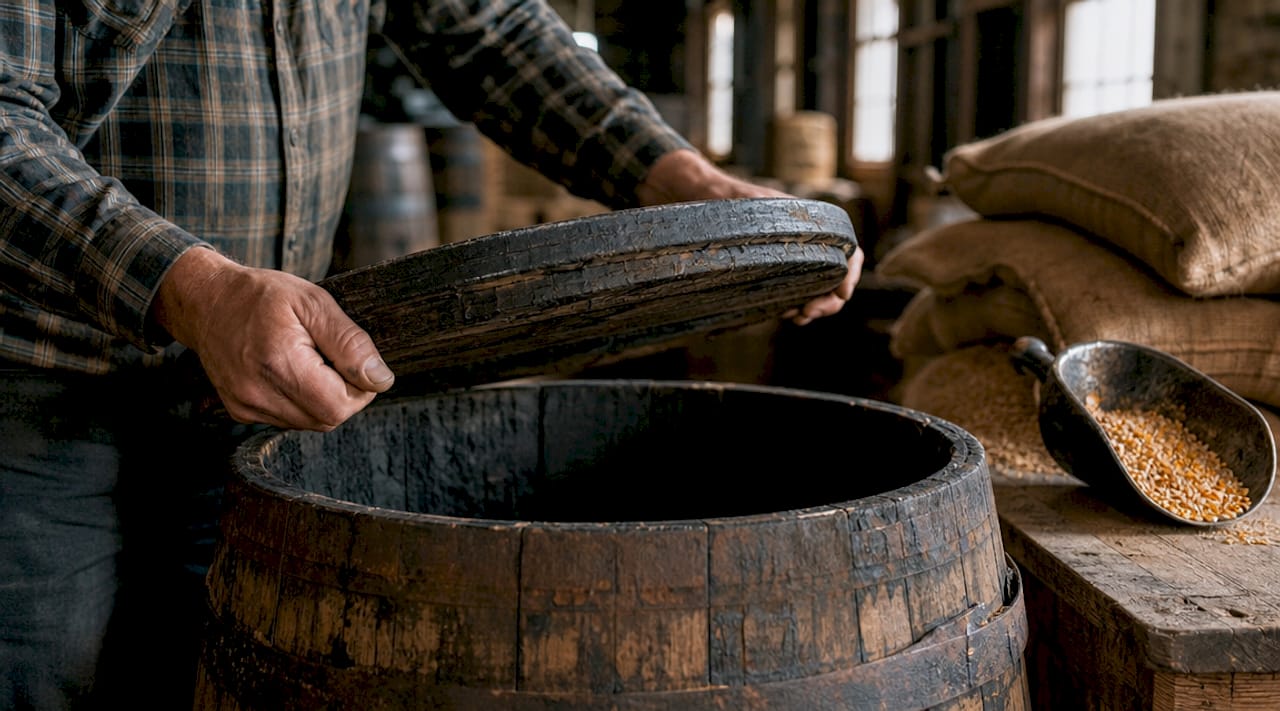
Bourbon production follows a single-mash approach. The corn-dominant grain bill, typically 65 to 75% corn alongside malted barley and either rye or wheat, is mashed, fermented, and distilled together. The resulting new make spirit goes into a brand new charred oak barrel, where it picks up colour, sweetness, and structure. Every drop of bourbon that enters a barrel has never held whisky before. That first-fill extraction is intense and consistent, which is why bourbon develops its signature vanilla and caramel character even in relatively young expressions.
Canadian whisky production is architecturally different. Most Canadian distillers produce two separate streams: a high-volume base whisky, typically distilled from corn at high proof for a clean, neutral character, and a lower-volume flavouring whisky, often rye-heavy and distilled at lower proof to preserve spice and complexity. These streams are aged separately and then blended after maturation to achieve a target flavour profile. Canadian whisky is also distilled up to 180 proof, higher than bourbon’s 160 proof ceiling, which produces a lighter, less congener-rich base spirit.
Barrel choice reinforces this difference. Canadian whisky is matured predominantly in used cooperage, often ex-bourbon barrels, which deliver a softer, more restrained oak influence. Bourbon’s mandatory new charred oak barrels extract far more wood character in the same period of time.
Pro Tip: If you want to understand how barrel type shapes flavour, compare a four-year-old bourbon against a four-year-old Canadian whisky side by side. The bourbon will show noticeably more oak, vanilla, and colour from its new barrel, while the Canadian will taste lighter and more grain-forward.
What are the flavour differences between bourbon and Canadian whisky?
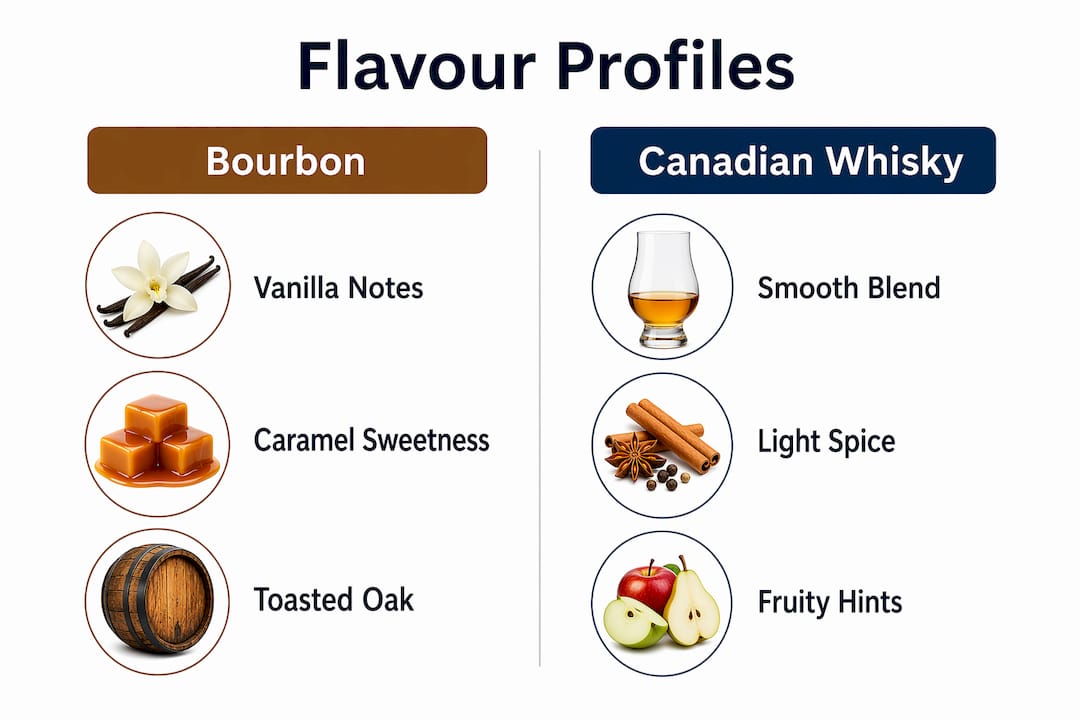
Production rules translate directly into what you taste. Bourbon’s new charred oak ageing delivers bold sweet notes like vanilla, caramel, and toasted wood. The corn-heavy mash bill adds a natural sweetness to the base spirit, and the synergy between corn content and new oak means even a relatively young bourbon at four or five years carries a full, rounded character. Bourbon is generally richer, heavier on the palate, and more assertively flavoured than its Canadian counterpart.
Canadian whisky presents a broader flavour range because blending is central to the style. The base whisky contributes smoothness and body. The flavouring whisky, often rye-dominant, adds spice, pepper, and complexity. The master blender controls the ratio, which is why Canadian whiskies can range from soft and approachable to genuinely spicy and layered. The additive flexibility in Canadian whisky, including sherry and wine additions, is a sophisticated blending tool rather than a quality shortcut. It allows producers to add dried fruit notes, sweetness, or depth that would be impossible to achieve through distillation and barrel ageing alone.
| Feature | Bourbon | Canadian whisky |
|---|---|---|
| Primary flavour notes | Vanilla, caramel, toasted oak, corn sweetness | Lighter grain, rye spice, soft fruit, subtle oak |
| Body | Full, rich, assertive | Light to medium, smooth |
| Oak influence | Strong (new charred barrels) | Restrained (used barrels) |
| Sweetness source | Corn mash and new oak extraction | Blending and optional additives |
| Complexity driver | Grain bill and barrel char level | Blending ratio and flavouring whisky |
For cocktail use, bourbon’s boldness holds up in spirit-forward drinks like an Old Fashioned or a Manhattan, where the whisky needs to cut through sugar and bitters. Canadian whisky’s lighter profile makes it more versatile in long drinks and highballs, where a subtler spirit lets other ingredients breathe. Neither is superior. They are built for different moments.
How do you choose between bourbon and Canadian whisky?
Choosing between the two styles depends on what you want from a glass of whisky.
-
Start with flavour preference. If you enjoy rich, sweet, oak-driven spirits, bourbon is the natural choice. Producers like Buffalo Trace, Maker’s Mark, and Wild Turkey each express the corn-and-new-oak formula differently, giving you a clear range to explore. If you prefer lighter, smoother spirits that are easy to sip or mix, Canadian whisky is a better starting point.
-
Consider your cocktail habits. Bourbon is the backbone of classic American cocktails. Canadian whisky works particularly well in highballs, whisky sours, and blended drinks where you want whisky flavour without it dominating the glass.
-
Think about exploration versus consistency. Bourbon’s tight regulations mean the style is relatively predictable. You know what you are getting within a broad range. Canadian whisky’s blending freedom means the category is far more variable. That variability is a feature if you enjoy discovering different expressions.
-
Factor in Australian availability. Both styles are well-represented in the Australian market. You can buy whisky online in Australia from specialist retailers who stock a curated range of North American expressions, often with detailed tasting notes to guide your selection.
Pro Tip: If you are new to North American whisky, try a Canadian whisky first. Its lighter body and smoother finish make it a more forgiving introduction. Once you have a baseline, move to a mid-range bourbon to understand how new charred oak and corn sweetness change the experience entirely.
For those interested in how bourbon-style maturation influences other spirits, the Buffalo Trace range in Australia is a useful reference point. It demonstrates how different mash bills and barrel programmes produce distinct expressions within the same regulatory framework.
Key takeaways
Bourbon and Canadian whisky differ fundamentally in grain rules, barrel requirements, and additive permissions, and those differences produce two distinct flavour profiles that suit different drinkers and occasions.
| Point | Details |
|---|---|
| Bourbon’s defining rules | Minimum 51% corn, new charred oak barrels only, no additives except water. |
| Canadian whisky’s flexibility | Aged minimum 3 years, used barrels permitted, additives up to 9.09% allowed. |
| Flavour contrast | Bourbon is richer and oak-forward; Canadian whisky is lighter, smoother, and more variable. |
| Production architecture | Bourbon uses a single mash; Canadian whisky blends separately aged base and flavouring whiskies. |
| Practical choice | Choose bourbon for bold sipping and classic cocktails; choose Canadian whisky for lighter mixing and easier entry. |
Why the rules versus freedom divide matters more than most people realise
I have tasted a lot of North American whisky over the years, and the framing I keep coming back to is this: bourbon is a category defined by constraint, and Canadian whisky is a category defined by craft. That sounds like a compliment to Canada and a criticism of bourbon, but it is neither.
Bourbon’s regulatory rigidity is actually its greatest commercial asset. When you pick up a bottle labelled straight bourbon, you know exactly what went into it and what did not. That trust is built into the legal definition. The consistency is not accidental. It is the product of rules that have been refined over decades, and it is why bourbon has become one of the most recognisable spirit categories in the world.
Canadian whisky, on the other hand, is genuinely misunderstood. The additive allowance gets dismissed as a quality compromise by people who have not looked closely at how master blenders actually use it. Adding a small percentage of aged sherry or wine to a blended whisky is no different in principle from a winemaker blending varietals. It is a precision tool, not a shortcut.
What I would tell any enthusiast starting their North American whisky exploration is this: do not rank the two styles. Understand them on their own terms. Bourbon rewards patience and attention to barrel character. Canadian whisky rewards curiosity about blending and grain variety. The difference between whiskey and bourbon is a good place to ground your knowledge before you go deeper into either category.
The most interesting bottles I have encountered sit at the edges of each style. A high-rye bourbon that pushes the spice notes toward Canadian territory. A Canadian whisky aged long enough in quality cooperage to develop genuine depth. Those bottles remind you that the categories are defined by rules, but the best expressions always push against the boundaries of what those rules allow.
— Brendan
Explore bourbon and Canadian whisky at Uisuki
If this comparison has you ready to taste the difference for yourself, Uisuki stocks a curated selection of North American whiskies alongside expressions from Scotland, Japan, and Australia. For something that demonstrates bourbon-style maturation in a local context, the Hobart Whisky Bourbon Matured Rum Finished Single Malt shows exactly what new charred oak extraction does to a spirit, with an Australian single malt base and a rum finish for added complexity.

Uisuki ships across Australia with free shipping thresholds and multiple payment options. Whether you are building a home collection or buying your first serious bottle, the team can help you find the right expression for your palate. Check the whisky delivery guide for full details on shipping options and timelines to your state.
FAQ
What makes bourbon different from Canadian whisky?
Bourbon must be produced in the USA with at least 51% corn, aged in new charred oak barrels, and contains no additives except water. Canadian whisky is aged in Canada for a minimum of three years, permits used barrels, and allows additives up to 9.09% of final volume.
Is Canadian whisky smoother than bourbon?
Generally yes. Canadian whisky is typically lighter and smoother because it is often distilled to a higher proof, matured in used barrels with softer oak influence, and blended from separately aged base and flavouring whiskies. Bourbon’s new charred oak ageing produces a bolder, richer spirit.
Can Canadian whisky contain additives that bourbon cannot?
Canadian whisky regulations permit additives including caramel, sherry, wine, and other spirits up to 9.09% of final volume. Bourbon regulations prohibit all additives except water. This is one of the most significant regulatory differences between the two styles.
Which is better for cocktails: bourbon or Canadian whisky?
Bourbon suits spirit-forward cocktails like an Old Fashioned or Manhattan, where its bold oak and corn sweetness hold up against other ingredients. Canadian whisky works better in lighter mixed drinks and highballs, where its smoother profile complements rather than dominates the other flavours.
Does bourbon have to be made in Kentucky?
No. Bourbon must be produced in the United States but is not legally required to come from Kentucky. However, the vast majority of bourbon production does occur in Kentucky, and the state is closely associated with the style’s heritage and character.