

TL;DR:
- Bourbon, rye, and Scotch each have unique flavors shaped by their grains and regional production laws. Bourbon is sweet with vanilla and caramel, while rye offers spiciness and Scotch displays regional variety from smoky to fruity. Choosing the right whisky depends on taste preference, occasion, and whether one values sweetness, spice, or complexity.
Bourbon, rye, and Scotch are three distinct styles of whisky, each defined by specific grains, production laws, and regional origins that produce fundamentally different flavours. The comparison of bourbon vs rye vs scotch is not simply a matter of taste preference. It is a question of grain, geography, and regulation. Bourbon must be at least 51% corn, aged in new charred oak barrels, and produced in the United States under standards set by 27 CFR §5.143. Rye requires at least 51% rye grain and follows similar American barrel rules. Scotch must be produced in Scotland, aged a minimum of three years in oak casks under the Scotch Whisky Regulations 2009, and is governed by the Scotch Whisky Association. Even the spelling signals origin: American producers use “whiskey,” while Scottish producers use “whisky.”
What are the key flavour differences between bourbon, rye, and Scotch?
Bourbon delivers a sweeter, rounder flavour than either rye or Scotch. The high corn content amplifies sugars drawn from new charred oak, producing classic bourbon tasting notes of vanilla, caramel, and baked stone fruit. Good bourbon typically leaves a lingering finish of 20–40 seconds, which reflects how deeply the wood interacts with the spirit during ageing.

Rye whiskey characteristics sit at the opposite end of the sweetness scale. Rye grain produces a drier, spicier spirit with notes of black pepper, cinnamon, dried herbs, and sometimes a faint mintiness. The spice and dry character of rye can be more polarising for new drinkers accustomed to sweeter spirits, but that same boldness is exactly what makes it so effective in cocktails.
Scotch covers the widest flavour range of the three. Regional terroir significantly influences Scotch whisky profiles: Islay expressions carry heavy peat smoke and brine, Speyside whiskies lean toward honey, apple, and dried fruit, and Highland bottlings often show floral and grassy notes. The difference between rye and Scotch is particularly stark. Where rye is bold and linear in its spice, Scotch can be delicate, complex, and wildly varied depending on the distillery and cask.
| Style | Primary flavours | Sweetness | Spice level | Finish |
|---|---|---|---|---|
| Bourbon | Vanilla, caramel, corn, oak | High | Low to medium | Long, warm |
| Rye | Pepper, cinnamon, herbs, grain | Low | High | Dry, crisp |
| Scotch | Fruit, floral, smoke, peat | Medium | Low to medium | Variable |
Pro Tip: If you are new to whisky, start with bourbon for its approachable sweetness, then move to rye once your palate is ready for more complexity.
How do production methods shape the final spirit?
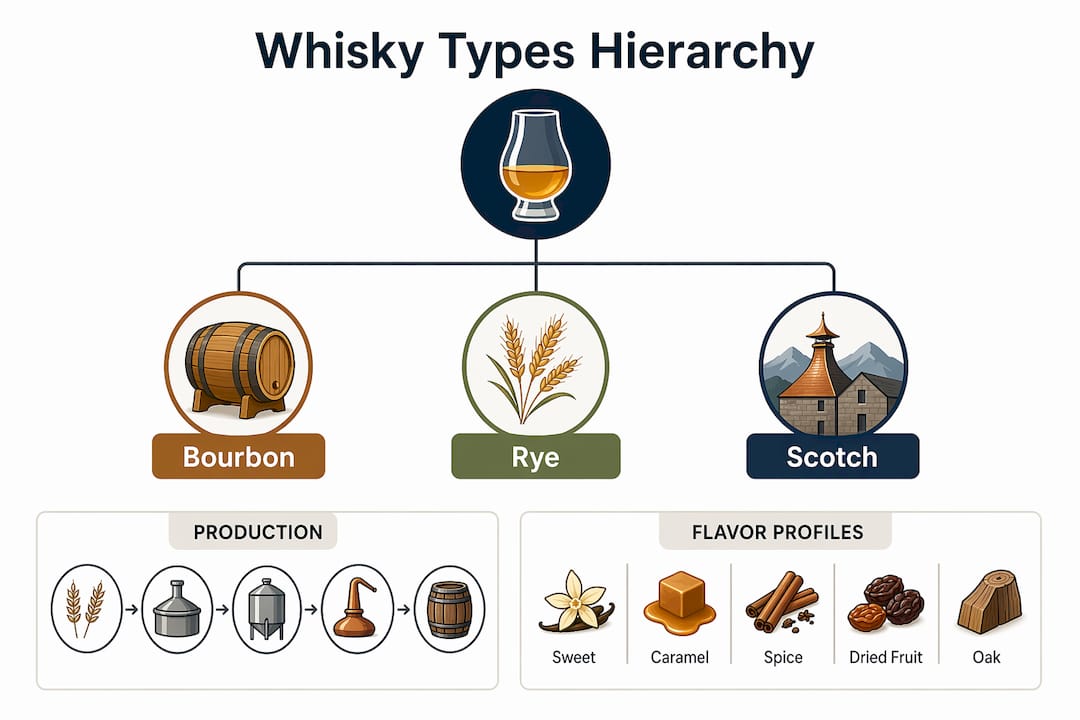
The grain bill is the single biggest driver of flavour in any whisky. Bourbon and rye both follow American federal law, but the grain interaction with wood is what separates them in the glass. Bourbon’s corn and new charred oak work together to amplify sweetness, while rye’s spice actually balances the wood’s natural sugars, producing a more structured mouthfeel.
Key production distinctions across the three styles:
- Bourbon: Minimum 51% corn mash bill, distilled to no more than 160 proof, aged in new charred American oak, bottled at minimum 80 proof. “Straight” bourbon requires at least two years of ageing.
- Rye: Minimum 51% rye grain, same distillation and barrel rules as bourbon. “Straight” rye also requires two years minimum. Mashbill variations between wheated and high-rye bourbons show how grain ratios shift sweetness and spice balance even within a single category.
- Scotch: Made in Scotland, aged minimum three years in oak casks not exceeding 700 litres, with caramel colouring as the only permitted additive. Cask variety is far broader than in American whisky, including ex-sherry, ex-port, and ex-bourbon barrels.
The cask question is where Scotch diverges most sharply from its American counterparts. American law mandates new charred oak for bourbon and rye, which means every barrel is used only once for those spirits. Scottish distillers reuse casks, often sourced from bourbon or sherry producers, which layers additional flavour complexity onto the base spirit. Peat, used to dry malted barley at certain Scottish distilleries, adds a smoky, medicinal quality that has no equivalent in bourbon or rye production.
How are bourbon, rye, and Scotch best enjoyed?
Serving style follows flavour profile directly. Bourbon’s sweetness makes it the most versatile of the three for both neat sipping and mixed drinks.
- Neat or on the rocks: Bourbon rewards slow sipping at room temperature. A few drops of water can open up the vanilla and caramel notes without diluting the finish.
- Old Fashioned: Bourbon suits sweeter cocktails like the Old Fashioned and Whiskey Sour, where its natural sweetness complements sugar and citrus without fighting them.
- Manhattan with rye: The Manhattan traditionally uses rye because its spice cuts through the sweetness of vermouth, creating a drier, more complex drink. Bourbon in a Manhattan produces a softer, sweeter result.
- Sazerac and Vieux Carré: Both are rye cocktails by design. The Sazerac, originating in New Orleans, relies on rye’s pepper notes to balance absinthe and bitters.
- Scotch highball: Scotch works beautifully with soda water, which lifts the spirit’s aromatics without masking them. A peated Islay malt with soda is one of the most refreshing long drinks in whisky.
Pro Tip: When gifting whisky, match the style to the recipient’s usual drink. Bourbon suits wine and cocktail drinkers; rye suits gin or bitter aperitif fans; Scotch suits those who already appreciate complexity and aged spirits.
The scotch vs bourbon flavour contrast also shows up in food pairing. Bourbon pairs naturally with barbecue, dark chocolate, and pecan desserts. Rye suits cured meats, aged cheeses, and rye bread. Peated Scotch pairs with smoked salmon, oysters, and strong blue cheese.
What should you consider when choosing between the three?
Choosing between bourbon, rye, and Scotch comes down to four practical factors: flavour preference, occasion, budget, and whether you are buying for yourself or as a gift.
- Flavour preference: If you prefer sweet and approachable, bourbon is the clear starting point. If you want something drier and more challenging, rye delivers. If you want variety and regional character, Scotch offers the broadest range of any whisky category.
- Value for money: Rye whiskeys priced $40–$60 can rival the complexity and depth of $80–$100 bourbons. Rye often offers better value for complexity, which makes it a strong choice for enthusiasts who want to explore without spending heavily.
- Gifting: Bourbon is the safest gift for someone unfamiliar with whisky. A well-chosen Scotch single malt signals thoughtfulness and knowledge. Rye is the right gift for someone who already knows their way around a whisky glass and wants something less expected.
- Building a collection: A well-rounded whisky collection includes at least one example from each style. Start with a wheated bourbon for sweetness, a high-rye expression for spice, and a Speyside Scotch for fruity complexity. Add an Islay malt when you are ready for smoke.
For deeper guidance on choosing between styles, tasting notes and curated recommendations make the selection process far less guesswork-heavy. Uisuki.com.au provides detailed product descriptions, ABV information, and flavour profiles across its full range of American and Scottish whiskies.
Key takeaways
Bourbon, rye, and Scotch each deliver a distinct flavour experience defined by their grain, production law, and regional origin, making the right choice entirely dependent on your palate and occasion.
| Point | Details |
|---|---|
| Grain drives flavour | Corn makes bourbon sweet; rye grain makes rye spicy; malted barley gives Scotch its range. |
| Barrel rules matter | Bourbon and rye require new charred oak; Scotch uses varied casks for added complexity. |
| Rye offers strong value | Rye whiskeys at $40–$60 often match the complexity of bourbons priced $80–$100. |
| Cocktail pairing is not interchangeable | Rye suits dry, spiced cocktails; bourbon suits sweeter drinks; Scotch works in highballs and sours. |
| Scotch has the widest range | Regional variation from Islay to Speyside means no two Scotch whiskies taste the same. |
Brendan’s take on picking your style
The biggest mistake I see whisky enthusiasts make is treating these three categories as a ladder, as if you graduate from bourbon to rye to Scotch as your palate matures. That framing is wrong. They are not a progression. They are three separate conversations about what grain, wood, and place can do to a spirit.
Bourbon is not simpler than Scotch. A well-aged wheated bourbon from a small Kentucky distillery can be as nuanced as a 15-year Speyside single malt. The difference is that bourbon’s sweetness makes it immediately legible to almost any drinker, which is both its strength and the reason serious enthusiasts sometimes underestimate it.
Rye is where I send people who tell me they are bored with bourbon. The spice is not just heat. It is structure. A good rye in a Manhattan is one of the most precisely balanced cocktails in existence, and once you taste it made correctly, the bourbon version feels like a compromise.
My honest recommendation for anyone building their first collection: buy one of each style before you decide you have a favourite. Taste them neat, then in a simple cocktail, then with food. You will learn more about your own palate in three bottles than in three years of reading about whisky.
— Brendan
Whisky worth exploring at Uisuki
Uisuki.com.au stocks a curated range of bourbon, rye, and Scotch whiskies sourced from across the United States and Scotland, with detailed tasting notes and ABV information on every listing.

Whether you are buying your first bottle or adding to an existing collection, the full whisky range at Uisuki covers everything from approachable entry-level bourbons to rare Islay single malts. The site also offers personalised sourcing requests for hard-to-find bottles, free shipping above the threshold, and expert guidance to help you match the right whisky to your taste or occasion. Browse the scotch vs bourbon guide for a deeper look at how these styles compare across specific expressions.
FAQ
What is the main difference between bourbon and rye?
Bourbon must contain at least 51% corn and delivers a sweeter flavour profile with vanilla and caramel notes. Rye must contain at least 51% rye grain and produces a drier, spicier spirit with pepper and herbal characteristics.
Is Scotch whisky the same as bourbon?
Scotch and bourbon are entirely different spirits. Scotch is made in Scotland from malted barley and aged a minimum of three years, while bourbon is an American spirit made primarily from corn and aged in new charred oak barrels.
Which whisky is best for beginners?
Bourbon is the most approachable starting point for new whisky drinkers due to its natural sweetness and smooth finish. Its vanilla and caramel notes are familiar and easy to enjoy without prior whisky experience.
Why does rye whiskey taste spicier than bourbon?
Rye grain contains compounds that produce pepper, cinnamon, and herbal flavours during fermentation and distillation. Because rye must make up at least 51% of the mash bill, those spice characteristics dominate the final spirit.
Can you use bourbon and rye interchangeably in cocktails?
You can substitute one for the other, but the result changes noticeably. Rye produces a drier, more structured cocktail, while bourbon creates a sweeter, softer version. The Manhattan is the clearest example: rye is the traditional choice because its spice balances the vermouth.