

Australian whisky fans often face a clear fork in the road when choosing a new bottle. The choice between malt and grain whisky shapes the flavours, aromas, and textures that end up in your glass. Whether you’re refining your collection or aiming to sharpen your tasting skills, grasping the ingredients and distinct production methods behind these categories unlocks a deeper appreciation for every sip. This guide helps you confidently navigate the malt versus grain divide and discover which style best complements your palate.
Table of Contents
- Malt Vs Grain Whisky: Defining The Distinction
- Ingredients And Production Methods Compared
- The Malting Process That Starts Everything
- Distillation Methods: Where The Flavour Splits
- How Flavour And Texture Differ In The Glass
- Choosing The Right Whisky For Your Collection
- Building A Balanced Collection
- Key Factors That Determine Selection
Key Takeaways
| Point | Details |
|---|---|
| Difference in Ingredients | Malt whisky is made from 100% malted barley, while grain whisky uses various grains, affecting flavour profiles. |
| Production Methods Impact Flavour | Copper pot stills for malt whisky create richness, whereas continuous column stills for grain whisky yield a lighter spirit. |
| Building a Collection | Consider your taste preferences and diversify origins, ages, and styles when curating your whisky collection. |
| Tasting Experience | Taste malt and grain whiskies side by side to appreciate their distinct textures and flavour complexities. |
Malt Vs Grain Whisky: Defining The Distinction
The core difference between malt and grain whisky comes down to ingredients and production methods. Malt whisky is produced exclusively from malted barley, whilst grain whisky uses other cereals like maize, wheat, or rye, often with some malted barley added for enzyme activity.
This fundamental split shapes everything you’ll taste in your glass. The distinction matters whether you’re a collector building a diverse cellar or a newcomer trying to understand what you’re actually drinking.
Here’s what separates them:
- Malt whisky: Made solely from malted barley, distilled in copper pot stills, rich and complex flavours
- Grain whisky: Made from various grains, distilled in continuous column stills, lighter and smoother characteristics
- Blended whiskies: Combine both malt and grain to balance intensity with smoothness
Production Methods That Shape Flavour
Malt whisky distillation in pot stills retains more flavour compounds because these copper vessels interact with the liquid during heating. Pot stills create that characteristic richness Australian whisky enthusiasts pursue in bottles like Australian single malts.
Grain whisky production uses continuous column stills, which operate differently. These tall, efficient stills produce spirit much faster and at higher alcohol content, but with a lighter profile. The continuous process strips away some of those bold flavour compounds.
This is why grain whisky typically serves as a supporting player in blends rather than standing alone. It softens the stronger characteristics of malt, creating balance.
Why The Difference Matters For Your Collection
If you prefer bold, fruity, or smoky notes, malt whisky delivers complexity you’ll explore across multiple tastings. Single malts from Scotland, Japan, and Australia showcase distinct regional characteristics because the barley malting process captures subtle variations.
If you favour smooth, approachable whiskies, grain-based spirits offer elegance without intensity. Many Australian drinkers appreciate blended whiskies for their refinement.
The production method difference is permanent. Grain whisky types create distinct flavour profiles that cannot be replicated through other means, which is why grain specialists command respect among collectors.
Understanding the malt-versus-grain distinction transforms how you evaluate whisky. Your taste preferences will naturally guide you toward one category or a blend of both.
Pro tip: When tasting, try a malt and a grain whisky back-to-back to experience the textural difference yourself—malt typically feels richer on your palate, whilst grain feels cleaner and more refined.
Ingredients And Production Methods Compared
The ingredients you start with determine the entire whisky-making journey. Malt whisky begins exclusively with malted barley, whilst grain whisky blends multiple cereals—typically maize, wheat, rye, and some malted barley.
These ingredient choices create vastly different spirits before distillation even begins. Understanding what goes into the mash is crucial for collectors evaluating what they’re purchasing.
Here’s the ingredient breakdown:
To better understand core distinctions, here is a summary table comparing malt, grain, and blended whisky across multiple aspects:
| Attribute | Malt Whisky | Grain Whisky | Blended Whisky |
|---|---|---|---|
| Primary Grain Used | 100% malted barley | Maize, wheat, rye, malted barley mix | Both malted barley and other cereals |
| Distillation Method | Copper pot stills (batch) | Continuous column stills | Both pot and column distillation methods |
| Texture/Mouthfeel | Rich, viscous, lingering | Light, clean, fast finish | Balanced between richness and smoothness |
| Typical Flavour Profile | Fruity, smoky, complex layers | Subtle, elegant, lighter flavours | Harmonised, accessible, wide flavour spectrum |
| Role in Blending | Provides depth and intensity | Offers smoothness and dilution | Combines features of both for balance |
- Malt whisky grains: Malted barley only (100%)
- Grain whisky grains: Maize, wheat, rye, and malted barley (varying percentages)
- Blended whisky grains: Combination of malted barley and other cereals
The Malting Process That Starts Everything
Malting converts barley through soaking, germination, and kilning, creating enzymes that unlock fermentable sugars later. This biological transformation is what makes malted barley special—the grain itself changes at a molecular level.
During germination, barley grains develop enzymes that break down starches. Kilning (drying) then stops this process at the perfect moment, preserving those critical enzymes for mashing later.
Barley variety and quality matter tremendously. Germination rate, protein content, and moisture levels all influence final malt quality. Scottish distillers spend years perfecting their barley selections for consistent results.
Grain whisky production skips or simplifies this step. Most grain whisky uses unmalted grains or minimal malted barley, relying instead on exogenous enzymes added during mashing.
Distillation Methods: Where The Flavour Splits
Once you have your mash, distillation method becomes crucial. Malt whisky uses copper pot stills, which are batch stills requiring manual heating and cooling between runs.
Grain whisky typically uses continuous column stills, tall industrial towers that operate continuously without stopping. These stills produce spirit at higher proof but with less flavour contact with copper.
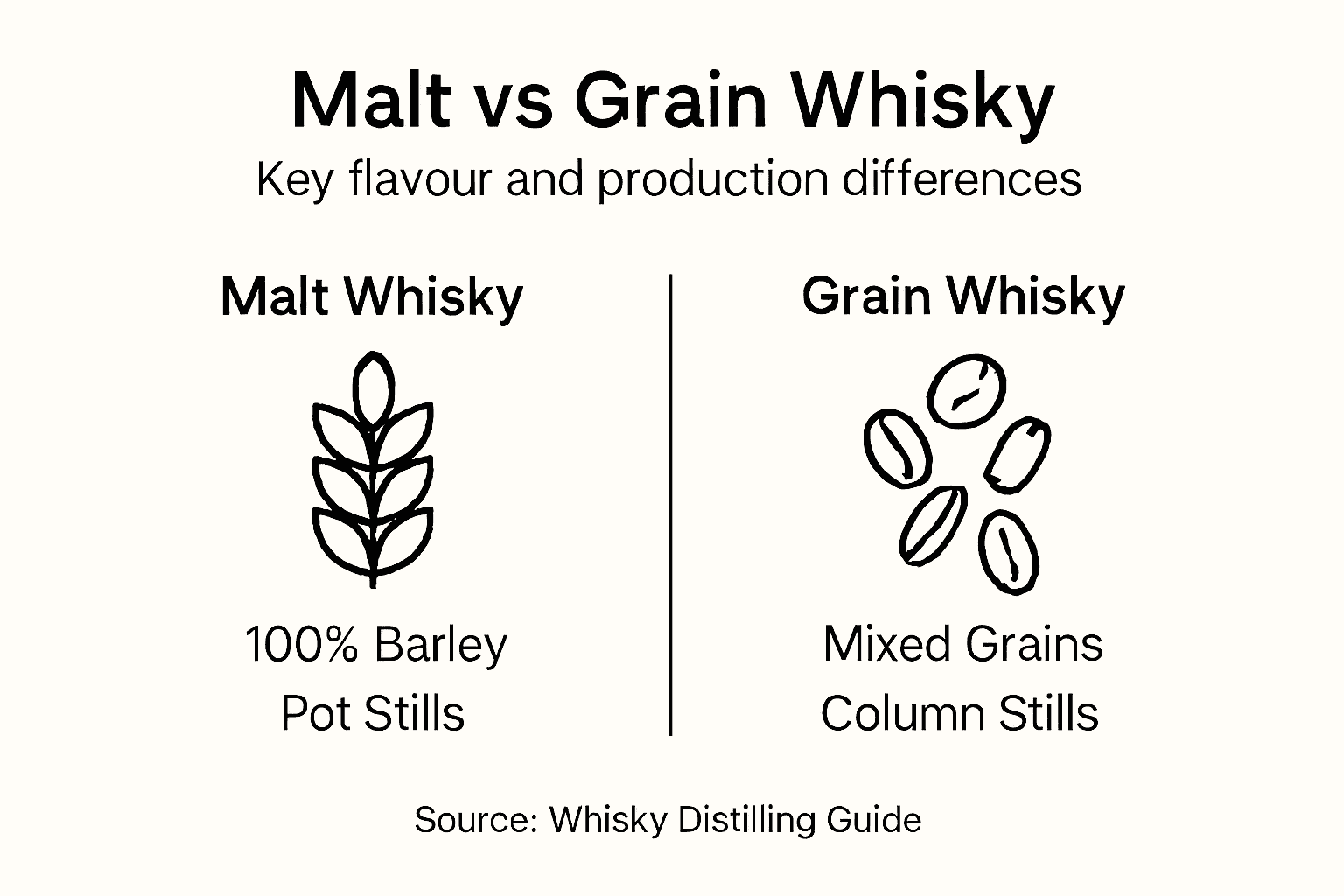
Pot stills retain more congeners (flavour compounds), creating richness. Column stills strip away these compounds efficiently, producing cleaner spirits ideal for blending.
After distillation, both types age in wooden barrels. Yet the spirit’s foundation—determined by ingredients and distillation—remains unchanged throughout ageing.
The production method you choose is permanent. Malt whisky’s richness and grain whisky’s smoothness cannot be reversed or swapped, no matter how long they age.
Pro tip: When comparing whiskies, check the production method on the label or ask your retailer—this single detail tells you more about expected flavour than age alone.
How Flavour And Texture Differ In The Glass
Taste a malt whisky, then taste a grain whisky side by side. The difference hits immediately. Malt whisky coats your palate with richness and complexity, whilst grain whisky delivers a cleaner, lighter experience that slides across your tongue smoothly.
These differences stem directly from ingredients and production methods. The sensory experience you get is no accident—it’s chemistry and physics working together in your mouth.
Here’s what you’ll notice:
- Malt whisky: Fuller mouthfeel, complex aromas, pronounced sweetness, lingering finish
- Grain whisky: Lighter body, subtle flavours, crisp palate, cleaner aftertaste
- Blended whisky: Balanced texture combining both characteristics
Flavour Complexity: Where Malt Excels
Malt whisky develops complex aromas through malting and chemical reactions, creating layered tasting experiences. Malted barley’s high enzyme content produces more flavour compounds during fermentation, giving you fruity, spicy, smoky, or honeyed notes depending on the distillery.
Grain whisky, distilled to higher purity in continuous stills, strips away many of these compounds. The result is cleaner but less complex—you won’t find the same depth of fruit or spice.
When you sip a Scottish malt, you’re tasting years of barley selection and malting technique. Australian single malts from distilleries like Starward showcase this complexity beautifully, revealing different flavours across multiple tastings.
Texture And Mouthfeel: The Physical Difference
Mouthfeel is everything when comparing these whiskies. Malt whisky feels heavier on your tongue, coating your mouth with viscosity and richness. This fuller texture comes from higher protein and enzyme content in malted barley, which creates more glycerols and other compounds that add body.
Grain whisky feels lighter and cleaner. Your mouth doesn’t feel coated the same way. The spirit moves across your palate quickly, leaving minimal residue.
This textural difference explains why distillers blend malt and grain together. Malt provides richness; grain provides balance and smoothness. Neither is better—they serve different purposes.
Flavour complexity and texture work together. You cannot separate them. A rich mouthfeel carries flavours longer, whilst a light texture delivers flavours quickly and cleanly.
Pro tip: Pour both whiskies into glasses and let them sit for five minutes—warmer spirit releases more aromatic compounds, making the flavour and texture differences even more pronounced when you taste.
Choosing The Right Whisky For Your Collection
Building a whisky collection is personal. Your choices reflect your tastes, budget, and goals as a collector. Whether you favour rich malt whiskies or smooth grain blends, understanding how to select bottles strategically transforms casual drinking into deliberate curation.
Australian collectors have unique advantages. Access to Scottish, Japanese, American, and local whiskies means your collection can tell a global story. The question is: where do you start?
Consider these selection criteria:
The following table outlines key factors to consider when building a comprehensive whisky collection:
| Factor | Impact on Collection | Example Action |
|---|---|---|
| Flavour Preference | Guides bottle selection strategy | Choose complex malts if preferred |
| Origin Diversity | Adds global character to your range | Include Australian, Scotch, Japanese |
| Age and Maturation | Influences flavour and value | Pair young with older expressions |
| Limited Editions | Enhances uniqueness and investment | Seek rare or special releases |
| Budget Allocation | Shapes collection size and mix | Set spend limits per acquisition |
- Flavour preference: Do you lean towards complex malts or smooth grain whiskies?
- Origin diversity: Include Scottish, Japanese, American, and Australian expressions
- Age and maturation: Balance younger expressions with aged statements
- Limited editions: Seek unique bottlings that appreciate over time
- Budget allocation: Decide how much to invest per bottle
Building A Balanced Collection
Start by understanding your palate. Taste both malt and grain whiskies side by side to discover what resonates with you. Some collectors gravitate exclusively towards single malts for their complexity, whilst others appreciate how blended whiskies balance richness with smoothness.
A balanced collection includes variety. Don’t buy the same style repeatedly—this limits your tasting experiences and growth as a collector. Mix in different origins, age statements, and cask types.
Award-winning whiskies provide reliable quality benchmarks when evaluating potential purchases. Competition results show how spirits rank against peers, offering objective guidance for your selections.
Key Factors That Determine Selection
Understanding whisky type, origin, and maturation significantly influences character and value helps you make informed decisions. Age statements, cask type, and distillation method all matter when evaluating a bottle’s potential for your collection.
Maturation deserves special attention. A 12-year-old malt tastes fundamentally different from the same distillery’s 18-year expression. The extra time in wood transforms the spirit, developing deeper flavours and smoother textures.
Limited editions and unique expressions hold special appeal for collectors. These bottles become harder to source over time, making early purchases strategic investments. Australian distilleries increasingly produce limited releases that deserve collection priority.
Your collection should reflect your journey as a whisky enthusiast. Start with what you love, then expand systematically into territory that challenges and excites you.
Pro tip: Keep detailed tasting notes for every bottle you purchase—record the flavour profile, mouthfeel, and your impressions on purchase date, then revisit these notes annually to track how your palate evolves.
Discover Your Perfect Whisky Match with Uisuki
Understanding the difference between malt and grain whisky is crucial for any enthusiast looking to expand their collection or refine their palate. This insightful article highlights key challenges such as distinguishing complex malt flavours from the lighter, smoother notes of grain whisky. If you are searching for premium whiskies that showcase these unique characteristics, Uisuki offers an expertly curated selection from renowned regions like Scotland, Japan and Australia that caters to your flavour preferences and collecting goals.

Explore our range at Uisuki and immerse yourself in rich single malts or smooth grain whiskies that bring each style to life. Take advantage of detailed product descriptions and expert guidance to make confident choices today. Start your whisky journey now and elevate your collection with rare finds and new arrivals that match the flavour profiles you love. Visit Uisuki Whisky Collection and experience the difference malt and grain whisky can make to your glass.
Frequently Asked Questions
What is the main difference between malt and grain whisky?
Malt whisky is produced exclusively from malted barley, while grain whisky uses a mix of grains such as maize, wheat, or rye, and may include some malted barley.
How do the production methods affect the flavour of whisky?
Malt whisky is distilled in copper pot stills, which enhances flavour complexity, resulting in richer tastes. In contrast, grain whisky is distilled in continuous column stills, producing a lighter, smoother spirit that lacks some of the depth found in malt whisky.
Why is understanding the malt and grain difference important for whisky collectors?
Knowing the differences helps collectors evaluate their preferences, guiding them towards bottles that suit their taste, whether they prefer the bold complexity of malt whiskies or the smoothness of grain whiskies.
What sensory differences can I expect when tasting malt versus grain whisky?
Malt whisky provides a fuller mouthfeel and richer flavours, while grain whisky offers a lighter body with a cleaner, crisper finish. This textural contrast shapes the overall drinking experience.