

Most whisky lovers assume a bottle labelled “single malt” tells the whole story. It doesn’t. The term is used across Scotland, Ireland, Japan, the United States, and Australia, yet the rules governing what qualifies vary significantly from one country to the next. Scotland demands pot stills and a minimum of three years in oak. The US, following finalised standards in 2024, imposes no such requirements. For collectors and enthusiasts who want to make genuinely informed choices, understanding these distinctions is not just interesting — it is essential.
Table of Contents
- What defines a single malt whisky?
- Single malt versus blended malt: what’s the difference?
- World-leading single malt whiskies: award winners and recommendations
- Why collectors value single malts: age, provenance, and investment potential
- Discover premium single malts and blended selections
- Frequently asked questions
Key Takeaways
| Point | Details |
|---|---|
| Single malt basics | Single malts are made from 100% malted barley at a single distillery and aged in oak. |
| Global regulations differ | Production standards for single malts vary by country, with unique requirements in the US, Scotland, and beyond. |
| Collector strategies | Award-winning and age-stated single malts are prime picks for collectors and enthusiasts seeking provenance and investment potential. |
| Blended vs single | Blended malts feature lighter bodies and multiple distilleries; single malts deliver intense, distinct character. |
| Where to find premium malts | Australian collectors can easily access curated selections and exclusive bottles through specialist retailers. |
What defines a single malt whisky?
At its core, a single malt whisky is made from 100% malted barley and produced at a single distillery. Beyond that, the rules diverge sharply depending on where the whisky is made. In Scotland, the Scotch Whisky Regulations require pot still distillation and a minimum of three years maturation in oak casks of no more than 700 litres. Ireland follows a similar framework. Japan has its own standards, introduced in 2021, which align closely with Scotland’s approach.
The United States took a different path. The Alcohol and Tobacco Tax and Trade Bureau (TTB) finalised American single malt rules in 2024, after a proposal first raised in 2016. Under these rules, an American single malt must use 100% malted barley, come from a single US distillery, be distilled to no more than 160 proof, and be bottled at a minimum of 80 proof. Crucially, there is no requirement for pot stills and no minimum ageing period.
Here is a quick comparison of how major whisky nations define “single malt”:
| Country | Grain required | Still type | Minimum age | Cask type |
|---|---|---|---|---|
| Scotland | 100% malted barley | Pot still | 3 years | Oak, max 700L |
| Ireland | 100% malted barley | Pot still | 3 years | Oak |
| Japan | 100% malted barley | Pot still | 3 years | Oak |
| USA | 100% malted barley | Any | None | Oak (any) |
| Australia | 100% malted barley | Pot still | 2 years | Oak |
These differences matter enormously when you are tasting or collecting. A Scottish single malt like the Glendronach 12YO carries the weight of strict regulation and long tradition. An American single malt might be younger, lighter, and distilled on a column still — a genuinely different product under the same label.
Key requirements shared across all major single malt categories:
- 100% malted barley
- Production at a single distillery
- Maturation in oak casks
- Bottled at a minimum strength (varies by country)
Single malt versus blended malt: what’s the difference?
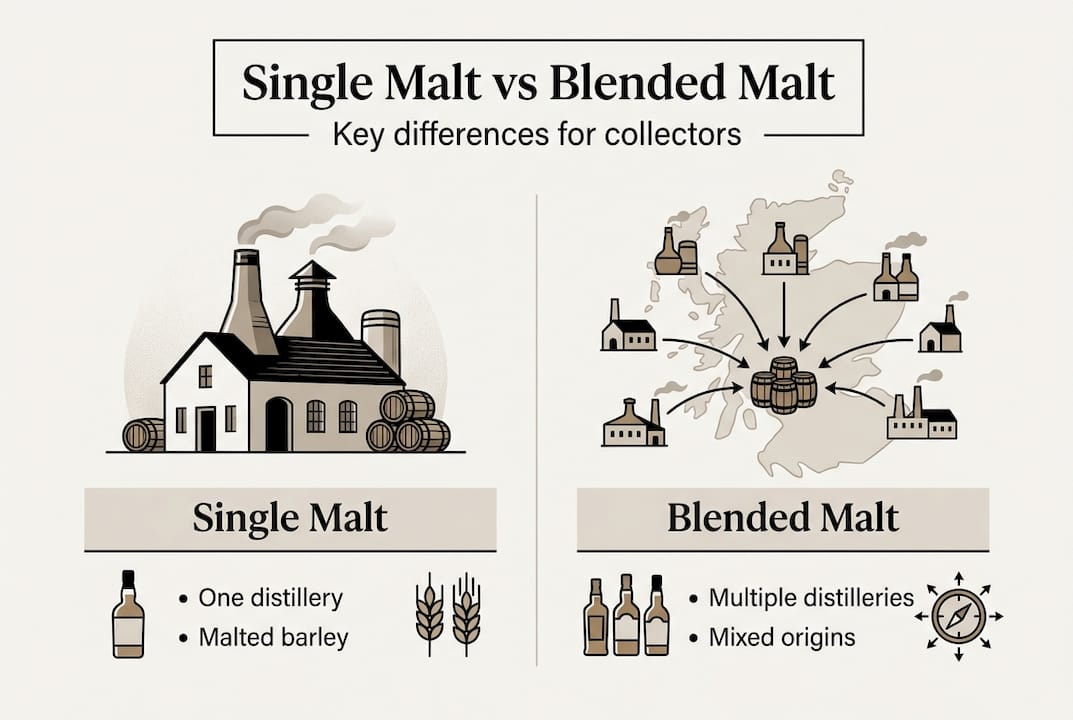
Once you understand what a single malt is, the next question collectors often ask is how it compares to a blended malt. The distinction is straightforward but important. A single malt comes from one distillery only. A blended malt, sometimes called a “vatted malt,” combines malt whiskies from two or more distilleries, with no grain whisky added.
As a general rule, blended malts tend to be lighter-bodied with a shorter finish, while single malts deliver a fuller, more intense flavour profile that reflects the specific character of their home distillery. Neither is inherently superior — they serve different purposes.
Here is a side-by-side comparison:
| Feature | Single malt | Blended malt |
|---|---|---|
| Source | One distillery | Multiple distilleries |
| Grain | 100% malted barley | 100% malted barley |
| Body | Fuller, more intense | Lighter, more approachable |
| Finish | Long, complex | Shorter, smoother |
| Collector appeal | High (distillery character) | Moderate (consistency) |
| Example | Glenfiddich 12YO | Ardnamurchan MacLean’s Nose |
For collectors, single malts hold the edge because they express a unique distillery fingerprint. You can trace every flavour note back to one place, one set of stills, one water source. That specificity is what makes bottles like the Glenfiddich 12YO miniature so useful for building a comparative tasting collection.
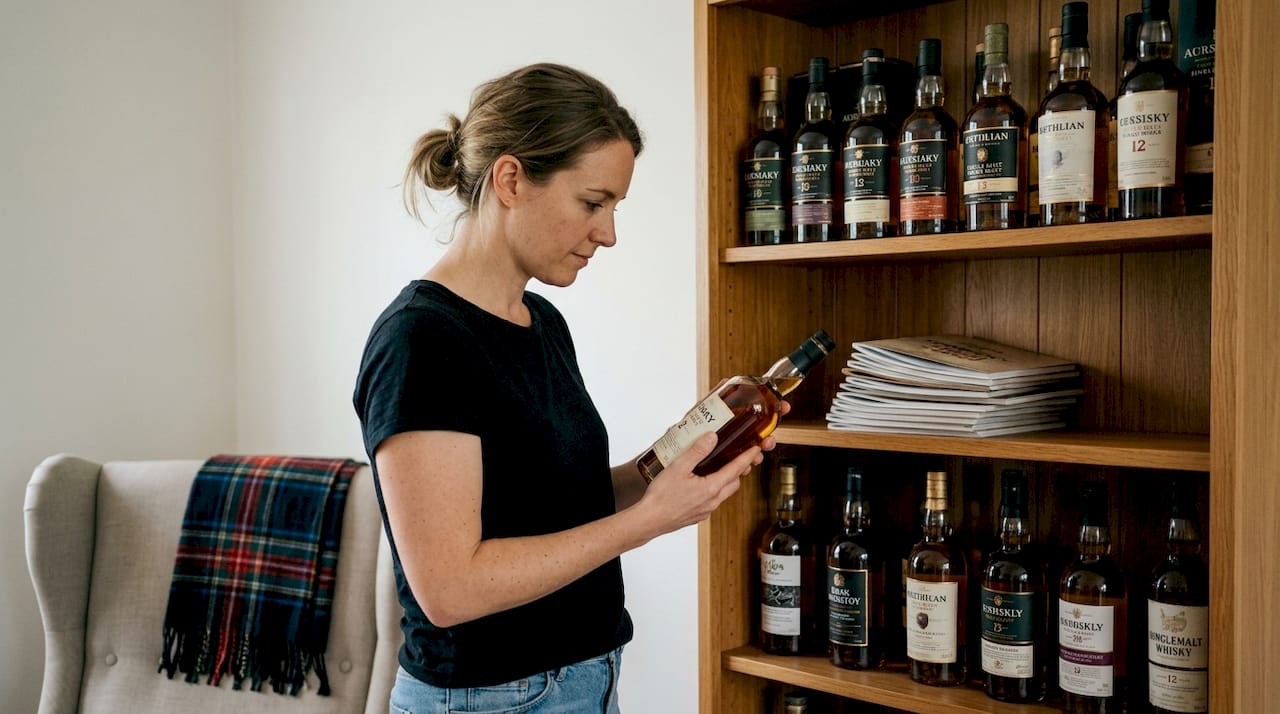
Blended malts are not without merit, though. The Ardnamurchan MacLean’s Nose is a fine example of how skilled blending can create something genuinely complex and enjoyable.
Pro Tip: Taste a single malt and a blended malt from the same region side by side. The contrast in finish length and body will immediately sharpen your palate and help you identify what you personally value in a dram.
“The single malt’s power lies in its specificity. Every bottle is a portrait of one place, one process, one moment in time.”
World-leading single malt whiskies: award winners and recommendations
Knowing the theory is one thing. Knowing which bottles to actually seek out is another. The 2025 World Whiskies Awards named The GlenAllachie Speyside Single Malt 12 Years Old as the world’s best single malt, a remarkable result for a distillery that has quietly become one of Scotland’s most exciting producers under master distiller Billy Walker.
Other category winners from the same awards demonstrate just how global single malt production has become:
- Scotland: GlenAllachie 12YO (world’s best overall)
- USA: Balcones Texas 1
- Ireland: Teeling Single Malt
- India: Amrut Peated Single Malt
What makes a whisky award-worthy? Judges consistently look for flavour complexity, balance between sweetness and structure, a distinctive regional character, and a finish that evolves rather than simply fades. Age statements matter too — they signal a commitment to patience that no-age-statement (NAS) releases cannot always match.
For collectors building a serious shelf, the GlenAllachie 15YO offers an excellent step up from the award-winning 12YO, with additional depth from extended maturation. If you prefer something with more cask strength intensity, the GlenAllachie 10YO Batch 4 at 56.1% ABV is a standout expression.
Pro Tip: When building a collection, prioritise age-stated releases over NAS bottles. Age statements are a legal guarantee of minimum maturation, which gives you a reliable benchmark for comparison and resale value.
Why collectors value single malts: age, provenance, and investment potential
Flavour is only part of the story. For serious collectors, a single malt bottle represents something more: a record of time, place, and craft that cannot be replicated once it is gone. This is why age-stated single malts consistently command higher prices and stronger collector interest than their NAS counterparts.
Several factors drive collector value:
- Age statement: A 10YO, 18YO, or 35YO expression signals rarity and patience. Older stocks are finite.
- Distillery heritage: Closed or mothballed distilleries produce bottles that can never be replicated.
- Limited releases: Small-batch or single-cask bottlings with numbered labels attract premium interest.
- Award recognition: A World Whiskies Award win can significantly lift secondary market prices within months.
- Cask type: Unusual finishes — port, sherry, rum — add complexity and collector intrigue.
The GlenAllachie 35YO is a prime example of how age and provenance combine to create something genuinely rare. At 48% ABV and with decades of maturation behind it, this is the kind of bottle that collectors hold rather than open. Similarly, the Glendronach Allardice 18YO represents the sweet spot between accessibility and long-term value, matured entirely in Oloroso sherry casks.
“Collectors seek both flavour and provenance. The bottle on the shelf is as much a document of whisky history as it is a drink.”
Pro Tip: Track secondary market platforms to monitor price trends on bottles you already own. A consistent upward trend on a specific distillery or age statement is a strong signal to acquire more before prices climb further.
Investment in whisky is not guaranteed, of course. But single malts with strong distillery reputations, clear age statements, and award recognition have historically held their value better than most NAS releases. The key is buying what you genuinely love — that way, if the market shifts, you still have something worth opening.
Discover premium single malts and blended selections
At Uisuki.com.au, we curate bottles that matter — not just what is popular, but what is genuinely worth your time and money as a collector or enthusiast. Whether you are chasing award-winning Speyside expressions or exploring something closer to home, our range covers the full spectrum.

For something distinctly Australian, the Hobart Whisky Bourbon Matured Rum Finished Single Malt at 56.4% ABV is a bold, locally crafted expression worth adding to any serious collection. If you want to explore the blended side of the spectrum, the Ichiro’s Malt and Grain Limited Edition is a world-class Japanese blend that consistently impresses. Browse our full range to find your next great bottle, with expert curation and collector-friendly purchasing options.
Frequently asked questions
Are all single malts made from 100% malted barley?
Yes, 100% malted barley is a universal requirement for single malts across all major producing countries, though distillation methods and ageing rules differ significantly by region.
What is the difference between single malt and blended malt whisky?
A single malt comes from one distillery, while a blended malt combines whiskies from multiple distilleries. Single malts tend to be fuller-bodied with a longer, more complex finish.
What are the top-rated single malt whiskies for collectors in 2026?
The World Whiskies Awards 2025 named GlenAllachie 12YO as the world’s best single malt. Other strong collector picks include Laphroaig 10YO, Macallan, Balcones Texas 1, Teeling, and Amrut Peated.
Do American single malts require pot stills or minimum ageing?
No. Under TTB rules finalised in 2024, American single malts have no pot still requirement and no minimum ageing period, making them distinctly different from their Scottish counterparts.
How does an age statement impact a single malt’s collector value?
Age-stated bottles are generally more sought-after by collectors because they guarantee a minimum maturation period, which signals quality, rarity, and long-term investment potential compared to no-age-statement releases.