

The releases worth chasing right now are The Macallan Harmony Collection finale (two expressions, split between global online and Global Travel Retail), Ardbeg Vintage Y2K 23-year, Ardbeg’s Sicily-inspired limited edition, Bruichladdich Greener Still 15-year, Glenfiddich Royal Edinburgh Military Tattoo 14-year (230 bottles only), Stranahan’s Bottled-in-Bond, Kavalan and BenRiach limited cask releases, and the latest Booker’s and Buffalo Trace allocations. Several of these will reach Australia, but not all, and the ones that do will move fast.
- The Macallan Harmony Collection finale — two expressions, NAS, 44.2% ABV; one global online, one GTR-exclusive; confirmed August 2026; RRP in GBP, expect Australian shelf price to vary depending on importer margin
- Ardbeg Vintage Y2K — 23-year, limited edition; visitor-centre first, UK wider release following; heavily peated with unusual cask finish; allocation-only in Australia
- Ardbeg Sicily limited edition — NAS, Marsala-cask finish; Ardbeg Day-style release; secondary market uplift expected
- Bruichladdich Greener Still — 15-year, specialist retailer and distillery website; non-peated Islay; confirmed 2026
- Glenfiddich Royal Edinburgh Military Tattoo — 14-year, 230 bottles total; distillery and retailer exclusivity window
- Stranahan’s Bottled-in-Bond — Colorado’s oldest BiB whiskey; US domestic focus, limited export
- Booker’s Bourbon — annual small-batch BiB-adjacent release; TTB filings confirm 2026 batches
- Buffalo Trace Antique Collection — annual autumn allocation; Australian allocation via licensed importers
Australian availability is strongest for the Macallan, Ardbeg, Bruichladdich, and Glenfiddich releases. Stranahan’s and Buffalo Trace BTAC bottles are harder to secure locally and often require importer contact or specialist pre-order.
Pro Tip: Register your interest with your preferred Australian specialist retailer before a release is confirmed, not after. Most allocation lists close within 48 hours of an announcement going public.
Key takeaways
The most important move for Australian whisky collectors in 2026 is getting on specialist retailer and importer lists before releases are confirmed, not after.
| Point | Details |
|---|---|
| Macallan Harmony finale | The sixth and final release splits between global online and GTR channels, creating two separate scarcity profiles. |
| Ardbeg Y2K timing | A 23-year visitor-centre-first release; Australian stock will lag the UK launch by weeks to months. |
| AUD pricing rule | Multiply GBP RRP by 2.2–2.5 and USD RRP by 2.0–2.4 to estimate Australian shelf price before committing. |
| BiB as a hold signal | Bottled-in-Bond designations signal foundational quality; collectors treat them as a long-term hold indicator. |
| Uisuki sourcing | Uisuki accepts sourcing requests for releases not yet listed, putting collectors in the queue before stock arrives. |
Primary sources and release calendars
- The Whisky Wire — distillery press releases and confirmed UK launch dates
- OnlyDrams 2026 Bourbon & Whiskey Release Calendar — TTB filings, distillery announcements, retailer reports for US releases
- Breaking Bourbon Release Calendar — confirmed US bourbon release windows and allocation notes, updated regularly
- CaskCompare — UK retailer listings and new release tracking
- Vita Magazine — Ardbeg and Islay distillery release coverage
- Fred Minnick — Macallan and premium Scotch release analysis
- WhiskeyPulse — US whiskey news including BiB and TTB filing coverage
- Chasing The Unicorn — Australian-relevant bourbon release calendar and local allocation notes
- TTB label approval database — primary source for US bourbon release leads, 4–8 weeks ahead of retail announcements
- Australian specialist retailer mailing lists and importer newsletters — the most reliable early signal for local availability windows
Table of Contents
- What upcoming whisky releases are landing in the next 3–6 months?
- Which limited editions are worth prioritising?
- How do you actually secure these bottles in Australia?
- Should you buy, hold, or flip?
- Why tracking releases matters for serious collectors
- Uisuki stocks rare and upcoming releases for Australian collectors
- Sources
What upcoming whisky releases are landing in the next 3–6 months?
The table below reflects confirmed and credibly rumoured releases based on distillery announcements, retailer listings, and TTB filings tracked by calendars including OnlyDrams and Breaking Bourbon. Status labels: C = Confirmed, R = Rumoured, TTB = TTB filing observed.
A note on AUD pricing: Most Scotch and Irish whisky RRPs are quoted in GBP. A rough rule for estimating Australian shelf price: multiply the GBP RRP by 2.2 to 2.5 to account for exchange rate, import duty, excise, and GST. US bourbon RRPs in USD typically land at 2.0 to 2.4 times USD shelf price in Australia. These are guides only; actual shelf prices vary by importer and retailer margin.
- Confirmed releases with distillery press releases are the most reliable for planning pre-orders
- TTB filings for US bourbon give 4–8 weeks of lead time before a retail announcement
- Rumoured releases should be treated as watch-list items, not pre-order triggers
Which limited editions are worth prioritising?
The Macallan Harmony Collection: the series finale
The Macallan’s sixth and final Harmony Collection is the one release in 2026 that ticks every collector box simultaneously: series finale, two-expression split, and a distribution structure that creates genuine scarcity. One expression goes through global online channels and specialist retailers; the other is restricted to Global Travel Retail, meaning Australian buyers who miss the online window face a duty-free hunt. Previous Harmony expressions have held value well, and the finale status adds a premium that the secondary market will reflect quickly. Uisuki stocks multiple Macallan Harmony expressions, including the Amber Meadow and Rich Cacao releases.
Ardbeg: two releases, two very different hunts
Ardbeg’s Sicily-inspired limited edition pairs heavy Islay peat with a Marsala cask finish, the kind of bold combination that defines Ardbeg’s festival release strategy. Ardbeg Day and committee releases consistently outperform core range bottlings on the secondary market, and this one fits that pattern. The Ardbeg Vintage Y2K is a different proposition: a 23-year expression launched at the Islay visitor centre, with wider UK availability following the initial window. For Australian collectors, that means a delay of weeks to months before local stock appears. Both releases are worth pursuing through different channels: the Sicily edition via specialist retailers, the Y2K via importer waitlists. Uisuki’s Ardbeg Ardcore and Heavy Vapours listings show how these festival releases land in the Australian market.

Pro Tip: For visitor-centre-first releases like Ardbeg Y2K, contact your Australian specialist retailer the week of the distillery launch. Importers often have a small allocation earmarked before the wider UK release ships.
Glenfiddich Royal Edinburgh Military Tattoo 14-year
Only 230 bottles were produced for this release, making it one of the smallest bottle counts of any named expression in 2026. Distillery and select retailer exclusivity applies during the initial window. At 14 years, it sits in a sweet spot for Speyside collectors: old enough to carry genuine age character, young enough to be approachable on price. Whether any bottles reach Australia depends entirely on importer relationships.
Bruichladdich Greener Still 15-year
A 15-year unpeated Islay malt with a sustainability angle, sold through the distillery website and specialist retailers. It represents a different corner of the Islay market from Ardbeg, and for collectors who want Islay provenance without the smoke, it fills a genuine gap. Availability in Australia is expected through specialist channels.
Stranahan’s Bottled-in-Bond
Stranahan’s Colorado BiB is Colorado’s oldest bottled-in-bond whiskey, and the BiB designation is worth understanding. Collectors treat BiB releases as a quality floor rather than a marketing claim. Export to Australia is limited; this one requires direct importer contact.
How do you actually secure these bottles in Australia?
The Australian market for limited whisky releases operates differently from the UK or US. Allocation windows are shorter, importer stock is smaller, and the gap between a distillery announcement and local availability can stretch from weeks to months. A systematic approach beats luck.
- Register with specialist retailers before releases are announced. Most Australian specialist retailers maintain pre-allocation lists. Getting on the list before a release is confirmed is the only way to be considered for the first wave of stock.
- Follow importer announcements directly. Australian importers for Macallan, Ardbeg, Glenfiddich, and Bruichladdich control local allocation. Their newsletters and social channels are the earliest signal of local availability.
- Monitor TTB filings for US bourbon leads. The TTB filing system gives 4–8 weeks of lead time on US releases. Calendars like OnlyDrams and Breaking Bourbon track these in near real-time.
- Check Global Travel Retail availability. For GTR-exclusive expressions like the Macallan Harmony GTR edition, Australian international airports are a legitimate purchase channel. Stock varies by airport and route.
- Contact importers for allocation updates. For releases like Stranahan’s BiB or BTAC, a direct email to the Australian importer is more effective than waiting for retail listings.
- Factor in AUD pricing before committing. Apply the 2.2–2.5x GBP multiplier (or 2.0–2.4x USD) as a sanity check before agreeing to a pre-order price. Some retailers price aggressively; others pass on full import costs.
- Use Uisuki’s sourcing request service. For releases not yet listed, a sourcing request puts you in the queue before stock arrives.
Pro Tip: Local specialist retailers and importer notifications are more reliable than US-centric calendars for Australian availability windows. A release confirmed in the US in October may not hit Australian shelves until January.
Should you buy, hold, or flip?
Not every limited release is worth holding. The secondary market rewards scarcity, provenance, and demand, and those three factors rarely align perfectly. Here is how to read the signals.
Strong hold signals:
- Series finale or final expression in a named collection (Macallan Harmony finale fits this exactly)
- Very small bottle count (Glenfiddich Royal Edinburgh at 230 bottles is an obvious example)
- Visitor-centre-first release with delayed export (Ardbeg Y2K)
- BiB designation on a historically undervalued distillery (Stranahan’s)
- Unusual cask finish on a high-demand distillery (Ardbeg Sicily Marsala finish)
Signals that favour drinking over holding:
- Wide global distribution with no stated bottle limit
- Annual release with consistent year-on-year availability (Jack Daniel’s limited editions, most core-range expressions)
- No series or collection context to anchor collector demand
Counterfeit and scam risk in Australia: The secondary market for rare whisky in Australia carries real fraud risk. Suspicious listings typically share a few tells: prices significantly below expected secondary market value, sellers with no verifiable history, bottles offered without original packaging or with mismatched labels, and payment requests outside established platforms. For high-value bottles, verify the batch number and label details against distillery records before purchasing. The distribution split between global online and GTR channels for releases like the Macallan Harmony finale also creates arbitrage opportunities that fraudsters exploit, so buy through known retailers or verified secondary platforms only.
The BiB designation returning to US whiskey is worth watching as a long-term collector signal. It suggests distilleries are prioritising foundational quality over experimental batch releases, which historically correlates with stronger secondary market performance over a 3–5 year hold.
How this list is compiled and updated
Sources tracked for this release calendar:
- Distillery press releases and official announcements (primary source for confirmed releases)
- Specialist retailer listings in Australia and the UK
- TTB label approval filings (4–8 weeks lead time on US releases)
- Industry calendars: OnlyDrams, Breaking Bourbon, and local Australian retailer feeds
- Importer announcements for the Australian market
This list was last reviewed in August 2026. An interim update is triggered by a confirmed retailer listing, a TTB filing, or a distillery press release. Rumoured releases are promoted to Confirmed only when a primary source (distillery or major retailer) publishes a listing with price and availability detail. If you know of a release missing from this calendar, contact Uisuki directly via the website.
Why tracking releases matters for serious collectors
The whisky release calendar has become genuinely complex. A single distillery can now launch a visitor-centre exclusive, a global online expression, a GTR variant, and a committee release within the same quarter, each with different scarcity profiles and different implications for Australian buyers. The collectors who secure the right bottles are the ones who treat release tracking as a discipline, not a hobby.
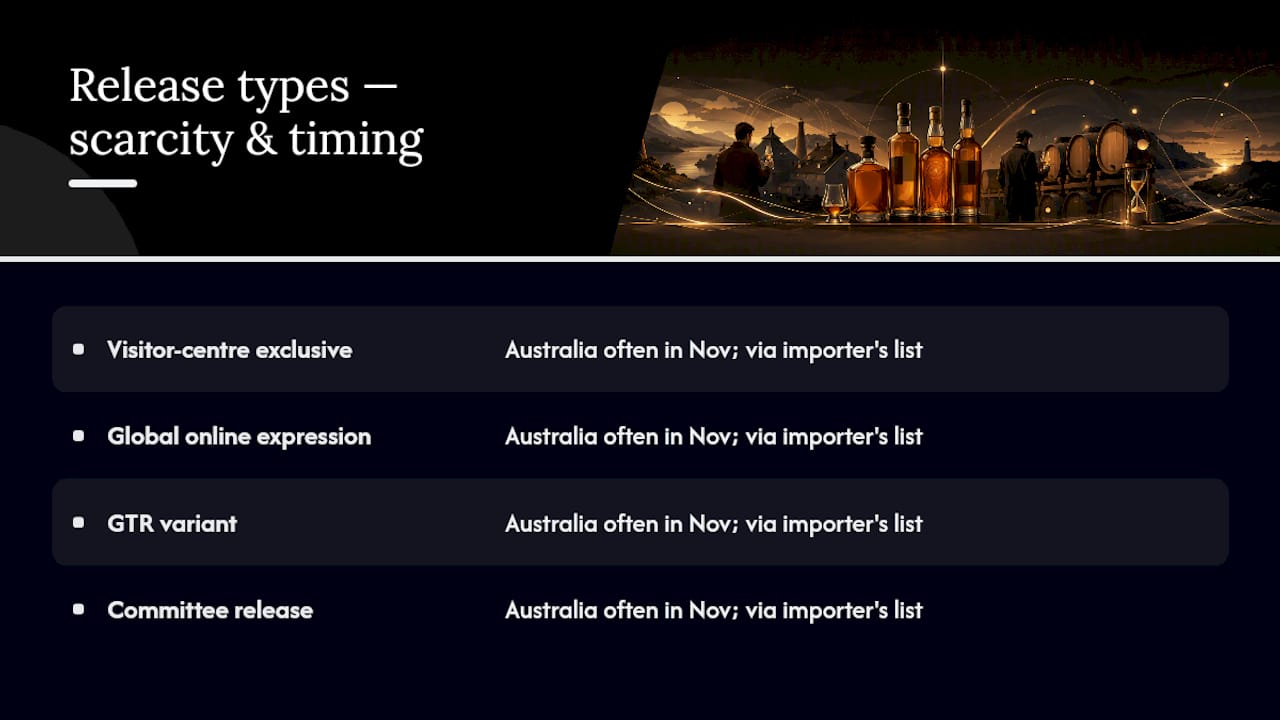
What most guides miss is the asymmetry between announcement timing and Australian availability. A UK distillery announcement in August does not mean Australian stock in August. It often means Australian stock in November, if at all, and only for collectors already on an importer’s list. The practical gap between “released” and “available in Australia” is where most local collectors lose out.
The Ardbeg Sicily release is a good example of why the peaty paradox works commercially: Ardbeg pairs heavy smoke with unexpected finishes, and collectors keep coming back because the combination is genuinely surprising. That surprise is also what drives secondary market premiums. Buying on announcement, before the tasting notes circulate widely, is consistently the better entry point.
Uisuki stocks rare and upcoming releases for Australian collectors
Securing limited whisky releases in Australia is harder than it looks from the outside. Importers hold small allocations, retail windows close fast, and the gap between a UK announcement and a local listing can stretch across seasons. Uisuki exists to close that gap.
As a specialist Australian whisky retailer, Uisuki carries curated stock from Scotland, Japan, the USA, and Australia, including hard-to-find limited editions and new arrivals as they land. The Hobart Whisky Bourbon Matured Rum Finished Single Malt is one example of the kind of locally relevant, allocation-grade bottle that moves quickly. For releases not yet listed, Uisuki accepts personalised sourcing requests, so you can get in the queue before stock arrives. Browse current stock and register your interest at Uisuki.
Sources
- The Macallan launches its final Harmony Collection release – The Whisky Wire
- Ardbeg’s new limited‑edition whisky brings a taste of Sicily to Islay — Vita Magazine
- Ardbeg unveils Vintage Y2K — CaskCompare (UK)
- 2026 Bourbon & Whiskey Release Calendar | OnlyDrams
- Release calendar — Breaking Bourbon
- Stranahans releases Colorado’s oldest bottled‑in‑bond whiskey — WhiskeyPulse