

Bourbon must be made in the US from a corn-heavy mash bill and aged in new charred oak, which gives it that vanilla sweetness. Rye demands the same American rulebook but built on rye grain, so it drinks drier and spicier. Scotch is a different animal entirely: made and matured in Scotland for at least three years, usually in casks that already held something else, which is why one dram tastes nothing like the next. The spelling split (whisky in Scotland, whiskey in the US) traces straight back to these legal borders, not just tradition.
TL;DR:
- Bourbon must be made in the US from at least 51% corn and aged in new charred oak barrels, which imparts vanilla and caramel flavors.
- Rye whiskey, also made in the US, uses at least 51% rye grain, resulting in a drier, spicier profile compared to bourbon.
- Scotch is produced in Scotland and aged for at least three years, with flavor variations influenced heavily by the type of cask used and region of origin.
- Label terms like “straight” or “bottled in bond” provide legal guarantees about age and production, unlike vague marketing phrases.
- Choosing the right style depends on personal taste preferences for sweetness, spice, or regional variety, with side-by-side tasting recommended.
Table of Contents
- Rye vs bourbon vs scotch: the quick comparison
- What legally defines bourbon, and how does it taste?
- What makes rye whiskey taste different from bourbon?
- What rules and regional styles define Scotch whisky?
- How do you choose between bourbon, rye and scotch?
- Which cocktails suit bourbon, rye and scotch best?
- What Uisuki’s whisky expertise brings to this guide
- Where to buy bourbon, rye and scotch worth trying
- Sources
- FAQ
Rye vs bourbon vs scotch: the quick comparison
Before getting into the detail, here’s how the three stack up side by side. Each line links through to where you can read the full story on that style.
- Bourbon: made in the USA, minimum 51% corn mash bill, aged in new charred oak barrels, no minimum age for standard bourbon (two years for “straight”), flavour tag: sweet, vanilla, caramel.
- Rye whiskey: made in the USA (Canadian rye has its own looser traditions), minimum 51% rye grain, aged in new charred oak, flavour tag: spicy, peppery, dry.
- Scotch: made and matured in Scotland, minimum three years in oak casks, usually malted barley or grain, bottled at a minimum 40% ABV, flavour tag: variable, smoky to fruity depending on region.
Each style earns a much longer explanation than a bullet point allows. The 51% rule and 3-year law governing all three is worth understanding properly before you buy, because label language leans heavily on it.
What legally defines bourbon, and how does it taste?
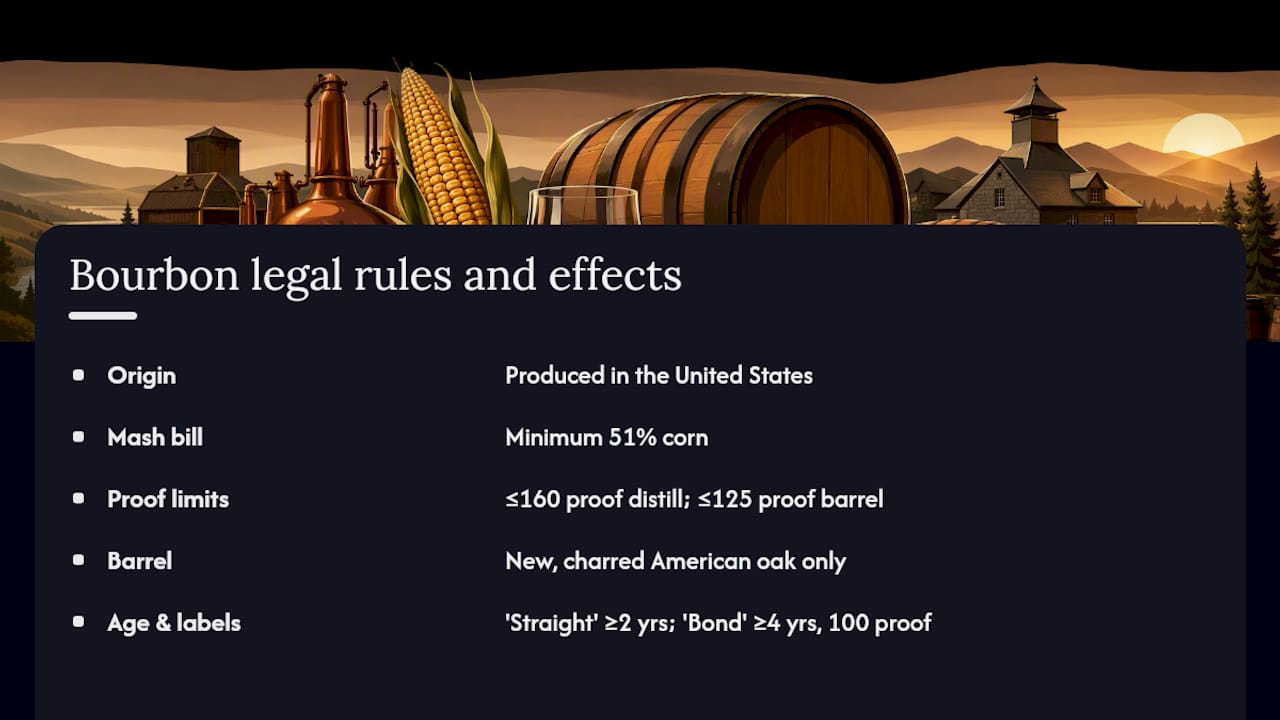
Bourbon has a strict rulebook, and almost every flavour trait it’s known for traces back to a specific regulation. It has to be produced in the United States (not just Kentucky, despite what most people assume), from a mash bill that’s at least 51% corn. The rest is typically a mix of rye or wheat plus malted barley.
Distillation can’t exceed 160 proof, and the spirit has to go into the barrel at no more than 125 proof, rules the Alcohol and Tobacco Tax and Trade Bureau enforces down to the decimal. The barrel itself is non-negotiable too: new, charred American oak, used once and never again for bourbon. That single rule does more to shape bourbon’s taste than any recipe tweak a distiller makes.
New charred oak is aggressive. The char layer caramelises the wood sugars sitting just under the surface, and the spirit pulls vanillin, tannins, and wood lactones out of that layer fast. The Whiskey Wash points out this is the main reason bourbon reads sweeter and more heavily oaked than Scotch of a comparable age. Scotch, aged in barrels that already gave up their punchiest compounds to a previous batch of bourbon or sherry, never gets hit with that same intensity.
Mash bill composition changes the story within bourbon itself. A “high-rye” bourbon (typically 20 to 35% rye in the mix) drinks spicier and drier, closer to rye whiskey in character without crossing the legal line. A wheated bourbon swaps that rye slot for wheat, and the result is rounder, softer, sometimes almost bready. Both are still bourbon by law, but a bottle’s secondary grain tells you more about what’s in the glass than its age statement often does.
Standard bourbon typically has no legally mandated minimum age, though many producers adhere to aging guidelines. Anything labelled “straight bourbon” must be aged at least two years, and if under four years old, the label must state the age. “Bottled in bond” is a stronger signal again: it guarantees a single distillery, a single distilling season, at least four years of age, and bottling at exactly 100 proof under federal supervision.
Expect vanilla, caramel, toasted coconut, and baking spice as the baseline notes, with proof typically sitting between 40% and 50% ABV for standard releases, though barrel proof bottlings can run well past that. A splash of water opens up the aromatics on anything above 50%; neat is fine below it.
When buying, prioritise the label terms that carry legal weight. “Straight,” “bottled in bond,” and an explicit age statement all tell you something regulators have verified, unlike marketing terms like “small batch,” which have no legal definition at all. Uisuki’s American whiskey collection lists mash bill and proof details on the product page for exactly this reason.
What makes rye whiskey taste different from bourbon?
Swap the dominant grain and the whole character of the whiskey changes. American rye whiskey follows nearly the same legal structure as bourbon, produced domestically, aged in new charred oak, but the mash bill has to run at least 51% rye instead of corn. Canadian rye is looser: Canadian law doesn’t set a minimum rye percentage, so “Canadian rye” is more a stylistic and historical label than a strict compositional one, which trips up plenty of drinkers expecting the same bite.
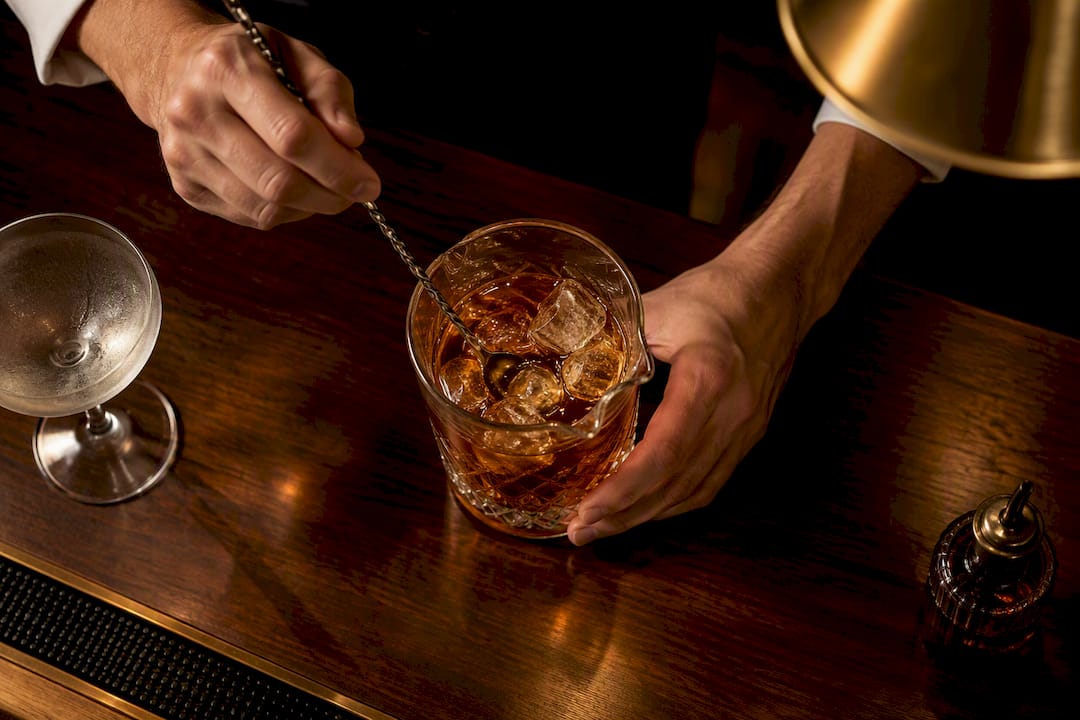
Rye grain behaves nothing like corn in a still or a barrel. It’s oilier and more aromatic, and it pushes the spirit toward pepper, clove, and dried herb rather than caramel. The finish runs drier too, since rye contributes less residual sweetness than corn does at the fermentation stage. That dryness is the whole point for a lot of rye drinkers, and it’s why a rye Manhattan tastes structurally different from a bourbon one even with an identical recipe.
Rye’s history is a genuine boom-bust-boom story that is more interesting than most spirits categories can claim. Rye was the dominant American whiskey through the 1800s, especially in Pennsylvania and Maryland. Prohibition gutted the category badly, shutting distilleries that never reopened, and the styles that survived the 1930s repeal leaned hard into corn-forward bourbon instead. Kilchoman Distillery traces rye’s slide into near-irrelevance through the mid-20th century, when it became a fraction of the whiskey market it once commanded.
The comeback is almost entirely a bartender’s doing. Cocktail culture rediscovered rye for one practical reason: its spice and dryness balance sweeter mixers far better than bourbon does, which makes it the better structural choice in drinks loaded with vermouth, bitters, or syrup. That demand shift pushed distilleries to bring old rye labels back and release new ones, reversing decades of decline in under twenty years.
If you’re picking a first rye, look for something in the 45 to 50% ABV range to start, enough proof to carry the spice without overwhelming a newcomer. Rye rewards drinkers who already find bourbon a touch too sweet, and it’s the whiskey most cocktail recipes were originally written around before bourbon substitutions became common. For a side-by-side breakdown of exactly where the two diverge, Uisuki’s rye versus bourbon comparison walks through specific bottle recommendations.
What rules and regional styles define Scotch whisky?
Scotch operates under a completely different legal framework, and that’s before you even get to flavour. It has to be both distilled and matured entirely in Scotland, matured for a minimum of three years in oak casks, and bottled at no less than 40% ABV. There’s no upper age minimum tier the way bourbon has “straight,” but age statements on the bottle have to reflect the youngest whisky in the blend, no exceptions.
Single malt Scotch comes from one distillery, made entirely from malted barley, and it’s almost always distilled in copper pot stills, which retain more character-giving compounds than the column stills common in American whiskey production. Blended Scotch mixes single malts with grain whisky (often made from wheat or corn in continuous column stills) to build a more consistent, approachable flavour at a lower price point. Neither is objectively better; they’re built for different jobs.
Peat is where Scotch gets its reputation for smoke. Distilleries dry malted barley over peat fires to varying degrees, measured loosely in phenol parts per million, though as The Whiskey Wash notes, most distilleries don’t publish exact PPM figures, so region and tasting notes remain the practical shorthand for how smoky a bottle will actually be.
Cask choice is where Scotch earns its reputation for variety. Because Scotland almost never uses brand-new oak, distilleries lean on ex-bourbon barrels (which impart lighter vanilla and coconut, having already been stripped of their most intense wood compounds by an earlier bourbon fill), ex-sherry casks (which bring dried fruit, nuttiness, and a deeper colour), and increasingly wine casks for a final finishing period. This is the single biggest reason two single malts from neighbouring distilleries can taste almost unrecognisable from each other.
Region gives you a rough map before you’ve even opened the bottle:
| Region | Typical style |
|---|---|
| Speyside | Fruity, honeyed, gentle oak |
| Islay | Peaty, smoky, maritime |
| Highlands | Broad range, often lightly smoky and heathery |
| Lowlands | Light, grassy, floral |
| Campbeltown | Briny, oily, distinctive |
A Speyside malt is the safer starting point for someone coming from bourbon, since the sweetness carries over. Islay is the deep end, worth trying once you know smoke is what you’re after. Uisuki’s Scotch whisky collection is organised so you can browse by these regional cues alongside cask and ABV details on each listing.
How do you choose between bourbon, rye and scotch?
Matching the right style to the right moment is mostly about being honest with yourself about what you actually enjoy drinking, not what sounds impressive to order. Whether bourbon, rye, or Scotch tastes “better” genuinely comes down to preference rather than any objective ranking, and most drinkers land firmly in one camp within their first few pours.
- Start with what you already like. If you gravitate toward sweeter drinks, bourbon’s vanilla and caramel profile is the natural entry point. If you find sweet spirits a bit flat, rye’s pepper and structure will suit you better.
- Decide how much variety you want. Scotch is the category for drinkers who want a different experience every bottle, thanks to the wide range of regions and cask finishes on offer.
- Taste all three side by side, in this order: bourbon first (sweetest, easiest entry), then rye (to feel the spice contrast), then a lightly peated Scotch (to see how smoke and cask change things again).
- Check the label before you check the price. Terms like “straight,” “single malt,” “bottled in bond,” and an actual cask type tell you something concrete; vague marketing language does not.
Pro Tip: Nose each pour for a few seconds before you taste it. Most of what separates rye’s pepper from bourbon’s vanilla shows up in the aroma before it ever hits your tongue, and it trains your palate faster than sipping straight in.
Pay a premium for age statements and cask finishes only once you know your preferred style; an older bottle in the wrong category won’t convert a rye drinker to bourbon, or vice versa.
Which cocktails suit bourbon, rye and scotch best?
The right glass depends entirely on which style you’re pouring, and swapping one whiskey for another in a classic recipe changes the drink more than most people expect.
- Old Fashioned: built for bourbon’s sweetness, though a rye version brings welcome spice to cut the sugar.
- Manhattan and Sazerac: both originated as rye cocktails, and the drier profile balances vermouth and bitters better than bourbon does.
- Rob Roy and Rusty Nail: classic Scotch cocktails, built to let a blended or lightly peated malt shine through Drambuie or vermouth.
- Highball: works with any of the three; higher proof bourbons and Scotches hold up best against soda water.
Neat drinking suits anything above 50% ABV once you add a small splash of water to open the aromatics, since raw high-proof spirit can numb the palate before you taste anything. Bourbon pairs naturally with orange peel and cherry garnishes, rye favours a twist of lemon, and Scotch generally needs nothing at all beyond the glass.
What Uisuki’s whisky expertise brings to this guide
The curated whisky selection includes detail on batch, ABV, and cask for each product listing. That’s the same detail this guide leans on to separate genuine legal distinctions from label spin. A sourcing request service is offered for locating rare and hard-to-find whisky releases. Readers wanting to go deeper than this guide can browse the full bourbon, rye and Scotch breakdown on the Uisuki blog.
— Brendan
Where to buy bourbon, rye and scotch worth trying
Reading the legal fine print only gets you so far. A curated catalogue of Scotch, Japanese, Australian, and American whiskey is available with detailed product information on Uisuki’s website.

If this guide has pointed you toward bourbon’s sweetness, rye’s spice, or Scotch’s regional range, the American whiskey collection covers the first two, and the Scotch whisky collection covers the third, both searchable by cask and proof. Can’t find the exact bottle or vintage you’re after? A personalised sourcing request service is available for rare and hard-to-find whisky releases. Browse the current range and send a sourcing request if what you want isn’t listed yet.
Sources
- Alcohol and Tobacco Tax and Trade Bureau (TTB) — spirits regulations
- The essential guide to understanding bourbon, rye and Scotch | The Whiskey Wash
- What are the differences between Scotch, Bourbon and Rye? | Kilchoman Distillery
FAQ
What tastes better, rye or bourbon?
Neither is objectively better; it comes down to whether you prefer sweetness or spice. Bourbon leans vanilla and caramel from its corn-heavy mash bill, while rye drinks drier and peppery because rye grain contributes less natural sweetness during fermentation.
What are the seven types of whiskey?
Common whiskey categories include bourbon, rye, Tennessee whiskey, corn whiskey, malt whiskey, Scotch, and Canadian whisky, though exact groupings vary by source and country. Each is defined by its country of production, dominant grain, and specific ageing rules rather than one universal standard.
Is Jack Daniel’s a bourbon or a scotch whisky?
Jack Daniel’s is legally a Tennessee whiskey, not a Scotch. It meets bourbon’s compositional rules (corn-majority mash bill, new charred oak) but goes through an additional charcoal filtering step called the Lincoln County Process before barrelling, which is why it carries its own state-specific label rather than “bourbon.”
Why did rye whiskey lose popularity?
Prohibition shut down many rye-focused distilleries permanently, and the industry that rebuilt afterward leaned toward corn-forward bourbon instead. Rye’s decline continued through the mid-20th century until cocktail bartenders rediscovered its structural bite in classics like the Manhattan and Sazerac, driving the current revival.
Is scotch always spelled without the “e”?
Yes, Scotch whisky drops the “e” because it’s made in Scotland, following the spelling convention used across most whisky-producing countries outside the US and Ireland. American and Irish producers generally use “whiskey,” and that spelling difference is a reliable, though not universal, clue to a bottle’s country of origin.