

The peatiest whiskies on the market are the “super-peated” single malts, releases whose malt was peated far beyond standard commercial levels, with some recorded malt phenol counts exceeding 200 to 300 parts per million. But that number describes the barley before distillation, not what ends up in your glass, and that gap is the single most misunderstood fact about peated whisky.
TL;DR:
- Extreme peated whiskies like Octomore can exceed 200 to 300 PPM in malt specification, but only a small portion of phenols actually end up in the glass.
- Classic heavily peated staples such as Laphroaig 10 and Ardbeg 10 maintain malt PPM around 40 to 50, offering consistent, accessible smoky profiles for regular drinking.
- PPM measures phenol concentration before distillation and does not directly translate to the whisky’s final smoky intensity due to distillation and maturation effects.
- Regional differences influence flavor significantly, with Islay producing coastal, medicinal smoke, while Highland and Orkney whiskies tend toward earthier, floral peat notes.
- Most high-PPM releases are limited or special editions, while standard staples provide better value and balance for building a versatile peated whisky collection.
Table of Contents
- What is the most peated whisky? Editorial examples worth knowing
- What is PPM (phenol parts per million), really?
- Why identical PPM figures can taste completely different
- Regional peat signatures: what your nose can already tell you
- How to pick the right peat intensity for your palate
- Brendan and Uisuki’s curated perspective on peat
- Sensory analysis and expert scoring beyond the PPM number
- How peated whisky production has changed over time
- Is heavily peated whisky safe to drink? Phenol content explained
- Why extreme peat matters, and when you don’t need it
- Browse or request peated whisky at Uisuki
- Sources
- FAQ
What is the most peated whisky? Editorial examples worth knowing
There’s no single crowned “most peated whisky” because distilleries don’t all publish figures the same way, and PPM is measured before the spirit ever sees a still. What we can do is point to the releases that keep showing up at the top of documented malt phenol counts, alongside the staples that built heavy peat’s reputation in the first place. Treat this as a tasting reference, not a shopping list. Some of these are once-in-a-lifetime curiosities. Others belong in a regular rotation.
Super-peated examples (extreme, often limited, built to push the ceiling):
- Octomore series (Bruichladdich) — The benchmark for “how high can PPM go.” Various Octomore editions have carried malt phenol specifications well into the 100s, with some releases regularly documented at very high malt PPMs that outstrip almost everything else on shelf. Typically bottled at higher ABV, often limited-run, and priced as a collector’s item rather than a nightly dram.
- Bruichladdich’s experimental peat releases — Beyond the Octomore name itself, one-off cask experiments from the same distillery have occasionally chased even higher malt specifications, usually sold in tiny allocations to collectors and specialist retailers.
- Ardbeg Supernova (historical release) — One of the earlier “extreme peat” marketing moments in Scotch, credited with popularising the idea that PPM was a number worth quoting on a label. Original bottlings are now firmly in secondary-market territory.
- Festival and distillery-exclusive super-peated one-offs — Various Islay distilleries release small-batch, high-PPM expressions around whisky festivals. These rarely reappear, and pricing reflects both the peat and the scarcity.
Classic heavily peated staples (available, repeatable, built for the regular dram):
- Laphroaig 10 Year Old — Sits comfortably in the traditional heavy-peat bracket, with malt typically peated in the 40 to 50 PPM range that defines classic heavy peat Scotch. Medicinal, briny, and consistent bottling after bottling.
- Lagavulin 16 Year Old — Slightly softer than Laphroaig in delivery despite similar malt specifications, thanks to longer maturation rounding the smoke into something more balanced.
- Ardbeg 10 Year Old — The entry point for a lot of drinkers into serious peat, and a fair benchmark for what “heavily peated” tastes like at standard ABV.
- Talisker 10 Year Old — Not Islay, but genuinely heavily peated with a maritime, peppery edge that shows how location changes the character even at comparable phenol levels.
The rarity gap between these two groups matters as much as the PPM figure. A super-peated one-off might be a single taste worth chasing for the story; a classic staple is the bottle you actually finish over a few months.
What is PPM (phenol parts per million), really?
PPM measures the phenol concentration in kiln-dried malted barley, before it’s mashed, fermented, or distilled. It’s a malt specification, not a finished-whisky measurement, and distilleries publish it because it’s the easiest single number to put on a spec sheet or a marketing page.
Rough bands used across the industry:
- Unpeated: 0 to 2 PPM
- Lightly peated: 3 to 15 PPM
- Medium peated: 15 to 35 PPM
- Heavily peated: 35 to 50 PPM
- Super-heavy / extreme: 50+ PPM, with some documented releases exceeding 200 to 300 PPM
Pro Tip: Don’t treat a five or ten PPM gap as meaningful on its own. A whisky at 42 PPM and one at 48 PPM will likely taste closer to each other than to a 20 PPM dram, once distillation and maturation get involved.
The number on the tin tells you about the raw material. It doesn’t tell you what survives the journey to the bottle, which is where things get interesting.
Why identical PPM figures can taste completely different
Two whiskies can share a malt specification and still land nowhere near each other in the glass. Distillation is the first filter: still shape and cut points determine how much phenolic character actually carries over, and tall, narrow-necked stills with conservative cuts tend to leave more smoke behind than squat stills running wider cuts.
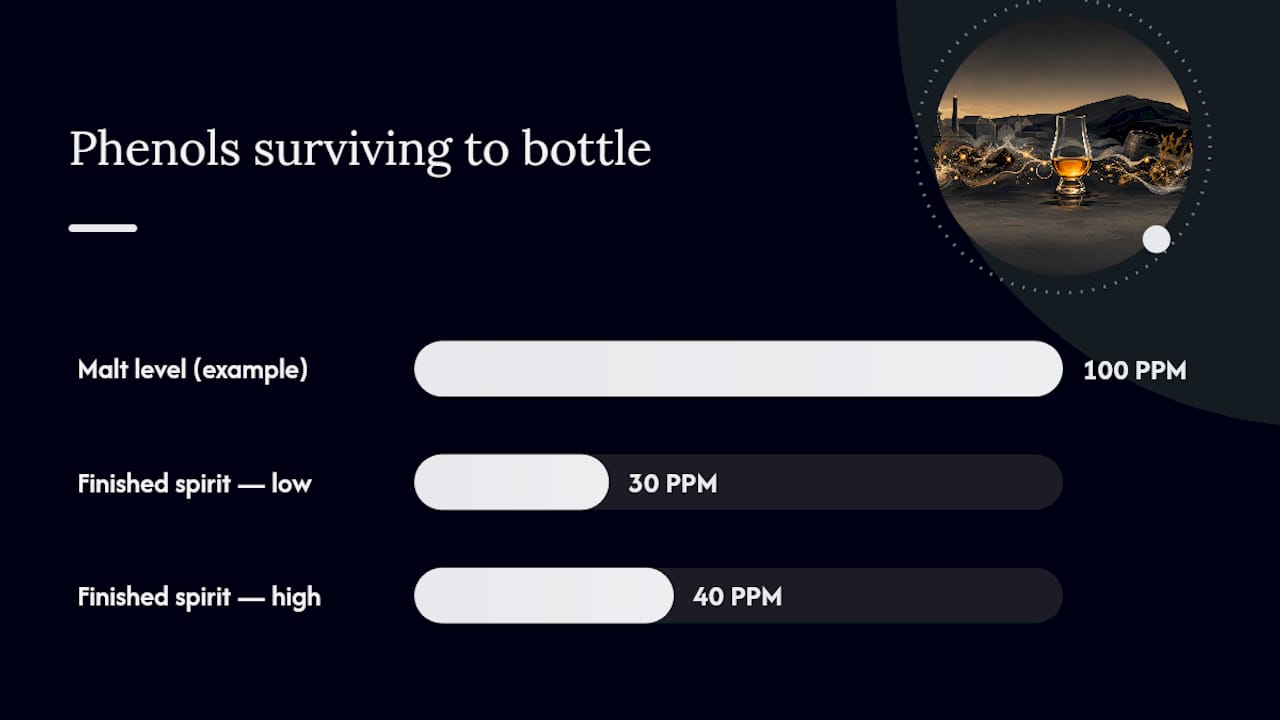
Maturation does the rest of the work. A first-fill sherry cask can smother youthful smoke under dried fruit and spice; a tired refill cask lets peat dominate for years. Age matters too, since long maturation tends to round sharp medicinal notes into something softer and more integrated.
Then there’s the peat itself. Where it was cut, and what it’s made of, shapes the aroma as much as the quantity:
- Coastal peat, thick with decomposed seaweed, tends to push toward brine and iodine.
- Inland peat, dominated by heather and other moorland plant matter, leans earthier and more floral.
As a rule of thumb, expect roughly 30 to 40% of a malt’s phenolic compounds to survive into the finished spirit. A malt peated to 100 PPM does not produce a 100 PPM whisky in the bottle, not even close.
Regional peat signatures: what your nose can already tell you
Region often predicts flavour more reliably than the PPM figure printed on a spec sheet. Islay’s peat, cut from bogs saturated with marine material over centuries, tends to deliver medicinal, briny, seaweed-forward smoke that’s instantly recognisable once you’ve tasted it a few times.
Highland and Orkney peat comes from different terrain entirely, and it shows in the glass:
- Islay: medicinal, iodine, brine, seaweed, sometimes described as “hospital bandage” in the most extreme examples.
- Highland and Orkney: earthier, with heather and honeyed smoke rather than a coastal edge.
- Speyside: rarely heavily peated, but when it is, expect a gentler, more floral smoke than Islay’s intensity.
Outside Scotland, peated whisky takes on its own regional accent. Japanese distilleries tend toward a cleaner, more restrained smoke that plays second fiddle to fruit and spice, while newer peated releases from India and Australia often lean into local peat sources with their own mineral or eucalyptus-adjacent character. Our own guide to peated whisky’s flavour and origins covers this in more depth if regional comparison is what you’re chasing.
How to pick the right peat intensity for your palate
Matching intensity to experience saves you from either boredom or palate fatigue.
- New to peat? Start around 15 to 35 PPM, taste neat first, then add a dash of water and compare. Notice how the smoke shifts before jumping to anything heavier.
- Comfortable with peat? Run a side-by-side tasting of two heavily peated drams from different regions. Focus on balance, whether sweetness cuts through the smoke, and how medicinal versus earthy the finish reads.
- Chasing extreme peat? Treat super-peated bottles as sipping, not session, whiskies. Higher ABV means smaller pours, and these are genuinely worth sharing rather than working through solo.
- No PPM listed? Lean on ABV, limited-edition labelling, and tasting notes mentioning “medicinal,” “tar,” or “bonfire” as reliable proxies. Our tasting guide to different whisky profiles is a useful companion if you’re building a comparison approach from scratch. Beginners specifically might want our guide to choosing a first whisky before committing to anything at the heavy end.
Brendan and Uisuki’s curated perspective on peat
Uisuki’s team has spent years sourcing and tasting through Scotland’s peated releases, and Brendan’s picks reflect that firsthand exposure across regions and rarity tiers. For someone starting out, a standard 40 to 50 PPM Islay dram is the honest entry point. For a collector chasing scarcity, a documented super-peated one-off is worth the hunt. For anyone building a serious shelf, a regularly available heavy peat staple earns its place through consistency, not spectacle.
If a specific bottle isn’t in current stock, requests for sourcing rare or limited peated releases may be taken where availability allows.
Sensory analysis and expert scoring beyond the PPM number
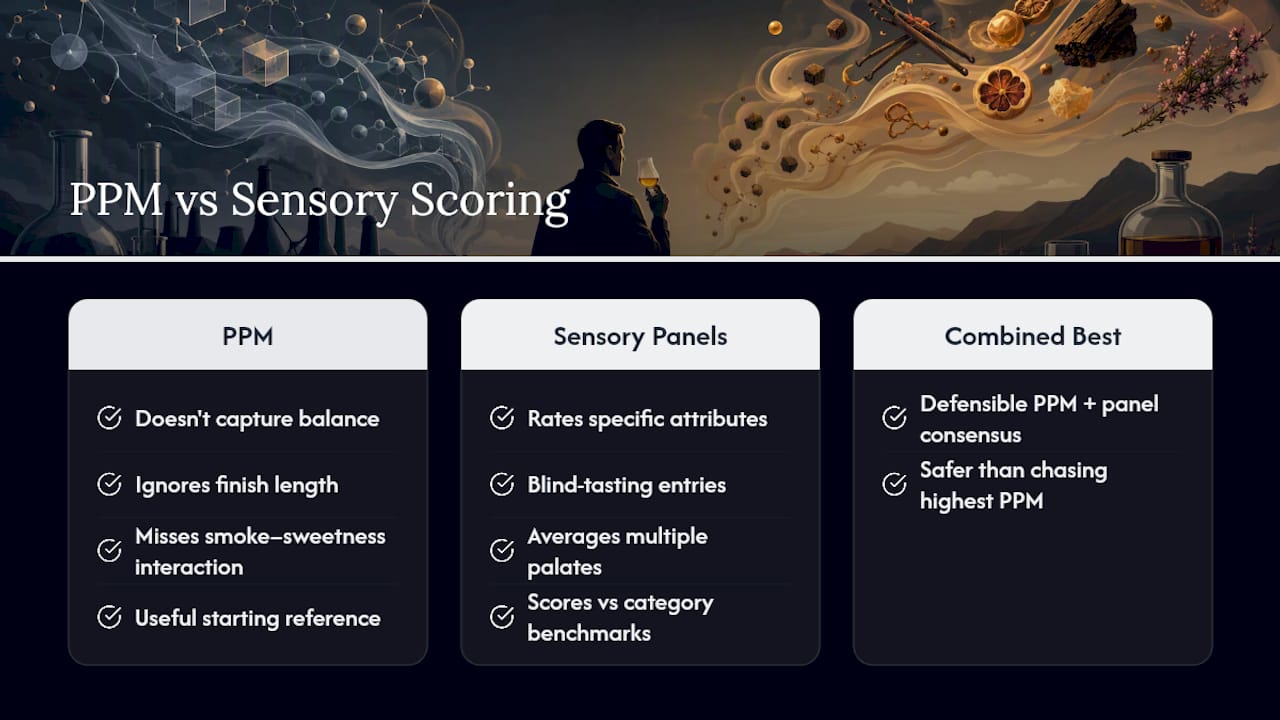
PPM can’t capture balance, finish length, or how smoke interacts with sweetness, which is why tasting panels and expert scoring still matter. Structured sensory analysis asks tasters to rate specific attributes, smoke intensity, medicinal character, sweetness, mouthfeel, on consistent scales, then averages those scores across multiple palates to cancel out individual bias.
Competition scoring systems (used by whisky awards and specialist publications) work similarly, usually blind-tasting entries and scoring against category benchmarks rather than a single numeric spec. This matters most at the extreme end, where two 100+ PPM malts might score wildly differently on a tasting panel despite near-identical spec sheets, because one integrates its smoke with cask influence and the other doesn’t.
None of this replaces PPM as a starting reference. It fills the gap PPM leaves, which is everything that happens after the malt leaves the kiln. A whisky that scores well on both counts, a defensible PPM and strong panel consensus, is a safer bet than chasing the highest number alone.
How peated whisky production has changed over time
Peat was originally a fuel of necessity, not style. Highland and island distilleries burned what was locally available to dry malted barley, and peat happened to be abundant where wood and coal weren’t. The resulting smoke character was a byproduct, not a design choice.
That changed once distilleries realised customers had developed a taste for it. Islay’s distilleries, sitting on some of Scotland’s most peat-rich land, leaned into the character rather than trying to eliminate it as production modernised through the 20th century. By the 1990s and 2000s, an explicit “peat arms race” emerged, with releases like Ardbeg’s Supernova and Bruichladdich’s Octomore series deliberately chasing the highest documented malt PPM figures as a marketing point in their own right.
That shift changed consumer behaviour too. Before the arms race, most drinkers never encountered a PPM figure at all. Now it’s printed on tasting notes, retailer listings, and distillery spec sheets as a comparison shorthand, even though, as covered earlier, it’s an incomplete one.
Is heavily peated whisky safe to drink? Phenol content explained
Phenolic compounds are what create peat’s smoky character, and they’re present in tiny concentrations even in the highest-PPM releases once you account for dilution through mashing, fermentation, and distillation. The compounds responsible for smoky, medicinal aromas in whisky are the same broad chemical family found in small amounts in foods like smoked fish and grilled meat, and there’s no evidence that peated whisky’s phenol levels pose a distinct health risk beyond the standard considerations that apply to alcohol consumption generally.
The more practical consideration is ABV, not phenol content. If you’re pouring for guests unfamiliar with heavy peat, warn them about the ABV before the smoke.
As always, moderate consumption and awareness of your own tolerance matter more with any high-strength spirit, and that applies equally whether the whisky is peated or not.
Why extreme peat matters, and when you don’t need it
Distilleries chase extreme PPM partly to test their own limits, partly because a small, vocal audience genuinely wants the most intense version possible. That’s a legitimate reason for these releases to exist. But most excellent peated whisky sits well below the extreme end, and a well-matured 40 PPM dram often gives more pleasure than a young, aggressive 200 PPM curiosity. Chase the number once for the experience. Build your shelf on balance.
— Brendan
Browse or request peated whisky at Uisuki
Specialist retailers may offer curated stock ranging from classic heavy-peat staples through to rare, limited super-peated releases, and may take sourcing requests to track down specific bottles.

That matters most at the extreme end of this category, where allocations are small and bottles disappear fast. Rather than scrolling generic marketplace listings hoping for stock, a curated selection backed by knowledgeable experts may be available, plus options to inquire about specific bottles if not currently listed. Start by browsing the current single malt Scotch selection or head straight to Uisuki’s whisky collection to check availability or submit a sourcing request for the bottle you’re chasing.
Sources
- Peat bombs: most heavily peated whiskies
- The race to make the most heavily peated scotch whisky
- Peat in Scotch whisky
FAQ
What are the top peated Scotch whiskies?
Octomore releases from Bruichladdich top documented malt PPM figures, followed by classic heavy-peat staples like Laphroaig, Lagavulin, and Ardbeg that sit in the traditional 40 to 50 PPM range.
Which whisky is the smokiest?
Among widely available bottles, Octomore consistently carries the highest documented malt phenol specification, though how “smoky” it tastes in the glass also depends on distillation and cask maturation, not just the PPM figure.
Which Scotch whisky is more peaty, Islay or Highland?
Islay whiskies are generally peatier and carry a more medicinal, coastal character, while Highland and Orkney peated whiskies tend toward earthier, heather-driven smoke even at similar PPM levels.
What is the best smoky whisky available in Australia?
Laphroaig 10 Year Old and Ardbeg 10 Year Old are reliably stocked, heavily peated staples that suit most palates, and rarer super-peated releases can be sourced through specialist retailers like Uisuki when available.