

TL;DR:
- Bourbon is made from at least 51% corn, while rye whiskey contains at least 51% rye grain. Their flavor profiles differ, with bourbon being sweet and mellow and rye being spicy and herbal. Rye offers strong value and unique complexity, especially in cocktails, and deserves more recognition among whiskey enthusiasts.
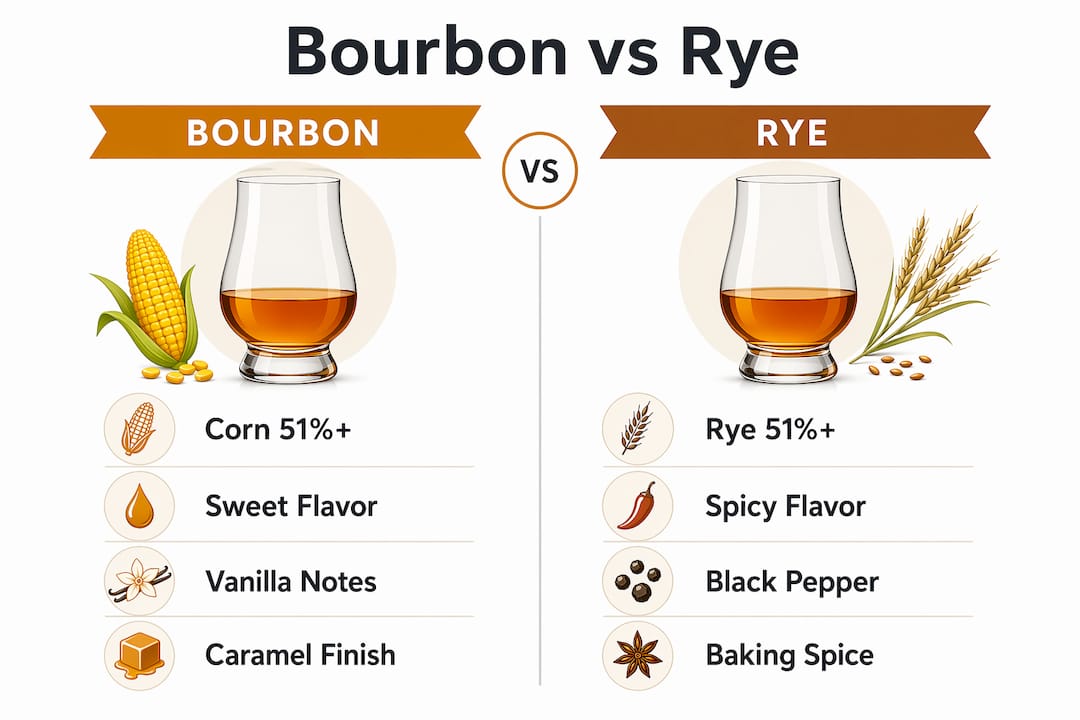
Bourbon is defined as an American whiskey made from a mash bill of at least 51% corn, while rye whiskey requires at least 51% rye grain. That single grain distinction drives everything: the sweetness of Jim Beam versus the peppery punch of Bulleit Rye, the way each spirit behaves in a cocktail, and the price you pay at the bottle shop. Understanding the difference between bourbon and rye is less about memorising regulations and more about knowing what you actually want in your glass.
What legal rules separate bourbon from rye whiskey?
The legal requirements for both spirits are set by US federal law and are surprisingly specific. Bourbon must contain at least 51% corn in the mash bill. Rye whiskey must contain at least 51% rye grain. Both must be produced in the United States, distilled at no more than 160 proof, aged in new charred American oak barrels, and bottled at a minimum of 80 proof. The “Straight” designation on a label means the spirit has aged for at least two years.
One thing worth knowing: a whiskey cannot legally satisfy the majority grain requirement for both corn and rye at the same time. The mash bill must commit to one identity. A high-rye bourbon like Four Roses Single Barrel may contain up to 35% rye, but because corn still dominates, it remains legally a bourbon.
Canadian whisky is often labelled “rye” on the shelf, which causes real confusion. Canadian rye is not legally required to contain any rye grain at all. The name is a historical holdover, not a grain guarantee. When you are comparing the difference between whisky and rye in the American sense, Canadian bottles play by entirely different rules.
| Requirement | Bourbon | Rye whiskey |
|---|---|---|
| Primary grain | Min. 51% corn | Min. 51% rye |
| Country of production | United States | United States |
| Distillation proof | Max. 160 proof | Max. 160 proof |
| Barrel type | New charred American oak | New charred American oak |
| Minimum bottling proof | 80 proof | 80 proof |
| “Straight” ageing | Min. 2 years | Min. 2 years |
How do bourbon and rye differ in flavour?
The flavour difference between bourbon and rye whiskey comes directly from the grain. Bourbon’s corn base produces a sweet, round palate loaded with vanilla, caramel, toffee, and honey. The finish lingers warmly for 20–40 seconds. It is approachable, mellow, and rarely confrontational, which is why bourbon is the entry point for most whiskey drinkers.
Rye delivers something completely different. The rye grain produces a drier, bolder spirit with black pepper, baking spices, mint, and herbal notes. The finish is leaner and spicier. Where bourbon wraps around your palate, rye cuts through it.
A common misconception is that rye’s intensity comes from alcohol burn or harshness. It does not. The spice in rye comes from aromatic compounds including pepper, cinnamon, and caraway. Under-aged or over-proof spirits can sting, but that is a production issue, not a grain characteristic. A well-made rye like Rittenhouse Bottled-in-Bond or WhistlePig 10 Year is spicy in the way a good meal is spicy: complex, layered, and satisfying.
| Characteristic | Bourbon | Rye whiskey |
|---|---|---|
| Primary flavour | Sweet, vanilla, caramel | Spicy, peppery, herbal |
| Body | Round and full | Lean and dry |
| Finish | Warm, 20–40 seconds | Crisp, spicy, lingering |
| Approachability | High | Moderate |
| Common examples | Maker’s Mark, Buffalo Trace | Rittenhouse, WhistlePig |
Pro Tip: To fully appreciate rye’s complexity, try “chewing” the spirit. Take a small sip, let it coat your entire mouth, and work your jaw gently before swallowing. This tasting technique unlocks the herbal and peppery layers that a quick sip will miss entirely.
How do secondary grains and barrel ageing shape each style?
The majority grain sets the character, but the secondary grains in the mash bill do the fine-tuning. Most bourbons include malted barley for fermentation efficiency, plus either wheat or rye as a flavouring grain. Wheated bourbons like Maker’s Mark and Pappy Van Winkle swap rye for wheat, producing an even softer, sweeter result. High-rye bourbons like Basil Hayden’s push the rye content close to that legal 35% ceiling, adding spice while keeping corn in charge.
Secondary grains interact differently with new charred American oak during ageing. Bourbon’s corn sweetness is amplified by the oak’s vanilla and caramel compounds. Rye’s natural spice offsets the oak sweetness, preventing the spirit from becoming cloying. This is why a well-aged rye whiskey can feel more balanced than a similarly aged bourbon, even though bourbon is the sweeter spirit on paper.
Understanding mash bills helps you shop smarter. Here is what to look for:
- Wheated bourbons (Maker’s Mark, Larceny): maximum sweetness, minimum spice, ideal for those new to whiskey
- Standard bourbons (Jim Beam White, Wild Turkey 101): balanced corn sweetness with a light rye edge
- High-rye bourbons (Basil Hayden’s, Four Roses Single Barrel): spicy and complex while still legally bourbon
- American rye whiskey (Rittenhouse, Sazerac Rye): bold, peppery, and dry with herbal depth
- High-rye rye whiskey (WhistlePig 10 Year, Michter’s Rye): maximum rye character, often with fruit and oak complexity
Pro Tip: If you enjoy bourbon but want to explore rye whiskey, start with a high-rye bourbon like Four Roses Single Barrel. It bridges the gap between the two styles without throwing you in the deep end.
What cocktails suit bourbon versus rye?
The difference between bourbon whiskey and rye becomes most obvious in a cocktail glass. Bourbon’s sweetness makes it the natural choice for drinks that need a smooth, approachable base. Rye’s spice makes it the better choice when you want the whiskey to assert itself through mixers and sweeteners.
Classic bourbon cocktails include:
- Old Fashioned: bourbon’s caramel notes complement the sugar and bitters without competing
- Whiskey Sour: the citrus and sweetness balance beautifully against bourbon’s vanilla base
- Mint Julep: bourbon’s soft sweetness works with fresh mint rather than clashing with it
Classic rye cocktails include:
- Manhattan: rye’s spice cuts through sweet vermouth and gives the drink its backbone
- Sazerac: rye is the traditional and legally specified spirit in this New Orleans classic
- Vieux Carré: rye’s herbal complexity holds its own alongside cognac and two types of bitters
The practical takeaway is straightforward. If a cocktail recipe calls for whiskey without specifying a type, bourbon will produce a sweeter, rounder result. Rye will produce a drier, more assertive one. Neither is wrong. They are just different drinks.
Price is worth mentioning here. Rye whiskey at the $40–$60 price point often matches the complexity of bourbons costing $80–$100. For cocktail use especially, rye delivers serious value. You can read more about making informed choices between the two styles if you are building a home bar or a collection.
Key takeaways
Bourbon and rye are defined by their grain: corn drives bourbon’s sweetness, rye grain drives rye whiskey’s spice, and every legal, flavour, and cocktail difference follows from that single fact.
| Point | Details |
|---|---|
| Grain is the defining factor | Bourbon needs 51% corn; rye whiskey needs 51% rye grain by US law. |
| Flavour follows the grain | Bourbon is sweet and round; rye is dry, spicy, and herbal. |
| Barrel rules are identical | Both age in new charred American oak, so oak influence is a constant, not a variable. |
| Cocktail choice is practical | Use bourbon for sweeter drinks; use rye when you want the spirit to cut through mixers. |
| Rye offers strong value | Rye at $40–$60 regularly matches bourbon complexity at $80–$100. |
Brendan’s take: why rye deserves more credit than it gets
Most people start with bourbon, and I think that is completely reasonable. Bourbon is generous. It meets you halfway with sweetness and warmth, and it rarely asks anything difficult of you. But I have noticed that the drinkers who stick with whiskey long enough almost always shift toward rye at some point. Not because bourbon stops being good, but because rye starts revealing things bourbon cannot.
The mistake I see most often is people trying rye for the first time and calling it “harsh.” They are usually drinking it too fast, or they have picked up a cheap bottle that is under-aged. A quality rye like Rittenhouse or WhistlePig is not harsh. It is precise. The spice is aromatic, not aggressive, and once your palate adjusts to it, bourbon can start to feel a little one-note by comparison.
Rye is also genuinely underpriced right now. The bourbon market has been inflated by collector demand for years. Rye has not caught up yet, which means you can find extraordinary bottles at prices that would be impossible in the bourbon category. If you are spending more than $80 on a bourbon for everyday drinking, I would seriously suggest redirecting that budget toward rye. You will almost certainly get more complexity per dollar.
My honest suggestion: buy one bottle of each, taste them side by side, and then try both in a Manhattan. The difference between rye whiskey and bourbon becomes completely clear the moment you taste them in the same cocktail context.
— Brendan
Explore bourbon and rye at Uisuki
Uisuki stocks a curated range of American bourbons and rye whiskies, from accessible everyday bottles to rare and hard-to-find expressions. Whether you are building a home bar, shopping for a gift, or putting together a tasting flight to explore the difference between whiskey, bourbon, and rye firsthand, the range covers every style discussed in this article.

For something that shows what thoughtful barrel selection can do, the Hobart Whisky Bourbon Matured Rum Finished single malt is a standout Australian expression that demonstrates exactly how bourbon barrel influence shapes a spirit’s character. Browse the full range at Uisuki and find the bottle that suits your palate.
FAQ
What is the core difference between bourbon and rye?
Bourbon must contain at least 51% corn in the mash bill, producing a sweet, vanilla-forward spirit. Rye whiskey must contain at least 51% rye grain, producing a drier, spicier, more herbal spirit.
Can a whiskey be both bourbon and rye?
No. US law requires the majority grain to define the spirit’s category, so a whiskey cannot simultaneously qualify as both bourbon and rye whiskey.
Is Canadian rye whisky the same as American rye whiskey?
No. Canadian rye is a historical nickname and carries no legal requirement to contain rye grain. American rye whiskey must contain at least 51% rye by law.
Which is better for cocktails, bourbon or rye?
Bourbon suits sweeter cocktails like the Old Fashioned and Whiskey Sour. Rye suits bolder cocktails like the Manhattan and Sazerac, where its spice balances sweet vermouth and bitters.
Is rye whiskey more expensive than bourbon?
Rye is generally better value. Quality rye at $40–$60 often matches the complexity of bourbons priced at $80–$100, making it a strong choice for both sipping and cocktails.