

TL;DR:
- U.S. law strictly defines bourbon as at least 51% corn and rye whiskey as at least 51% rye, affecting flavor profiles and collectability. While both spirits share production standards, their primary grain content creates distinct tastes: bourbon is sweet and mellow, whereas rye is spicy and structured. Proper label identification and understanding mash bills are crucial for collectors to accurately assess value and authenticity, especially in Australia.
Walk into any well-stocked bottle shop or browse an online whisky retailer and you’ll likely spot rye and bourbon sitting side by side, sometimes at similar prices, occasionally from the same distillery. Many buyers assume these are two marketing names for roughly the same thing. They’re not. U.S. labelling law draws a firm line: bourbon requires at least 51% corn in the mash bill, while rye whiskey demands at least 51% rye grain. That single distinction ripples through flavour, collectability, cocktail performance, and retail value in ways that matter enormously for Australian collectors and enthusiasts.
Table of Contents
- What makes a bourbon or a rye: The legal standards explained
- How the mash bill shapes flavour in your glass
- High-rye bourbon, pure rye and the collector’s dilemma
- Choosing rye or bourbon for drinking and mixing
- The hidden impact of mash bill choices on Australian collections
- Explore top Australian whisky selections for rye and bourbon lovers
- Frequently asked questions
Key Takeaways
| Point | Details |
|---|---|
| Mash bill defines category | Whiskey must have at least 51% of its named grain to be called bourbon or rye. |
| Flavour shaped by grain | Corn leads to sweeter bourbon while rye provides spice and structure. |
| Labels can be misleading | A spicy-tasting bourbon is not a rye unless it meets the legal grain threshold. |
| Mixology matters | Rye is often the best choice for classic cocktails needing structure, while bourbon suits sipping. |
| Collector value in details | Collectors should always check mash bill information for maximising value and diversity. |
What makes a bourbon or a rye: The legal standards explained
With confusion about labels so common, let’s clarify precisely what makes each whiskey a bourbon or a rye at the regulatory level. The foundation of both categories is U.S. federal law, which is the framework that applies to virtually every American-produced bottle you’ll find at Australian retailers.
The grain standards explained are actually quite concise: bourbon must use at least 51% corn, while rye whiskey must use at least 51% rye grain in the fermented mash. Beyond the primary grain, both categories share a surprising amount of regulatory common ground. Proof and barrel requirements are largely identical across the two: both must be distilled to no more than 160 proof, entered into barrel at no more than 125 proof, and aged in new charred oak containers with no additives permitted.
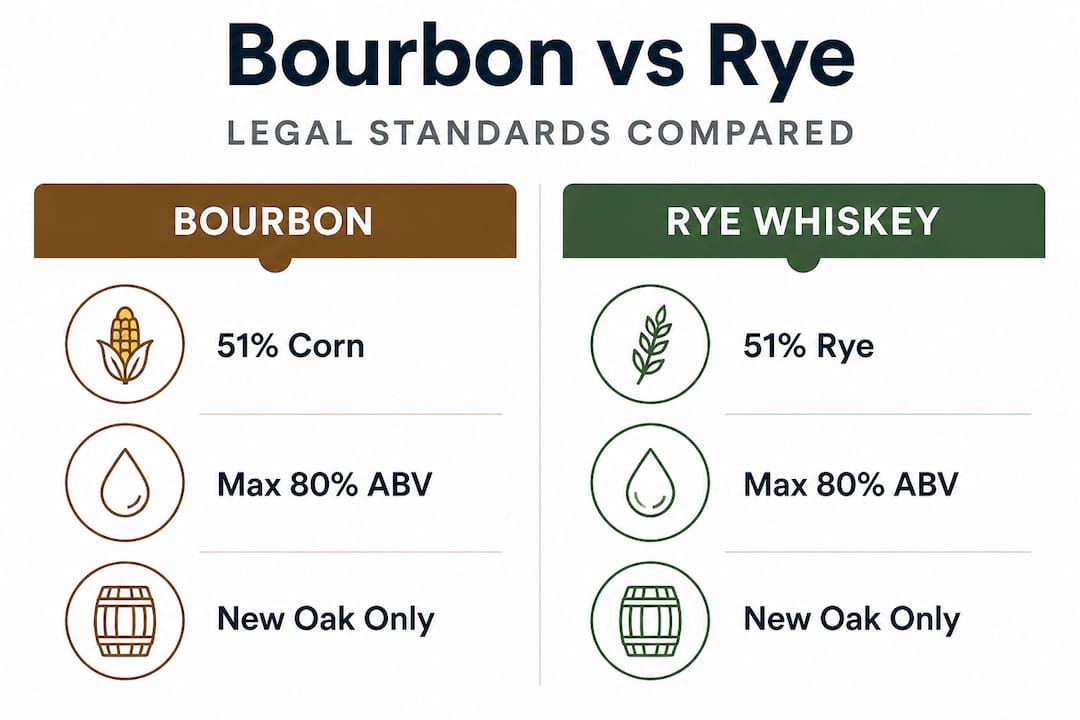
| Requirement | Bourbon | Rye whiskey |
|---|---|---|
| Primary grain minimum | 51% corn | 51% rye |
| Distillation limit | 160 proof (80% ABV) | 160 proof (80% ABV) |
| Barrel entry proof | Max 125 proof (62.5% ABV) | Max 125 proof (62.5% ABV) |
| Required barrel type | New charred oak | New charred oak |
| Additives permitted | None | None |
| Minimum bottling strength | 80 proof (40% ABV) | 80 proof (40% ABV) |
This table makes clear that the two categories diverge at one crucial point: the grain. Everything else is essentially equivalent at the baseline legal level. Understanding what defines bourbon versus understanding rye whisky at this level prevents you from paying a premium for a bottle labelled in a way that doesn’t match its flavour profile.
A common misconception is that secondary grains (malted barley, wheat, or the remaining rye/corn) don’t matter. In practice, those secondary grains influence the finished flavour enormously, but they don’t change the legal category. You can have a bourbon with significant rye as a secondary grain and it will still be bourbon, provided corn dominates at 51% or above.
Pro Tip: When buying American whiskey through Australian retailers, look for the words “straight bourbon” or “straight rye” on the label. “Straight” signals the spirit has been aged for a minimum of two years with no added colouring or flavouring, giving you an extra layer of quality assurance beyond the basic legal minimum.
How the mash bill shapes flavour in your glass
Now that you know the regulations, discover how what goes into the mash bill changes what you taste in the glass. This is where the collector’s investment either rewards or disappoints.
Corn is a starchy, sweet grain. When it ferments and distils, it yields a spirit with natural richness, vanilla-like sweetness, and a smooth, round mouthfeel. The bourbon flavour spectrum is dominated by notes of caramel, toffee, stone fruit, and toasted oak, all underpinned by that corny sweetness. Rye grain, by contrast, is assertive. It contributes spice, pepper, dried herb, and sometimes a pleasantly austere dryness that cuts through sweetness. The rye whisky flavours are often described as structured, angular, and savoury compared to bourbon’s rounder profile.

As Food & Wine notes, bourbon’s corn content makes it sweet and grain-forward, while rye asserts itself more aggressively in the finished product. That assertiveness is not a flaw. For many collectors and drinkers, it’s exactly the point.
| Flavour attribute | Typical bourbon | Typical rye whiskey |
|---|---|---|
| Primary taste | Sweet, round, mellow | Spicy, dry, structured |
| Aroma | Vanilla, caramel, stone fruit | Black pepper, dried herbs, rye bread |
| Mouthfeel | Full, oily, soft | Leaner, more angular |
| Finish | Warm, sweet, oaky | Dry, long, slightly bitter |
| Best temperature to serve | Room temp or with a single ice cube | Neat or over a large cube |
What enthusiasts most commonly notice when tasting side by side:
- Bourbon feels approachable immediately; rye demands a moment to open up
- Rye’s spice intensifies when the whiskey warms in the glass
- Bourbon sweetness can fade quickly; rye’s pepper often lingers on the finish
- High-proof rye can taste more intense at the same ABV as a comparable bourbon
- Barrel influence is easier to taste in bourbon because the sweetness and oak work together; in rye, the grain fights for attention alongside the wood
“The best way to understand the difference is to try them back to back with the same secondary grain profile. When the only variable is the primary grain, corn versus rye, the flavour shift is remarkable and immediate.”
Oak ageing unites both categories structurally, but it expresses itself differently in each. The new charred oak adds vanilla, caramel, and toasty notes to both. In bourbon, those oak notes reinforce the corn sweetness. In rye, the wood adds complexity without softening the spice, which is why well-aged rye whiskeys are considered some of the most complex American spirits available.
High-rye bourbon, pure rye and the collector’s dilemma
Having explored the typical flavour impact, let’s dig into the grey zone of high-rye bourbon and what it means for collectors and enthusiasts.
This is where things get genuinely tricky for buyers, especially those shopping online or importing bottles into Australia. Many popular bourbon expressions use a “high-rye” mash bill, meaning rye is the dominant secondary grain, sometimes in proportions as high as 35% to 40%. These bourbons taste noticeably spicy. They can easily be mistaken for rye whiskey by someone relying on flavour alone.
The legal position is firm, however. As American Whiskey Authority makes clear, the 51% primary grain threshold is the determining factor. A high-rye bourbon is still bourbon, not rye whiskey, no matter how peppery it tastes. Mislabelling or misidentifying a bottle based on flavour alone can cost collectors real money, particularly when purchasing on the secondary market.
Here are the label clues to look for when choosing bourbon or rye:
- The words “rye whiskey” or “straight rye whiskey” must appear on a true rye bottle
- If the label says “bourbon” anywhere, it cannot legally be rye, regardless of taste
- Some distilleries voluntarily print the mash bill on the label or bottle neck
- “High-rye bourbon” is a descriptor, not a regulated category, so treat it as a flavour note, not a classification
- Watch for import labels that summarise the category in small print near the ABV statement
Pro Tip: When assessing legal definitions and collector tips for a potential purchase, photograph the label before buying and search the distillery’s website for the official mash bill. This takes under two minutes and removes all ambiguity, especially valuable when buying at auction or through third-party platforms.
The collector’s risk here is real. A buyer who pays a rye premium for what is actually a high-rye bourbon has overspent. Conversely, a buyer who dismisses a true rye as “too spicy” because they’ve only tasted high-rye bourbons may miss outstanding bottles in the $80 to $150 Australian retail range that offer outstanding value and ageing potential.
Choosing rye or bourbon for drinking and mixing
Now let’s get practical. When should you reach for a rye or a bourbon for your next pour or cocktail?
The answer depends heavily on what you’re trying to achieve, and making the right choice starts with understanding the role each style plays in different contexts.
- Manhattan cocktails: Reach for rye. Bartenders consistently recommend a good spicy rye because it holds its character against sweet vermouth and bitters, even after dilution from stirring over ice.
- Old Fashioned with a sweeter profile: Bourbon is your friend here. The natural corn sweetness works beautifully with a sugar cube and orange bitters.
- Whiskey Sour: Either works, but rye adds a dry, citrus-compatible spice that many bartenders prefer for balance.
- Neat sipping for newcomers: Start with bourbon. The approachable sweetness creates a less confronting introduction to American whiskey.
- Neat sipping for experienced collectors: Try rye. The complexity and grain-forward character reward attention and patience.
- Highball or ginger beer mix: Both work, but rye’s spice punches through carbonation more effectively.
- Food pairing with rich meats: Bourbon’s sweetness complements smoked meats; rye pairs better with charcuterie or aged cheese.
Understanding grain types and flavour also helps when you’re building a collection rather than just buying for drinking. A cellar that contains both styles gives you flexibility for different occasions and a broader range of flavour experiences to share with guests.
“Rye handles dilution without losing its personality. Bourbon opened with water becomes gentle; rye opened with water becomes interesting. That’s the difference for cocktail work.”
Mixologists working in Australia’s growing whisky cocktail scene increasingly stock both categories precisely because they are not interchangeable. The spice architecture of a proper rye carries through a cocktail in a way that even a high-rye bourbon cannot fully replicate.
The hidden impact of mash bill choices on Australian collections
Here is something most articles about rye versus bourbon won’t tell you: in the Australian collector market, mash bill literacy is rapidly becoming a competitive advantage.
The casual buyer looks at the label, notes the price, maybe reads a tasting note or two. The serious collector asks what percentage of the mash is rye, whether it’s a wheated bourbon instead, and how the barrel proof interacts with the grain character. That level of attention matters more now because grain value in collections has become a genuine differentiator as global demand for American whiskey continues to climb.
Australia’s whisky collector market is young compared to Scotland’s secondary market, but it is growing quickly. Bottles of allocated American rye whiskeys, particularly those from Kentucky distilleries releasing small-batch and single-barrel expressions, are beginning to command premiums at auction. Buyers who understand that the mash bill is the defining characteristic of long-term flavour development are better positioned to make acquisitions that reward patience.
There is also a contrarian argument worth making: high-rye bourbons may actually be the smarter strategic buy for diversity-focused collectors right now. They sit at a lower price point than comparable true rye expressions, they offer substantial spice and complexity, and they are generally more available through Australian retail channels. A carefully assembled set of high-rye bourbons alongside two or three genuine rye expressions gives your collection a flavour spectrum that neither category alone can provide.
The mistake we see repeatedly is collectors who go all-in on one style without understanding where the flavour comes from. When you know that it’s the grain bill driving the character you love, you start to seek out different expressions of that grain rather than chasing brand names. That shift in thinking is where real collecting wisdom begins.
Explore top Australian whisky selections for rye and bourbon lovers
Ready to enhance your collection or try a new style? Whether you’re drawn to bourbon’s sweetness or rye’s assertive spice, a well-curated selection makes all the difference.

At Uisuki, we stock a carefully chosen range spanning both American and Australian expressions that speak directly to these flavour discussions. If you’re exploring bourbon-adjacent styles, the Hobart Whisky bourbon-matured rum-finished single malt offers a fascinating local take on bourbon barrel influence with Australian character. For those who love blended complexity, Ichiro’s Malt and Grain Limited Edition World Blended Whisky shows how grain-forward thinking translates across international styles. And if you want a Scotch benchmark for comparison, the Ardnamurchan MacLean’s Nose Blended Scotch provides a clear reference point for how grain character expresses itself beyond American whiskey traditions. Browse, compare, and reach out if you’d like a personalised recommendation.
Frequently asked questions
Can a bourbon also be a rye whiskey if it tastes spicy?
No. Regardless of flavour, the 51% primary grain threshold is what determines the legal category. A spicy bourbon is still bourbon; only a spirit made from at least 51% rye grain in the mash may be legally labelled rye whiskey.
What does the mash bill mean for collectors in Australia?
The mash bill determines legal category, core flavour character, and collectability. Serious Australian buyers check the mash bill before investing in both local and international bottles, as it directly influences long-term flavour development and auction market value.
Why do some cocktails specify rye instead of bourbon?
Rye whiskey’s spice and structural dryness help it maintain character in cocktails like the Manhattan, where rye handles dilution far better than bourbon without losing the flavour the cocktail depends on.
Are Australian rye and bourbon-style whiskies made the same way?
Australian distillers may follow similar production principles but local regulations differ from U.S. federal law. Always check the actual mash bill and label description rather than assuming Australian expressions follow American legal definitions exactly.
Does ageing impact rye and bourbon differently?
Both are aged in new charred oak under the same baseline standards, so the differences you taste reflect grain character interacting with oak over time, not simply the wood itself. Rye tends to develop more savoury complexity; bourbon leans further into sweetness and vanilla as it ages.