

TL;DR:
- Bourbon must meet strict federal standards including 51% corn, specific proof limits, and new charred oak barrels.
- Straight bourbon requires at least two years of aging and no added coloring or flavoring.
- Proper label compliance is essential for authenticity, value, and accurate collection documentation.
Not all bourbon is created equal, and not every bottle labelled “bourbon” meets the strict legal standards that serious collectors rely on. For those who appreciate the nuance behind a well-chosen whisky, understanding what legally defines bourbon whiskey is not simply trivia. It shapes what you drink, what you pay, and what your collection is actually worth. The federally mandated standards governing bourbon are precise, sometimes counterintuitive, and far more consequential than most enthusiasts initially expect. This guide breaks down each layer of the definition so you can read labels with confidence, make smarter purchasing decisions, and protect your collection from misleading marketing.
Table of Contents
- What is bourbon whiskey? The legal definition
- The rules of straight bourbon: How it differs and why it matters
- Label compliance: Knowing what makes a bourbon label ‘official’
- Bourbon expressions and collector cues: Beyond the basics
- What most collectors miss about bourbon whiskey definitions
- Explore and collect bourbon expressions with confidence
- Frequently asked questions
Key Takeaways
| Point | Details |
|---|---|
| Legal definition | Bourbon must follow U.S. federal standards for ingredients, distillation, and aging. |
| Straight bourbon | Straight bourbon is a stricter class requiring at least two years of aging and no additives. |
| Label compliance | Only bottles matching legal type and class can call themselves ‘bourbon’ or ‘straight bourbon’. |
| Collector tips | Verify label details and regulatory status to ensure authenticity and value for your collection. |
What is bourbon whiskey? The legal definition
Bourbon whiskey is not simply a style or a regional tradition. It is a federally defined type of whisky with specific production standards. These standards, known as a “standard of identity,” override brand storytelling, pricing, and heritage claims. If a whisky does not meet the criteria, it cannot legally carry the bourbon designation in the United States marketplace, regardless of what the producer says on its website or social media.
The core requirements are precise and unambiguous. Understanding them is the first skill every serious enthusiast needs to develop.
The core bourbon requirements at a glance:
- Grain bill: At least 51% corn in the mash
- Distillation proof: Must not exceed 160° proof (80% ABV)
- Entry proof: Must enter the barrel at no more than 125° proof (62.5% ABV)
- Barrel type: New charred oak containers only
- Additives: None. No colouring, flavouring, or blending with other spirits
- Bottling strength: Must be bottled at a minimum of 80° proof (40% ABV)
One detail that surprises many collectors is the barrel requirement. Unlike Scotch whisky, which can be matured in a wide range of previously used casks, bourbon must use brand new charred oak barrels for every batch. This single requirement is one of the biggest drivers of bourbon’s characteristic vanilla, caramel, and toasted wood flavour profile. It also means that once a barrel has been used for bourbon, it can never be used again for bourbon, which is why so many Scotch and Irish distilleries source second-fill American oak casks.
There is also no minimum ageing requirement for standard bourbon. A spirit could technically meet all other criteria and be bottled immediately, though almost no serious producer does this. This is a critical distinction when you begin exploring the difference between bourbon and whiskey more broadly, as ageing requirements vary significantly across categories.
| Requirement | Standard |
|---|---|
| Grain bill | Minimum 51% corn |
| Distillation proof | Maximum 160° proof |
| Barrel entry proof | Maximum 125° proof |
| Barrel type | New charred oak |
| Additives | None permitted |
| Bottling proof | Minimum 80° proof |
| Ageing duration | No minimum for standard bourbon |
“Bourbon whisky is a federally defined type with specific production standards. If a spirit fails any single requirement, it loses the bourbon designation entirely, regardless of price, heritage, or marketing.”
These requirements also explain why comparing bourbon to other styles like rye whisky requires careful attention to grain content and barrel selection. For those curious about the distinctions, a closer look at bourbon vs rye whisky reveals how small shifts in grain percentages produce dramatically different flavour outcomes.
The rules of straight bourbon: How it differs and why it matters
If all bourbon is defined by the federal standards above, what separates “straight bourbon” from ordinary bourbon? This is where the labelling becomes especially important for collectors.
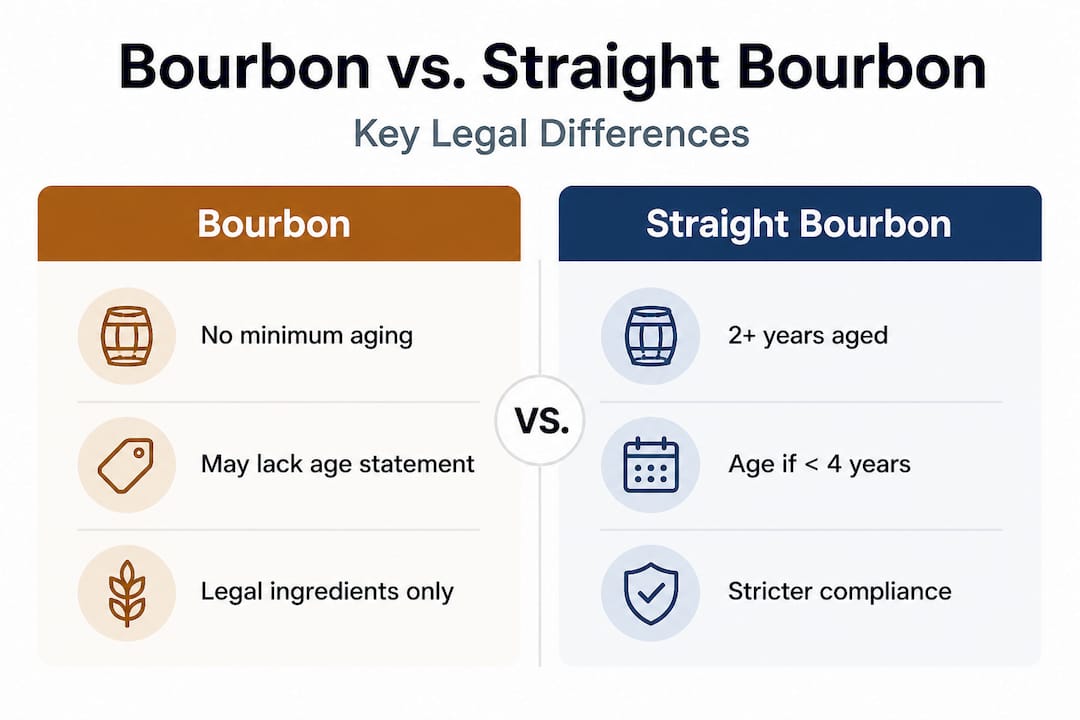
Straight bourbon whisky is a stricter subcategory that builds on the base bourbon definition with additional ageing, labelling, and additives constraints. These extra rules are not cosmetic. They signal a meaningfully different product and carry direct implications for what the bottle is worth on the secondary market.
The additional requirements for straight bourbon are:
- The spirit must be aged for a minimum of two years in new charred oak barrels.
- If aged for less than four years, the age must be stated on the label as a mandatory disclosure.
- No colouring, flavouring, or other spirits may be added after distillation under any circumstances.
- The whisky must meet all of the core bourbon requirements before it can claim the “straight” designation.
- If the bourbon is a blend of straight bourbons from different states, the label must disclose the state of origin or use the term “Kentucky Straight Bourbon” only if all of the whisky was produced in Kentucky.
This last point catches many collectors off guard. A bottle labelled “Kentucky Straight Bourbon Whiskey” carries the implicit guarantee that every drop of that spirit was distilled and aged within the state of Kentucky. That geographic specificity is part of what drives the premium pricing around certain Kentucky producers.
| Criteria | Bourbon | Straight bourbon |
|---|---|---|
| Minimum ageing | None | 2 years |
| Age statement required | No | Yes, if under 4 years |
| Additives permitted | No | No |
| Geographic labelling | Not required | Required if multi-state blend |
Pro Tip: When comparing bottles at auction or in a shop, check whether a “straight bourbon” is under four years old. If it is, federal rules require an age statement. The absence of one on a young bottle is a potential red flag worth investigating before you buy.
The practical difference between bourbon and straight bourbon matters enormously for collections with resale value in mind. Understanding bourbon vs whiskey comparisons at this level of detail also clarifies why certain age statements command such loyalty among enthusiasts, and how the definitions interact with broader styles like Scotch and bourbon when you are assessing a mixed collection.
Label compliance: Knowing what makes a bourbon label ‘official’
Understanding straight bourbon’s enhanced requirements leads directly to one of the most practically useful collector skills: reading and verifying what a label actually claims versus what it is legally permitted to claim.
In the United States, the Alcohol and Tobacco Tax and Trade Bureau, known as the TTB, oversees all distilled spirits labelling. The TTB labelling guidance treats the class and type designation, such as “Bourbon Whiskey” or “Straight Bourbon Whiskey,” as a required label element. This means the labelling category and the actual production standard must align precisely. A spirit that fails one requirement is no longer compliant with its stated designation, even if every other element checks out.
For collectors, label compliance is the practical benchmark. If a bottle’s claims do not align with the applicable US standards of identity, the label designation is no longer legally valid and the bottle’s representation as a compliant bourbon or straight bourbon collapses entirely.
Common compliance pitfalls to watch for:
- Products branded as “bourbon” that were distilled or aged outside the US, where federal standards may not apply
- Labels using the word “straight” without meeting the two-year ageing minimum
- Spirits with colouring or flavouring that still describe themselves with the bourbon class designation
- Age statements that are technically correct but structured to imply a longer maturation than the youngest component
- “Bourbon-style” or “bourbon-inspired” language used to sidestep the legal definition while mimicking its visual and market associations
Pro Tip: Before adding a bottle to your collection, cross-reference the label’s stated class designation against the TTB’s publicly accessible labelling database. This is especially important for limited releases or imported expressions that trade on bourbon-adjacent branding.
Knowing why whisky label details matter for collection value is a skill that pays dividends over time. If you are also trying to identify rare whisky with genuine investment potential, label compliance is consistently one of the most overlooked verification steps.
Bourbon expressions and collector cues: Beyond the basics
Identifying a compliant label is the foundation, but serious collectors quickly encounter a second layer of complexity: special bourbon expressions that carry additional marketing terms. Words like “single barrel,” “small batch,” and “cask strength” appear across premium releases, and each needs to be assessed against the core bourbon and straight bourbon definitions before being taken at face value.
These terms are not federally regulated in the same way as “bourbon” and “straight bourbon.” There is no legal minimum or maximum number of barrels that qualifies as “small batch,” and “single barrel” has no standardised proof or age requirement attached to it. This means a producer has significant discretion over how these expressions are framed, which is why the underlying bourbon classification on the label remains the authoritative source of information for compliance purposes.
Collector cues for special bourbon expressions:
- Confirm that the base designation is either “Bourbon Whiskey” or “Straight Bourbon Whiskey” before evaluating any additional descriptors
- “Cask strength” or “barrel proof” simply means the spirit has not been diluted after barrel ageing. Check that it still meets the minimum 80° proof bottling requirement
- Look for age statements on any expression aged under four years, as absence of this statement on a young spirit is a regulatory breach
- “Single barrel” releases can vary dramatically between barrels. Request the barrel number and bottling date where possible
- Recognised bourbon expressions from established producers generally carry stronger compliance histories, but this is not a substitute for reading the label yourself
The quality criteria that separate exceptional bourbon from mediocre bourbon are not always found in the marketing copy. They live in the specific combination of grain bill, distillation proof, barrel char level, ageing duration, and warehousing conditions that the regulations constrain but do not fully dictate. Once you understand what the law requires, you are in a much better position to evaluate what a producer has chosen to do beyond the baseline.
Pro Tip: Build a habit of photographing the full label, including the back label and any regulatory language, whenever you acquire a new bottle. This creates a personal compliance record and is invaluable if you ever consider selling or trading from your collection.
What most collectors miss about bourbon whiskey definitions
Here is the honest truth that most bourbon discussions avoid. Brand heritage and bottle price do not guarantee compliance. A celebrated producer with decades of history and a four-figure secondary market price tag can still release an expression that skirts the edges of the standard of identity, especially in the premium limited edition space where TTB scrutiny is occasionally slower than the hype cycle.
The deeper issue is that many collectors treat the legal definition as background noise rather than the primary framework for valuation. They focus on flavour scores, brand reputation, and scarcity. These factors matter, but they are all downstream of the fundamental question: does this bottle actually represent what it claims to be?
The boldest finds in any collection can still fail legal definitions. A non-compliant label does not just create a technical problem. It actively undermines a bottle’s resale value, its provenance story, and its position in a collection built around authentic expressions. We have seen collectors discover, years after purchase, that a “straight bourbon” in their collection did not carry a required age statement for a sub-four-year spirit. That absence alone is a compliance failure, and it changes the conversation when it comes time to value the bottle.
What we encourage enthusiasts to develop is what we call “label literacy.” This means understanding the limits and possibilities of bourbon’s legal identity well enough to spot inconsistencies before they become costly errors. It means knowing that label details for collectors are not bureaucratic formalities. They are the language through which a product’s authenticity is expressed.
The collectors who get the most out of bourbon, both in enjoyment and in long-term value, are those who treat regulatory knowledge as part of the hobby. Not because regulators are always right, but because the standards define the category, and the category defines the value.
Explore and collect bourbon expressions with confidence
Understanding bourbon’s legal framework changes how you approach every bottle.

At Uisuki, we curate a selection of premium American whiskies including verified bourbon and straight bourbon expressions, alongside rare and hard-to-find bottles from Scotland, Japan, and Australia. Our product listings include detailed descriptions, ABV percentages, and distillery information to support informed purchasing decisions. Whether you are building a collection around Kentucky straight bourbon or exploring international expressions that complement your American whisky shelf, our team can assist with sourcing requests and personalised recommendations. Browse our current bourbon selection and use your label literacy to make every acquisition count.
Frequently asked questions
What is the minimum corn content for bourbon whiskey?
Bourbon whiskey must be made from a mash containing at least 51% corn, with the remainder typically comprising malted barley, rye, or wheat.
Can bourbon whiskey contain additives or colourings?
No. Bourbon must not include any additives or colourings to meet the legal definition, which is one of its key distinguishing features from other whisky styles.
What does “straight bourbon” mean on a whisky label?
“Straight bourbon” means the spirit meets all standard bourbon requirements and has been aged for a minimum of two years in new charred oak, with no additives permitted at any stage.
How can collectors confirm a bourbon’s label is compliant?
Check that the label’s type designation, proof, and all content claims match US federal standards, and consult the TTB labelling guidance or its public database for any expressions you are uncertain about.