

TL;DR:
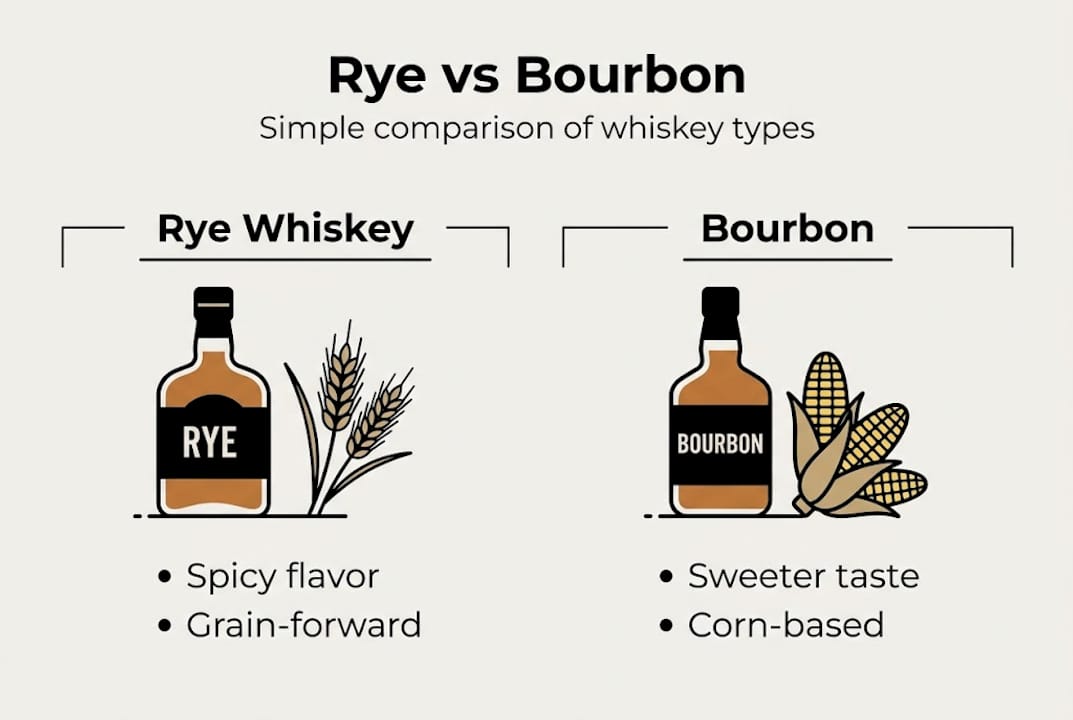
- Rye whiskey and bourbon differ mainly in their grain compositions, with rye containing at least 51% rye and bourbon at least 51% corn.
- Bourbon is generally sweeter with vanilla and caramel notes, while rye is spicier and herbal with peppery flavors.
- Both spirits follow similar production rules but have distinct flavor profiles and ideal uses in cocktails.
Walk into any bottle shop or browse an online whisky store and you’ll likely see rye whiskey and bourbon sitting side by side, looking almost identical. Many first-time buyers assume they’re basically the same thing with different labels. They’re not. The grain bill, flavour profile, and best uses differ in ways that genuinely change your drinking experience. Once you understand what separates them, you’ll stop second-guessing at checkout and start choosing with confidence. This guide breaks down the legal definitions, flavour differences, production quirks, and practical buying advice so you can pick the right bottle every single time.
Table of Contents
- What defines rye whiskey and bourbon
- How rye and bourbon taste: Flavours and serving styles
- Production process and its subtle impacts
- Edge cases, regions and buying advice
- What most guides miss: Why difference doesn’t always matter — and when it really does
- Explore the world of American whiskey with Uisuki
- Frequently asked questions
Key Takeaways
| Point | Details |
|---|---|
| Mash bill matters | Bourbon must have at least 51% corn, rye whiskey at least 51% rye, shaping their signature flavours. |
| Distinct flavour profiles | Bourbon is sweeter and smoother, while rye brings bold, spicy and herbal notes to the glass. |
| Similar strict standards | Both spirits must follow US regulations for ageing, barrels, and no additives, ensuring high quality. |
| Cocktail compatibility | Rye stands out in spicy cocktails, while bourbon excels in sweeter mixes or sipping neat. |
| Personal taste rules | Try both to decide which suits your palate and favourite serves—there’s no wrong answer. |
What defines rye whiskey and bourbon
Now that you know why it matters, let’s look at what makes each spirit unique by definition.
Both rye whiskey and bourbon are American spirits governed by the same federal regulations, but the single biggest distinction sits in the grain mixture used to make them. The mash bill requirement is clear: bourbon needs at least 51% corn, while rye whiskey needs at least 51% rye grain. That one difference in grain percentage is what drives everything else, from flavour to mouthfeel to cocktail suitability.
Beyond the mash bill, the two spirits share a surprising number of rules. Both must be distilled and barrelled to specific proof limits, aged in new charred oak barrels, bottled at no less than 80 proof, produced in the United States, and contain no additives other than water. These shared standards mean the quality floor is consistent across both categories.
The term “straight” adds another layer. For straight designation, both spirits require a minimum of two years ageing, and any bottle aged under four years must carry an age statement on the label. This is useful information when you’re shopping, because it tells you exactly how long that whiskey has been developing its character in the barrel.
| Feature | Bourbon | Rye whiskey |
|---|---|---|
| Primary grain | Minimum 51% corn | Minimum 51% rye |
| Distillation limit | 160 proof max | 160 proof max |
| Barrel entry proof | 125 proof max | 125 proof max |
| Barrel type | New charred oak | New charred oak |
| Minimum bottle proof | 80 proof | 80 proof |
| Country of origin | United States | United States |
For a broader look at how these rules fit into the wider whisky world, the difference between whiskey and bourbon is worth reading alongside this. And if you want to dig further into grain-specific distinctions, the whisky and rye differences article covers the nuances well.
Key shared production requirements:
- Produced in the United States
- Aged in new charred oak barrels
- No additives other than water
- Bottled at no less than 80 proof
- Distilled to no more than 160 proof
Pro Tip: If you’re shopping and unsure which category a bottle belongs to, check the mash bill on the label or the distillery’s website. A higher rye percentage, even in a bourbon, will give you a spicier, drier flavour than a standard corn-forward bourbon.
How rye and bourbon taste: Flavours and serving styles
Understanding the rules is step one. Now, let’s explore how those rules turn into distinct flavours in your glass.

The grain bill doesn’t just determine legal classification. It shapes every sip. Bourbon’s flavour profile leans sweet, with prominent notes of vanilla, caramel, and oak. That sweetness comes directly from the high corn content, which produces more fermentable sugars and interacts beautifully with the charred oak barrel during ageing. The result is a spirit that feels round, warm, and approachable, especially for new drinkers.
Rye whiskey takes a very different direction. Its flavour profile is spicier, more herbal, and peppery, with notes of dill, mint, and black pepper. Where bourbon wraps you in warmth, rye cuts through with a sharper, more assertive character. That boldness is exactly why bartenders have long preferred rye in classic cocktails.
“Rye brings boldness and structure to a cocktail. Bourbon brings balance and sweetness. Knowing which you want is the difference between a good drink and a great one.”
This flavour contrast matters enormously when you’re building cocktails. Rye’s spice makes it the traditional choice for a Sazerac or a classic Manhattan, where the grain’s assertiveness holds its own against bitters and vermouth. Bourbon’s sweetness shines in an Old Fashioned or a Whiskey Sour, where its caramel notes complement rather than compete. For more on how rye whisky flavours develop, it’s worth exploring the grain’s full story.
| Bourbon | Rye whiskey | |
|---|---|---|
| Primary flavours | Vanilla, caramel, oak | Pepper, dill, mint, spice |
| Mouthfeel | Round, full, smooth | Dry, lean, assertive |
| Best neat or on ice | Yes, especially for beginners | Yes, for those who enjoy spice |
| Best cocktail use | Old Fashioned, Whiskey Sour | Manhattan, Sazerac |
Recommended cocktails by spirit:
- Bourbon: Old Fashioned, Whiskey Sour, Mint Julep, Boulevardier
- Rye whiskey: Manhattan, Sazerac, Toronto, Paper Plane
If you want a full breakdown of flavour categories and what to look for when tasting, the bourbon flavour guide is an excellent companion read.
Production process and its subtle impacts
Alongside flavour, the art of making these spirits plays a role in what ends up in your bottle.
Both rye whiskey and bourbon follow the same core production stages: mashing the grain, fermenting the mash, distilling the liquid, and ageing it in barrel. The process is broadly identical, but there’s one practical difference that every distiller knows. Rye grain is stickier than corn, which makes handling the mash more challenging and can require specialised equipment or adjusted processes at the distillery level.
That stickiness is a small detail with big implications. It’s part of why rye whiskey production can be more labour-intensive, and it contributes to why some smaller distilleries find bourbon an easier starting point.
When it comes to ageing, the two spirits take different paths. Rye tends to assert grain flavours more directly, which means it’s often bottled younger because the grain character is the point. Bourbon, by contrast, relies heavily on the barrel for its signature sweetness and complexity, which is why longer ageing tends to reward bourbon drinkers with richer, more layered expressions.
The key production stages for both spirits:
- Milling: Grains are ground into a coarse flour called grist.
- Mashing: Grist is cooked with water to convert starches into fermentable sugars.
- Fermenting: Yeast is added to convert sugars into alcohol, creating the “distiller’s beer.”
- Distilling: The liquid is distilled to concentrate alcohol and remove impurities.
- Barrel ageing: The new make spirit goes into new charred oak barrels to develop flavour and colour.
- Bottling: The aged whiskey is diluted to bottling proof with water and sealed.
Pro Tip: When comparing two bottles of similar age, a rye will often taste more vibrant and grain-forward, while a bourbon of the same age will feel more barrel-influenced. Age statements tell part of the story, but the grain bill tells the rest. Understanding why age matters in whisky and the whisky ageing process will sharpen your ability to read a label with confidence.
Edge cases, regions and buying advice
Even with clear rules, there are some tricky exceptions, and practical advice can make all the difference at checkout.
One of the most confusing terms you’ll encounter is “high-rye bourbon.” This is a bourbon where the mash bill contains 20 to 35% or more rye but still meets the minimum 51% corn requirement. It’s legally classified as bourbon, not rye whiskey, but it tastes noticeably spicier than a standard corn-forward bourbon. High-rye bourbons are a brilliant bridge for drinkers who love bourbon but want more bite.
Regional variation adds another layer of complexity. US rye whiskey styles vary significantly by region. Kentucky rye tends to be corn-heavy and bourbon-like in character. Pennsylvania rye is high-rye and bold, the style that defined American rye before Prohibition. Maryland rye sits in the middle, softer and more approachable. Knowing the regional style of the bottle you’re considering gives you a much better idea of what to expect.
Here’s a practical buying framework depending on where you’re starting from:
- New to American whiskey? Start with a standard bourbon. The sweetness and approachability make it an easy entry point.
- Ready for more complexity? Try a high-rye bourbon. You get the familiar bourbon structure with added spice.
- Chasing bold flavour? Go straight to a rye whiskey, particularly a Pennsylvania-style expression.
- Building cocktails? Rye for spirit-forward drinks, bourbon for sweeter, more balanced serves.
It’s also worth noting that the differences between rye and bourbon may be less obvious than you’d expect without training. A 2016 blind study involving 21 participants found that average consumers tend to group whiskies by brand, ABV, and age rather than mash bill, suggesting the distinctions can be subtler in practice than on paper. That’s not a reason to ignore the differences. It’s a reason to taste more deliberately.
For a side-by-side look at how these spirits stack up against other American styles, the American whiskey comparison guide is a smart next read.
What most guides miss: Why difference doesn’t always matter — and when it really does
With all these details laid out, there’s one crucial perspective that often gets left out of the discussion.
Most whisky content treats the rye versus bourbon distinction as a clear, decisive line. In reality, it’s more of a spectrum, and where you sit on that spectrum depends on how you drink. A 2016 blind study showed that casual drinkers consistently struggle to identify the difference without guidance. That’s not a failure. It’s actually liberating. It means you don’t need to be an expert to enjoy either spirit.
For casual drinkers, brand familiarity and context often matter more than technical definitions. The bottle you open at a barbecue with friends is doing a different job than the one you sip neat on a quiet evening. But here’s where flavour awareness starts to pay off: once you understand what rye brings versus what bourbon brings, you can make smarter choices in both settings. You’ll know when to reach for the spice and when to lean into the sweetness.
Enthusiasts who chase the subtle differences between mash bills, distilleries, and ageing regimes unlock a genuinely rewarding world. The gap between rye and bourbon isn’t always massive, but it’s real, and learning to taste it is one of the most satisfying skills a whisky lover can develop. Exploring the bourbon and whiskey differences in depth is a great place to sharpen that palate.
Explore the world of American whiskey with Uisuki
Now that you know the crucial differences, here’s where you can put that knowledge into action.
At Uisuki, we’ve curated a selection of American whiskies that spans the full spectrum from approachable, sweet bourbons to bold, grain-forward rye expressions. Whether you’re buying your first bottle or hunting for something rare and hard to find, knowing what you’re looking for makes the experience far more satisfying.

Browse our discover American whiskey selection and filter by style, region, or ABV to find exactly what suits your palate. Our product listings include detailed tasting notes, mash bill information where available, and expert recommendations. You’ve done the reading. Now it’s time to do the tasting.
Frequently asked questions
Is rye whiskey stronger than bourbon?
Rye whiskey isn’t necessarily higher in alcohol. Both spirits must be bottled at 80 proof minimum by law, but rye tends to taste bolder and spicier, which can make it feel more intense.
Can you use rye whiskey and bourbon interchangeably in cocktails?
You can swap them in most recipes, but the result will taste different. Rye suits spicy cocktails like the Sazerac, while bourbon works better in sweeter serves like the Old Fashioned.
What does ‘high-rye bourbon’ mean?
High-rye bourbon contains 20 to 35% or more rye in its mash bill but is still classified as bourbon because corn makes up at least 51% of the grain mixture.
Why does bourbon taste sweeter than rye?
Bourbon tastes sweeter because its mash bill is dominated by corn, which produces more fermentable sugars and generates those characteristic vanilla and caramel notes during barrel ageing.
Does age affect rye and bourbon differently?
Yes. Both require minimum two years ageing for a straight designation, but bourbon often benefits from longer time in barrel, while rye is sometimes bottled younger to preserve its vibrant grain character.