

Scotch whisky is built on malted barley. Every category of Scotch, from a peaty Islay single malt to a light blended grain, must include malted barley by law. Under the Scotch Whisky Regulations 2009, all Scotch must be distilled in Scotland from water, yeast, and cereals, with malted barley as the non-negotiable foundation. Here is how the grains break down across styles:
- Single Malt Scotch: 100% malted barley, pot still distillation, single distillery
- Single Grain Scotch: malted barley plus other cereals (usually wheat or maize), continuous column still
- Blended Scotch: a combination of malt and grain whiskies from multiple distilleries
- Grain Scotch mash: typically around 90% unmalted wheat or maize, with roughly 10% malted barley added to supply the enzymes needed for starch conversion
- Uncommon grains: rye and oats are legally possible in Grain Scotch but require careful legal review before use
The malted barley is not just an ingredient. It is the enzymatic engine that makes the whole process work.
What types of grain are used in Scotch whisky production?
Scotch draws on a narrow but deliberate range of cereals, each chosen for a specific biochemical or flavour purpose rather than convenience.
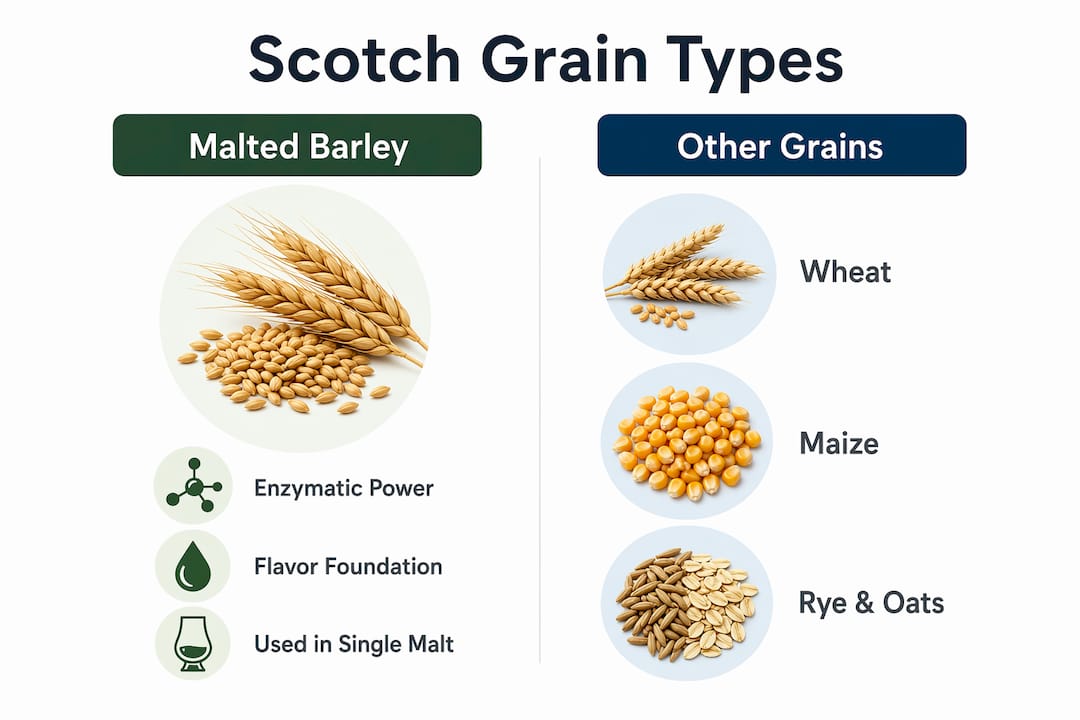
Malted barley is the cornerstone. Barley is steeped in water, allowed to partially germinate, then kiln-dried to halt the process. Germination activates alpha- and beta-amylase enzymes, which later convert grain starches into fermentable sugars during mashing. No other cereal does this job as efficiently under Scottish regulations, which prohibit added enzymes entirely.
Wheat became the dominant unmalted grain in Grain Scotch production during the 1980s, largely because European Economic Community pricing and export refunds made it commercially attractive. Soft winter wheat is the standard variety. It contributes a high starch load and produces a lighter, slightly sweet spirit well suited to blending.
Maize was the traditional grain of choice before wheat took over. Some distilleries have returned to it for consistency, processability, and energy efficiency. Maize contains approximately 72% starch on a dry weight basis, making it an effective carbohydrate source for grain distillers.
Rye and oats sit at the edges of what is legally permissible. The Scotch Whisky Association strongly advises any distillery considering these grains to consult its legal team first, since the resulting spirit must still fall within the colour, taste, and aroma profile traditionally associated with Scotch Whisky.
Grain sourcing and quality matter more than most drinkers realise. Distilleries typically source malted barley under contract from commercial maltsters, and the nitrogen content of that barley is closely monitored. Barley with nitrogen content above 1.8% delivers the high Diastatic Power needed for full starch conversion across the entire mash, including any unmalted cereals in the mix.
How do single malt, single grain, and blended Scotch differ?
The five legal categories of Scotch reflect genuine differences in grain composition and production method, not just marketing labels.
Single Malt uses 100% malted barley, distilled in copper pot stills at a single distillery. The pot still retains more of the grain’s natural character, producing a spirit with greater complexity, weight, and the kind of flavour congeners that reward long maturation. Think of the rich, waxy texture of a Highlands expression or the medicinal smoke of an Islay malt.
Single Grain combines malted barley with other cereals, typically wheat or maize, and is distilled in continuous column stills. Column distillation strips out more congeners, yielding a lighter, smoother spirit. Single Grain whiskies are often underrated as standalone bottles, but they carry a delicate sweetness and approachability that makes them genuinely enjoyable to drink young.
Blended Scotch accounts for around 90% of all Scotch Whisky sales, and Grain whisky is its backbone. The Grain component provides a consistent, lighter base that balances the richness and intensity of Single Malt components. Getting that ratio right is the blender’s art.
| Category | Grain requirement | Distillation method | Distillery requirement |
|---|---|---|---|
| Single Malt | 100% malted barley | Pot still | Single distillery |
| Single Grain | Malted barley + other cereals | Column still | Single distillery |
| Blended Malt | 100% malted barley | Pot still | Multiple distilleries |
| Blended Grain | Other cereals | Column still | Multiple distilleries |
| Blended Scotch | Mix of malt and grain whisky | Mixed | Multiple distilleries |
Blended Scotch accounts for around 90% of all Scotch Whisky sales, and Grain whisky is its backbone.
How does grain choice shape Scotch whisky flavour?
The grain selection and mash handling directly controls which congeners form during fermentation, and congeners are what give Scotch its aroma and flavour range. This is not a minor variable.
Malted barley supplies the amylase enzymes that break starch into fermentable sugars. The composition of those sugars influences which yeast strains thrive and, in turn, which esters, aldehydes, and higher alcohols the yeast produces. A mash built on malted barley alone tends to produce a wort rich in complex sugars, supporting a fermentation that generates more flavour-active compounds.
Unmalted wheat or maize, by contrast, contributes a simpler starch profile. The resulting wort ferments more cleanly, and column distillation amplifies that effect by removing heavier congeners. The spirit that emerges is lighter and smoother, with less of the oily, waxy character you find in pot still malt whisky. That is not a flaw; it is the point. Grain whisky is designed to carry a blend without overwhelming it.
Pro Tip: When reading a Grain Scotch label, look for “high DP malted barley” references in distillery notes. Barley selected for Diastatic Power above 1.8% nitrogen delivers more complete starch conversion, which means a cleaner fermentation and a more consistent spirit across batches.
Grain choice also shapes how a whisky matures. Malt whiskies, with their denser congener load, tend to benefit from longer time in oak. Grain whiskies can develop elegantly over shorter periods, though well-aged single grain expressions can surprise even experienced drinkers with their depth.
How did grain use in Scotch production develop historically?
Scotch whisky’s grain story is one of practical adaptation as much as tradition. Early Highland distillers worked with whatever cereal grew locally, and barley was the obvious choice given Scotland’s climate and soil. Pot still production using 100% malted barley became the defining method for malt whisky, with skills and processes handed down across generations.
The industrial shift came in the 19th century with the invention of the Coffey still, also called the patent or continuous still, by Aeneas Coffey in 1831. This technology allowed distillers to process large volumes of unmalted grain far more efficiently than pot stills ever could. Lowland grain distilleries adopted it quickly, and maize became the standard unmalted cereal for most of the 20th century.
The 1980s brought another shift. EEC pricing structures made soft winter wheat more economical than maize, and most Scottish grain distilleries switched. Regional variation in grain use today largely reflects these economic and logistical realities rather than flavour-driven choices, though some distilleries have returned to maize specifically for its consistency and processing advantages.
What happens during malting, and why does it matter?
Malting transforms raw barley from a dormant seed into a grain capable of converting its own starch into sugar. The process has three stages: steeping, germination, and kilning.
Steeping saturates the barley in water for roughly 48 hours, triggering the biological signals that begin germination. During germination, which runs for four to seven days on malting floors or in mechanical turning drums, the grain produces alpha- and beta-amylase enzymes. These enzymes begin breaking down the protein matrix surrounding the starch granules, making the starch accessible for later conversion in the mash tun.
Kilning stops germination by applying heat. At distilleries that use peat, the kiln fire introduces phenolic compounds from burning peat smoke, which bind to the malt and carry through into the final spirit. Phenol levels are measured in parts per million; lightly peated malts sit around 5–15 ppm, while heavily peated expressions can exceed 160 ppm. The malting process is where Scotch’s famous smoky character originates, not in the distillery itself.
What roles do wheat, maize, and other less common grains play?
Wheat and maize are the workhorses of Grain Scotch production, but they function very differently from malted barley. Neither contains meaningful enzyme activity on its own. Their job is to supply starch, and they do it efficiently. Wheat’s soft, fine-milled starch gelatinises readily at lower temperatures, making it straightforward to process. Maize requires higher temperatures to liquefy its starch, but its approximately 72% starch content on a dry weight basis makes it one of the most carbohydrate-dense options available to distillers.
Rye brings a spicy, dry character familiar to drinkers of North American whiskey styles. In Scotch production, its use is legally complex. The resulting spirit must still sit within the traditional Scotch flavour profile, and rye’s assertive character can push a mash outside those boundaries. Oats present similar challenges, with a higher fat content that can affect distillation and spirit character in ways that require careful management.
The whisky grain types used in any given Grain Scotch are ultimately a balance between enzymatic capacity, starch yield, processability, and the flavour target the distiller is working toward. It is a deliberate set of choices, not a default.
Key takeaways
Malted barley is legally required in every category of Scotch whisky, supplying the enzymes that convert starch to sugar, while wheat and maize provide the starch base for lighter Grain Scotch styles.
| Point | Details |
|---|---|
| Malted barley is mandatory | Every Scotch category must include malted barley; Single Malt uses it exclusively at 100%. |
| Grain Scotch incorporates malted barley as a minority portion of the mash | The remaining mash is typically unmalted wheat or maize, providing starch for fermentation. |
| No added enzymes are permitted | Scotch regulations require all starch conversion to rely on malted barley’s natural amylases. |
| Grain choice controls flavour congeners | Mash composition and grain selection directly shape the aroma and flavour spectrum of the final spirit. |
| Blended Scotch dominates sales volumes | Grain whisky forms the consistent base in blended expressions, which account for around 90% of all Scotch sales. |