

TL;DR:
- All whiskey is a distilled grain spirit aged in wood, but bourbon and Scotch are distinct types based on origin and production. Bourbon is an American whiskey made from at least 51% corn and aged in new charred oak barrels, offering a sweet flavor profile, while Scotch is a Scottish product from malted barley aged in reused casks with a wide flavor range. The spelling of whiskey or whisky indicates geographic tradition without quality implications.
All bourbon is whiskey, and all Scotch is whisky, but not all whiskey is either. The three are related by category and separated by geography, grain, and law. Whiskey is the broad umbrella for any distilled grain spirit aged in wood. Bourbon sits inside that umbrella as an American whiskey built on corn. Scotch sits inside it too, but as a Scottish product built on malted barley with its own strict rulebook.
The core differences at a glance:
- Whiskey/whisky: the overarching category for grain spirits distilled and aged in oak, produced worldwide
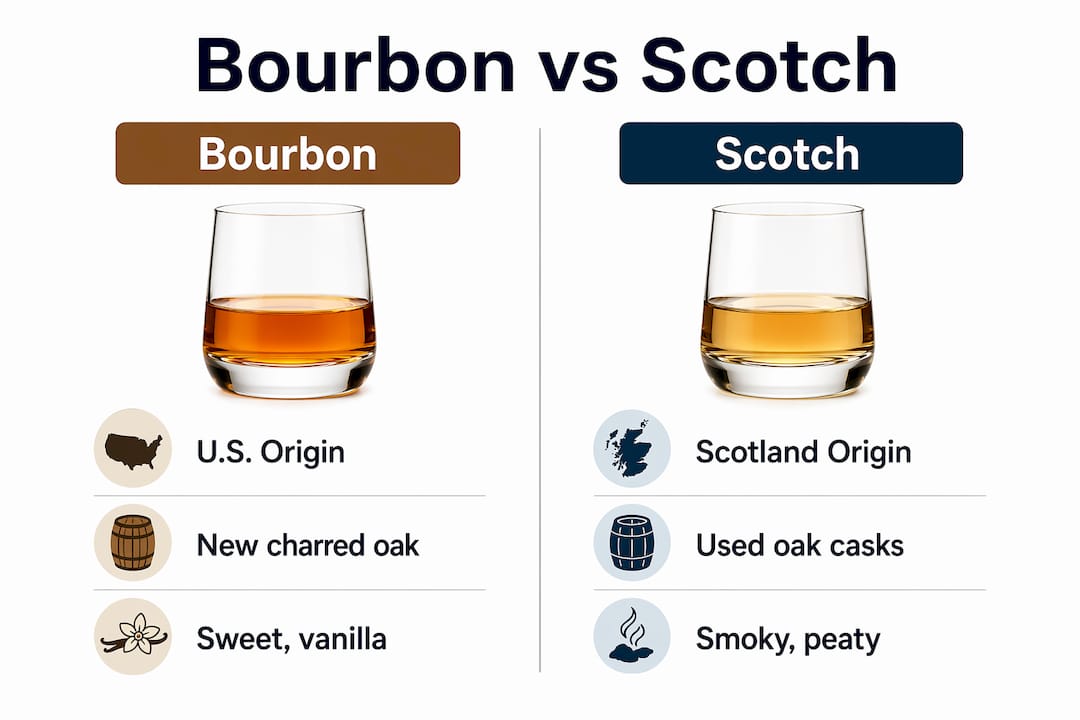
- Bourbon: a type of American whiskey requiring at least 51% corn and ageing in new, charred oak barrels; typically sweet with vanilla and caramel
- Scotch: whisky produced and matured exclusively in Scotland, primarily from malted barley, aged at least a few years in oak casks; flavour ranges from dry and malty to intensely smoky
- Flavour shorthand: bourbon runs sweet and oak-forward; Scotch runs malty and complex; other whiskeys vary widely
Table of Contents
- What is whisky, exactly?
- What makes bourbon different from other whiskeys?
- What makes Scotch whisky distinct?
- Whisky versus whiskey: why the spelling differs
- Other whiskey styles worth knowing
- Bourbon versus whiskey versus Scotch: side-by-side comparison
- How to choose between bourbon, Scotch, and other whiskeys
- Legal regulations that define each style
- The history and cultural weight behind each spirit
- Geographical indications and why they matter for classification
- Cocktails and classic serves for each style
- Key takeaways
What is whisky, exactly?
Whisky (or whiskey, depending on where it’s made) is a spirit distilled from fermented grain and aged in wooden barrels. That’s the whole definition. Everything else, the grain mix, the barrel type, the country of origin, is variation on those two steps.
The grain matters more than most people realise. Corn produces sweetness. Rye produces spice and dryness. Malted barley produces a rich, malty character. Distillers call the grain recipe the mash bill, and it’s the single biggest lever on how a whisky ultimately tastes.
Key attributes that define whisky as a category:
- Primary grains: corn, rye, malted barley, wheat, or combinations thereof
- Distillation: fermented grain wash is distilled to concentrate alcohol and flavour
- Barrel maturation: ageing in oak develops colour, softens harsh spirit, and adds flavour compounds
- Minimum bottling strength: typically 40% ABV across most regulated styles
- Spelling: “whiskey” in the US and Ireland; “whisky” in Scotland, Canada, Japan, and the EU
The spelling difference reflects geography and tradition, not quality. A bottle labelled “whisky” is not superior to one labelled “whiskey.” It simply tells you which tradition produced it.
What makes bourbon different from other whiskeys?
Bourbon is the most tightly regulated American spirit. To carry the name, a whiskey must meet a specific set of federal requirements, and none of them are optional.
Bourbon’s legal requirements:
- Origin: must be produced in the United States
- Grain bill: mash bill of at least 51% corn
- Distillation limit: no more than 80% ABV off the still
- Barrel entry: no more than 62.5% ABV when going into the cask
- Barrel type: must be aged in new, charred American oak containers
- Minimum bottling strength: 40% ABV
- Additives: no colouring, flavouring, or other additives permitted
There is no minimum ageing period to call a spirit bourbon, though “straight bourbon” requires at least two years. The new charred oak rule is the one that shapes flavour most aggressively. Fresh charred wood pushes vanilla, caramel, and baking spice into the spirit quickly, which is why even younger bourbons can taste rich and full.
Typical flavour notes: vanilla, caramel, toasted oak, brown sugar, cinnamon, and sometimes a warming, almost buttery finish. High-rye bourbons add a peppery edge; wheated bourbons lean softer and more pastry-like.

Pro Tip: Bourbon does not have to come from Kentucky. Federal law permits production anywhere in the United States. Kentucky dominates because its climate, with hot summers and cold winters, accelerates maturation and drives the spirit deeper into the wood. But distilleries in Texas, New York, and Colorado produce legitimate bourbon.
What makes Scotch whisky distinct?
Scotch is defined by place before anything else. The spirit must be distilled and matured entirely within Scotland. That geographical requirement is non-negotiable, and it’s backed by UK law through the Scotch Whisky Regulations 2009.
Beyond geography, Scotch must be aged in oak casks for a minimum of three years and bottled at no less than 40% ABV. No added flavouring is permitted, though caramel colouring is allowed in some styles.
The main Scotch categories:
- Single malt: made from 100% malted barley at a single distillery; the most sought-after style
- Single grain: made at one distillery but can include grains other than malted barley
- Blended Scotch: a mix of malt and grain whiskies from multiple distilleries; makes up most of what’s sold globally
- Blended malt: a mix of single malts from different distilleries, with no grain whisky
Regional variation shapes flavour dramatically. Islay produces heavily peated, smoky whiskies. Speyside is known for fruit, honey, and elegance. The Highlands cover a wide range from light to rich. Lowland malts tend to be lighter and grassier. Campbeltown carries a distinct maritime character.
Scotch uses reused casks, most commonly ex-bourbon barrels, but also ex-sherry, port, and wine casks. Because the wood has already given up its most intense flavours, Scotch develops complexity more slowly and subtly than bourbon. That patience is part of the point.
Whisky versus whiskey: why the spelling differs
The “e” is a geography marker, nothing more. The United States and Ireland spell it “whiskey.” Scotland, Canada, Japan, and the European Union spell it “whisky.” Getting this right signals familiarity with the category, and getting it wrong on a label can actually create legal problems in some jurisdictions.
The convention traces back to different distilling traditions that developed independently across centuries. Neither spelling implies higher quality or a different production standard. Scotch is always “whisky.” Bourbon is always “whiskey.” Irish whiskey keeps the “e.” Japanese whisky drops it, following the Scotch tradition.
Other whiskey styles worth knowing
Bourbon and Scotch get most of the attention, but the whiskey category is broader than both combined.
Key styles beyond bourbon and Scotch:
- Rye whiskey (American): requires a minimum of 51% rye grain; tastes dry, peppery, and spicy. It’s the traditional base for a Manhattan and a Sazerac, where its spice cuts through sweet vermouth rather than adding to it.
- Irish whiskey: typically triple-distilled and unpeated, producing a light, smooth, and slightly fruity spirit. Approachable and easy to drink neat or in a highball.
- Japanese whisky: follows the Scotch production model but with Japanese precision. Often delicate and floral, sometimes aged in Japanese mizunara oak for a soft, incense-like note. Built for sipping.
- Canadian whisky: usually lighter and blended, often with a higher rye component, though Canadian regulations are more flexible than American or Scottish rules.
- Tennessee Whiskey: meets all the legal requirements for bourbon but undergoes an additional step called the Lincoln County Process, where the spirit is filtered through charcoal before barrel ageing. Jack Daniel’s is the most recognised example.
Bourbon versus whiskey versus Scotch: side-by-side comparison
| Bourbon | Scotch | Whiskey (general) | |
|---|---|---|---|
| Origin | United States | Scotland only | Anywhere in the world |
| Primary grains | Min. 51% corn | Malted barley (single malt); varied grains (blends) | Corn, barley, rye, wheat, or combinations |
| Ageing requirements | New charred oak; no minimum age | Oak casks; minimum ageing period | Varies by country and style |
| Production regulations | US federal law; max 80% ABV distillation, max 62.5% barrel entry | Scotch Whisky Regulations 2009; no added flavouring | Varies widely by jurisdiction |
| Typical flavour profile | Sweet, vanilla, caramel, toasted oak, baking spice | Malty, dry; ranges from fruity and honeyed to smoky and peaty | Extremely diverse; spicy, smooth, sweet, or smoky |
The barrel difference is the clearest explanation for why bourbon and Scotch taste so different. Bourbon’s new charred oak delivers strong vanilla and caramel quickly. Scotch’s reused casks allow the spirit’s own character, and the influence of whatever previously lived in that barrel, to develop over years or decades.
How to choose between bourbon, Scotch, and other whiskeys
Start with what you actually enjoy drinking, not with what sounds most impressive.
- If you like sweetness: bourbon is the obvious starting point. Its corn base and new oak ageing guarantee a sweet, round profile that’s forgiving in cocktails and easy to enjoy neat.
- If you like complexity and variety: Scotch offers the widest spectrum of any whisky style. Start with an unpeated Speyside or Highland malt before moving toward smokier Islay expressions.
- If you want something smooth and light: Irish whiskey or Japanese whisky suits you. Both are built for sipping without demanding much from the drinker.
- If you like spice: rye whiskey delivers a dry, peppery character that bourbon simply doesn’t. Try it in a Manhattan to understand what it does.
- For cocktails: bourbon is the most versatile. An Old Fashioned, a Whiskey Sour, and most American classics work immediately with a good bourbon. Rye is the better call for a Manhattan or Sazerac.
Pro Tip: When tasting a new whisky, try it neat first, then add a few drops of water. Water opens up the aroma and can reveal flavours that high alcohol masks. Ice slows this down, so save it for after you’ve had a proper smell and first sip.
Uisuki stocks a curated range across all these styles. The Hobart Whisky Bourbon Matured Rum Finished Single Malt is a fascinating example of bourbon barrel influence applied to an Australian single malt, showing how production choices cross regional lines. For those exploring Scotch, the Ardnamurchan Macleans Nose Blended Scotch offers a well-priced entry into Highland character.

Legal regulations that define each style
The legal frameworks behind these spirits are what stop any brown liquid from claiming a prestigious name.
Bourbon is protected by US federal law, specifically the Code of Federal Regulations Title 27, which sets the grain, distillation, barrel, and bottling requirements. Congress declared bourbon “America’s Native Spirit” in 1964. The rules around new charred oak are particularly consequential: once a barrel has been used to age bourbon, it cannot be used for bourbon again. That creates a constant demand for new barrels and, conveniently, a steady supply of used barrels for Scotch distilleries.
Scotch is governed by the Scotch Whisky Regulations 2009, which define five categories of Scotch and set the rules for production, maturation, labelling, and geographical indication. The Scotch Whisky Association actively enforces these regulations. No spirit produced outside Scotland can legally be called Scotch, regardless of how it’s made.
Other styles have their own frameworks. Irish whiskey is regulated by Irish law. Japanese whisky has industry standards set by the Japan Spirits and Liqueurs Makers Association. Rye whiskey follows US federal rules similar to bourbon, with a 51% rye minimum and the same distillation and barrel-entry limits.
The history and cultural weight behind each spirit
Scotch whisky’s documented history stretches back to the 15th century, with the first written record of distillation in Scotland appearing in 1494. For centuries it was a rural, agricultural product, taxed heavily by the British government and frequently produced illegally. The formalisation of the industry through licensing in the 19th century, and the global spread of blended Scotch, turned it into one of Scotland’s most valuable exports.
Bourbon’s origins are more contested. The name likely comes from Bourbon County, Kentucky, where early American settlers distilled corn-heavy whiskey in the late 18th century. The spirit became tied to American identity, frontier culture, and later to the cocktail culture of the 19th and 20th centuries. Prohibition nearly destroyed the industry, but bourbon’s revival from the 1990s onward has been one of the most dramatic in spirits history.
Jack Daniel’s sits in an interesting cultural position. It legally qualifies as bourbon but markets itself as Tennessee Whiskey, a distinction it maintains because of the Lincoln County Process charcoal filtering step that sets it apart from standard bourbon production.
Geographical indications and why they matter for classification
A geographical indication (GI) is a legal protection that ties a product’s name to its place of origin. Scotch whisky holds one of the strongest GIs in the world: the name “Scotch” is legally reserved for whisky produced in Scotland, and this protection is recognised in trade agreements across dozens of countries.
Bourbon’s GI works differently. While Congress declared it America’s Native Spirit, bourbon can be produced in any US state. The geographical protection is national rather than regional. Kentucky has no exclusive legal claim to the name, though it produces the vast majority of the world’s supply and its climate genuinely influences the product.
These protections matter for consumers because they guarantee authenticity. When you buy a bottle labelled Scotch, you know it came from Scotland. When you buy bourbon, you know it came from the US and followed the federal rulebook. Without GIs, the names would be meaningless marketing terms. You can explore buying premium Scotch in Australia with that confidence intact.
Cocktails and classic serves for each style
Bourbon’s sweetness and oak make it the most cocktail-friendly whiskey. The Old Fashioned (bourbon, sugar, bitters, orange peel) and the Whiskey Sour (bourbon, lemon juice, sugar, egg white) are the two classics to start with. Both are forgiving and show off bourbon’s vanilla-caramel character without overwhelming it.
Rye is the historically correct choice for a Manhattan (rye, sweet vermouth, bitters) and a Sazerac (rye, absinthe rinse, sugar, Peychaud’s bitters). Bourbon works in both, but rye’s spice gives the drinks the backbone they were designed around.
Scotch is primarily a sipping spirit, but it has its cocktails. The Penicillin (blended Scotch, lemon juice, honey-ginger syrup, with a smoky Islay float) is the modern classic. A Rob Roy is essentially a Manhattan made with Scotch. For everyday drinking, a blended Scotch in a highball with soda and ice is one of the most refreshing ways to drink whisky.
Irish whiskey suits a simple highball or a Hot Toddy. Japanese whisky, particularly in the highball format that’s become a cultural institution in Japan, shows off its delicate floral character without burying it.
Key takeaways
Bourbon, Scotch, and whiskey are not competing definitions but overlapping categories shaped by geography, grain, and law, with bourbon’s corn base and new oak producing sweetness, and Scotch’s malted barley and reused casks producing complexity.
| Point | Details |
|---|---|
| Whiskey is the category | All bourbon and Scotch are whiskey; the reverse is not true. |
| Bourbon requires 51% corn | US federal law mandates corn as the majority grain and new charred oak barrels. |
| Scotch must age three years | Scottish law requires a minimum of three years in oak casks, in Scotland. |
| Spelling follows geography | “Whiskey” is US and Irish; “whisky” is Scottish, Japanese, and Canadian. |
| Flavour follows the barrel | New charred oak drives bourbon’s sweetness; reused casks give Scotch its range. |