

TL;DR:
- Scotch whisky flavours are shaped by five production levers: barley, yeast fermentation, peat smoke, cask maturation, and regional style. These create over 300 compounds that cluster into twelve sensory families, which reveal how different production choices influence taste. Understanding these relationships transforms tasting from guesswork into an insightful exploration of whisky’s complex character.
Scotch whisky flavour is defined by five production levers: barley, yeast fermentation, peat smoke, oak cask maturation, and regional style. These levers combine to produce over 300 flavour-active compounds that cluster into roughly a dozen sensory families, from fruity and floral through to smoky, medicinal, and woody. Understanding the flavours of Scotch is not about memorising tasting notes. It is about recognising which production decision created which sensation in your glass. That shift in perspective turns every dram into something genuinely worth exploring.
What are the main flavour families in Scotch whisky?
Scotch flavour begins long before the spirit reaches a cask. Barley contributes biscuit, cereal, nutty, and honeyed base notes, while yeast fermentation generates fruity and floral aromas including apple, pear, and banana through ester production. These two stages lay the foundation that every subsequent process either builds on or transforms.
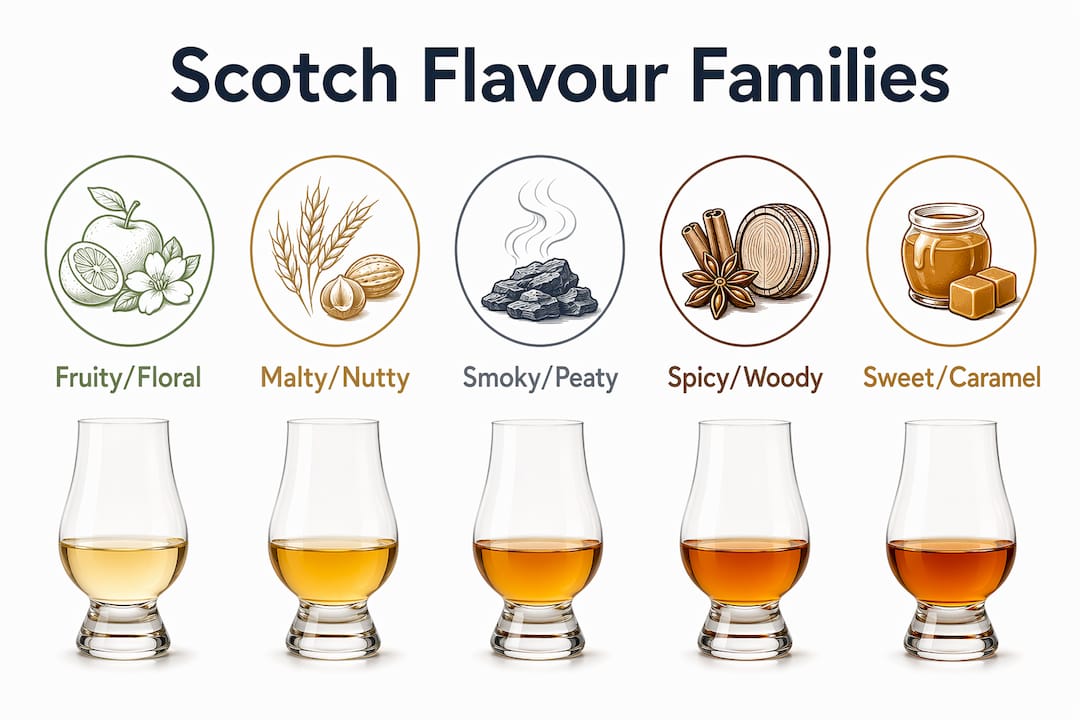
The full scotch flavour profile spans twelve dominant families:
- Fruity (apple, pear, dried stone fruit, citrus)
- Floral (heather, rose, jasmine, light blossom)
- Malty (biscuit, cereal, bread dough)
- Nutty (almond, walnut, hazelnut)
- Spicy (black pepper, ginger, clove, cinnamon)
- Smoky/peaty (bonfire ash, tar, iodine, seaweed)
- Medicinal (antiseptic, TCP, hospital notes)
- Sweet (vanilla, caramel, honey, toffee)
- Woody/tannic (oak, cedar, dry tannins)
- Oily/waxy (lanolin, engine oil, candle wax)
- Sulfury (struck match, rubber, meaty)
- Sour (citric acid, green apple, yoghurt)
Maturation in oak adds the sweet, spicy, and woody layers. Ex-bourbon casks deliver vanilla, coconut, and caramel lactones, while ex-sherry casks introduce dried fruit, chocolate, clove, and richer spice. The cask is less a container and more a flavour ingredient in its own right.
Pro Tip: When reading scotch whisky tasting notes, try to identify which family each descriptor belongs to rather than treating notes as a shopping list. “Dried apricot, raisin, and orange peel” all belong to the fruity family, which points directly to sherry cask influence.
| Flavour family | Primary production source |
|---|---|
| Fruity/floral | Yeast fermentation, ester production |
| Malty/nutty | Barley variety and kilning temperature |
| Smoky/medicinal | Peat kiln smoke during malting |
| Sweet/spicy | Oak cask maturation |
| Woody/tannic | Extended maturation, older casks |
How does peat shape the flavour spectrum of Scotch?
Peat flavour enters Scotch during malting, when wet barley is dried over a burning peat fire. The smoke deposits phenolic compounds onto the grain. Peat flavour comes from malt kilning smoke exposure, not from peat in the water supply, which is a common misconception worth correcting early.
Smokiness is measured in phenol parts per million (PPM). The tiers run from unpeated (0 to 2 PPM) through lightly peated (under 15 PPM), medium peated (15 to 35 PPM), heavily peated (35 to 50 PPM), and super-heavily peated at 50 PPM and above. Bruichladdich’s Octomore reaches over 300 PPM at malt specification, making it the most intensely peated whisky commercially produced. That number sounds extreme, but spirit PPM is always lower than malt PPM because distillation and maturation reduce phenol concentration significantly.
Regional peat also varies in botanical composition. Islay peat is formed from coastal mosses, seaweed, and heather, which produces the iodine, brine, and medicinal notes that define distilleries like Ardbeg and Laphroaig. Highland peat tends to be formed from heather and grass, producing a softer, earthier smoke without the coastal salinity.
“Phenol PPM labels serve as starting expectations, but experienced tasters rely on sensory evaluation since distillation and maturation reshape the final smoke perception.” — Scotch Authority
Ardbeg Corryvreckan at 57.1% ABV illustrates what heavy peat looks like in the glass: immense smoke layered with iodine, charcoal tar, black pepper, and dark fruit, finishing long and peppery with maritime salinity. It is a masterclass in peat complexity rather than peat aggression.
Pro Tip: Never judge a peated whisky by its PPM number alone. Two whiskies at 35 PPM can taste completely different depending on cask type, distillation cut, and maturation length. Always taste before you decide.
How do cask types and maturation shape Scotch flavours?
The cask is responsible for up to 60 to 70 per cent of a mature Scotch’s final flavour character. Think of the raw spirit as a set of base ingredients and the cask as the cookware that transforms them over years of contact with wood.
Ex-bourbon American oak casks are the most widely used vessel in Scotch production. They contribute vanilla, coconut, honey, and light caramel notes because bourbon regulations require new charred oak, which means the cask arrives pre-loaded with extractable wood sugars. Ex-sherry casks, typically made from European oak seasoned with Oloroso or Pedro Ximénez sherry, add dried fruit, dark chocolate, walnut, clove, and cinnamon. The difference between sherry cask maturation and bourbon cask maturation is one of the most practical flavour distinctions you can learn as a taster.
Maturation length matters too, but not always in the direction people expect. Older whiskies often taste less fruity and more oak and tannin driven because fruit esters form early in fermentation and distillation, while prolonged cask contact increases woody bitterness and diminishes that fruit forwardness. A 12-year Glenfarclas and a 25-year expression from the same distillery can feel like entirely different whiskies.
Pro Tip: When comparing two whiskies from the same distillery at different ages, focus on the fruit-to-oak ratio. If the younger expression is brighter and more fruit-forward while the older one is drier and spicier, you are tasting the direct effect of extended maturation on flavour balance.
| Cask type | Typical flavour contribution | Example style |
|---|---|---|
| Ex-bourbon (American oak) | Vanilla, coconut, honey, light caramel | Glenfiddich 12, Glenlivet 12 |
| Ex-sherry (European oak) | Dried fruit, chocolate, walnut, spice | Glenfarclas 15, Macallan Sherry Oak |
| Ex-wine/port | Red berry, plum, floral lift | GlenDronach Port Wood Finish |
| Refill casks | Subtle wood, spirit-forward character | Many NAS expressions |
How do Scotch whisky regions influence flavour tendencies?
Scotland’s five recognised whisky regions each carry flavour tendencies shaped by local tradition, water sources, and historical production styles. The key word is tendencies. Region indicates flavour tendencies but is not a guarantee, and production decisions like peat level, cask selection, and still shape create more flavour variance than geography alone.
Here is a practical summary of regional flavour patterns:
- Speyside: The most densely distilled region in Scotland. Flavour profile leans fruity, floral, and honeyed with gentle spice. Glenfiddich, Macallan, and Balvenie are the reference points. Light to no peat is the norm.
- Highland: The largest and most diverse region. Expect heather, honey, dried fruit, and light spice in the east; more maritime and peated character in the north and west. No single flavour dominates.
- Islay: The peat capital of Scotch. Ardbeg, Laphroaig, Bowmore, and Bruichladdich all operate here. Expect smoke, iodine, brine, and medicinal notes, though Bruichladdich’s unpeated Classic Laddie proves the island can produce very different styles.
- Lowland: Scotland’s lightest regional style. Triple distillation at distilleries like Auchentoshan produces delicate, grassy, floral, and lightly citrus-driven whiskies. Ideal for tasters new to Scotch.
- Campbeltown: A small region with a distinctive briny, slightly oily, and fruity character. Springbank is the benchmark, producing whiskies that sit between Highland earthiness and Islay coastal notes.
Cross-regional exceptions are common. Benriach in Speyside produces heavily peated expressions. Glengoyne in the Highlands uses zero peat. Using region as a starting point is sensible, but pairing that knowledge with production details gives you a far more accurate flavour prediction.
What practical tips help you identify and appreciate Scotch flavours?
Systematic tasting produces better results than free-form sniffing and sipping. The most effective approach is to work through flavour layers in sequence rather than trying to identify everything at once.
- Start with the base. Nose the whisky neat and look for the grain and malt character. Is it biscuity, cereal-forward, or nutty? This is the barley and fermentation layer.
- Identify peat or smoke. Is there any smoke present? If so, is it coastal and medicinal or softer and earthy? This tells you about kiln exposure and regional peat type.
- Read the sweetness. Vanilla and coconut point to bourbon cask. Dried fruit and chocolate point to sherry cask. Sweetness type is one of the clearest cask indicators.
- Look for spice and oak. Pepper and ginger often come from the spirit itself. Clove and cinnamon tend to indicate European oak or sherry cask influence. Dry tannins signal extended maturation.
- Assess the finish. Long, warming finishes with smoke or spice suggest higher ABV and peat or oak influence. Short, clean finishes are typical of lighter, lower-ABV expressions.
Linking tasting notes to production levers is the single most effective habit for deepening your appreciation. “Vanilla” stops being a vague descriptor when you know it means American oak. “Iodine” stops being intimidating when you know it means coastal Islay peat.
Pro Tip: Compare a Glenfiddich 12 (bourbon cask, fruity, vanilla) directly against a Glenfarclas 12 (sherry cask, dried fruit, spice) in the same sitting. This single comparison teaches you more about cask influence than reading a dozen tasting notes.
For a deeper look at reading whisky tasting notes and building your palate systematically, the approach transfers directly to any Scotch you pick up.
Key takeaways
The flavours of Scotch are shaped by five production levers: barley, yeast, peat, cask type, and maturation length, and understanding each one gives you a practical map for any dram you encounter.
| Point | Details |
|---|---|
| Flavour families framework | Over 300 compounds cluster into 12 families; use them to decode any tasting note. |
| Peat is measured in PPM | Phenol PPM indicates smoke intensity, but spirit PPM is always lower than malt PPM. |
| Cask type drives sweetness | Bourbon cask gives vanilla and coconut; sherry cask gives dried fruit and spice. |
| Region is a tendency, not a rule | Production decisions create more flavour variance than geography alone. |
| Taste in sequence | Work from base grain notes through peat, sweetness, spice, and finish for clearer results. |
Why flavour families changed how I taste Scotch
Before I started thinking in flavour families, my tasting notes were a mess of disconnected words. “Smoky, a bit sweet, some fruit.” That describes half the whiskies on the shelf without actually saying anything useful.
The shift happened when I started asking why rather than what. Why is this whisky sweet? Because it spent 12 years in a first-fill bourbon cask. Why does this one taste medicinal? Because the malt was kilned over coastal Islay peat with a high phenol load. That cause-and-effect thinking turns tasting from guesswork into something closer to reading.
My honest recommendation for anyone starting out is to avoid heavily peated Islay expressions first. Not because they are better or worse, but because peat is loud. It drowns out the subtler layers that teach you the most about fermentation and cask character. Start with a Speyside like Glenfiddich 12 or a Lowland like Auchentoshan Three Wood, build your reference points, and then move into peat when you have a baseline to compare against.
The other thing I have noticed is that flavour families are descriptive, not hierarchical. A heavily peated Ardbeg and a delicate floral Glenkinchie are not competing on the same scale. They are doing entirely different things. Once you stop ranking and start categorising, every style becomes interesting on its own terms.
— Brendan
Explore Scotch flavours with Com’s curated selection
If reading about flavour families has made you want to taste the differences rather than just read about them, Com has a curated range that covers the full spectrum.

The Ardnamurchan MacLean’s Nose Blended Scotch Whisky at 46% ABV is a strong starting point for exploring how coastal Highland character and cask influence combine in a single bottle. For something that pushes the maturation angle further, the Hobart Whisky Bourbon Matured Rum Finished single malt shows exactly what layered cask finishing does to a spirit’s flavour architecture. Browse the full Com catalogue at Uisuki.com.au to find expressions that match the flavour families you want to explore next.
FAQ
What are the main flavours found in Scotch whisky?
Scotch whisky flavours cluster into twelve families including fruity, floral, malty, nutty, spicy, smoky, medicinal, sweet, woody, oily, sulfury, and sour. Each family traces back to a specific production stage: fermentation, peat kilning, or cask maturation.
Why does some Scotch taste smoky and others do not?
Smokiness comes from drying malted barley over a burning peat fire during production. Distilleries that skip peat kilning produce unpeated Scotch, while those using high-phenol peat produce heavily smoky expressions measured in phenol PPM.
Does the age of a Scotch change its flavour significantly?
Older Scotch tends to be less fruity and more oak and tannin driven because fruit esters diminish with extended cask contact while wood compounds increase. A 12-year and a 25-year expression from the same distillery can taste markedly different for this reason.
What is the difference between sherry cask and bourbon cask Scotch?
Ex-bourbon casks contribute vanilla, coconut, and light caramel notes from American oak. Ex-sherry casks add dried fruit, dark chocolate, walnut, and warm spice from European oak seasoned with sherry wine.
Is Islay Scotch always heavily peated?
No. Islay is associated with heavily peated whisky, but Bruichladdich produces unpeated expressions like Classic Laddie at the same distillery. Region indicates a flavour tendency, not a fixed rule, and production choices always override geography.