

TL;DR:
- Whisky styles are defined by region, grains, distillation, maturation, and legal rules.
- Classic styles like Scotch, Irish, and American bourbons have distinct grains, distillation processes, and flavor profiles.
- Exploring global variants like Japanese and Australian whiskies broadens appreciation and enhances collections.
If you think all whiskies taste roughly the same, you’re missing one of the most varied and rewarding flavour landscapes in the world of spirits. From the smoky, coastal intensity of a Scotch Islay malt to the silky, fruit-forward pour of an Irish whiskey, or the bold caramel sweetness of an American bourbon, each style tells a completely different story. In this guide, we’ll walk through the major whisky styles, including Scotch, Irish, American, Japanese, and Australian, so you can sharpen your palate, make smarter buying decisions, and build a collection that genuinely reflects the breadth of what whisky has to offer.
Table of Contents
- Understanding whisky: What defines a whisky style?
- Classic whisky styles: What makes Scotch, Irish, and American unique?
- Global exploration: Japanese and Australian whisky styles
- How to taste and compare different whisky styles
- Why expanding your whisky horizons is the real collector’s edge
- Expand your collection with diverse whisky styles from Uisuki
- Frequently asked questions
Key Takeaways
| Point | Details |
|---|---|
| Whisky style basics | Recognising a whisky’s style involves understanding its region, ingredients, and production methods. |
| Classic and emerging styles | Scotch, Irish, American, Japanese, and Australian whiskies all feature distinctive characteristics worth exploring. |
| Tasting like an expert | Comparing styles side by side helps reveal subtle differences and develop your whisky palate. |
| Collection improvement | Expanding your whisky horizons results in a richer and more interesting collection. |
Understanding whisky: What defines a whisky style?
The word “style” in whisky refers to a recognisable set of characteristics shaped by where it’s made, how it’s made, and what it’s made from. These aren’t arbitrary categories. They’re the result of centuries of tradition, strict legal frameworks, and local geography all working together to produce something distinct.
The key variables that define a whisky style include:
- Region and country of origin: Scotland, Ireland, the USA, Japan, and Australia each have their own rules and traditions.
- Grain bill: Whether a whisky uses malted barley, corn, rye, wheat, or a blend of grains dramatically changes its flavour.
- Distillation method: Pot stills produce heavier, more complex spirits. Column stills produce lighter, cleaner ones.
- Maturation: The type of cask, the size, the climate, and the duration of ageing all shape the final character.
- Legal regulations: Many styles are protected by law. Scotch whisky, for example, must be aged at least three years in oak casks in Scotland.
For Australian collectors, understanding these variables is what separates casual drinking from genuine appreciation. When you know why a bourbon tastes sweet or why a Speyside Scotch leans floral, you start to develop a mental map of flavour. That map makes every new bottle more interesting.
| Term | What it means |
|---|---|
| Single malt | Made from malted barley at one distillery |
| Blended whisky | A mix of malt and grain whiskies from multiple sources |
| Grain whisky | Made from grains other than malted barley, often column-distilled |
| Pot still whisky | An Irish style using a mix of malted and unmalted barley in a pot still |
You can explore a solid types of whisky overview to get familiar with the terminology before diving deeper. The history of whisky styles also offers fascinating context for how these categories evolved over time.
Pro Tip: When tasting a new whisky, look up its production method before you pour. Knowing it’s pot still distilled or aged in sherry casks primes your senses to pick up those specific notes.
Classic whisky styles: What makes Scotch, Irish, and American unique?
Now that we’ve clarified what defines a whisky style, let’s examine the signature characteristics of the world’s most iconic styles.
Scotch whisky is perhaps the most varied of all. Scotland’s five regions, Highlands, Lowlands, Speyside, Campbeltown, and Islay, each produce noticeably different spirits. Islay malts are famous for their bold peat smoke and medicinal edge. Speyside expressions tend toward fruit, honey, and floral notes. Scotch must be distilled and matured in Scotland, and single malts must come from a single distillery using only malted barley.
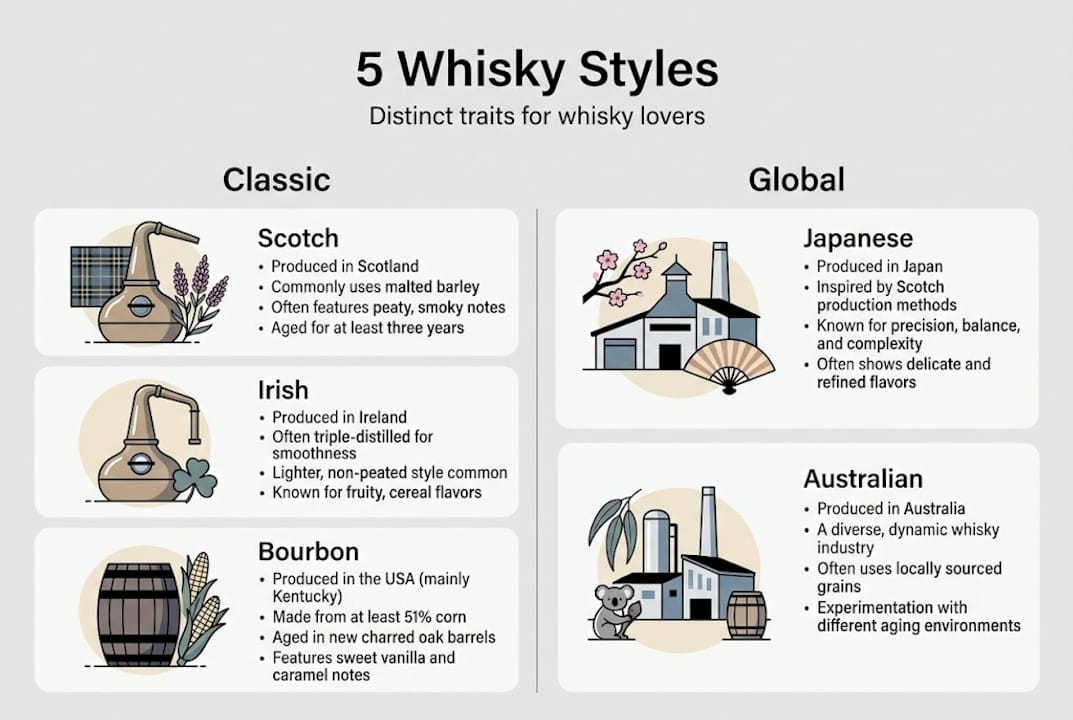
Irish whiskey takes a different path. It is triple-distilled for smoothness, made from malted or unmalted barley or grains, and is generally lighter in character with vanilla, honey, and fruit notes. That extra distillation pass removes heavier congeners (flavour compounds), which is why Irish whiskey has a reputation for being approachable and easy-drinking.
American whiskey is dominated by bourbon and rye. Bourbon must be made from at least 51% corn and aged in new, charred American oak barrels. That charred oak is the source of bourbon’s signature vanilla, caramel, and toasted wood flavours. Rye whiskey swaps corn for rye grain, producing a spicier, drier profile.
Here’s a quick comparison to keep things clear:
| Style | Key grain | Distillation | Typical flavours |
|---|---|---|---|
| Scotch | Malted barley | Double distilled (mostly) | Smoke, fruit, malt, floral |
| Irish | Malted/unmalted barley | Triple distilled | Vanilla, honey, light fruit |
| Bourbon | Corn (min. 51%) | Double distilled | Caramel, vanilla, oak, spice |
| Rye | Rye (min. 51%) | Double distilled | Spice, dry fruit, pepper |
The three most important things to remember when comparing these classic styles:
- Distillation count matters: More distillation generally means a lighter, smoother spirit.
- Grain drives the base flavour: Corn gives sweetness, rye gives spice, barley gives malt and complexity.
- Barrel type shapes maturation: New charred oak (bourbon) versus used sherry or wine casks (Scotch) creates very different outcomes.
“The most reliable way to understand a whisky style is to taste two expressions side by side. The contrast teaches you more in five minutes than an hour of reading.”
For a deeper look at how these styles sit against each other, the compare whisky styles guide is a great next step. You can also explore whisky flavour profiles to build a more detailed vocabulary for what you’re tasting.
Global exploration: Japanese and Australian whisky styles
Beyond the classic strongholds, global innovation makes the whisky landscape more exciting than ever.
Japanese whisky is built on a philosophy of harmony and precision. Japanese distillers, inspired by Scotch production methods, have developed a style that emphasises balance, subtlety, and meticulous blending. What sets Japan apart is the sheer variety of cask types used, including Mizunara oak (a native Japanese wood that imparts incense, sandalwood, and coconut notes), ex-bourbon barrels, and sherry casks. The result is often a whisky of extraordinary layered complexity.

Japanese distilleries also tend to run multiple still types within a single site, allowing them to create a wide spectrum of spirit styles in-house. This gives Japanese blended whiskies a remarkable internal diversity.
Australian whisky is a newer but rapidly maturing category. Australia’s warm climate accelerates maturation, meaning a five-year-old Australian whisky can show the complexity of a much older Scotch. Distilleries across Tasmania, Victoria, and Western Australia are experimenting boldly with local grains, native botanicals, and unconventional cask finishes including port, apera (Australian sherry), and even red wine barrels.
Key things to know about Japanese and Australian styles:
- Japanese whisky often features delicate floral and fruit notes with a clean, precise finish.
- Australian whisky tends to be bolder, richer, and more experimental in character.
- Both styles reward collectors who are willing to explore beyond the familiar.
- Climate is a key factor: Japan’s varied seasons and Australia’s heat both accelerate and shape maturation in distinct ways.
When shopping for rare whisky, Japanese and Australian bottles are increasingly strong picks for both drinking and collecting. A solid whisky buying checklist can help you evaluate each bottle before you commit.
Pro Tip: If you’re new to Australian whisky, start with a Tasmanian single malt. The island’s cool climate and clean water produce spirits that are often compared favourably to Scotch, but with a distinctly Southern Hemisphere character.
How to taste and compare different whisky styles
Having explored international styles, let’s bring it all together for your own tasting adventures.
Tasting whisky properly isn’t about being formal or pretentious. It’s about paying attention in a structured way so you get more out of every glass. Here’s a proven four-step process:
- Sight: Pour a small measure and hold it to the light. Colour can hint at cask type and age. Deep amber often suggests sherry or long maturation. Pale gold often points to ex-bourbon barrels or younger spirit.
- Nose: Bring the glass to your nose slowly and breathe in gently. Don’t rush. Let the alcohol settle and the secondary aromas emerge. Look for fruit, grain, wood, spice, or smoke.
- Palate: Take a small sip and let it sit on your tongue. Notice the texture (oily, thin, creamy) and the flavour progression from front to back of the palate.
- Finish: After swallowing, how long do the flavours linger? A long, warming finish is often a sign of quality and complexity.
Common tasting note categories to track:
- Fruit: Citrus, stone fruit, dried fruit, tropical fruit
- Grain: Cereal, malt, bread, biscuit
- Wood: Vanilla, oak, toasted wood, tannin
- Smoke: Peat, ash, bonfire, medicinal
- Spice: Pepper, cinnamon, clove, ginger
For a side-by-side comparison, pour two different styles at the same time. For example, an Irish whiskey next to a bourbon. The triple-distilled smoothness of Irish whiskey becomes immediately obvious when placed next to the bold, oaky sweetness of a Kentucky bourbon.
You can taste whisky like an expert with a bit of practice and the right framework. Learning to master whisky tasting notes takes time but pays off enormously. If you want to unlock flavour nuance in your pours, a structured approach makes all the difference. The whisky appreciation checklist is also a handy tool to keep nearby during any tasting session.
Pro Tip: Keep a small tasting notebook. Even brief notes like “tropical fruit, short finish, quite oily” help you build a personal reference library that makes future comparisons much sharper.
Why expanding your whisky horizons is the real collector’s edge
Here’s an opinion that might surprise some seasoned collectors: chasing the most famous bottles is often the least interesting way to build a collection. The bottles that generate the most conversation, the ones that genuinely expand your palate, are rarely the ones on every shortlist.
Australian and Japanese whiskies are a perfect example. Many enthusiasts overlook them in favour of well-known Scotch labels, but these styles offer a level of complexity and originality that can genuinely reframe how you think about whisky. A well-aged Tasmanian single malt or a carefully crafted Japanese blended expression can be more memorable than a bottle three times the price.
The real collector’s edge isn’t about rarity for its own sake. It’s about building a collection that tells a story, one that reflects curiosity, knowledge, and genuine engagement with the craft. Exploring lesser-known styles is how you develop that story. Our expert shopping insights can help you navigate that journey with confidence.
Expand your collection with diverse whisky styles from Uisuki
Ready to put your knowledge into practice and build a more interesting collection?

At Uisuki, we’ve curated a selection of bottles that span the full spectrum of whisky styles, from bold Scotch expressions to innovative local releases. If you’re looking to explore Australian whisky, the Tasmanian single malt from Hobart Whisky is a brilliant starting point, offering bourbon maturation with a rum finish for something genuinely unique. For a taste of Japanese craftsmanship, Ichiro’s Malt and Grain is a world blended whisky that showcases just how far the category has come. Browse our full whisky range to find bottles that match your palate and expand your collection in the right direction.
Frequently asked questions
What makes Scotch whisky different from other styles?
Scotch whisky must be produced and matured in Scotland under strict legal rules, and it often features distinctive regional characteristics like peat smoke from Islay or floral fruit notes from Speyside. Unlike Irish whiskey, which is triple-distilled for smoothness, most Scotch is double-distilled, producing a heavier and more complex spirit.
Is Australian whisky considered a distinct style?
Yes, Australian whisky is increasingly recognised as its own distinct category, defined by bold experimentation, warm climate maturation, and the use of local grains and unconventional cask finishes. The style is gaining serious global attention, particularly from Tasmanian distilleries.
How should I compare the taste of different whisky styles?
Pour two contrasting styles side by side and work through sight, nose, palate, and finish methodically, noting differences in fruit, spice, grain, and smoke. The contrast between a triple-distilled Irish whiskey and a peated Scotch, for example, makes the differences immediately obvious.
What’s the difference between single malt and blended whisky?
Single malt whisky comes from one distillery using only malted barley, while blended whisky combines malt and grain whiskies from multiple distilleries. Blended whiskies can offer remarkable consistency and complexity, while single malts reflect the unique character of a specific place and production method.