

Many whisky enthusiasts assume Scotch and Irish whiskey are nearly identical, differing only by country of origin. This misconception overlooks profound distinctions in production methods, ingredients, and flavour profiles that define each spirit. Understanding these differences transforms casual appreciation into informed tasting, revealing why Scotch whisky uses peat smoke for smoky depth while Irish whiskey favours smooth, lighter character. This guide clarifies the origins, distillation techniques, regulations, and sensory experiences that make Scotch and Irish whiskey distinct traditions worth exploring.
Table of Contents
- Origins And History Of Scotch And Irish Whiskey
- Production Methods: Grains, Distillation And Regulations
- Flavour Profiles And The Role Of Peat And Casks
- Regional Distinctions And Legal Protections
- Explore Premium Whiskies From Scotch And Irish Traditions
Key takeaways
| Point | Details |
|---|---|
| Grain composition differs significantly | Scotch predominantly uses malted barley whilst Irish whiskey often blends malted and unmalted barley in single pot still styles |
| Distillation frequency shapes smoothness | Irish whiskey typically undergoes triple distillation for lighter character versus Scotch’s traditional double distillation |
| Peat smoke creates contrasting flavours | Scotch derives smoky, earthy notes from peat whilst Irish whiskey avoids peat for cleaner, fruit-forward profiles |
| Regional regulations protect authenticity | Five protected Scotch regions enforce strict standards whilst Irish regulations allow creative experimentation within quality frameworks |
| Cask maturation influences final complexity | Both require minimum three years ageing but employ diverse cask types including bourbon, sherry, and rum finishes |
Origins and history of Scotch and Irish whiskey
The rivalry between Scotch and Irish whiskey extends beyond modern marketing into centuries of distinct cultural evolution. Whiskey has been distilled in Ireland since at least the 1400s, predating Scotland’s formalised whisky industry by generations. Irish monks returning from Mediterranean travels likely introduced distillation techniques, adapting them to local grains and climate. This early start established Ireland as a whiskey powerhouse long before Scotch gained international recognition.
Scotland’s whisky tradition developed under different constraints. Geographic isolation in Highland and Island regions meant limited access to diverse grains, forcing distillers to maximise malted barley’s potential. Peat became essential not just for fuel but for flavour, as wood scarcity made alternative drying methods impractical. These environmental factors created Scotch’s distinctive smoky character, turning necessity into signature style.
Taxation profoundly shaped both traditions. Single pot still whiskey emerged as a means of avoiding a tax introduced in 1785 on malted barley, prompting Irish distillers to blend unmalted barley into their mash bills. This innovation created a uniquely Irish style with spicy, oily texture that distinguished it from pure malt whiskies. Scottish distillers faced similar pressures but responded differently, developing illicit stills in remote glens that eventually evolved into legitimate distilleries.
Understanding this history of whisky reveals how economic and geographic realities, rather than mere preference, forged two parallel yet divergent paths. Irish distillers prioritised smoothness and accessibility whilst Scottish producers embraced boldness born from harsh landscapes. These historical foundations continue influencing production philosophies today, with Irish whiskey maintaining its approachable character and Scotch celebrating terroir-driven complexity.
The 19th century temperance movement and Irish independence struggles devastated Irish whiskey production, allowing Scotch to dominate global markets. Only recently has Irish whiskey reclaimed prominence, now representing one of the fastest-growing spirits categories worldwide. This resurgence demonstrates enduring appeal of traditional methods adapted for contemporary palates.
Production methods: grains, distillation and regulations
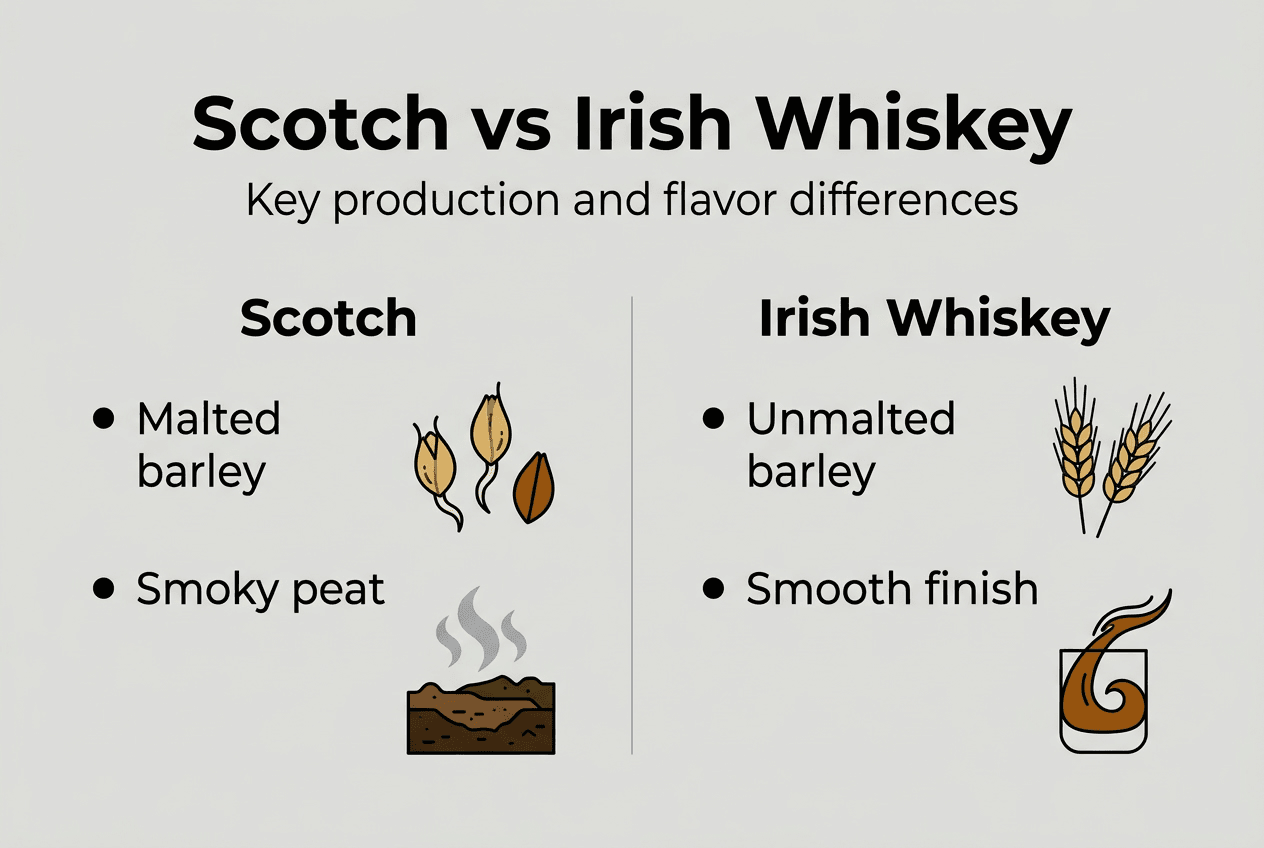
Grain selection forms the foundational difference between these whiskies. Scotch whisky predominantly uses malted barley; Irish whiskey often mixes malted and unmalted barley, especially in single pot still expressions. Malting activates enzymes that convert starches to fermentable sugars, but unmalted barley adds creamy texture and spicy notes impossible to achieve with malt alone. This distinction creates fundamentally different mash bill philosophies.
Scotch whisky categories include single malt, single grain, blended malt, blended grain, and blended Scotch. Single malts must come from one distillery using only malted barley in pot stills. Grain whiskies incorporate wheat or maize distilled in column stills for lighter character. Irish whiskey similarly offers single pot still, single malt, single grain, and blended varieties, but the single pot still category remains uniquely Irish, requiring both malted and unmalted barley.
Distillation frequency significantly impacts final spirit character:
- Irish whiskey typically undergoes triple distillation, producing lighter, smoother spirit with higher alcohol concentration
- Scotch whisky generally receives double distillation, retaining more congeners and heavier flavour compounds
- Triple distillation removes more impurities but also strips some character, requiring careful balance
- Some Scotch distilleries like Auchentoshan employ triple distillation, proving exceptions exist
Regulatory frameworks ensure quality whilst allowing regional expression. Irish whiskey must be distilled to no higher than 94.8% ABV and aged at least 3 years in wood, with regulations emphasising flexibility within quality parameters. Scotch Whisky Regulations 2009 impose stricter controls, mandating distillation and maturation in Scotland, minimum 40% ABV bottling strength, and prohibition of additives except caramel colouring.
These production differences between scotch and whiskey extend to water sources, yeast strains, and fermentation durations. Scottish distilleries often highlight local water’s mineral content as terroir markers, whilst Irish producers emphasise purity and neutrality. Fermentation times vary from 48 to 120 hours, with longer fermentations developing fruity esters that complement lighter Irish styles.
Pro Tip: When exploring malted barley in whisky production, look for single pot still Irish whiskeys to experience how unmalted grain adds distinctive spiciness and body that pure malt expressions cannot replicate.
The role of copper pot stills versus column stills further differentiates production. Traditional pot stills create batch distillation with more flavour retention, whilst column stills enable continuous distillation producing lighter, more neutral spirit. Most premium expressions from both countries favour pot stills, though blended varieties incorporate column-distilled grain whisky for balance and approachability.
Flavour profiles and the role of peat and casks
Scotch whisky is known for its smoky and peaty flavours derived from peat in malting, while Irish whiskey is smoother and lighter with fruit and honey notes. This fundamental contrast stems from drying methods during malting. Scottish distillers traditionally burned peat to dry malted barley, infusing it with phenolic compounds that create medicinal, smoky, earthy characteristics. Irish distillers predominantly used closed kilns with indirect heat, avoiding peat smoke entirely.
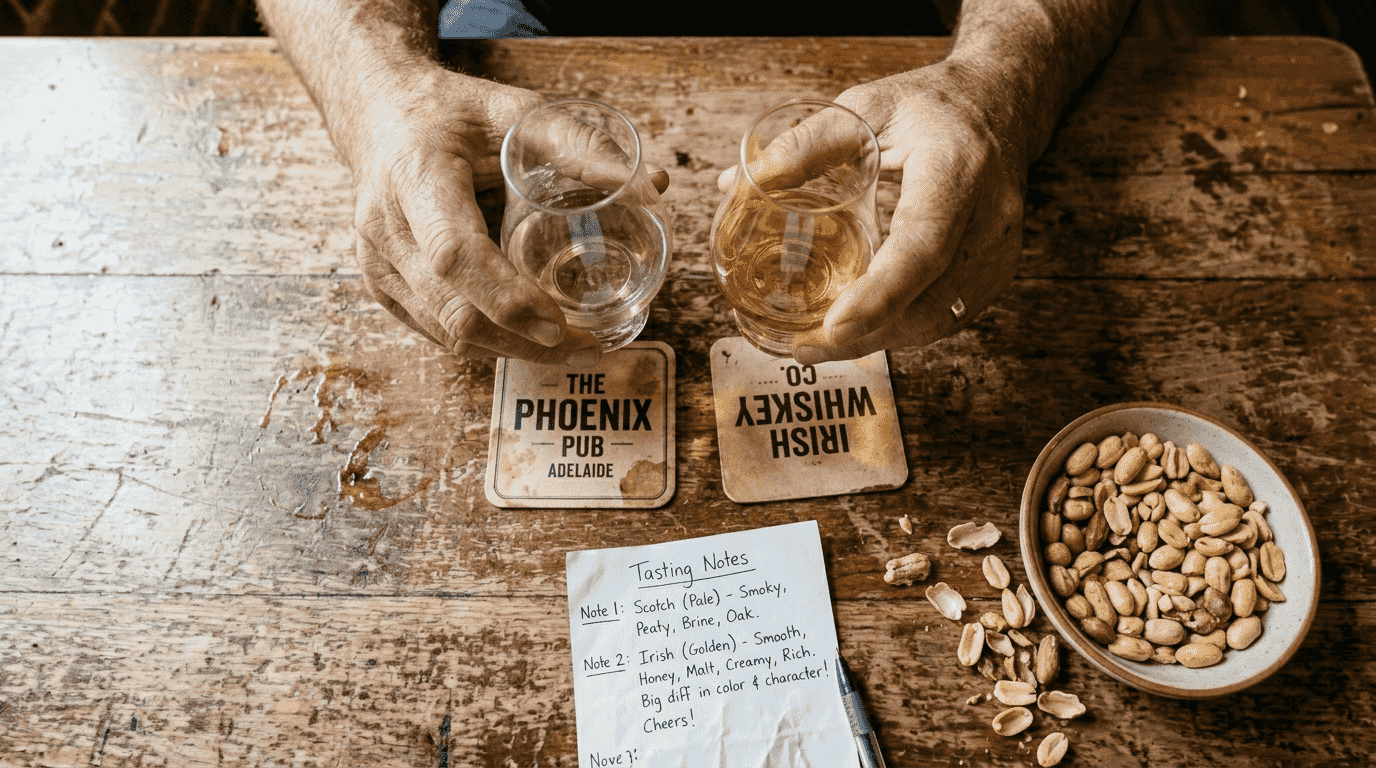
Peat itself varies dramatically by origin. Peat composition varies dramatically by location influencing whisky flavour, with Islay peat containing seaweed and maritime elements creating briny, iodine notes, whilst Highland peat offers heathery, floral smoke. This terroir specificity means peated Scotch from different regions tastes distinctly different despite sharing smoky foundations. Irish whiskey’s avoidance of peat allows grain character and cask influence to dominate flavour development.
| Characteristic | Scotch Whisky | Irish Whiskey |
|---|---|---|
| Primary flavour drivers | Peat smoke, malt character, cask influence | Triple distillation smoothness, grain spice, cask sweetness |
| Typical tasting notes | Smoke, leather, dried fruit, spice, maritime salinity | Honey, vanilla, green apple, citrus, light spice |
| Texture | Fuller body with oily mouthfeel | Lighter, silkier texture with creamy finish |
| Peat levels | 0-60+ ppm phenols depending on region | Typically 0-5 ppm, rarely peated |
Cask selection profoundly shapes both whisky styles. Choice of casks including sherry and bourbon impacts flavour profiles significantly, with ex-bourbon barrels imparting vanilla, caramel, and coconut whilst sherry casks add dried fruit, nuts, and spice. Irish whiskey’s lighter base spirit showcases cask influence more transparently, making wood selection critical for complexity. Scotch’s inherent character can either complement or contrast with cask flavours, creating layered experiences.
Understanding peat in whisky flavour requires recognising phenol measurement in parts per million. Lightly peated Scotch registers 5-15 ppm, medium peated 15-30 ppm, and heavily peated expressions exceed 40 ppm. Ardbeg and Laphroaig reach 50-60 ppm, delivering intense smoke that dominates all other flavours. Irish whiskey rarely exceeds 5 ppm, preserving delicate grain and fruit notes.
Finishing techniques add final complexity:
- Port casks introduce berry sweetness and rich colour
- Rum casks contribute tropical fruit and molasses notes
- Wine casks offer grape tannins and varied fruit profiles
- Virgin oak provides intense vanilla and wood spice
The whisky cask influence on flavour extends beyond wood type to include cask size, previous contents, and char levels. Quarter casks accelerate maturation through increased wood contact, whilst larger butts develop flavours more gradually. Sherry cask maturation particularly suits Scotch’s robust character, with oloroso sherries adding nutty richness and Pedro Ximénez contributing raisin sweetness.
Pro Tip: To appreciate flavour differences, taste unpeated Scotch like Glenmorangie alongside Irish single pot still like Redbreast, both matured in similar casks, isolating distillation and grain differences from peat influence.
Single pot still Irish whiskey delivers spicy, oily texture from unmalted barley that contrasts sharply with Scotch single malts. This style offers pepper, clove, and nutmeg notes alongside orchard fruit, creating complexity through grain diversity rather than peat smoke. Modern Irish distillers increasingly experiment with peated malt, blurring traditional boundaries whilst respecting core stylistic differences.
Regional distinctions and legal protections
The Scotch Whisky Regulations 2009 define five protected geographical indications including Campbeltown and Islay, each region developing distinctive house styles. Islay produces intensely peated, maritime whiskies with medicinal character. Speyside favours elegant, fruity malts with minimal peat. Highland encompasses diverse styles from light to robust. Lowland traditionally offers gentle, grassy whiskies. Campbeltown delivers briny, complex expressions from its remaining distilleries.
These regional protections ensure authenticity and prevent misrepresentation. Only whisky distilled, matured, and bottled in Scotland using approved methods can bear the Scotch whisky designation. Similar protections apply to Irish whiskey, though Irish whiskey regulations formalised in 1980 allow more production variety and focus on quality rather than rigid regional classifications. Ireland lacks formal sub-regions, though distillery locations influence character through water sources and climate.
| Region/Country | Key Regulations | Typical Characteristics |
|---|---|---|
| Islay, Scotland | Minimum 3 years maturation, pot still distillation | Heavy peat, maritime salinity, medicinal notes |
| Speyside, Scotland | Same as above, predominantly ex-bourbon casks | Fruity, elegant, sherry influence common |
| Ireland (all regions) | Minimum 3 years, distilled under 94.8% ABV | Smooth, light, triple distilled, minimal peat |
Climate impacts maturation significantly. Scotland’s cool, damp conditions slow angel’s share evaporation to roughly 2% annually, allowing extended ageing that develops complexity. Ireland’s slightly milder climate produces similar maturation rates, though coastal distilleries experience maritime influence comparable to Scottish island locations. These environmental factors contribute to terroir beyond ingredient selection.
Legal definitions protect consumers from inferior products whilst preserving traditional methods. Scotch must be matured in oak casks not exceeding 700 litres, preventing rapid over-extraction from small barrels. Irish regulations similarly mandate oak maturation but allow greater cask size flexibility. Both prohibit artificial flavouring beyond caramel colouring, ensuring authenticity.
Exploring history of whisky styles reveals how these regulations evolved from informal practices into codified law protecting centuries of tradition. The Scotch Whisky Association actively defends these standards globally, pursuing legal action against misuse of protected terms. Irish Whiskey Association similarly promotes quality standards whilst encouraging innovation within regulatory frameworks.
Regional water sources contribute subtle terroir markers. Speyside’s soft water suits delicate distillation, whilst Islay’s peaty water reinforces smoky character. Irish distilleries often highlight water purity as quality markers, with some sourcing from ancient wells or mountain streams. These geographic factors, combined with legal protections, ensure each bottle authentically represents its origin and tradition.
Explore premium whiskies from Scotch and Irish traditions
Now that you understand the distinctions between Scotch and Irish whiskey, experiencing these differences firsthand deepens appreciation beyond theory. Our curated selection includes expressions showcasing traditional and innovative approaches from both countries.

Discover Ardnamurchan Macleans Nose blended Scotch whisky, demonstrating how Scottish blending marries malt and grain for balanced complexity. For those seeking international perspectives, explore Ichiros Malt and Grain limited edition whisky, blending global influences with Japanese precision. Australian innovation shines in Hobart Whisky bourbon matured rum single malt, showcasing how New World distillers apply Old World techniques with creative cask finishing. Each bottle represents distinct production philosophies discussed throughout this guide, transforming knowledge into sensory experience.
FAQ
What is the main difference between Scotch and Irish whiskey?
Scotch whisky predominantly uses malted barley, undergoes double distillation, and often features peat smoke for smoky, robust character. Irish whiskey commonly blends malted and unmalted barley in single pot still styles, receives triple distillation for smoothness, and avoids peat for lighter, fruit-forward profiles. These production distinctions create fundamentally different flavour experiences despite both requiring minimum three-year maturation.
Why does Scotch whisky taste smokier than Irish whiskey?
Peat smoke used during malting imparts phenolic compounds creating smoky, medicinal, earthy flavours in Scotch whisky. Irish distillers traditionally dry malt using indirect heat without peat exposure, preserving clean grain character and allowing honey, vanilla, and fruit notes to dominate. Regional peat variations further specialise Scotch flavour profiles, from maritime Islay peat to heathery Highland peat.
Is Irish whiskey triple distilled and Scotch whisky always double distilled?
Irish whiskey typically undergoes triple distillation to enhance smoothness and lightness, though this remains a tradition rather than legal requirement. Scotch whisky generally receives double distillation, retaining more flavour congeners and heavier body, but exceptions like Auchentoshan employ triple distillation. Distillation frequency significantly influences final spirit character but does not solely define either style.
How do cask types affect the flavour of Scotch and Irish whiskies?
Both whiskies mature in oak casks, commonly ex-bourbon barrels imparting vanilla and caramel or ex-sherry casks adding dried fruit and spice. Cask selection, previous contents, and finishing techniques introduce unique flavour layers including tropical fruit from rum casks or berry sweetness from port pipes. Irish whiskey’s lighter base showcases cask influence more transparently whilst Scotch’s robust character creates complex interplay between spirit and wood.