

TL;DR:
- Whisky flavour profiles are shaped by distinct chemical families, including fruity, smoky, floral, nutty, and woody.
- Production choices, cask type, and maturation time influence these profiles, creating wide regional diversity.
Whisky flavour profiles are defined by distinct sensory families including fruity, smoky, floral, nutty, woody, and sweet, each shaped by specific production and maturation choices. The Scotch Whisky Research Institute has identified over 300 flavour-active compounds in mature Scotch whisky, grouped into approximately 12 primary families. Understanding different whisky profiles is the foundation for appreciating why a peated Islay malt tastes nothing like a Speyside single malt, or why a Kentucky bourbon differs so dramatically from a Japanese expression. These flavour families are not random. They are the direct result of grain selection, fermentation, distillation, and years spent in wood.
What are the different whisky profiles and how do they differ?
The primary whisky flavour profiles fall into seven dominant families, each with a distinct chemical origin. Knowing these families gives you a framework for every bottle you open.
Fruity and estery profiles are the most common in unpeated single malts. Esters form during fermentation when acids react with alcohols, producing notes of apple, pear, citrus, and tropical fruit. Speyside single malts are the classic example of this family. The chemical synthesis of esters during fermentation and distillation is the primary driver of these bright, fresh notes.
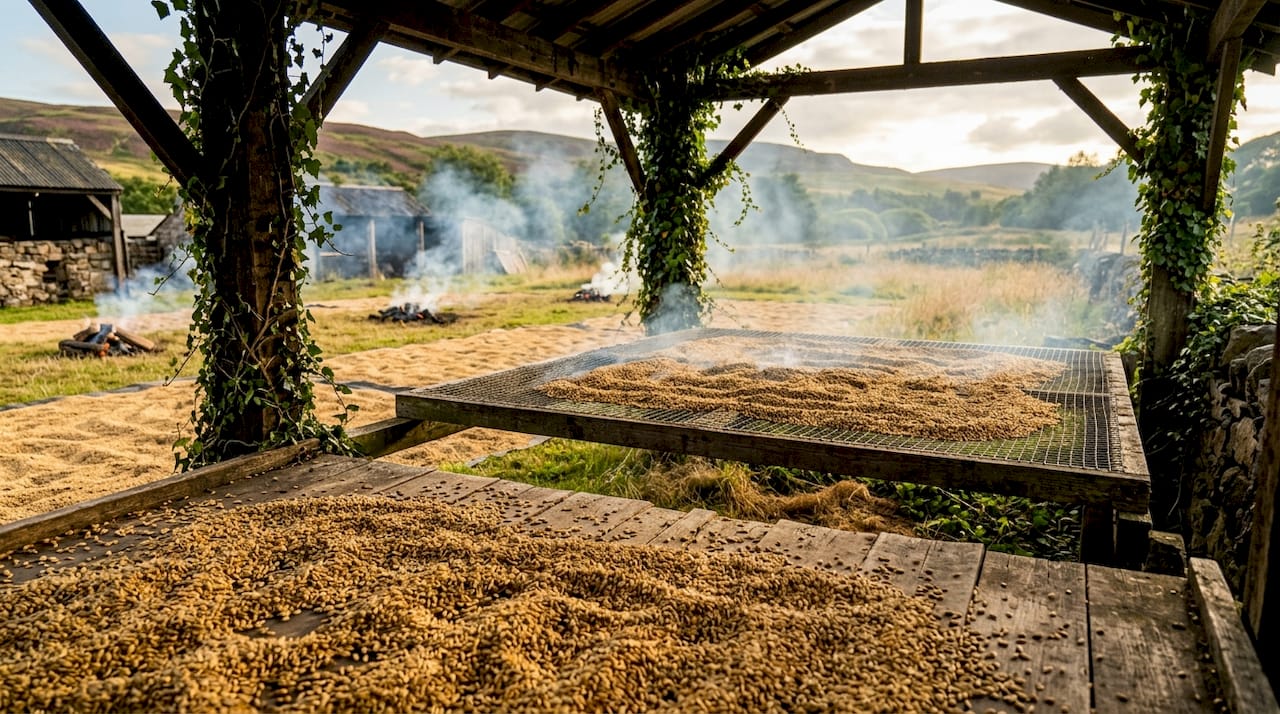
Smoky and peaty profiles come from phenolic compounds absorbed during the malting process when barley is dried over burning peat. Phenol levels are measured in parts per million (ppm), and heavily peated malts can reach 50 ppm or higher. This family produces notes of bonfire smoke, iodine, tar, and medicinal character.
Floral profiles are driven by terpenes and higher alcohols, producing notes of heather, rose, and fresh grass. These are most pronounced in lighter, unpeated Highland and Lowland expressions.
Nutty and cereal profiles come from grain-forward whiskies and from the Maillard reaction during kilning. Expect notes of toasted almonds, biscuit, and malt.
Woody and tannic profiles develop through extended contact with oak. Tannins from the wood create drying, spicy, and leathery sensations on the palate.
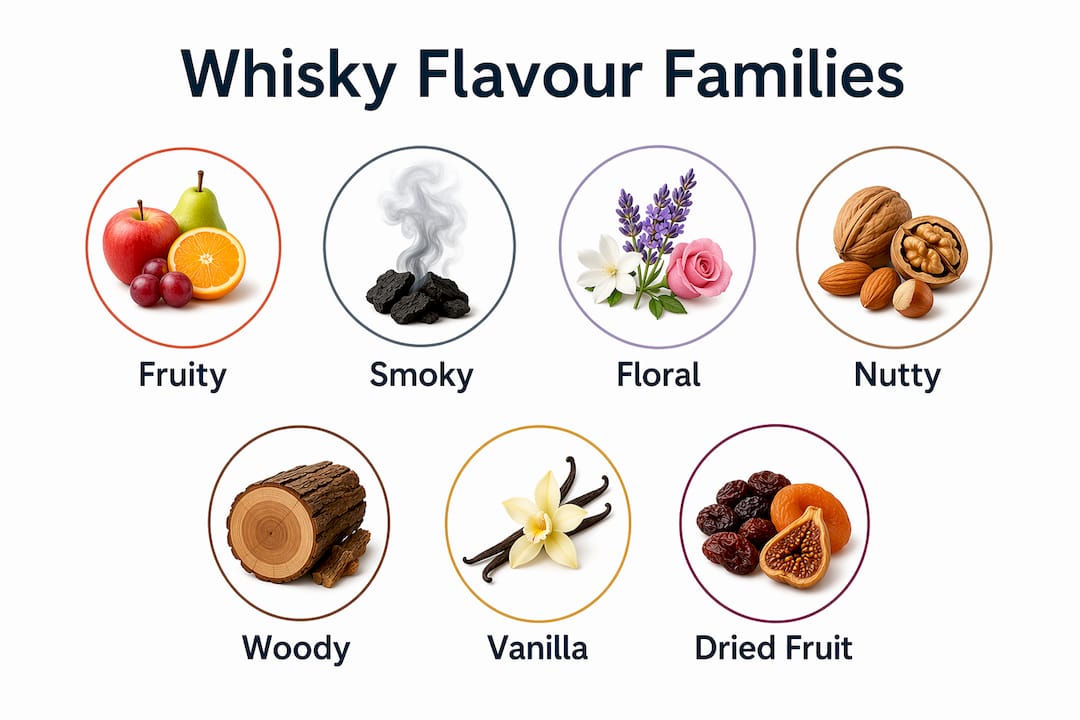
Vanilla and caramel profiles are the signature of American oak maturation. Vanillin and caramel lactones leach from the charred wood into the spirit over time.
Dried and spiced fruit profiles are the hallmark of ex-sherry cask maturation, delivering notes of raisin, dried fig, Christmas cake, and cinnamon.
| Flavour family | Key compounds | Typical character |
|---|---|---|
| Fruity and estery | Esters | Apple, pear, citrus, tropical fruit |
| Smoky and peaty | Phenols | Bonfire, iodine, medicinal |
| Floral | Terpenes, higher alcohols | Heather, rose, fresh grass |
| Nutty and cereal | Maillard compounds | Toasted almond, biscuit, malt |
| Woody and tannic | Oak tannins | Leather, spice, drying finish |
| Vanilla and caramel | Vanillin, lactones | Butterscotch, toffee, cream |
| Dried and spiced fruit | Sherry esters | Raisin, fig, cinnamon |
Pro Tip: When nosing a new whisky, try to identify just one flavour family first. Locking onto a single note trains your palate faster than trying to catalogue everything at once.
How do production methods and maturation shape whisky flavour?
Production choices are the single biggest determinant of which flavour families dominate a whisky. Every step from grain to glass leaves a chemical fingerprint.
Peat level is the most dramatic variable. Distilleries that dry their malt over peat fires lock phenolic compounds into the grain before fermentation even begins. The final spirit carries those compounds through distillation and into the cask. Distilleries that use unpeated malt produce a clean base that lets fruity and floral notes take centre stage.
Distillation style shapes the weight and texture of the spirit. Tall copper pot stills produce lighter, more floral spirits because the copper strips away heavier sulphurous compounds. Shorter, fatter stills retain more of those heavy, oily, and meaty notes. Column stills used for grain whisky produce a much lighter, more neutral spirit that takes on character almost entirely from the cask.
Cask type is where the most dramatic flavour transformation happens. Maturation in ex-bourbon and ex-sherry casks contributes distinct compounds including vanillin, caramel lactones, and dried fruit esters. Ex-bourbon casks are the most widely used and deliver vanilla, coconut, and light spice. Ex-sherry casks add depth, dried fruit, and chocolate. Other cask finishes including port, wine, and rum barrels each add their own signature.
Maturation time and environment also matter. Lighter-coloured whiskies tend to be sweeter, while darker whiskies carry richer fruit and spice, linked directly to cask type and time in wood. Warehouses in warmer climates accelerate extraction from the wood. A 10-year-old whisky matured in a warm rickhouse can carry the flavour complexity of a much older Scotch aged in a cool, damp warehouse.
Understanding whisky age statements helps you predict flavour before you even open a bottle.
| Maturation factor | Flavour effect |
|---|---|
| Ex-bourbon cask | Vanilla, coconut, light spice |
| Ex-sherry cask | Dried fruit, chocolate, richness |
| Long maturation | Oak, tannin, complexity |
| Warm climate | Faster extraction, bolder wood notes |
| Tall pot still | Lighter, more floral spirit |
- Start with the grain: peated or unpeated malt sets the phenolic baseline.
- Watch the still shape: tall stills produce lighter spirits, short stills produce heavier ones.
- Check the cask: ex-bourbon delivers sweetness, ex-sherry delivers fruit and spice.
- Factor in age: more time in wood means more oak influence, for better or worse.
- Consider climate: warmer maturation environments accelerate flavour development.
Pro Tip: Check the colour of a whisky before you nose it. A pale gold suggests lighter, sweeter notes. A deep amber or mahogany signals richer fruit and spice from the cask.
Which whisky profiles suit beginners, and how do you build tasting skills?
The best starting point for beginners is a light, fruity, or sweet profile. These whiskies are approachable because their dominant flavour families are familiar and pleasant rather than challenging. Beginners are recommended to start with light and fruity or sweet and rich profiles, with accessible options typically priced in the $30–$50 range.
The key insight from professional bartenders is that entry-level whiskies benefit from accessible complexity rather than sheer simplicity. A 10-year-old expression with notes of vanilla, maple, and cherry gives you enough to explore without overwhelming your palate. Whiskies with only one or two notes can actually be harder to learn from because there is less to identify and compare.
- Light and fruity: Speyside single malts and Irish whiskeys. Look for notes of apple, pear, and light vanilla. These are the most forgiving starting points.
- Sweet and rich: American bourbon. Vanilla, caramel, and oak dominate. The sweetness makes the alcohol heat easier to manage.
- Soft smoke: Lightly peated Highland or island expressions. These introduce the smoky family without the intensity of a heavily peated Islay malt.
How to taste whisky properly
Palate priming is the first step. Take a small sip and let it coat your mouth without swallowing immediately. This acclimates your tongue to the alcohol heat so the second sip reveals actual flavour rather than burn.
The retrohale technique takes detection further. After swallowing, exhale gently through your mouth with your lips slightly open. This pushes aroma molecules up through the nasal passage from the inside, revealing dried fruit, spice, and smoke notes that normal nosing misses entirely. Retrohaling triggers additional sensory pathways in the nasal cavity that are simply not activated by sniffing from above the glass.
Tasting with friends and keeping a journal accelerates learning. Writing down what you detect, even if it is just “smells like a hardware store” or “tastes like Christmas cake,” builds a personal flavour vocabulary faster than any other method. Read more about mastering tasting notes to develop your palate systematically.
How do whisky styles compare across global regions?
Different whisky types from around the world each carry characteristic flavour tendencies, though no region produces a single uniform style. Production choices within each region create enormous diversity.
Scotch whisky spans the widest flavour range of any category. The Scotch Whisky Association recognises five protected regions, each with distinct tendencies. Islay whiskies tend toward smoke and peat, Speyside toward fruit and floral notes, Highlands toward a mix of fruit, spice, and heather, Lowlands toward light and grassy profiles, and Campbeltown toward a briny, oily character. Individual distilleries within each region vary widely.
American bourbon must be made from a grain bill of at least 51% corn and aged in new charred American oak barrels. This legal requirement locks in the vanilla, caramel, and oak profile that defines the category. Rye-forward bourbons add a spicy, peppery edge. Straight rye whiskey amplifies that spice further.
Irish whiskey is typically triple-distilled and unpeated, producing a famously smooth, light, and approachable profile. Pot still Irish whiskey adds a distinctive spicy, oily character from the use of unmalted barley.
Japanese whisky draws heavily on Scotch tradition but tends toward delicacy, balance, and subtlety. Floral, fruity, and lightly smoky notes are common. Japanese distilleries often mature spirit in Mizunara oak, which adds a unique sandalwood and incense character not found elsewhere.
Australian whisky is a growing category with producers using local ingredients and diverse cask types. Expect bold fruit, spice, and sometimes coastal salt notes depending on the distillery’s location and production choices.
| Whisky style | Dominant flavour profile | Key production driver |
|---|---|---|
| Scotch (Islay) | Smoke, peat, iodine | High-ppm peated malt |
| Scotch (Speyside) | Fruit, floral, light vanilla | Unpeated malt, tall stills |
| American bourbon | Vanilla, caramel, oak | New charred American oak |
| Irish whiskey | Light, smooth, grassy | Triple distillation, unpeated |
| Japanese whisky | Delicate, floral, balanced | Mizunara oak, precise distillation |
| Australian whisky | Bold fruit, spice, coastal | Diverse local casks, climate |
Explore the full range of whisky flavour profiles across these styles to understand how production choices translate directly into what you taste.
Key takeaways
Understanding different whisky profiles requires knowing the seven core flavour families and how production choices, cask type, and maturation time combine to create each one.
| Point | Details |
|---|---|
| Seven core flavour families | Fruity, smoky, floral, nutty, woody, vanilla, and dried fruit each have distinct chemical origins. |
| Cask type drives sweetness and richness | Ex-bourbon adds vanilla and caramel; ex-sherry adds dried fruit and spice. |
| Beginners should start light | Light, fruity, or sweet profiles in the $30–$50 range build palate confidence progressively. |
| Retrohale reveals hidden notes | Exhaling through the mouth after swallowing activates nasal pathways that nosing alone misses. |
| Region indicates tendency, not certainty | Islay leans smoky, Speyside leans fruity, but individual distilleries vary widely within each region. |
Brendan’s take on building a whisky palate
The biggest mistake I see enthusiasts make is chasing complexity before they have built a baseline. They go straight for the most heavily peated or oldest expression they can find, and then wonder why they cannot identify anything beyond “strong” and “smoky.” That is like learning to cook by attempting a 12-course degustation on your first day.
My honest advice is to spend your first six months tasting side by side. Put a Speyside single malt next to an Irish pot still expression. Nose them both before you taste either. Write down three words for each. You will be surprised how quickly your palate starts to distinguish fruity esters from cereal notes, or light floral tones from heavier oak.
The finish is where quality reveals itself. A long finish that evolves over minutes signals a mature, complex whisky. If the flavour disappears in seconds, the whisky has less to say. Pay attention to what changes as the finish develops. Sweetness often gives way to oak, then spice, then smoke. That progression tells you more about a whisky than any tasting note ever could.
Do not get locked into brand loyalty early. The whisky world rewards curiosity. A $45 Irish expression can teach you as much as a $200 Scotch if you approach it with the same attention. Keep a notebook, taste with friends, and let the flavour families guide your choices rather than labels or price tags.
— Brendan
Premium whisky selections at Uisuki
Uisuki curates a range of whiskies from Scotland, Japan, Australia, and the USA, selected specifically for enthusiasts who want to explore flavour profiles with confidence.

Whether you are building your first collection or hunting a rare expression, Uisuki’s curated range covers every major flavour family and style. The site also publishes detailed educational guides on topics including whisky ageing and premium flavour, giving you the context to make better buying decisions. Free shipping thresholds, multiple payment options, and personalised sourcing requests make it straightforward to find exactly what you are looking for.
FAQ
What are the main whisky flavour profiles?
The seven primary whisky flavour profiles are fruity, smoky, floral, nutty, woody, vanilla and caramel, and dried and spiced fruit. Each is driven by specific compounds produced during fermentation, distillation, or maturation.
Which whisky profile is best for beginners?
Light and fruity or sweet and rich profiles are the most accessible starting points. Speyside single malts and American bourbons in the $30–$50 range offer enough complexity to learn from without being challenging.
How does cask type affect whisky flavour?
Ex-bourbon casks deliver vanilla, coconut, and light spice through vanillin and caramel lactones. Ex-sherry casks add dried fruit, chocolate, and richness through fruit esters absorbed from the wood.
What is the retrohale technique in whisky tasting?
Retrohaling means exhaling gently through your mouth after swallowing a sip. This pushes aroma molecules through the nasal cavity from the inside, revealing spice, smoke, and dried fruit notes that nosing from above the glass does not detect.
Do all Islay whiskies taste smoky?
Islay whiskies tend toward smoky and peaty profiles, but individual distilleries vary widely. Some Islay producers make unpeated expressions that are fruity and floral, so region indicates a tendency rather than a guarantee.