

TL;DR:
- Malt is the foundational element shaping whisky’s flavor, aroma, and body beyond just providing sugars. Its processing stages—steeping, germination, and kilning—critically influence enzyme activity and flavor development. Recognizing malt’s impact deepens appreciation for a whisky’s complexity, especially as new malting techniques and heritage grains emerge in production.
Malt is the quiet architect behind every glass of whisky, yet most drinkers give the credit to the cask. The effect of malt in whisky goes far beyond providing fermentable sugars. It shapes the base flavour, influences body and aroma, and in peated expressions, drives the smoke you taste on the palate. The industry term covering this broad influence is “malt character,” and understanding it changes the way you approach a tasting. Whether you are pouring a delicate Lowland single malt or an intensely smoky Islay expression, the malt is doing more work than you probably realise.
Table of Contents
- Key takeaways
- The effect of malt in whisky starts at malting
- How malt shapes whisky flavour profiles
- Single malt versus blended: malt’s different roles
- Reading tasting notes for malt character
- Malt innovation and emerging production techniques
- My take on malt’s underrated influence
- Explore malt-forward whiskies at Uisuki
- FAQ
Key takeaways
| Point | Details |
|---|---|
| Malt shapes base flavour | Malted barley provides cereal esters and thiols that form the foundational flavour of every whisky. |
| Kilning temperature matters | The heat and moisture levels used during kilning directly affect enzyme activity and final malt quality. |
| Peat ppm is not perception | Ultra-peated malts can exceed 300 ppm phenol, yet perceived smokiness depends on distillation and maturation. |
| Single malt means distillery origin | “Single malt” refers to one distillery’s output, not a single cask or malt variety. |
| Malt can guide your purchasing | Identifying malt-driven tasting notes helps you choose whisky expressions that match your palate preferences. |
The effect of malt in whisky starts at malting
Before malt ever meets a still, it goes through three carefully managed stages that set the flavour trajectory for the entire production run. Those stages are steeping, germination, and kilning. Each one transforms raw barley into a biochemically active ingredient.
Steeping saturates the barley with water, triggering the grain’s natural germination response. Germination is where the real chemistry begins. As the grain sprouts, it activates enzymes including α-amylase and β-amylase, which are responsible for breaking down starch into fermentable sugars during mashing. Without active enzymes, there is no fermentable wort, and without fermentable wort, there is no whisky. The temperature-moisture gradients during kilning introduce heterogeneity in malt enzyme activity and starch properties, meaning that malt from different layers of a kiln bed can behave differently during mashing.
Kilning stops germination by applying heat and, in some cases, peat smoke. The temperature and moisture gradient during kilning is one of the most technically demanding variables in malt whisky production. Too much heat too quickly destroys the enzymes the distillery needs. Too little, and the malt retains excess moisture that creates problems downstream.
- Steeping duration typically runs 40 to 60 hours depending on barley variety and ambient temperature.
- Germination takes around four to six days on traditional malting floors, longer in cooler conditions.
- Kilning for unpeated malt uses air temperatures starting around 60°C, finishing closer to 70°C to drive off residual moisture.
- Peated malt is kilned over smouldering peat at lower temperatures in the early stage to maximise phenolic absorption.
Pro Tip: When reading a distillery’s production notes, look for information about their malt source and kilning style. Floor-malted barley, which a handful of Scottish distilleries still use, often produces a slightly earthier, more complex base character than industrially malted barley.
How malt shapes whisky flavour profiles
Once you understand what happens during malting, the flavour science becomes considerably clearer. Malted barley provides cereal esters, thiols, and sulphurous compounds that form the base flavour substrate of the spirit. These compounds are not added. They emerge directly from the grain and carry through fermentation and distillation.
The clearest illustration of malt’s flavour power is peat. When barley is kilned over burning peat, phenolic compounds including guaiacol, cresol, and syringol settle onto the malt surface. These are measured in parts per million on the malt itself.
“Two whiskies from different distilleries using malt at a similar phenol ppm can taste entirely different in terms of smoke intensity. Distillation cuts and cask interactions transform and moderate phenolic character in ways that raw ppm measurements cannot predict.” — Scotch flavor profiles
Ultra-peated malts can exceed 300 ppm phenol, yet the phenolic load reaching the finished spirit is reduced and transformed by the distillation process. The phenol ppm on malt does not directly equate to the smoke you experience in the glass. This is a widely misunderstood point, even among enthusiasts.
Here is how different malt treatments translate into recognisable whisky flavour families:
| Malt treatment | Primary flavour contribution | Typical tasting notes |
|---|---|---|
| Unpeated, lightly kilned | Cereal, floral | Honey, biscuit, fresh barley, light fruit |
| Unpeated, heavily roasted | Rich cereal, nutty | Chocolate, coffee, toasted grain, dried fruit |
| Lightly peated (5-15 ppm) | Gentle smoke, earthy | Subtle ash, soft smoke, damp earth |
| Heavily peated (40-80 ppm) | Medicinal, campfire | Iodine, bonfire smoke, tar, brine |
| Ultra-peated (100+ ppm) | Intense phenolic | Coal smoke, rubber, volcanic, heavily medicinal |
The non-smoky base flavours are just as important. Malt type and treatment affect whisky’s aromatic complexity and mouthfeel in ways that are easy to miss when a heavily peated or heavily cask-influenced whisky dominates your glass.
Single malt versus blended: malt’s different roles
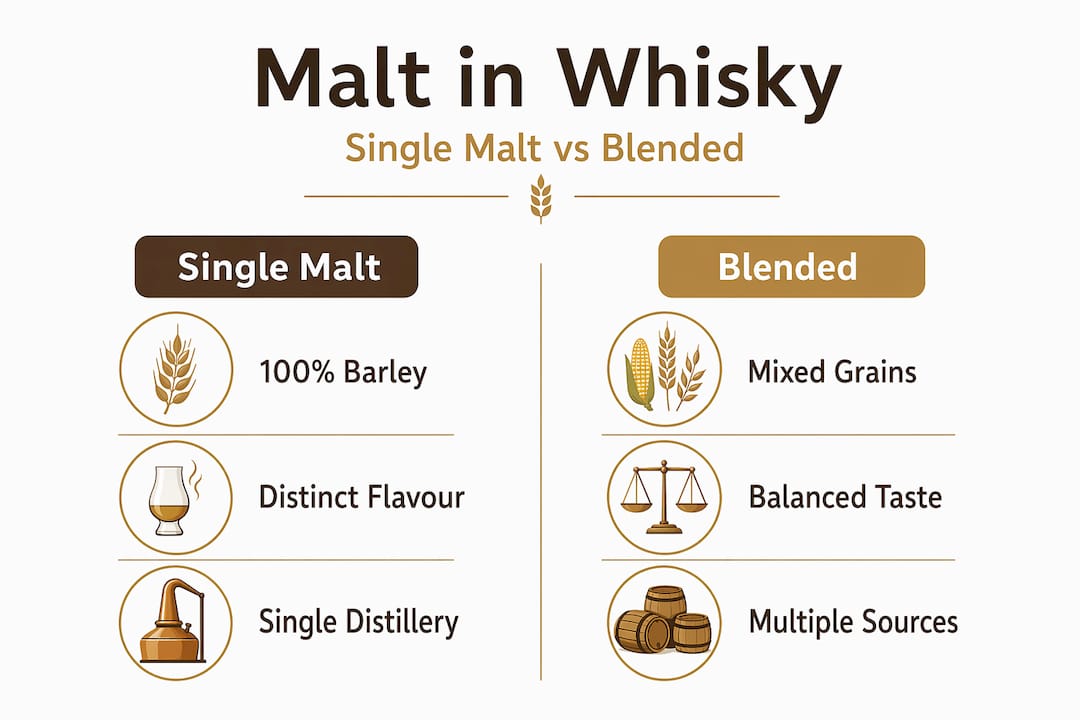
The word “malt” on a whisky label carries real meaning, but it is misunderstood more often than not. A single malt whisky is made from malted barley at a single distillery and is typically assembled from multiple casks and multiple years to achieve a consistent house style. “Single” refers to the distillery, not one cask or one batch of malt.
Scotch whisky regulations require malted barley usage and a minimum three-year maturation in oak casks not exceeding 700 litres. These rules exist to protect both quality and flavour character, and they place malt at the legal centre of Scotch identity.
In blended Scotch whisky, the malt component comes from one or more single malt distilleries, combined with grain whisky made predominantly from wheat or corn. The ratio matters enormously for the malt’s influence on the finished product.
- A blend with a high malt proportion (sometimes called a deluxe blend) carries more cereal depth, a richer body, and more identifiable malt-derived aromatics.
- Standard blends typically carry 20-40% malt whisky, with grain whisky providing lightness and approachability.
- Blended malt whisky, also known as vatted malt, contains only single malts from multiple distilleries blended together, with no grain whisky at all. This style lets malt character from different production philosophies interact without dilution.
Explore the single malt vs grain differences in more depth if you want a clearer picture of how malt content maps to what you taste.
Reading tasting notes for malt character
Tasting notes are where the science of malt finally lands in your glass. Knowing what to look for transforms a tasting note from marketing copy into a useful map.
- Look for cereal descriptors first. Biscuit, digestive, porridge, or raw grain notes almost always signal that malt character is prominent and the cask influence has not overwhelmed it.
- Notice the body and texture. Malt influences mouthfeel significantly. A well-modified malt with high sugar conversion tends to produce a fuller, rounder body compared to lightly modified grain.
- Identify whether smoke is phenolic or wood-derived. Phenolic smoke from peated malt smells medicinal, coastal, or bonfire-like. Smoke from charred or toasted casks tends to smell more like vanilla-tinged char or campfire with sweet backing notes.
- Check the finish length. Malt-forward whiskies often deliver a long, dry cereal finish that fades slowly. Grain-dominant whiskies tend to finish shorter and cleaner.
- Pay attention to sulphur. A light, struck-match sulphur note in some Speyside and Highland expressions comes directly from the malt. At low levels it adds complexity. At high levels it signals a production issue rather than malt character.
Pro Tip: To isolate malt influence from cask or peat effects, seek out young, unpeated single malts aged in refill casks. With cask influence minimised and no smoke to distract you, what you taste is as close to pure malt character as a finished whisky gets. Glen Elgin and Benrinnes are worth exploring for this reason.
The malt influence on whisky extends to aroma intensity, too. Highly modified malts with robust enzyme activity tend to produce cleaner, more defined aromatics in the new-make spirit, giving distillers a cleaner canvas for cask maturation.
Malt innovation and emerging production techniques
The malting industry is not standing still. Distillers and maltsters are pushing boundaries in ways that will shape what ends up in your glass over the next decade.
- Heirloom and heritage barley varieties such as Bere barley and older Chevallier strains are being revived for their distinctive flavour profiles. Early results show more pronounced nuttiness and a deeper cereal richness compared to modern high-yield varieties bred for efficiency over character.
- Precision kilning controls are addressing the heterogeneity challenge that has long plagued industrial maltings, with real-time temperature and moisture monitoring reducing variability across the malt bed and producing more consistent enzyme profiles.
- Experimental peat sources are being explored. Distilleries in Australia, Tasmania, and even Japan are using locally sourced peat, which differs chemically from Scottish Highland or Islay peat. The phenolic profile, and therefore the smoke character, varies meaningfully based on the organic composition of the peat source.
- Non-traditional grain malting is gaining traction in craft whisky production, particularly with malted rye and malted wheat being used either in whole-grain mashes or as flavour-dominant components alongside barley.
Each of these trends points to malt becoming more of a deliberate creative tool in whisky making, rather than simply a functional raw material. As distillers learn to control malt variables more precisely, expect to see flavour profiles that are more intentional and more traceable back to specific production decisions.
My take on malt’s underrated influence
I have spent years tasting whisky across Scotland, Japan, and Australia, and the conversation that almost never happens is the one about malt. People ask about the cask. They ask about the water. They ask about the still shape. Rarely does anyone ask which maltster supplied the barley or how long the kilning cycle ran.
In my experience, this gap in attention leads to a common mistake. Drinkers attribute complex, savoury, or earthy flavours to the cask when they are actually malt-derived. I have tasted expressions where the distillery used lightly peated malt at around 12 ppm, and the resulting earthy, almost mossy quality was being described by tasters as “heavy cask influence.” It was not. It was the malt.
What I find genuinely exciting right now is the revival of heritage grain varieties. I recently tasted a new-make spirit from a small Scottish distillery using Chevallier barley, and the difference in cereal depth compared to standard Concerto barley was immediately apparent, even before a day in cask. That depth does not vanish during maturation. It becomes the skeleton that the cask builds on.
My honest view is that malt selection and processing deserve the same level of discussion that cask policy gets. If you want to go deeper into understanding what drives a whisky’s character, start asking questions about the malt. It will change how you taste entirely.
— Brendan
Explore malt-forward whiskies at Uisuki

If this deep-dive into malt character has you wanting to taste the difference for yourself, Uisuki has a selection of bottles that put malt front and centre. The Hobart Whisky bourbon matured rum finished single malt is a superb example of Australian craftsmanship where the malted barley character is clearly the star, with the cask adding dimension rather than dominance. For those curious about how malt and grain interact within a blend, Ichiro’s Malt and Grain limited edition offers a Japanese perspective on that balance with uncommon clarity. Both bottles illustrate what becomes possible when distillers treat malt as a deliberate flavour decision rather than a starting-point commodity.
FAQ
What does malt do to whisky flavour?
Malted barley contributes cereal esters, thiols, and sulphurous compounds that form the foundational flavour of whisky. Depending on how the malt is kilned and processed, it can add notes ranging from honey and biscuit through to intense medicinal smoke.
Does higher peat ppm always mean smokier whisky?
No. Phenol ppm is measured on the malt, but distillation cuts and cask maturation transform and reduce the phenolic load significantly. Two whiskies produced from malt at similar ppm levels can differ substantially in perceived smokiness depending on how each was distilled and matured.
What is the difference between single malt and blended whisky malt content?
Single malt whisky is made entirely from malted barley at one distillery. Blended Scotch combines single malt whisky with grain whisky, with the malt proportion typically ranging from 20 to 60 percent depending on the style and quality tier of the blend.
How can I taste malt character in whisky?
Look for cereal notes such as biscuit, porridge, or raw grain on the nose and palate. A round, full body and a long, dry finish are also indicators of prominent malt character. Choosing young expressions aged in refill casks gives you the clearest view of what the malt itself brings to the glass.
Does the barley variety affect whisky flavour?
Yes, meaningfully so. Heritage varieties such as Bere barley and Chevallier produce more pronounced nutty and cereal-rich flavours compared to modern high-yield varieties. As craft distilleries revive these older grains, the connection between specific barley genetics and finished spirit character is becoming easier for drinkers to trace.