

TL;DR:
- “Single” in whisky refers to spirits from one distillery, not grain type or rarity.
- Single malt uses 100% malted barley and pot stills, creating complex flavors; single grain uses mixed grains and column stills, producing lighter spirits.
- Aged single grain whiskies from closed distilleries are becoming highly collectible and offer great value.
Most whisky lovers assume that “single” means made from one grain, or that it signals a bottle of exceptional rarity. Neither assumption is fully correct. The word “single” in both single malt and single grain whisky refers to something far more specific, and far more interesting, than most people realise. Understanding this distinction is not just an exercise in terminology. It shapes how you taste, what you collect, and how you spend your money. This guide breaks down the genuine differences between single malt and single grain whisky so you can approach your next dram or your next acquisition with genuine confidence.
Table of Contents
- What does ‘single’ mean in whisky?
- Key differences in ingredients and production
- How distillation shapes flavour profiles
- The collector’s angle: rarity, value, and evolution
- Choosing the right whisky for your collection or next dram
- A collector’s perspective: breaking the ‘single’ whisky hierarchy myth
- Explore our premium single malt and grain whisky selections
- Frequently asked questions
Key Takeaways
| Point | Details |
|---|---|
| ‘Single’ is about distillery | The word ‘single’ refers to whisky coming from one distillery, not to exclusive malt or grain content. |
| Distinct production methods | Single malt uses only malted barley and pot stills; single grain combines grains and is column-distilled, creating different spirit profiles. |
| Flavour and use differ | Single malt whiskies are bold and complex, while single grain offers lighter, smoother flavours, excelling in blends or as rare, aged bottles. |
| Collector value in both types | Rare aged single grain whiskies can be as valuable and intriguing for collectors as celebrated single malts. |
What does ‘single’ mean in whisky?
Since much confusion stems from terminology, let’s first clarify what “single” truly means in the whisky world.
The word “single” in both single malt Scotch and single grain Scotch does not refer to a single type of grain, a single cask, or some marker of exclusivity. It refers to one distillery. That’s it. When a bottle carries the word “single,” it means every drop of whisky inside came from one distillery’s production, not blended with spirit from any other site.
“Single refers to the distillery of origin, not the grain used or any implication of exclusivity or limited production. It is a legal designation under Scotch regulations.”
This is a critical distinction. A single malt Scotch whisky can contain malt from many different casks, all matured for different lengths of time, and it is still “single” as long as those casks came from the same distillery. Similarly, a single grain whisky can contain multiple grain types and still carry the “single” label, provided everything was produced at one site.
Why does this matter for collectors and enthusiasts? Because it anchors the identity of a whisky to a place and a process, not just an ingredient. The distillery’s water source, its still design, its house yeast strain, its maturation warehouses, all of these contribute to what makes a “single” whisky distinctive. When you buy a single malt or single grain, you are buying a product that expresses one producer’s signature.
Common misconceptions to discard:
- “Single” does not mean single cask (those bottles are labelled separately as “single cask”)
- “Single” does not mean made from one grain only
- “Single” does not automatically make a whisky more expensive or rare
- “Single” does not indicate age or quality
To understand more about the nuances of production differences explained between whisky styles, it helps to look at what actually sets these two categories apart at the production level.
The legal framework around this terminology is also important. The Scotch Whisky Regulations 2009 define the five categories of Scotch whisky, with both single malt and single grain having precise, enforceable definitions. Producers cannot use these terms loosely.
Key differences in ingredients and production
With terminology clarified, it’s crucial to understand what actually distinguishes these two whisky types at their core.
The most fundamental difference between single malt and single grain whisky lies in the raw ingredients and the type of still used to distil them. These two factors shape everything downstream, from the spirit’s character to its flavour and its commercial purpose.
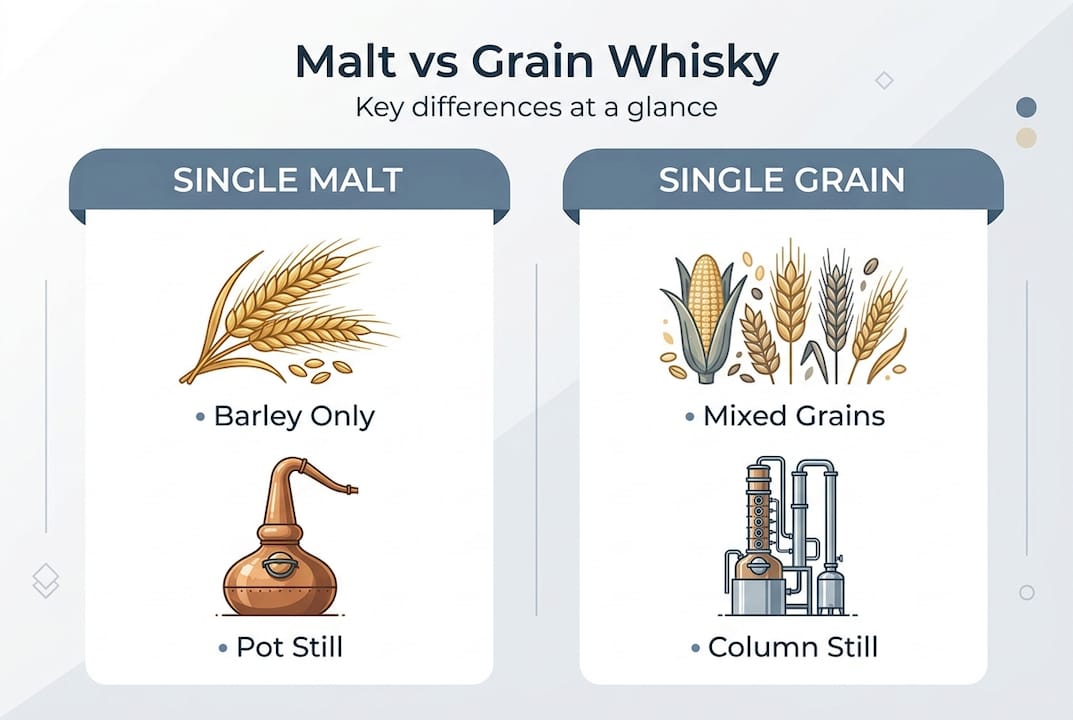
Single malt Scotch must, by law, be made from 100% malted barley. The grain is steeped in water, allowed to germinate (which activates the enzymes needed to convert starch to sugar), then kilned to halt germination. It is then mashed, fermented, and distilled in a pot still. Pot stills are the traditional copper kettle shape, and they work in batches. The spirit passes through the still twice, sometimes three times, retaining many of the heavier compounds that contribute to flavour complexity.
Single grain Scotch is a different beast. It uses malted barley plus other cereal grains, typically wheat or corn, and is distilled using a column still (also called a Coffey still or continuous still). Column stills operate continuously rather than in batches, separating alcohol from the wash at much higher efficiency.

| Feature | Single malt | Single grain |
|---|---|---|
| Primary grain | 100% malted barley | Malted barley + wheat, corn, or other grains |
| Still type | Pot still (batch) | Column still (continuous) |
| Alcohol efficiency | Lower, more character retained | Higher, lighter spirit produced |
| Typical ABV at distillation | 65 to 70% | Can reach 94.8% before dilution |
| Flavour character | Bold, complex, distillery specific | Lighter, smoother, cleaner |
| Common use | Standalone bottling | Backbone of blended Scotch |
Pro Tip: When reading a label, look for the still type mentioned in the tasting notes or producer’s description. If you see references to “copper pot distilled” or “double distilled,” you are looking at a malt. References to “continuous distillation” almost always signal a grain whisky.
Column stills allow for lighter spirit and greater production efficiency, which is why grain whisky is produced in much larger volumes and typically at lower cost per litre. This is not a criticism. It is simply a reflection of two different production philosophies serving two different purposes.
Understanding what grains make authentic Scotch gives you a firmer foundation for reading labels and understanding what you are actually paying for. And exploring distillation methods reveals just how profoundly the still design shapes the final spirit.
How distillation shapes flavour profiles
Knowing the production differences, let’s explore how these shape what you actually taste in your glass.
The pot still versus column still debate is not simply a technical curiosity. It is the engine of flavour differentiation. Pot stills retain more congeners, the flavour compounds that give whisky its personality, its fruit, its spice, its smoke, and its texture. Column stills strip much of this away in the pursuit of clean, high-strength spirit.
Classic single malt tasting notes:
- Peated expressions: smoke, iodine, sea salt, medicinal character (think Laphroaig or Ardbeg)
- Sherry-matured expressions: dried fruit, Christmas cake, dark chocolate, walnut
- Unpeated Highland or Speyside expressions: orchard fruit, honey, vanilla, gentle spice
- Coastal malts: brine, kelp, citrus zest, light smoke
Classic single grain tasting notes:
- Vanilla and coconut (from American oak influence, amplified by lighter spirit)
- Fresh cereal grain, almost biscuit-like
- Butterscotch, toffee, and cream
- Light dried fruit with long, clean finish
| Style | Body | Typical primary flavours | Best served |
|---|---|---|---|
| Single malt | Full, often oily | Fruit, spice, smoke, sherry | Neat or with a few drops of water |
| Single grain | Light to medium | Vanilla, cereal, coconut | Neat, on ice, or in a highball |
The flavour difference explained between these two styles also ties directly into how each whisky is best enjoyed. Single malt’s complexity rewards slow sipping, giving you time to find the layers. Single grain’s grain types and flavour profile lends itself to longer drinks, cocktails, or highballs where the spirit holds its own without overwhelming the mixer.
Here is the key insight for enthusiasts: single grain is not a lesser product. It is a different product, built for a different purpose and delivering a different kind of pleasure. When aged for 20 or more years in quality casks, single grain whisky develops robust, complex character that can genuinely rival some single malts in depth and interest.
The collector’s angle: rarity, value, and evolution
Beyond taste, collectors see each whisky type through the lens of rarity, investment, and provenance.
Single malt whisky dominates the collector market by sheer volume of offerings. Distilleries like The Glenlivet, Laphroaig, Glenfarclas, and Springbank release annual expressions, limited editions, and distillery-exclusive bottlings that enthusiasts track closely. The combination of regional character, house style, and maturation choices gives collectors enormous variety to pursue.
But single grain whisky is quietly becoming one of the most exciting collector categories in Scotch. Here is why.
Why aged single grain deserves collector attention:
-
Distillery closures create scarcity. Port Dundas, Caledonian, and Dumbarton distilleries have all closed. Any whisky produced there is finite, and values have climbed sharply. Rare aged single grains from closed distilleries offer collectibility and unique oak evolution that cannot be replicated.
-
Age makes grain extraordinary. A 30 or 40 year old single grain absorbs enormous oak character over decades. Because the spirit starts lighter, it does not become overwhelmed by wood the way some heavily peated malts might. The balance that emerges is often remarkable.
-
Value per bottle remains accessible. Relative to comparable-aged single malts, old single grain whisky often sells for less. That gap is narrowing, but for now, collectors can access serious age statements at reasonable prices.
-
Independent bottlers are paying attention. Companies like Signatory Vintage and Gordon and MacPhail have long bottled rare single grains. Their releases reveal what is possible when this overlooked category is given proper time and care.
Pro Tip: Look for rare whisky examples from distilleries that have closed or significantly reduced production. Label details to scrutinise include the distillation year, bottling year, cask type, and cask number. These details tell you far more about what is in the bottle than the price tag does.
The conventional wisdom that no absolute quality hierarchy exists between single malt and single grain is important to internalise. Single malt expresses its distillery’s character with full force. Single grain delivers smoothness, value, and long maturation potential. Neither is universally superior. Both deserve space in a serious collection. Exploring grain types for collectors helps you understand which grain-forward whiskies are worth pursuing and why.
Choosing the right whisky for your collection or next dram
With context, flavour, and value explained, here’s how to make an informed choice between whisky styles.
The choice between single malt and single grain should never be made on autopilot. Both styles are regulated under the Scotch Whisky Regulations 2009 with strict definitions that protect the integrity of each category. But within those boundaries, there is enormous variety.
Decision framework for choosing your next bottle:
- For bold, layered complexity: Reach for a single malt. Laphroaig 10 Year for coastal peat intensity, Glenlivet 18 for fruit-forward elegance, or Glenfarclas 105 for sherry richness.
- For approachable, smooth everyday drinking: Try a single grain. Loch Lomond’s single grain expressions offer clean, vanilla-forward character. Cameronbridge releases, especially older ones, show how time transforms grain spirit beautifully.
- For gifts: Single malt tends to have stronger name recognition and makes a more immediately impressive gift for someone new to whisky.
- For serious collecting: Consider a mix of both. Allocate budget toward aged single malts from celebrated distilleries, but do not overlook aged grain bottlings from closed sites.
- For highball drinking: Single grain is your friend. Its clean profile means it integrates beautifully with chilled soda water and a citrus garnish.
One striking statistic puts single grain’s role in perspective: approximately 90% of all Scotch sold is blended Scotch, and grain whisky forms the backbone of virtually every major blend. It is almost invisibly responsible for the most consumed whisky category in the world, yet it rarely gets the credit it deserves as a standalone spirit.
Edge cases worth knowing: some Irish and Japanese producers make pot still grain whiskies that blur the category lines, and aged grain complexity can genuinely surprise even experienced palates. The single grain whisky guide at Uisuki offers deeper exploration of this underappreciated style, while the single malt whisky guide walks you through choosing a malt that matches your palate.
A collector’s perspective: breaking the ‘single’ whisky hierarchy myth
Here is an opinion that some whisky traditionalists will push back on: the idea that single malt is inherently the pinnacle of Scotch whisky is a marketing story, not a tasting truth.
We have spent considerable time with aged single grains from closed Scottish distilleries, and the experience is consistently humbling. A 40 year old grain from Caledonian or Port Dundas carries a subtlety and a depth that demands just as much attention as any celebrated single malt. The flavour profile is different, yes. It will not hit you with Islay peat or sherry-drenched dried fruit. But the integration of oak, vanilla, and soft cereal character after four decades in cask is, frankly, extraordinary.
The whisky world is poorer when collectors ignore grain because of assumptions rather than experience. Open-mindedness is not just a virtue here. It is a practical advantage. Aged grain whisky remains undervalued relative to malt, which means collectors who pay attention can still access exceptional bottles at prices that would be unthinkable for comparable malts. For rare whisky insights, the lesson is consistent: follow your palate, not the hierarchy.
Explore our premium single malt and grain whisky selections
Inspired to deepen your whisky journey? Find a world of taste and discovery at your fingertips.
At Uisuki, we have curated a range of single malt and grain whiskies from Scotland, Japan, Australia, and the USA, selected specifically for enthusiasts and collectors who want more than the obvious choices.

Whether you are searching for a peated Islay single malt, a rare aged grain from a closed Scottish distillery, or simply want guidance on where to begin, our team is here to help. Browse our new arrivals and rare releases, explore our expert guides, or reach out directly for a personalised sourcing request. We ship across Australia and internationally, with expert knowledge behind every recommendation we make.
Frequently asked questions
Is single malt really always better than single grain whisky?
No, both styles deliver genuinely unique profiles. Some rare aged single grains older than 20 years develop oak-dominant complexity that rivals the most celebrated single malts.
Can a whisky be both ‘single’ and ‘blended’?
No. “Single” refers to one distillery, while “blended” means whisky from multiple distilleries has been combined. The two terms are mutually exclusive by legal definition.
Why is single grain whisky used so much in blends?
Its lighter, smoother profile and the efficiency of column distillation make it ideal for creating consistent, affordable, balanced Scotch. Single grain forms the backbone of roughly 90% of all Scotch sold globally.
Are there any famous single grain whisky brands?
Yes. Loch Lomond produces well-regarded single grain expressions, and older releases from Cameronbridge, Girvan, and Invergordon are considered collectible, particularly from closed or reduced-capacity sites.
Does the region affect single malt or grain whisky flavour?
Yes, regional terroir shapes both styles, but its influence is more pronounced in single malts where distillery character comes through more directly and the production process retains more local character.