

TL;DR:
- Single malt whisky is produced at one distillery using only malted barley and aged for at least three years, while double malt, a non-legal term, usually refers to blended malt whisky from multiple distilleries. Both categories have distinct production regulations and flavor profiles, but neither is inherently superior, and their classification affects your drinking experience. Carefully reading labels and understanding legal definitions helps consumers make informed choices in this complex whisky landscape.
Single malt whisky is defined as malt whisky produced at one distillery using only malted barley, while double malt is a popular but non-legal term that most commonly refers to blended malt, a combination of malt whiskies from two or more distilleries. Understanding what is single malt vs double malt matters because these classifications directly shape what ends up in your glass. The production method, legal standing, and flavour profile of each category differ in ways that affect every buying decision you make. This guide cuts through the marketing noise and explains both categories precisely.
What is single malt vs double malt whisky?
Single malt whisky is made from malted barley, distilled at one distillery in Scotland using pot stills, matured in oak casks for at least three years, and bottled at no less than 40% ABV. The word “single” refers exclusively to the number of distilleries involved, not the number of barrels or batches used. This is the most commonly misunderstood point in whisky classification.
Double malt, by contrast, carries no legal protection under Scotch Whisky Regulations. The term is used in marketing and casual conversation, but the closest regulated equivalent is blended malt Scotch, which combines malt whiskies from multiple distilleries with no grain whisky included. Brands like Monkey Shoulder and Compass Box Hedonism are well-known examples of this style. Knowing the distinction between these two categories is the foundation for reading any whisky label accurately.
How is single malt whisky made and regulated?
Single malt production follows a tightly defined legal framework under the Scotch Whisky Regulations 2009. Every step from grain selection to bottling is governed, which is why the category carries such strong consumer trust.
The core production requirements are:
- Grain: Malted barley is the only grain permitted.
- Distillation: Must occur at a single distillery using pot stills.
- Maturation: Aged in oak casks not exceeding 700 litres for a minimum of three years.
- Bottling strength: No less than 40% ABV.
- Location: The entire process must take place in Scotland for Scotch classification.
Legal definitions require that cask size be capped at 700 litres, which maximises wood contact and accelerates flavour development compared to larger vessels. This is why age statements on single malts carry real weight. A 12-year-old expression from a 200-litre barrel will taste noticeably different from the same spirit aged in a 500-litre hogshead.
One detail that surprises many enthusiasts: most single malts are blends of multiple casks from the same distillery. The master distiller selects and combines barrels to achieve a consistent house style across every release. Only bottles labelled “single cask” come from one individual barrel. Distilleries like Glenfarclas and GlenDronach regularly release single cask expressions that show just how dramatically one barrel can differ from the next.
Pro Tip: When exploring single malts for the first time, compare a standard bottling from a distillery against its single cask release. The contrast reveals how much work goes into maintaining a consistent house style.
What is blended malt (double malt) whisky?
Blended malt whisky is the legally recognised category that most people mean when they say “double malt.” The 2009 Scotch regulations clarified this terminology, distinguishing blended malt (malt whiskies from multiple distilleries, no grain) from blended Scotch (which includes grain whisky). Before 2009, the term “vatted malt” was commonly used for the same product.
The key characteristics of blended malt whisky are:
- Grain source: Malted barley only, sourced from two or more distilleries.
- No grain whisky: Unlike blended Scotch, no column-distilled grain spirit is added.
- Minimum age: Three years in oak, same as single malt.
- Bottling strength: Minimum 40% ABV.
- Legal status: A recognised Scotch category, but “double malt” itself is not a protected term.
Blended malt represents a middle ground that combines the richness of malt-only whisky with the blender’s ability to draw on multiple distillery characters. Because no grain whisky is present, the result is richer in texture than a standard blended Scotch. Compass Box, one of the most respected independent blenders in Scotland, built its reputation almost entirely on blended malts, demonstrating that the category can rival single malts in complexity and craftsmanship.
Pro Tip: If a bottle uses the phrase “double malt” without specifying the distilleries or declaring it as blended malt, check the label carefully. The term has no legal protection and may be used purely as a marketing device.
How do single malt and blended malt differ in flavour?
The flavour difference between single malt and blended malt comes down to one core principle: single malt expresses one distillery’s character, while blended malt draws on several. Neither is objectively superior. They serve different purposes and suit different palates.
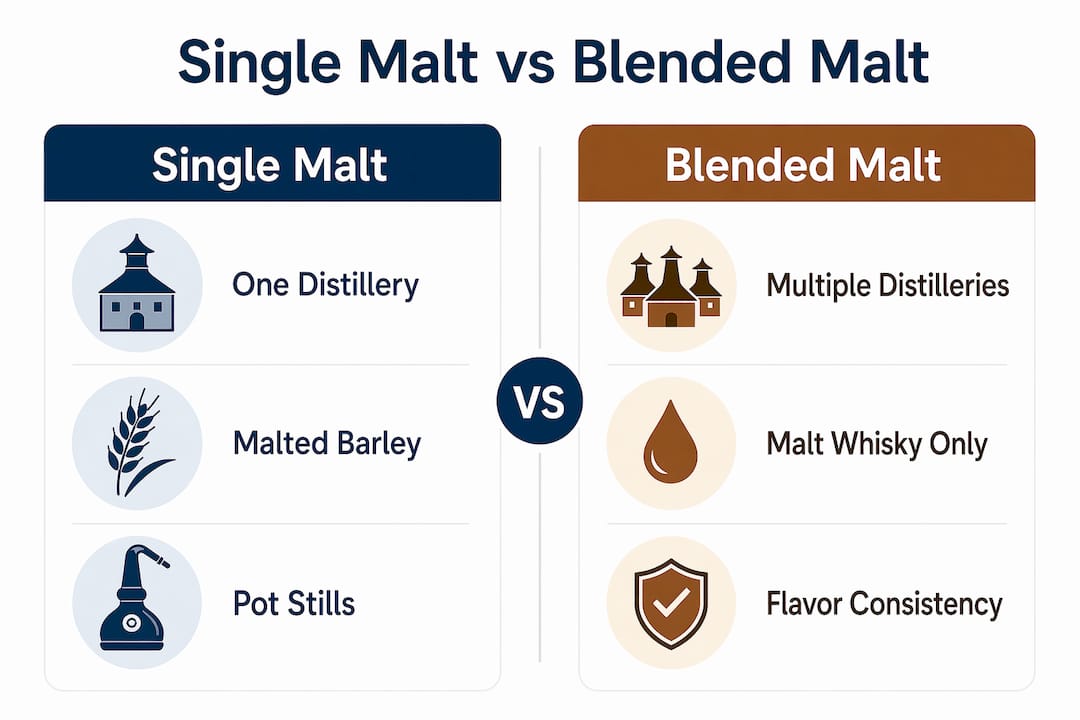
| Feature | Single malt | Blended malt |
|---|---|---|
| Grain source | Malted barley, one distillery | Malted barley, multiple distilleries |
| Flavour consistency | Varies by cask, age, and season | More consistent across batches |
| Complexity | Reflects one house style deeply | Broader character from multiple sources |
| Texture | Rich, varies by region | Rich, often layered |
| Grain whisky | None | None |
Single malt seeks to express one distillery’s unique style, which means a Speyside expression like Glenfiddich 15 will taste markedly different from an Islay expression like Laphroaig 10. The terroir, water source, still shape, and cask selection all contribute to what whisky writers call the “house style.” This specificity is exactly what single malt collectors prize.
Blended malts, on the other hand, allow blenders to create a more consistent profile across batches by drawing from multiple distilleries. This reduces the variability you might encounter between different cask releases of the same single malt. The trade-off is that blended malts can feel less site-specific, though skilled blenders like those at Compass Box or Johnnie Walker’s blending team use this freedom to build genuinely complex expressions.
Blended malt avoids the lightness of grain whisky, delivering richer texture than standard blended Scotch. This makes it a strong choice for drinkers who want the malt character of a single malt but with a broader, more layered flavour profile. Think of it as a curated playlist versus a single artist’s album. Both have merit, and the right choice depends entirely on what you are after.
Pro Tip: Explore malt whisky flavour by tasting a blended malt alongside a single malt from one of its source regions. The comparison is one of the most instructive exercises in whisky education.
Reading whisky labels and avoiding common misconceptions
Whisky labels carry precise legal meaning, but marketing language can blur the lines. These are the most common misconceptions and how to address them.
Misconception 1: Single malt means from one cask. This is the most widespread error. Single malt production involves marrying multiple casks of differing ages and profiles to achieve the distillery’s signature flavour. Only bottles explicitly labelled “single cask” come from one barrel.
Misconception 2: Double malt is a regulated term. It is not. Marketing labels using “double malt” carry no legal protection under Scotch regulations. The term may mean blended malt, or it may simply be a brand’s way of suggesting premium quality or dual maturation. Always look for the regulated category declaration on the label.
Misconception 3: Blended means lower quality. Blended malt and blended Scotch are different products. Blended malt contains no grain whisky and can match single malts in complexity. Dismissing it on the basis of the word “blended” means missing some of the most interesting expressions available.
Practical tips for reading labels accurately:
- Look for the words “single malt Scotch whisky” or “blended malt Scotch whisky” as the legal category declaration.
- Check whether the distillery is named. Named distilleries confirm single malt status.
- If the label says “double malt,” look for additional detail about source distilleries or maturation. Without it, treat the term as marketing.
- For single malt vs grain whisky comparisons, the grain source declaration is your clearest guide.
- Age statements on both categories indicate the youngest whisky in the bottle, not the average.
Key takeaways
Single malt whisky comes from one distillery using malted barley only, while double malt (blended malt) combines malt whiskies from multiple distilleries with no grain whisky added, and neither category is inherently superior to the other.
| Point | Details |
|---|---|
| Single malt definition | Malted barley, one distillery, pot stills, minimum three years in oak. |
| Double malt is not a legal term | “Double malt” has no regulatory protection; blended malt is the correct legal category. |
| Single malt and casks | Most single malts blend multiple casks; only “single cask” bottlings come from one barrel. |
| Blended malt texture | No grain whisky means richer texture than standard blended Scotch. |
| Label reading | Always check the legal category declaration, not just the marketing language on the front label. |
Why I think the double malt debate misses the real point
Brendan here. After years of tasting across both categories, the single malt versus double malt conversation often gets stuck in a prestige argument that does not serve the drinker. Single malt carries cultural weight, particularly in Scotland, and that reputation is well earned. But treating blended malt as a lesser product is a mistake I see even experienced enthusiasts make.
The most interesting bottles I have encountered at Uisuki have often been blended malts from independent bottlers who are doing genuinely creative work. Compass Box’s Peat Monster, for instance, draws on Ardmore and Laphroaig to build a smoky, layered expression that neither distillery could produce alone. That kind of intentional blending is a craft in its own right.
My honest view is that the “single” in single malt has become a marketing advantage as much as a production descriptor. Consumers associate it with authenticity and terroir, which is fair. But the single malt whisky meaning is simply about distillery origin, not about quality ceiling. Some of the most consistent, well-priced expressions I reach for regularly are blended malts.
If you are building your whisky knowledge, taste both categories without prejudice. The classification tells you where the spirit came from and how it was assembled. What it cannot tell you is whether you will love it. That part you have to discover yourself.
— Brendan
Explore single malt and blended malt whiskies at Uisuki
Whether you are drawn to the focused character of a single malt or the layered complexity of a blended malt, Uisuki stocks expressions that represent both categories at their best.

The Hobart Whisky Bourbon Matured Rum Finished Single Malt is a standout Australian single malt that shows exactly what one distillery can achieve with thoughtful cask selection. For those curious about the blended side, Ichiro’s Malt and Grain is a world blended whisky that demonstrates how combining malt and grain sources from different countries produces something genuinely distinctive. Both bottles are available now with shipping across Australia.
FAQ
What does single malt whisky mean?
Single malt whisky is produced from malted barley at one distillery using pot stills, aged in oak casks for at least three years, and bottled at a minimum of 40% ABV. The word “single” refers to one distillery, not one cask or one batch.
Is double malt whisky a real category?
“Double malt” is not a legally protected term under Scotch Whisky Regulations. It most commonly refers to blended malt whisky, which combines malt whiskies from two or more distilleries with no grain whisky added.
Does single malt taste better than blended malt?
Neither category is inherently better. Single malt expresses one distillery’s house style, while blended malt combines multiple distillery characters for broader complexity. Preference depends entirely on your palate and what you are looking for in a dram.
How do I tell single malt from blended malt on a label?
Look for the legal category declaration on the label. “Single malt Scotch whisky” confirms one distillery source. “Blended malt Scotch whisky” confirms multiple malt distilleries with no grain whisky. The term “double malt” alone is a marketing phrase and carries no legal definition.
Does blended malt contain grain whisky?
No. Blended malt contains only malt whiskies from multiple distilleries. Grain whisky is present in blended Scotch whisky, which is a separate and distinct category under Scotch regulations.