

What single grain whisky actually is, and why the definition matters
Single grain whisky is one of the five legally recognised categories of Scotch whisky. Under the Scotch Whisky Regulations 2009, it must be produced at a single distillery using water, malted barley, and optionally other whole cereal grains, then distilled to below 94.8% ABV. That upper ABV limit is what separates it from neutral grain spirit.
The word “single” trips people up. It refers to the distillery, not the grain. A single grain whisky can contain wheat, maize, rye, or a blend of cereals alongside malted barley. What it cannot do is draw spirit from more than one site.
Key distinctions worth knowing:
- Single malt vs single grain: Single malt uses 100% malted barley distilled in pot stills. Single grain uses a mixed mash distilled in continuous column stills, producing a lighter, sweeter spirit with fewer congeners.
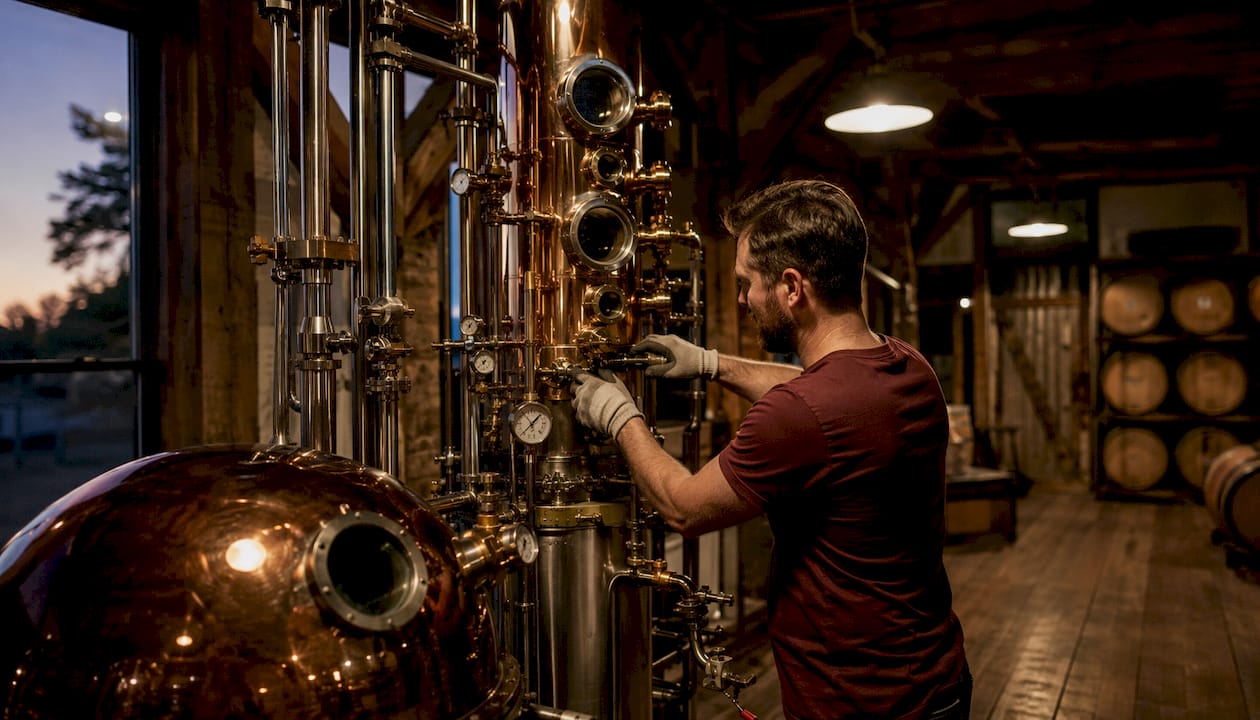
- Column still distillation: The continuous column still runs two tall columns, the rectifier and the analyser, enabling uninterrupted distillation at high proof.
- Role in blends: Grain whisky forms the volume backbone of blended Scotch, smoothing out the intensity of single malts and delivering flavour consistency at scale.
- Maturation: Like all Scotch, it must age in oak casks in Scotland for at least three years.
The 2009 Regulations did more than codify these rules. They ended decades of ambiguous labelling and gave single grain whisky a clear commercial identity for the first time.
Table of Contents
- How single grain whisky is made, and how that process evolved
- How single grain whisky travelled the world and found new audiences
- Key takeaways
How single grain whisky is made, and how that process evolved
The grain bill and its historical roots
Scottish distillers have used mixed cereal mashes for centuries. Oats, rye, and wheat all featured alongside malted barley, with grain proportions shifting in response to 18th-century malt taxes that made pure barley mashes expensive. Malted barley remained non-negotiable because its enzymes convert starches to fermentable sugars. Everything else was subject to economics.
The Coffey still changes everything
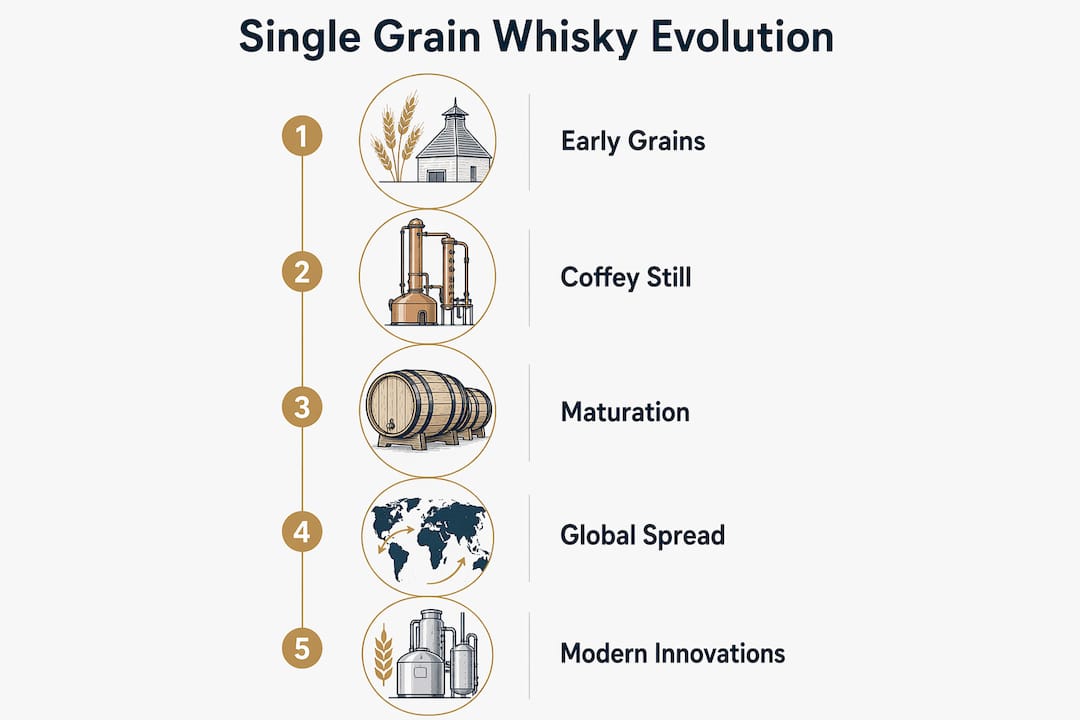
The pivotal moment in the history of grain whisky came in 1831, when Aeneas Coffey patented his continuous column still. Where pot stills required batch distillation and produced a heavier, more flavoursome spirit, the column still ran continuously, separated congeners efficiently, and yielded a lighter, higher-proof distillate. Large distilleries like Cameronbridge in Fife adopted the technology quickly, and grain whisky production scaled in a way pot still operations simply could not match.
Pro Tip: If you want to understand why blended Scotch dominates global sales, look at the column still. Its efficiency made consistent, affordable blending possible, and blended Scotch now accounts for the vast majority of Scotch whisky sold worldwide.
From mash to cask: the production stages
- Milling — Cereals are milled to expose starch.
- Mashing — Hot water converts starches to sugars using malted barley enzymes.
- Fermentation — Yeast converts sugars to a low-strength wash.
- Column distillation — The wash passes through the analyser and rectifier columns, reaching close to 94% ABV.
- Maturation — Spirit fills oak casks, typically ex-bourbon barrels, for a minimum of three years.
Ex-bourbon casks are the industry standard for grain whisky maturation, and they leave a clear flavour signature: vanilla, toffee, and light caramel. Compared to malt whisky aged in sherry casks, the profile is gentler and more approachable, which is precisely why grain whisky suits blending so well.
| Feature | Single grain whisky | Single malt whisky |
|---|---|---|
| Grain bill | Malted barley + other cereals | 100% malted barley |
| Still type | Continuous column still | Copper pot still |
| ABV at distillation | Below 94.8% | Below 94.8% |
| Typical cask | Ex-bourbon | Ex-bourbon or sherry |
| Flavour profile | Light, sweet, vanilla-forward | Complex, rich, varied |
Australian distilleries are now exploring single grain expressions of their own, experimenting with local grains and different cask types. The results diverge noticeably from Scotch traditions, reflecting Australia’s warmer climate and shorter effective maturation cycles.
How single grain whisky travelled the world and found new audiences
For most of its history, grain whisky was invisible to consumers. It left the distillery in tanker trucks, disappeared into blending vats, and emerged as Johnnie Walker or Chivas Regal with no mention of its origin. The grain distilleries producing it, including Cameronbridge, Port Dundas, and Invergordon, were industrial operations built for volume, not prestige.
That began to shift in the late 20th century as independent bottlers started releasing aged single grain expressions. Whisky enthusiasts who encountered a 30-year-old Cameronbridge or a vintage Dumbarton discovered something unexpected: grain whisky, given time, develops genuine complexity. The lighter spirit allows wood influence to accumulate gradually, producing flavours that differ from malt whisky but reward attention just as much.
Export markets, particularly Japan and the United States, drove early collector interest. Japanese whisky culture, with its appreciation for delicate, precise flavours, proved receptive to well-aged grain expressions. That international curiosity fed back into the Scotch industry, encouraging distilleries to hold back more grain stock for standalone bottling.
In Australia, appreciation for Scotch grain whisky has grown alongside the broader premium whisky boom. Australian consumers increasingly seek out single grain releases as a distinct category rather than treating them as a curiosity. Local distilleries are responding with their own grain-forward releases, drawing on both Scotch heritage and distinctly Australian ingredients and conditions.
Key takeaways
Single grain whisky’s history is inseparable from the industrial and regulatory forces that shaped Scotch whisky as a whole, from 18th-century malt taxes to the 2009 Regulations that finally gave it a legal name.
| Point | Details |
|---|---|
| Legal definition | Produced at one distillery, malted barley plus optional cereals, distilled below 94.8% ABV under the 2009 Regulations. |
| Column still origins | Aeneas Coffey’s 1831 invention made continuous, high-volume grain distillation possible for the first time. |
| Role in blends | Grain whisky provides the volume and lighter flavour that allows single malts to define a blend’s character. |
| Maturation flavour | Ex-bourbon cask ageing delivers vanilla and toffee notes distinct from the richer profiles of malt whisky. |
| Australian growth | Local distilleries are now producing grain-forward expressions that complement and diverge from Scotch traditions. |

Uisuki stocks a curated range of whiskies that reflect the full spectrum of grain and malt traditions, from Scotch classics to Australian releases. The Ichiro’s Malt and Grain Limited Edition is a compelling example of grain whisky’s role in world-class blending. Browse the full selection at Uisuki.com.au.