

TL;DR:
- Single malt whisky is made at one distillery from 100% malted barley, not from a single cask.
- The cask type, maturation process, and distillery influence flavor more than age or regional labels.
- Understanding the true meaning of single malt helps consumers appreciate quality differences globally.
Most people assume ‘single malt’ means whisky from a single barrel or cask. It doesn’t. The term actually refers to where and how the whisky is made, not how many casks went into your bottle. This common misconception leads drinkers to overpay for ordinary bottles or dismiss extraordinary ones without a second look. Whether you’re exploring Scotch for the first time or chasing down the next great Australian single malt, understanding what the term really means changes how you shop, taste, and collect. This guide cuts through the confusion and gives you the full picture, from distillery definitions to maturation rules and global variations.
Table of Contents
- What single malt whisky really means
- How single malt whisky is made: the process explained
- Single malt vs blended whisky: key differences
- Global styles: Scotch, Australian and other single malts
- Why understanding ‘single malt’ matters more than ever
- Explore top single malt choices at Uisuki
- Frequently asked questions
Key Takeaways
| Point | Details |
|---|---|
| Single malt definition | Single malt whisky is made from 100% malted barley at one distillery, not from a single barrel. |
| Production process | Malting, fermentation, distillation and oak maturation create the unique character of single malt whisky. |
| Key differences | Single malt uses only malted barley from one distillery; blended whisky mixes various grains and distilleries. |
| Australian rules | In Australia, single malt must mature at least 2 years, and process rules are similar but not identical to Scotch. |
| Quality insight | Cask quality and distillery skill matter more than age alone in judging great single malt whisky. |
What single malt whisky really means
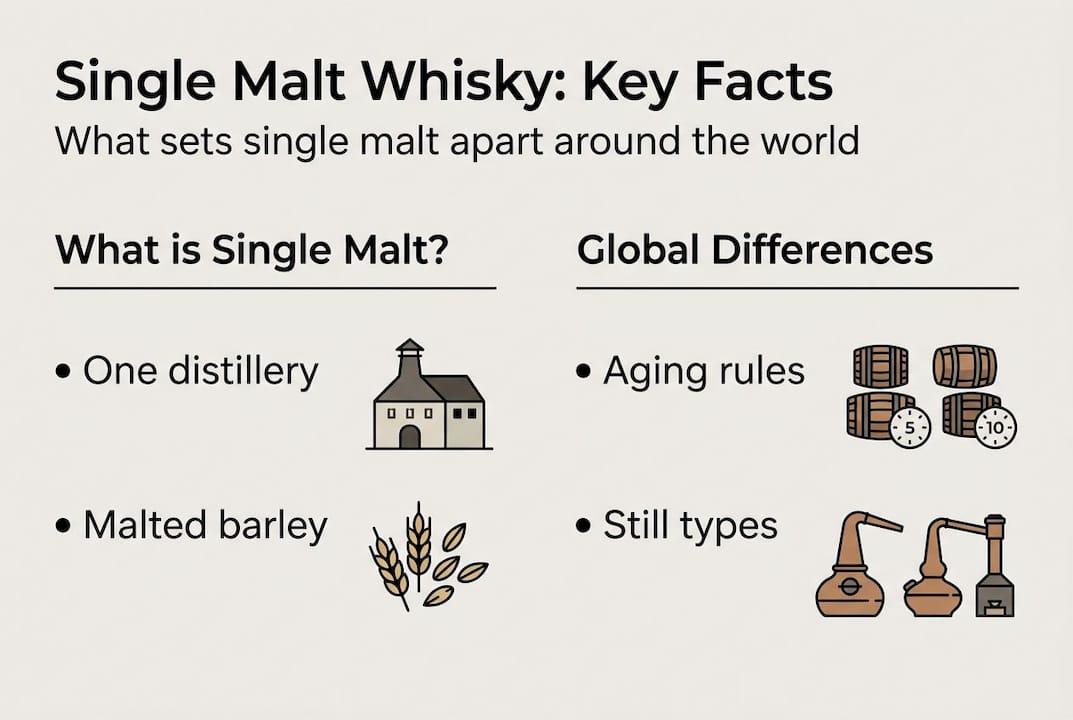
Let’s start with the definition itself. Single malt whisky is whisky produced at a single distillery from 100% malted barley, distilled in pot stills, and matured in oak casks. Every word in that sentence matters. ‘Single’ refers to the distillery, not the cask. ‘Malt’ refers to malted barley, the only grain used. And ‘whisky’ means it must be aged in oak before it ever reaches your glass.
The cask confusion runs deep. Bottles are usually vatted from multiple casks, often dozens or even hundreds, to achieve a consistent house style. The master distiller’s job is to blend those casks so each bottle tastes like the last. A ‘single cask’ whisky is a separate and specific thing, where all the liquid in the bottle comes from one individual cask, and it’s usually labelled as such.
Here’s a quick snapshot of what defines single malt whisky:
- Grain: 100% malted barley only
- Distillery: Produced entirely at one site
- Still type: Pot stills (in most regulated markets)
- Maturation: Oak casks for a minimum period (varies by country)
- Vatting: Usually a blend of multiple casks for consistency
| Feature | Single malt | Single cask |
|---|---|---|
| Number of distilleries | One | One |
| Number of casks | Multiple (vatted) | Exactly one |
| Consistency | High | Varies bottle to bottle |
| Availability | Wide | Very limited |
For a practical walkthrough on choosing single malt whisky, it helps to know these distinctions before you even look at a label. And if you want to understand single malt characteristics in greater depth, the regulations and flavour profiles are worth exploring separately.
Pro Tip: If you see ‘single cask’ or ‘cask strength’ on a label, that’s a specific bottling style, not a definition of single malt itself. Most single malts are not single cask.
How single malt whisky is made: the process explained
Knowing the definition is one thing. Understanding the process is where appreciation really begins. Single malt production follows a logical sequence, and each stage shapes the flavour in the glass.
- Malting: Barley grains are soaked in water and allowed to germinate, converting starches into fermentable sugars. The grain is then kilned (dried with heat) to stop germination. Peat smoke at this stage creates the smoky character you find in Islay Scotch.
- Mashing: The malted barley is ground into a coarse flour called grist, then mixed with hot water in a large vessel called a mash tun. This extracts the sugars into a liquid called wort.
- Fermentation: The wort is cooled and transferred to fermentation vessels called washbacks, where yeast is added. Fermentation runs for 48 to 96 hours, producing a beer-like liquid around 8% ABV called wash.
- Distillation: The wash goes through pot stills twice (sometimes three times in Ireland). Each pass concentrates alcohol and removes unwanted compounds. The shape and size of the still directly affects flavour.
- Maturation: New spirit goes into oak casks for ageing. Whisky maturation is where the real magic happens. The wood adds colour, softens the spirit, and contributes vanillin, tannins, and spice.
- Bottling: The distiller selects and vatts casks, then dilutes to bottling strength (typically 40% to 46% ABV), unless releasing at cask strength.
“The cask is responsible for up to 70% of a whisky’s final flavour.” This widely cited industry figure is a reminder that great barley and perfect distillation still depend on wood to become great whisky.
Pro Tip: Pay attention to the cask type on the label. Ex-bourbon barrels bring vanilla and honey. Sherry casks add dried fruit and spice. The cask tells you as much as the distillery name does.
Single malt vs blended whisky: key differences
Once you understand how single malt is made, blended whisky makes more sense as a contrast. Blended Scotch includes grain whisky from multiple distilleries combined with malt whisky, often from several distilleries. The goal is accessibility, consistency, and volume at a reasonable price point.
Blended whisky is not lesser whisky. Brands like Johnnie Walker, Chivas Regal, and Dewars have spent generations perfecting their blends. A master blender uses up to 40 or 50 different whiskies to build a consistent product year after year. That’s a different skill set to the single malt distiller, but it’s no less valid.
Here’s how the two stack up:
| Category | Single malt | Blended Scotch |
|---|---|---|
| Grain used | 100% malted barley | Malted barley plus grain whisky |
| Distilleries | One | Multiple |
| Price range | Mid to premium | Entry to premium |
| Flavour character | Distillery-specific | Consistent house style |
| Collector appeal | High | Lower (exceptions exist) |
For drinkers exploring different styles, understanding types of single malt Scotch whisky helps clarify what you actually enjoy. Some people love the grassiness of a Speyside, others want the salt and smoke of an Islay. Blended whisky tends to soften those edges for broader appeal. You can also read more about the blended vs single malt debate from a global perspective.
“Single malt is the distillery’s signature in a glass. Blended is a craftsman’s recipe. Neither is wrong—they’re just answering different questions.”
What matters practically is this: if you want to explore a specific region, producer, or flavour profile with precision, single malt is your lens. If you want reliable enjoyment at a fair price, blended whisky delivers every time.
Global styles: Scotch, Australian and other single malts
Here’s where things get interesting for Australian drinkers. ‘Single malt’ isn’t a globally uniform term. Each country sets its own rules, and the differences are meaningful.
No universal global definition exists for single malt whisky. The USA, for instance, has no minimum age requirement and no mandatory pot still rule. Japan largely follows Scottish traditions but has only recently formalised its own whisky regulations. Australia sits between those worlds.
Australian single malt typically requires 100% malted barley at a single distillery, produced using pot or column stills, and matured in oak for a minimum of two years. Compare that to Scotland’s three-year minimum under the Scotch Whisky Association’s regulations.
| Country | Grain requirement | Still type | Min. maturation | Defining body |
|---|---|---|---|---|
| Scotland | 100% malted barley | Pot still | 3 years | Scotch Whisky Association |
| Australia | 100% malted barley | Pot or column | 2 years | Australian Distillers Association |
| Japan | Malted barley (primary) | Pot still preferred | 3 years (since 2021) | Japan Spirits & Liqueurs Makers Association |
| USA | Malted barley (primary) | Any | No minimum | TTB |
The Scotch Whisky Association definitions are among the strictest in the world, which is part of why Scotch commands such reverence globally. But Australian producers are proving that shorter minimum maturation periods don’t automatically mean inferior whisky. Tasmania’s climate accelerates maturation significantly compared to Scotland’s cooler conditions.
- Australia’s warmer climate means faster interaction between spirit and wood
- Local cask types, including Australian ex-wine casks, create unique flavour profiles
- Distilleries like Lark, Starward, and Archie Rose are gaining international recognition
For a closer look at sourcing quality bottles from local producers, the Australian single malt sourcing guide covers the key considerations.
Why understanding ‘single malt’ matters more than ever
Most whisky guides point you toward region and age. Speyside for elegance, Islay for smoke, older is better. We’d push back on that. Knowing the true meaning of single malt shifts your focus from prestige markers to the things that actually determine quality: cask selection, maturation conditions, and the distiller’s intent.
Cask type and quality can make a younger single malt outperform an older one with ease. A beautifully managed sherry butt can transform a five-year-old spirit into something you’d mistake for a 15-year-old. That’s why No Age Statement (NAS) whiskies are increasingly serious products, not budget substitutes.
For Australian collectors, this matters even more. Local producers are working with shorter ageing windows and extraordinary raw materials. Dismissing them because they lack a 12-year age statement means missing some of the most exciting whisky being made right now. The best whiskies for collectors increasingly include younger Australian expressions that punch well above their age. Understanding why gives you a genuine edge, whether you’re buying to drink or to hold.
Explore top single malt choices at Uisuki
Now that you know what single malt actually means and what separates an exceptional bottle from an ordinary one, the next step is finding the right whisky for your palate and collection.

At Uisuki, we curate single malts from Scotland, Japan, Australia, and beyond, including rare and limited releases that serious collectors chase. The Glenglassaugh 48yo Australia Exclusive is a remarkable example of long-matured Scotch aged in Pedro Ximenez sherry cask, exclusive to Australian buyers. If you’re after something closer to home, the Old Kempton whisky gift set offers a beautifully presented introduction to Tasmanian single malt. Browse our full selection and find the bottle that fits your story.
Frequently asked questions
What does ‘single malt’ actually mean?
‘Single malt’ means whisky made from 100% malted barley at one distillery, not from a single barrel. Most bottles are vatted from multiple casks to achieve a consistent flavour.
Is single malt whisky always better than blended?
Not necessarily. Both styles have genuine strengths. Blended Scotch combines grain whisky from multiple distilleries for broad appeal, while single malt showcases a specific distillery’s character. Quality exists in both categories.
How long does single malt whisky need to mature?
It depends on the country. Scotch requires minimum 3 years, while Australian single malt must mature for at least 2 years in oak. Climate and cask type influence how much develops in that time.
Can young single malt whisky still be high quality?
Absolutely. Cask quality can lift a young single malt well beyond its age. Australian distilleries in particular benefit from a warmer climate that accelerates maturation, producing complex whisky even at the two-year minimum.