

TL;DR:
- Single malt whisky is produced at a single distillery using only malted barley and pot stills, then matured in oak casks for at least three years. Its diverse flavors are shaped by region, climate, cask type, and distillery character, resulting in a wide range of profiles from smoky Islay to honeyed Speyside. Understanding label terms and cask influences helps consumers make informed choices among various global styles.
Single malt whisky is defined as a spirit produced at a single distillery using only malted barley and pot stills, then matured in oak casks. The Scotch Whisky Association enforces this definition under the 2009 Scotch Whisky Regulations, requiring a minimum three years of oak maturation. What makes the types of single malt whisky so compelling is not the shared production method but the extraordinary diversity that emerges from it. Region, climate, cask selection, and distillery character combine to produce whiskies as different from one another as Laphroaig is from Glenlivet.
1. What are the types of single malt whisky?
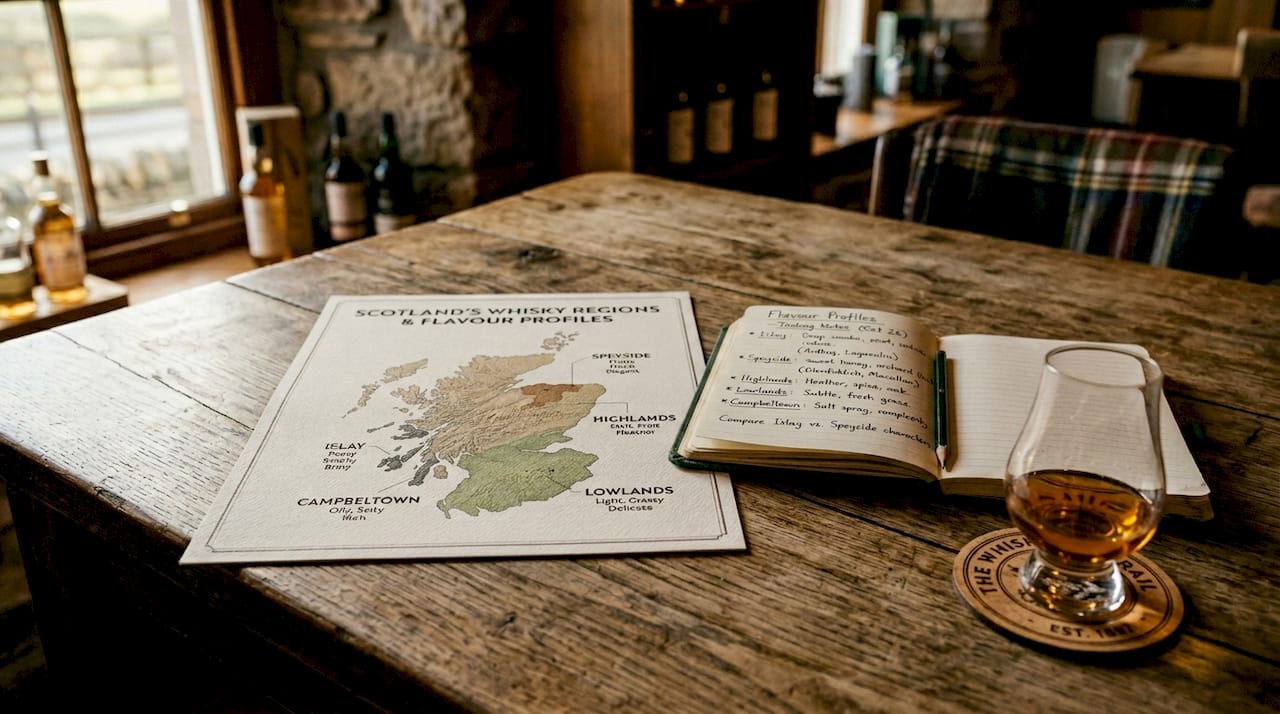
The regional styles of Scotch single malt are the most widely recognised framework for understanding how geography shapes flavour. Scotland’s five producing regions each carry a signature character, though individual distilleries frequently defy expectations.
Here is a quick comparison of the five Scotch single malt regions:
| Region | Flavour profile | Example distillery |
|---|---|---|
| Speyside | Honeyed, fruity, floral | Glenfiddich, Glenlivet |
| Highland | Varied: fruit, spice, light peat | Glenmorangie, Dalmore |
| Islay | Heavily peated, smoky, medicinal | Laphroaig, Ardbeg |
| Lowland | Light, floral, gentle | Auchentoshan, Glenkinchie |
| Campbeltown | Briny, robust, complex | Springbank, Glen Scotia |
Speyside is the most densely populated whisky region in the world, home to more than half of Scotland’s distilleries. Whiskies from here tend toward sweetness, with Glenfiddich and Glenlivet both offering approachable, fruit-forward profiles that make them ideal starting points for new drinkers.
Islay sits at the opposite end of the spectrum. The island’s whiskies are shaped by peat bogs and coastal air, producing the medicinal, smoky character that Laphroaig has made famous. If you enjoy bold, assertive flavours, Islay is where to look first.
2. Highland single malt: the most varied style
Highland single malts resist easy categorisation, which is precisely what makes them worth exploring. The region stretches from the gentle hills near Perthshire to the rugged northern coast, and the whiskies reflect that geographic spread.
Glenmorangie, from the northern Highlands, produces a tall-still spirit known for its delicate citrus and stone fruit character. Dalmore, by contrast, leans into rich chocolate and orange peel. Both are Highland single malts, yet they taste nothing alike. This internal diversity is the defining trait of the region, not a flaw in the classification.
Peated Highland expressions also exist, particularly from distilleries like Ardmore and Clynelish, though the smoke here tends to be softer and earthier than the full-throttle peat of Islay. For drinkers who want a hint of smoke without the intensity, Highland peated malts offer a useful middle ground.
3. Speyside single malt: sweet, honeyed, and approachable
Speyside is the natural entry point for most whisky drinkers, and for good reason. The honeyed and sweet profiles of Speyside whiskies come from the region’s soft water, cool climate, and long tradition of sherry cask maturation.
Macallan is the most globally recognised Speyside producer, built on a reputation for sherry-forward richness. Glenfarclas and Aberlour follow a similar house style. Glenlivet and Glenfiddich sit at the lighter, fruitier end of the Speyside spectrum, making them among the best-selling single malt scotch whisky brands worldwide.
What distinguishes Speyside from other regions is consistency. You rarely encounter a Speyside whisky that surprises with aggression or austerity. That reliability makes the region a safe choice for gifting, particularly to someone whose palate you are not entirely sure of.
4. Islay single malt: peat, smoke, and the sea
Islay single malts are the most polarising category in whisky, and that is their greatest strength. The island produces whiskies that non-drinkers recognise by smell alone, a testament to how distinctive the style is.
Laphroaig, Ardbeg, and Bowmore are the three most prominent names. Laphroaig is the most medicinal, with iodine and seaweed notes that divide opinion sharply. Ardbeg leans toward a drier, more complex smoke with citrus underneath. Bowmore sits in the middle, offering smoke balanced by fruit and a characteristic dark chocolate finish.
Bruichladdich deserves a mention as the outlier. Its Port Charlotte range is heavily peated, while its core Bruichladdich expression is entirely unpeated, proving that Islay distilleries are not locked into a single style. The island’s character comes from more than just peat.
5. Lowland and Campbeltown: the underrated styles
Lowland single malts are the most underappreciated category in Scotland. Light, floral, and often triple-distilled, they represent a gentler approach to whisky that suits aperitif-style drinking. Auchentoshan is the most accessible example, with a clean, grassy character that works well neat or with a drop of water.
Campbeltown once had over 30 distilleries operating simultaneously, making it the whisky capital of the world in the late 19th century. Today only three remain: Springbank, Glengyle, and Glen Scotia. Springbank is the standout, producing a briny, complex malt with a slightly oily texture that collectors actively seek out. The region’s near-extinction and subsequent revival give Campbeltown whiskies a story as compelling as their flavour.
6. How cask types shape single malt flavour
Cask maturation is where single malt whisky gains most of its colour, aroma, and flavour. The spirit that enters a cask is clear and relatively raw. What emerges years later depends almost entirely on what that cask previously held.
Sherry casks impart rich dried fruit, nutty depth, and a deep amber colour. Bourbon casks, which are the most commonly used vessel in Scotch production, deliver vanilla, caramel, and a lighter golden hue. Wine casks, including those that held Bordeaux, Sauternes, or port, add layers of red fruit, sweetness, and sometimes a pink tint to the spirit.
Cask finishing is a separate technique where whisky completes its maturation in a second cask for a shorter period, typically six months to two years. Old Pulteney’s 200th Anniversary expression used ex-Bourbon, Manzanilla, and Oloroso casks, resulting in a whisky that carried vanilla, salinity, and fruitcake simultaneously. That layering is the point of finishing.
Pro Tip: When choosing a single malt, look at the cask type before the age statement. A 12-year-old finished in an Oloroso sherry cask will often deliver more flavour complexity than a 15-year-old matured entirely in refill bourbon wood.
7. Japanese single malt: precision and subtlety
Japanese single malt whisky draws directly from Scottish techniques but produces a distinctly different result. Distilleries like Nikka’s Yoichi and Suntory’s Yamazaki use a combination of Scottish-style pot stills, local water sources, and unique cask choices to create whiskies defined by precision and restraint.
Yamazaki is the most internationally recognised Japanese single malt, known for its layered stone fruit, incense, and subtle oak. Yoichi takes a more robust approach, with light peat and maritime notes that echo Highland Scotch more than it resembles its Japanese counterparts. Japanese mizunara oak used in finishing imparts sandalwood and incense aromas, requiring lengthy maturation to fully develop. That patience is built into the Japanese approach to whisky making.
8. Indian single malt: climate-accelerated intensity
Indian single malts are among the most misunderstood whiskies in the world, often overlooked in favour of Scottish or Japanese expressions. The reality is that Amrut and Paul John have both won international awards that place them alongside the best Scotch has to offer.
The key difference is climate. Indian single malts mature quickly due to the subcontinent’s heat, producing intense oak influence and spicy complexity in a fraction of the time a Scottish distillery would require. Amrut Fusion, which uses a blend of Indian and Scottish peated barley, delivers a whisky of remarkable depth for its age. Paul John’s Brilliance expression is unpeated and showcases tropical fruit and vanilla in a way that feels entirely its own.
For gifting purposes, Indian single malts offer exceptional value relative to their quality. A bottle of Amrut or Paul John at a mid-range price point will frequently outperform Scottish expressions at the same price.
9. Australian single malt: the emerging category
Australian single malt whisky has moved from curiosity to genuine contender in under two decades. Distilleries in Tasmania, Victoria, and Western Australia are producing whiskies that reflect local grain, water, and climate in ways that no other country can replicate.
Sullivans Cove from Tasmania was the first Australian whisky to win a major international award, taking World’s Best Single Malt at the World Whiskies Awards in 2014. That result changed how the global industry viewed Australian production. Lark Distillery, also Tasmanian, uses small 100-litre casks that accelerate maturation and concentrate flavour, producing whiskies with a richness that belies their relatively young age.
The Australian category is also notable for experimental cask use. Local wine barrels, port casks from the Barossa Valley, and even rum casks from Queensland are all being used to create expressions that have no direct equivalent elsewhere. For Australian drinkers, this is a category worth following closely.
10. How to read a single malt whisky label
The label on a single malt bottle contains more useful information than most buyers realise. Understanding what each term means turns a confusing shelf into a navigable selection.
“Single malt” confirms the whisky came from one distillery using malted barley. “Single cask” goes further: it means the whisky from one cask was bottled without blending, making it unique and often sought after by collectors. The ‘single’ in single malt refers to the distillery, not the cask. Most single malts are vatted from multiple casks before bottling to achieve a consistent house style.
Age statements tell you the minimum time the youngest whisky in the bottle spent in oak. “No age statement” (NAS) whiskies are not inferior by definition. Many NAS expressions use older stock blended with younger spirit to achieve a specific flavour target. “Peated” indicates the barley was dried over peat smoke before mashing. “Finished” tells you a second cask was used. Understanding these terms is the foundation of informed whisky selection.
Pro Tip: If a label says “natural colour” and “non-chill filtered,” the producer is prioritising flavour integrity over visual consistency. These are reliable indicators of a more serious expression.
Key takeaways
Regional origin and cask maturation are the two most reliable predictors of single malt whisky flavour, and understanding both makes every bottle selection more confident.
| Point | Details |
|---|---|
| Region defines base character | Speyside delivers sweetness, Islay delivers smoke, Lowland delivers lightness. |
| Cask type shapes the final flavour | Sherry casks add dried fruit and nuts; bourbon casks add vanilla and caramel. |
| “Single” means one distillery | Most single malts blend multiple casks from that distillery for consistency. |
| International styles are worth exploring | Amrut, Paul John, Yamazaki, and Australian distilleries offer genuine alternatives to Scotch. |
| Label terms guide selection | “Single cask,” “peated,” and “finished” each signal specific flavour expectations. |
Brendan’s take: what most whisky guides get wrong
Most introductions to single malt whisky treat Scotch as the default and everything else as a footnote. That framing does a disservice to the category and to the drinker.
I have tasted Australian single malts from Hobart that outperformed 18-year-old Speysides in blind comparisons. I have recommended Amrut Fusion to Scotch purists who came back asking where to buy a case. The geography of great single malt has expanded dramatically, and the drinkers who benefit most are the ones willing to look beyond the familiar labels.
My honest advice for anyone building their palate: start with a Speyside like Glenfiddich 12 to understand the baseline, then move to a sherry-forward expression like Macallan 12 to feel what cask influence does. After that, try Laphroaig 10 to understand peat. Those three bottles cover more ground than a year of reading about whisky.
For gifting, cask-finished expressions are the safest choice. They carry a story on the label, a flavour that is easy to describe, and a price point that signals thoughtfulness without requiring a second mortgage. Regional and maturation choices often influence flavour more than age or alcohol strength, and that is the insight most buyers never receive.
— Brendan
Explore single malt whisky at Uisuki
Uisuki curates single malt whiskies from Scotland, Japan, India, and Australia, with a focus on bottles that are genuinely hard to find elsewhere in Australia.

A standout example of local craft is the Hobart Whisky bourbon matured rum finished single malt, a Tasmanian expression that layers the vanilla of bourbon wood with the rich sweetness of rum cask finishing. It is exactly the kind of bottle that demonstrates what Australian distilling is capable of. Whether you are selecting for your own collection or looking for a gift that will genuinely impress, the single malt range at Uisuki covers every style discussed in this guide, with detailed tasting notes and expert recommendations to help you choose with confidence.
FAQ
What does “single malt” actually mean?
Single malt means the whisky was produced at one distillery using only malted barley and pot stills. The word “single” refers to the distillery, not the cask, so most single malts are vatted from multiple casks before bottling.
Which single malt region is best for beginners?
Speyside is the most accessible region for new drinkers, with brands like Glenfiddich and Glenlivet offering sweet, fruity, and approachable profiles. Lowland single malts like Auchentoshan are also a gentle starting point.
How does cask finishing change a whisky’s flavour?
Cask finishing places the whisky in a second cask for a shorter period after primary maturation, adding layers of flavour from whatever the cask previously held. Sherry finishing adds dried fruit and nuts; rum finishing adds sweetness and tropical notes.
Are non-Scotch single malts worth buying?
Amrut and Paul John from India, Yamazaki from Japan, and Sullivans Cove from Australia have all won major international awards. These whiskies offer genuine quality and often represent better value than comparable Scotch expressions at the same price point.
What is the difference between single malt and single cask?
Single malt confirms the whisky came from one distillery. Single cask goes further, indicating the bottle came from one specific cask without blending with other barrels, making each bottling unique and often limited in quantity.