

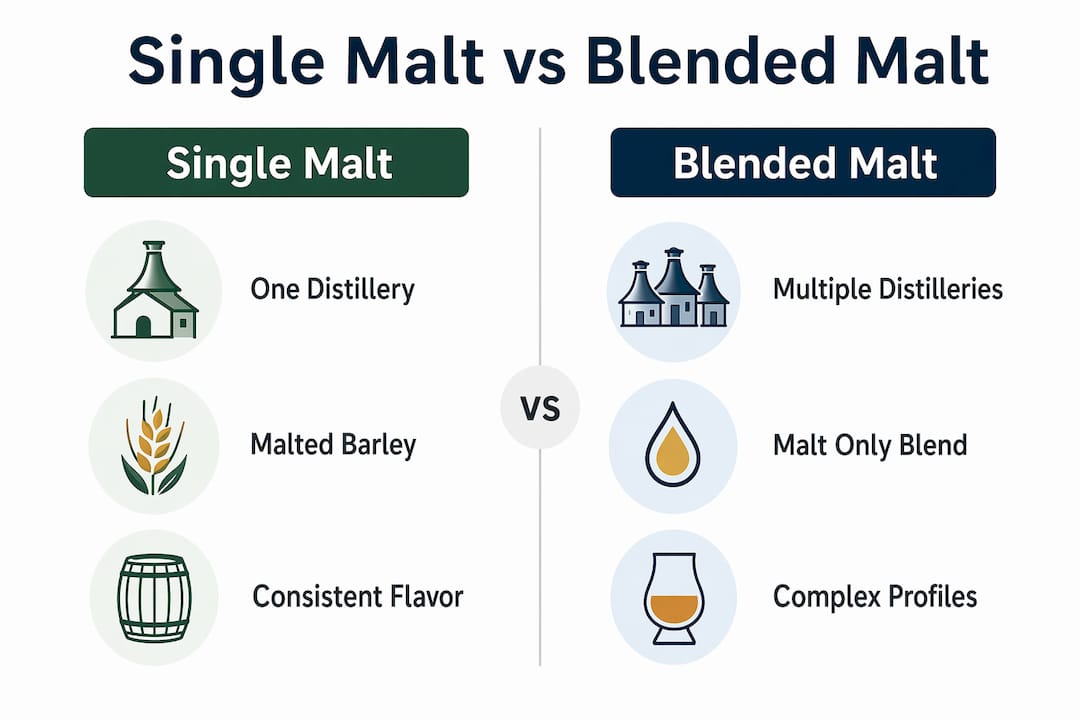
A single malt comes from one distillery, made entirely from malted barley. “Double malt” is not a legal category anywhere in the whisky world. It is either casual shorthand for a blended malt (two or more single malts from different distilleries combined) or a widespread misunderstanding that it means double-distilled. Knowing which meaning is in play changes what you should expect in the glass and how much you should pay.
The practical verdict:
- Collecting or exploring provenance: reach for a single malt whisky with a clear distillery name, age statement, and cask declaration.
- Everyday drinking or cocktails: a blended malt (what most people call “double malt”) often delivers more complexity per dollar and holds up better when diluted.
- Gifting: either works, but a named single malt from a recognised region reads as more considered to most recipients.
The term “double malt” is not a formal legal category for Scotch or any other major whisky-producing nation, so when you see it on a label or in a bar menu, ask what it actually means before you order.
Table of Contents
- What do the terms on a whisky label actually mean?
- How production actually differs between single and blended malts
- How region, peat, and cask shape what you actually taste
- What the law says and how to read a label in Australia
- Is single malt worth the premium over a blended malt?
- How to taste and serve single malts and blended malts
- Common myths about single malt and double malt, debunked
- Where to find single malts and blended malts in Australia
- Key takeaways
- A perspective on choosing between the two
- Useful sources and further reading
What do the terms on a whisky label actually mean?
The whisky category is unusually well-regulated, which makes the persistence of “double malt” as a phrase all the more confusing. Here is what the terms you will encounter on a bottle actually signify.
Single malt is the most precisely defined. Under the Scotch Whisky Regulations 2009 (UK Statutory Instrument 2009 No. 2890), a single malt must be produced at one distillery from malted barley, distilled in copper pot stills, and matured in oak casks not exceeding 700 litres for a minimum of three years in Scotland. Crucially, “single” refers to the distillery of origin, not to a single cask. Most bottlings are a vatting of many casks selected to hit a consistent house style.
Blended malt (also called vatted malt or, in older usage, pure malt) is a blend of two or more single malts from different distilleries. No grain whisky enters the mix. The blender’s job is to combine complementary distillery characters into something layered and consistent that no single distillery could produce alone.
Single grain is made at one distillery but from grains other than (or in addition to) malted barley, typically in a continuous column still. It tends to be lighter and sweeter than malt whisky.
Blended whisky combines malt whisky with grain whisky, often from multiple distilleries. The grain component softens the body and keeps costs manageable, which is why most of the world’s best-selling Scotch brands are blends.
“Double malt” sits outside all of these categories. It appears on some labels and menus as a shorthand for a blended malt, and in online discussions as a mistaken synonym for double distillation. Neither use has legal standing. If a bottle says “double malt,” read the back label carefully: it is almost certainly a blended malt or a marketing invention.
Pro Tip: When a label says “pure malt” or “vatted malt,” treat it as a blended malt. The Scotch Whisky Regulations phased out both terms in favour of “blended malt” in 2012, but older stock and some non-Scotch producers still use them.
How production actually differs between single and blended malts

Understanding what happens in the distillery explains why the two styles taste so different, and why cask choice often matters more than the single-versus-blended label.
The single-malt production path
- Malting: Barley is steeped, allowed to germinate, then kiln-dried. Peat burned in the kiln at this stage is the primary source of smoky phenols. The level of peating (measured in parts per million of phenol) is set here and cannot be undone later.
- Mashing: Milled malt (grist) is mixed with hot water in a mash tun to convert starches to fermentable sugars, producing a liquid called wort.
- Fermentation: Yeast is added to the wort in washbacks. Fermentation time (typically 48–120 hours) shapes the fruity ester profile of the spirit. Longer fermentation generally produces more tropical and floral notes.
- Distillation: The wash passes through copper pot stills, usually twice (occasionally three times, as in Lowland distilleries). The shape of the still, the speed of distillation, and where the distiller makes the spirit cuts all influence texture and character.
- Maturation: New spirit fills oak casks. The cask species, its previous contents (ex-bourbon, Oloroso sherry, PX, wine), and the number of times it has been used are the single biggest levers on final flavour. Scotland’s cool, damp climate slows maturation relative to warmer regions.
- Vatting: Before bottling, the master distiller selects and combines casks from the same distillery to hit the house style. This internal vatting is what keeps a 12-year-old expression consistent year to year.
Where blended malts diverge
A blended malt follows the same individual steps at each contributing distillery. The difference is that blending happens after maturation, when a master blender draws from the warehouses of two or more distilleries. The blender’s skill lies in selecting whiskies whose characters complement rather than cancel each other. A peaty Islay malt might provide backbone and smoke; a Speyside malt adds fruit and sweetness; a Highland expression brings structure and spice.
| Feature | Single malt | Blended malt (“double malt”) |
|---|---|---|
| Distillery source | One distillery only | Two or more distilleries |
| Grain used | Malted barley only | Malted barley only (no grain whisky) |
| Still type | Copper pot still | Copper pot still at each distillery |
| Maturation | One distillery’s warehouses | Multiple distilleries’ warehouses |
| Blending stage | Internal cask vatting | Post-maturation cross-distillery blending |
| Consistency driver | House style of one distillery | Blender’s recipe across distilleries |
| Grain whisky present? | No | No |
The production choices that most shift flavour are peat level, cask type and previous fill, maturation length, and climate. Whether the whisky is a single malt or a blended malt is secondary to those variables. A heavily sherried blended malt from two Speyside distilleries will taste closer to a sherried single malt than to a peated Islay single malt.
Pro Tip: Check the cask declaration before the label type. “First-fill ex-bourbon” or “Oloroso sherry cask” tells you more about what will be in the glass than “single malt” alone.
How region, peat, and cask shape what you actually taste
Flavour in malt whisky is not random. Each production variable leaves a fingerprint, and regional character is a useful starting point even if it describes the centre of the distribution rather than every bottle.
Scottish regional profiles
- Speyside: Apple, pear, honey, vanilla, dried fruit. The region’s sheltered valleys and long fermentation traditions produce the most approachable single malts. Ex-sherry casks from distilleries like The Macallan push the profile toward Christmas cake and dark chocolate; ex-bourbon casks from Craigellachie pull it toward vanilla and orchard fruit.
- Islay: Peat smoke, brine, iodine, medicinal notes. The phenol level of the malt and the coastal warehouse environment are the dominant drivers. Bowmore’s sherry-cask-led expressions show how wood can soften and sweeten even a heavily peated spirit.
- Highlands: Heather, dried fruit, malt, light spice. The region is large and internally diverse, so treat Highland as a broad category rather than a precise flavour promise.
- Lowlands: Light, floral, grassy, gentle citrus. Triple distillation at some distilleries produces a delicate spirit that suits aperitif-style drinking.
- Campbeltown: Brine, toffee, old leather, light peat. A small region with a distinctive maritime character that sits between Islay and Highland in weight.
Beyond Scotland
The 2026 World Whiskies Awards recognised top single malts from the United States, Japan, India, Canada, and England alongside Scotland, confirming that single malt is no longer a Scottish monopoly. Japanese single malts tend toward restraint and precision; Indian expressions often show tropical fruit and spice from faster maturation in a warmer climate; Taiwanese malts (using STR casks) deliver honey, tropical fruit, and light oak spice.
Single malt versus blended malt in the glass
Single malts tend to show a clearer distillery signature and a more defined texture, whether that is the oily weight of a Campbeltown or the silky lightness of a Lowland. Blended malts are intentionally layered and rounded: the blender smooths out the rough edges of any single component and builds complexity by design. Neither is inherently superior. A well-crafted blended malt can be more interesting than a mediocre single malt from a distillery having a bad run of casks.
Tasting-note sketches:
- Classic Speyside single malt: ripe pear, vanilla cream, light oak, a whisper of dried apricot.
- Islay single malt: bonfire smoke, sea salt, lemon zest, medicinal finish.
- Blended malt (Speyside-led): layered orchard fruit, soft toffee, gentle spice, rounded finish with no sharp edges.
- Blended malt (Islay-led): smoke up front, then sweetness from a Speyside component, finishing with coastal brine.
What the law says and how to read a label in Australia
The Scotch Whisky Regulations 2009 define five legal categories: single malt, single grain, blended malt, blended grain, and blended Scotch whisky. “Double malt” appears in none of them. When a bottle uses the phrase, it is either a marketing term or a non-Scotch producer’s invention, and neither carries the regulatory weight of the five official categories.
For shoppers in Australia, Scotch imports must comply with those regulations before they leave Scotland, so the label on a bottle of Scotch you buy here is legally meaningful. Australian single malts are governed by the Australian New Zealand Food Standards Code, which has its own definitions, and Japanese whisky labelling rules have tightened since 2021 under the Japan Spirits & Liqueurs Makers Association’s voluntary standards.
Label-reading checklist for Australian shoppers:
- “Single malt Scotch whisky”: one distillery, malted barley, pot stills, three-plus years in Scotland. The most regulated and traceable category.
- “Blended malt Scotch whisky”: two or more single malts, no grain whisky. Look for a named blender or blending house.
- “Single malt” without “Scotch”: check the country of origin. Australian, Japanese, and American single malts have different regulatory frameworks.
- Age statement: the number on the label is the age of the youngest whisky in the bottle. No age statement (NAS) does not mean young; it means the producer chose not to declare.
- Cask finish statement: “finished in X casks” means the whisky spent its primary maturation elsewhere and had a secondary period in the stated cask. It is additive, not a replacement for the primary cask.
- “Double malt” on the label: not a regulated term. Read the full label to determine whether it is a blended malt, a marketing phrase, or something else entirely.
Country variations matter. Irish whiskey, American whiskey, and Canadian whisky each operate under their own legal frameworks, and none of them use “double malt” as a formal category either. For single malt characteristics and regulations across different producing nations, the regulatory body for each country is the authoritative source.
Is single malt worth the premium over a blended malt?
Not always, and the answer depends entirely on what you are buying for.
Single malts command higher prices for several reasons: distillery identity and traceability, limited release volumes, age statements that require years of warehouse space, cask provenance (a first-fill Oloroso sherry butt costs significantly more than a refill hogshead), and the prestige that comes with award recognition. Industry awards coverage in 2026 reinforces that single malts remain the cornerstone for collectors, while blended malts gain recognition for blending skill and commercial versatility.
Cask management, including the sequence of casks used and any finishing period, often influences price and flavour more than the simple label “single” or “blended.” Judges at the World Whiskies Awards reward nuanced wood work regardless of category.
That said, a single malt is not automatically better value for drinking. A well-made blended malt at a mid-range price point can outperform a budget single malt from a distillery cutting corners on maturation. Blended malts also give better consistency and versatility for bars and cocktails, where the nuance of a single distillery’s character is often lost in the mix.
Buying checklist by goal:
- Collecting: prioritise single malts with age statements, named cask types, limited release numbers, and distillery provenance. These hold value and tell a story.
- Ageing in your own collection: single malts in sealed bottles do not improve, but rare expressions appreciate in secondary market value. Blended malts rarely do.
- Daily drinking: a quality blended malt or an accessible single malt at the 10–12 year mark gives the best flavour-per-dollar. Check how to select a single malt for a structured approach.
- Cocktails and highballs: blended malts or blended Scotch. The grain component in a blend softens the spirit for mixing; a blended malt adds malt complexity without the price premium of a single malt.
Pro Tip: Shopping guides consistently show that affordable single malts and well-crafted blended malts are both valid everyday picks. Do not pay a single-malt premium for a bottle you plan to use in a Rob Roy.
How to taste and serve single malts and blended malts
The glass and the approach matter more than most enthusiasts admit.
A simple tasting ritual
- Choose the right glass. A tulip-shaped glass (Glencairn or copita) concentrates aromas at the narrow rim. A wide tumbler disperses them. For serious tasting, the tulip wins every time.
- Nose before you sip. Hold the glass at chest height first, then bring it slowly to your nose. Keep your mouth slightly open to avoid the alcohol sting. Give the whisky two or three minutes to open up after pouring.
- First sip, neat. Let it coat the whole palate. Note the arrival (front of mouth), development (mid-palate), and finish (throat and aftertaste). Single malts often show a more defined arrival; blended malts tend to develop more gradually.
- Add a few drops of water. Room-temperature, low-mineral water. Even two or three drops can open up esters and reduce the alcohol heat enough to reveal compounds that were masked at full strength. This is where single-malt distillery character often becomes most obvious.
- Revisit the nose. Water changes the aromatic profile noticeably. Peat smoke often becomes more pronounced; fruit esters can bloom.
Serving suggestions
- Neat: the purist’s choice for aged single malts and premium blended malts. Preserves the full texture and character.
- With a drop of water: recommended for anything above 46% ABV. Cask-strength expressions (often 55–65% ABV) genuinely need it.
- On ice: a single large cube is preferable to crushed ice. It chills without diluting too fast. Best for lighter, lower-ABV expressions rather than heavily peated or aged single malts where cold suppresses the aromatics.
- Highball: blended malts shine here. Two parts chilled soda water to one part whisky, over ice, with a lemon twist. The carbonation lifts the malt sweetness.
- Stirred cocktails (Rob Roy, Rusty Nail): blended malts or blended Scotch. A single malt’s distillery character can clash with vermouth or Drambuie rather than complement it.
For a deeper look at blended malt use cases and serving ideas, the style rewards more experimentation than its reputation suggests.
Common myths about single malt and double malt, debunked
“Single malt means one cask.” Wrong. Single refers to one distillery. Almost every bottling is a vatting of multiple casks selected for consistency.
“Double malt means double-distilled.” No. Double distillation is standard practice for most Scotch single malts anyway. “Double malt” is not a production descriptor with any regulated meaning.
“Blended whisky is low quality.” The world’s most consumed Scotch expressions are blends, and master blenders spend careers perfecting them. Quality varies by producer, not by category.
“A higher age statement always means better whisky.” Age is one variable among many. A 10-year-old from an exceptional distillery with first-fill sherry casks can outperform a 25-year-old from a mediocre distillery using tired refill casks.
“Single malts are always more complex than blended malts.” Blended malts are specifically designed to achieve complexity by combining complementary distillery characters. A skilled blender can build more layers than a single distillery’s output allows.
“NAS (no age statement) means young and cheap.” Some of the most interesting releases in recent years have been NAS expressions where the master distiller had the freedom to select casks by character rather than by age. NAS is a production choice, not a quality signal in either direction.
Where to find single malts and blended malts in Australia
Australia’s whisky retail market has matured considerably. Scotch single malts from all five Scottish regions are widely available through specialist retailers, and Japanese single malts from distilleries such as Nikka and Suntory are stocked by most serious bottle shops. Australian single malts, particularly from Tasmania (Lark, Sullivans Cove, Hellyers Road) and newer mainland producers, have built genuine international reputations.
Practical routes to buy in Australia:
- Specialist online retailers: the most reliable source for rare and allocated bottles, with detailed product descriptions that include ABV, cask type, and age statement. Uisuki.com.au curates single malts and blended malts from Scotland, Japan, Australia, and the USA, with shipping available across Australia.
- Auction and private listings: useful for discontinued expressions and older age statements, but carry risks around storage conditions and provenance. Always check the fill level and label condition before bidding.
- Bottle shops and department stores: good for mainstream expressions; limited for rare or allocated releases.
Example expressions available through Uisuki.com.au (examples only, not an exhaustive list):
- Hobart Whisky Bourbon Matured Rum Finished Single Malt: an Australian single malt showing what local distillers can do with creative cask sequencing.
- Ichiro’s Malt and Grain Limited Edition World Blended Whisky: a Japanese blended expression that illustrates how blending across regions and grain types produces a distinctive layered profile.
- Ardnamurchan Maclean’s Nose Blended Scotch: a Highland-sourced blended Scotch for readers wanting to explore the blended style at a fair price point.
Uisuki.com.au’s team sources rare and hard-to-find bottles and accepts personalised sourcing requests for expressions not currently in stock.
Pro Tip: For allocated or limited-release single malts, join the mailing list of a specialist retailer rather than waiting for bottles to appear on general sale. By the time a sought-after expression hits the mainstream, it is usually gone.
Key takeaways
Single malt whisky is defined by its distillery of origin, not by a single cask or a single grain, while “double malt” remains an informal and legally meaningless phrase that most accurately describes a blended malt made from two or more single malts.
| Point | Details |
|---|---|
| “Single” means one distillery | Single malt is produced at one site from malted barley; most bottlings vat multiple casks. |
| “Double malt” has no legal standing | The term is informal shorthand for a blended malt or a misunderstanding of double distillation. |
| Cask type drives flavour | Ex-bourbon, sherry, and finishing casks shape taste more than the single-versus-blended label. |
| Blended malts offer real value | For daily drinking and cocktails, a quality blended malt often outperforms a budget single malt. |
| Uisuki.com.au for Australian buyers | Uisuki stocks single malts and blended malts from Scotland, Japan, and Australia with Australia-wide shipping. |
A perspective on choosing between the two
There is a tendency in whisky circles to treat “single malt” as a synonym for quality and everything else as a compromise. That framing does a disservice to some genuinely excellent blended malts and, frankly, to the drinker’s own palate.
The more useful question is not single malt versus blended malt but rather: what am I actually tasting for, and what is the cask doing? A blended malt built around a peated Islay component and a fruity Speyside base can be more interesting on a Tuesday evening than a single malt from a distillery coasting on its reputation. The label tells you the origin story; the cask declaration tells you what to expect in the glass.
When choosing for a specific occasion, three questions cut through the noise. First, what is the purpose: sipping, gifting, collecting, or mixing? Second, what is the budget, and is the premium for a single malt justified by the specific bottle rather than the category? Third, what does the cask and region tell you about the flavour direction, regardless of whether it is a single or blended malt?
Single malts earn their place as the collector’s benchmark and the enthusiast’s exploration tool. Blended malts earn their place as the blender’s art form and the drinker’s daily companion. Both categories contain outstanding bottles and forgettable ones.
Explore single malts and blended malts available in Australia

Uisuki.com.au stocks a curated range of single malts and blended malts from Scotland, Japan, Australia, and the USA, with Australia-wide shipping and personalised sourcing for hard-to-find bottles. For a local example of what Australian distilling can achieve with creative cask work, the Hobart Whisky Bourbon Matured Rum Finished Single Malt is a strong starting point. For readers wanting to explore the blended style, Ichiro’s Malt and Grain Limited Edition shows how blending across regions and grain types produces something neither distillery could achieve alone. These are examples from the current range, not an exhaustive list of what is available. Browse the full selection at Uisuki.com.au or submit a sourcing request for a specific bottle.
Useful sources and further reading
-
Scotch Whisky Regulations 2009 (via Global Whiskey Authority): covers the legal production requirements for all five Scotch categories, including the malted-barley and pot-still mandates for single malt. The regional flavour table is a useful quick reference.
-
World Whiskies Awards 2026 Winners: the authoritative annual ranking of single malts, blended malts, and other categories by country. Useful for identifying which distilleries are producing at the highest level in any given year.
-
The Whiskey Wash: Best Single Malts 2026 by Country: detailed coverage of the 2026 World Whiskies Awards winners, with notes on cask types and regional character. Good for understanding what judges are rewarding.
-
The Double Strainer: Single Malt, Blended Malt, Single Grain and Blended Whisky: a clear, label-focused explainer covering all four major Scotch categories and the production differences between them.
-
The Glenlivet: Single Malt vs Double Malt: a distillery-authored piece that addresses the “double malt” question directly and explains why the term has no formal standing.
-
Whisky Magazine: ongoing industry commentary, awards coverage, and production explainers. The World Whiskies Awards commentary is particularly useful for tracking how blended malts are gaining critical recognition.