

TL;DR:
- Single malt whisky is produced at one distillery using 100% malted barley, not from one cask or batch.
- Age, peat level, and bottling strength significantly influence a whisky’s flavor and collectability.
- Regional labels indicate production styles but don’t strictly define taste, making exploration essential.
Most whisky lovers assume ‘single malt’ means the whisky came from a single cask or a single batch. It doesn’t. The word ‘single’ refers to the distillery, not the barrel, and this one misunderstanding shapes how collectors buy, assess, and talk about Scotch. For Australian enthusiasts building a serious collection or simply chasing better flavour experiences, understanding what malt Scotch actually is changes everything. This article unpacks the real definitions, the production process, the characteristics that matter most, and how regional styles connect to the bottles worth hunting down.
Table of Contents
- What defines a malt Scotch whisky?
- How is malt Scotch made? Step-by-step process
- Key characteristics: Peat, age, and strength
- Regions and collecting: Finding your style in malt Scotch
- Expert perspective: The real art of malt Scotch appreciation
- Explore and collect: Your next malt Scotch adventure
- Frequently asked questions
Key Takeaways
| Point | Details |
|---|---|
| Single malt definition | Single malt Scotch must be made at one Scottish distillery using only malted barley and meet strict legal standards. |
| Production steps matter | The entire process, from malting to maturation and cask choices, shapes a malt Scotch’s final character. |
| Peat and age diversity | Australian collectors can explore a spectrum of flavours by comparing peat levels and age statements, not just chasing high ages. |
| Regions guide exploration | Each Scotch region offers unique styles, but true complexity comes from each distillery’s craft. |
| Smart collecting | Investing in malt Scotch is about flavour, story, and rarity as much as age or region. |
What defines a malt Scotch whisky?
The legal definition of malt Scotch is tighter than most people realise. According to the Scotch Whisky Regulations 2009, a single malt Scotch must be produced at one distillery in Scotland using 100% malted barley, distilled in pot stills to no more than 94.8% ABV, matured in oak casks of no more than 700 litres for at least three years in Scotland, and bottled at a minimum of 40% ABV. Every one of those parameters is enforceable. Not a suggestion.
What confuses newcomers is the word ‘single.’ It does not mean one cask. It does not mean one batch. It means one distillery. A bottle of Glenfarclas 25 Year Old may contain whisky from dozens of casks, all from the same Speyside distillery. That’s still a single malt. The word signals provenance, not scale.
Malt Scotch sits within a broader family. Scotch whisky is divided into five legal categories: Single Malt, Single Grain, Blended Malt, Blended Grain, and Blended Scotch. Blended Scotch combines single malts and grain whiskies from multiple distilleries into a smooth, consistent product, and it dominates roughly 90% of all Scotch whisky sales worldwide. Single malt, by comparison, is a far smaller slice, but it attracts the most collector attention because each bottle is a direct expression of one distillery’s craft.
For Australian collectors, it’s worth knowing that Scotch whisky is a geographically protected product. The term ‘Scotch’ is legally restricted to whisky produced and matured in Scotland under Scottish law. Bottles imported to Australia carrying this designation must meet every SWA requirement, giving you a reliable quality baseline when sourcing through reputable retailers.
Here’s a quick comparison to keep the categories straight:
| Category | Grain | Distilleries | Style |
|---|---|---|---|
| Single malt | 100% malted barley | One | Complex, distillery-specific |
| Blended malt | 100% malted barley | Multiple | Rich, layered |
| Blended Scotch | Malt + grain | Multiple | Smooth, consistent |
| Single grain | Mixed grains | One | Light, versatile |
For collectors wanting to understand the full range of what’s out there, exploring the types of single malt Scotch is a practical next step.
How is malt Scotch made? Step-by-step process
With an understanding of definitions, let’s see how those rules translate into the actual creation of malt Scotch. The production steps follow a consistent sequence: malting, milling, mashing, fermentation, distillation, maturation, vatting, dilution, and bottling. Each step introduces variables that shape the final flavour.
- Malting Barley is steeped in water and allowed to germinate, activating enzymes that convert starch to sugar. Some distilleries use peat smoke to halt this process, embedding smoky phenols into the malt.
- Milling The dried malt is ground into a coarse flour called grist, ready for mashing.
- Mashing Grist is mixed with hot water in a vessel called a mash tun. The sugars dissolve into a liquid known as wort.
- Fermentation Yeast is added to the wort in large vessels called washbacks. Over 48 to 96 hours, the yeast converts sugars to alcohol, producing a beer-like liquid called wash at around 8% ABV. Longer fermentation tends to create fruitier, more complex flavours.
- Distillation Wash goes through pot stills, typically twice. The first distillation (wash still) produces low wines at about 20% ABV. The second (spirit still) yields new make spirit at around 65 to 70% ABV. The shape of the still, particularly still neck height and lyne arm angle, directly influences flavour character.
- Maturation New make spirit enters oak casks and rests for a minimum of three years, though most quality expressions are aged far longer. Ex-bourbon barrels add vanilla and caramel notes. Ex-sherry casks contribute dried fruit and spice. Smaller casks accelerate maturation; larger ones slow it.
- Vatting, dilution, and bottling Casks are often combined (vatted) for consistency, then diluted to bottling strength with water, unless released as cask strength.
Pro Tip: When comparing distilleries, look up their still shape and fermentation time. A tall, elegant still with long fermentation produces a lighter, fruitier spirit. A short, squat still with fast fermentation leans heavy and oily. These decisions define house style far more than marketing language ever will.
Understanding regional whisky flavours helps you connect production choices to the styles you’ll encounter in each part of Scotland.
Key characteristics: Peat, age, and strength
Once made, malt Scotch is shaped by characteristics that make each bottle unique and prized among enthusiasts. Three dimensions matter most: peat level, age statement, and bottling strength.

Peat is measured in phenol parts per million (ppm). Unpeated malt typically sits below 5 ppm, delivering clean, cereal or fruity character. Lightly peated malts fall in the 10 to 20 ppm range. Heavily peated expressions from Islay distilleries like Bruichladdich’s Octomore can exceed 300 ppm, producing bold smoke, brine, and medicinal notes that are either deeply loved or strongly avoided. Peat is not just about smoke, it’s about the entire aromatic structure of the whisky.
Age statements tell you the youngest whisky in the bottle. The legal minimum is three years, but most respected expressions start at 10 or 12. Common age tiers are 10, 12, 15, 18, and 21 years. Above that, you’re typically in premium collector territory. No Age Statement (NAS) releases are increasingly common as older stock becomes scarcer. NAS whiskies are not inherently inferior. Some are exceptional. The key is to understand what the distillery is communicating through the bottling style.
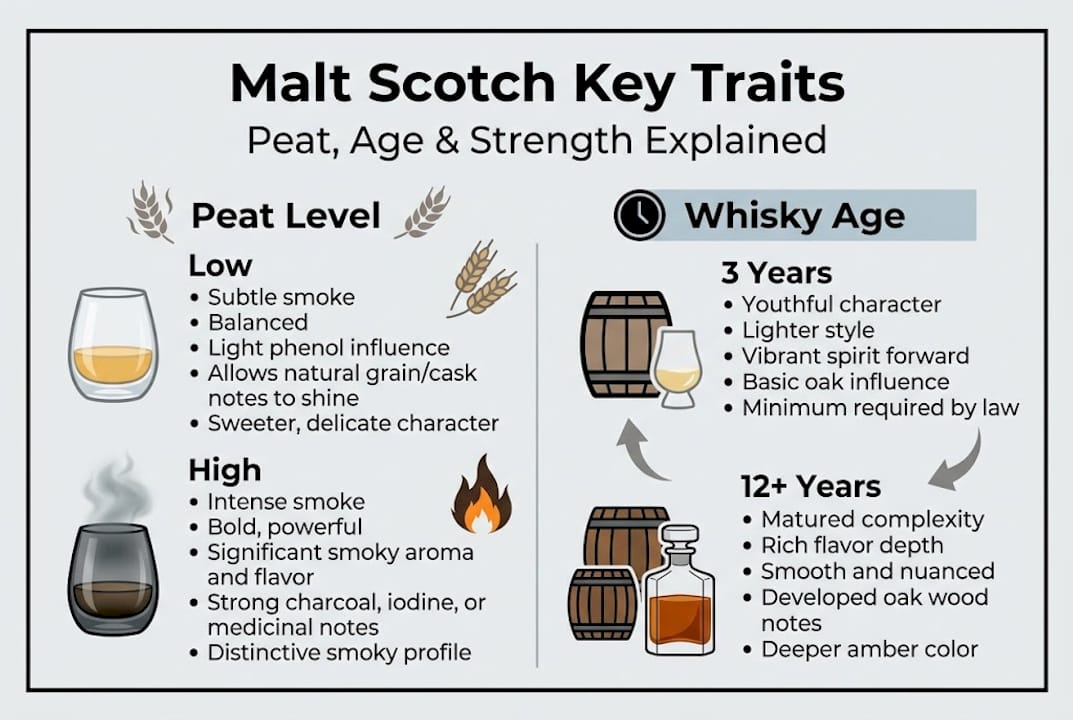
Collectors should pay close attention to why age statements matter for both flavour and market value, alongside understanding the growing importance of NAS whisky in the modern market.
Bottling strength splits broadly into two camps. Standard releases sit between 40 and 46% ABV, often chill filtered for clarity and shelf appeal. Cask strength releases typically land between 55 and 65% ABV, bottled without significant dilution, preserving the full texture and intensity of the spirit. Non-chill filtered and cask strength bottles are highly sought by collectors because they offer more information: more flavour, more complexity, and a direct window into the cask.
- Unpeated: Clean, cereal, floral or fruity
- Lightly peated: Subtle smoke with fruit balance
- Heavily peated: Bold smoke, medicinal, coastal notes
- Standard ABV: Smooth, accessible, often chill filtered
- Cask strength: Intense, layered, ideally non-chill filtered
- NAS: Quality varies; focus on producer reputation and bottling style
Pro Tip: Add a small amount of water to cask strength whisky when tasting. It opens the spirit, releases esters, and reveals complexity that might otherwise be masked by alcohol heat.
Regions and collecting: Finding your style in malt Scotch
Now let’s connect these characteristics to the real world, exploring how regional diversity and production choices shape both drinking experience and collectability. Scotland’s flavour profile is built from a chain of decisions including still shape, cut point, fermentation time, and cask selection, not from geography alone. Regional labels are useful starting points, not rigid rules.
| Region | Signature style | Notable distilleries |
|---|---|---|
| Speyside | Fruity, elegant, honeyed | Glenfiddich, Macallan, Aberlour |
| Highlands | Diverse: heathery, spiced, rich | Dalmore, Glenmorangie, Oban |
| Islay | Peated, smoky, maritime | Laphroaig, Ardbeg, Bruichladdich |
| Lowlands | Light, floral, approachable | Auchentoshan, Glenkinchie |
| Campbeltown | Briny, complex, oily | Springbank, Glen Scotia |
For Australian collectors, exploring whisky regions gives you a mental map for building a diverse and well-rounded collection. But be cautious about leaning too hard on regional shorthand. Springbank in Campbeltown produces expressions that are wildly different from each other across their range. Bruichladdich on Islay releases both heavily peated and completely unpeated single malts from the same distillery.
“Flavour in Scotch whisky comes from the accumulation of decisions made across the entire production process. Region tells you where a whisky was made, not necessarily what it will taste like.”
For collectors, the most valuable and interesting bottles often sit at the intersection of rarity and house style authenticity. Limited edition picks from independent bottlers, single cask releases, and distillery exclusives tend to attract serious collector interest. Australian buyers benefit from a robust import market and access to SWA-compliant retailers who can verify provenance.
- Prioritise authenticity: always buy from reputable sources with documented provenance
- Seek diversity across regions, peat levels, and cask types in your collection
- Follow distillery house styles rather than chasing generic ‘age = quality’ logic
- Track independent bottler releases for genuine single cask rarities
Expert perspective: The real art of malt Scotch appreciation
Here’s the honest truth that most collector guides won’t tell you: obsessing over age statements and regional labels is the least interesting way to build a whisky collection. We’ve seen collectors walk past extraordinary bottles because they weren’t 18-year-old Speysiders, only to overpay for heavily marketed expressions that deliver far less in the glass.
The collectors who build truly great collections follow house style. They understand that Springbank’s 10-year-old tells a more complete and honest story than many 21-year-old releases from distilleries chasing prestige pricing. They know that a well-chosen NAS from a master distiller with a clear philosophy often outperforms a heavily aged whisky left too long in an exhausted cask.
Flavour, rarity, and the story behind production decisions are what drive long-term value, both financially and in the glass. Understanding age statements matters, but treating age as a proxy for quality is a shortcut that leads to mediocre collections and missed opportunities. The best approach is curiosity: taste widely, follow producers you trust, and let the whisky speak for itself.
Explore and collect: Your next malt Scotch adventure
Ready to put your knowledge into practice? At Uisuki, we source authentic, SWA-compliant whiskies for Australian collectors who take quality seriously. Whether you’re rounding out a regional collection or hunting for a standout bottle, our curated selection spans rare Scotch expressions and exceptional local distillations.

For something genuinely exciting from Australian soil, the Hobart single malt from Hobart Whisky is a cask strength, rum-finished expression that rewards close attention. If you’re after classic Scotch character, the Ardnamurchan blended Scotch from a modern Highland distillery delivers genuine complexity at an accessible price point. Browse our full range and let us help you find your next great bottle.
Frequently asked questions
What is the difference between single malt and blended Scotch?
Single malt Scotch comes from one distillery using 100% malted barley, while blended Scotch mixes malts and grain whiskies from multiple distilleries, dominating roughly 90% of global Scotch sales with a smooth, consistent profile.
Does higher age always mean better whisky?
Not necessarily. Age influences flavour and complexity, but cask quality, distillery style, and peat level can make younger expressions genuinely superior to older ones from less distinguished producers.
What’s the minimum legal age for Scotch whisky?
Scotch whisky must be matured for at least three years in oak casks in Scotland before it can legally be sold as Scotch.
How important is peat level in choosing a malt Scotch?
Peat level shapes the entire aromatic character of the whisky. Low ppm delivers mild, clean spirit while high ppm creates powerful smoke and medicinal notes, so matching peat level to your palate is one of the most useful decisions you can make as a collector.