

TL;DR:
- Whisky flavour categories are shaped by production pillars such as grain base, fermentation time, distillation style, and cask influence. Understanding these factors helps identify specific taste profiles like Rich & Sherried, Smoky & Peaty, or Floral & Fruity in each bottle.
Whisky flavour categories are defined as broad sensory styles shaped by four core production pillars: grain base, fermentation time, distillation method, and maturation environment. Understanding these categories gives you a reliable framework for identifying what you taste in the glass, rather than guessing based on geography or label alone. Chemical compounds like vanillin from American oak and phenols from peat kilning drive the most recognisable flavour differences between styles. The industry recognises five broad whisky taste profiles: Rich & Sherried, Smoky & Peaty, Coastal & Maritime, Light & Floral, and Fruity & Spicy. Knowing these profiles transforms tasting from guesswork into genuine appreciation.
What production factors determine whisky flavour categories?
Whisky flavour is shaped by four production pillars, each contributing distinct sensory outcomes. Distillers use these pillars deliberately to steer a whisky toward a particular style category. Understanding what each pillar contributes gives you a real advantage when tasting.

Grain base sets the foundation. Malted barley produces malty, biscuity, and cereal notes. Corn-heavy mashes, common in American whiskey production, lean toward sweetness. Rye grain pushes flavour toward spice and pepper. The grain choice is the first decision that shapes everything downstream.
Fermentation time builds complexity. Longer fermentation produces more esters, the chemical compounds responsible for fruity and floral aromas. Shorter fermentation keeps the spirit cleaner and more cereal-forward. Distillers who want a Fruity & Spicy profile will often extend fermentation to maximise ester development.
Distillation style controls texture and weight. Pot still distillation retains more congeners, producing heavier, oilier spirits with richer mouthfeel. Column still distillation strips the spirit back, creating lighter, more neutral profiles suited to the Light & Floral category. The shape and size of the still also matter: taller stills produce lighter spirits, shorter stills produce heavier ones.
Maturation cask and environment deliver the finishing flavours. American oak imparts vanilla and coconut; European oak sherry casks provide dried fruits and warming spice. The key flavour contributors across all categories include:
- Vanillin: from American oak, delivers vanilla and coconut sweetness
- Phenols: from peat kilning, deliver smoke, medicinal, and earthy notes
- Esters: from fermentation, deliver fruity and floral aromas
- Lactones: from oak wood, contribute coconut and creamy texture
- Tannins: from cask wood, add dryness and structure to the finish
Each of these compounds layers into the final whisky, which is why two whiskies from the same region can taste completely different based on cask choice and peating level alone.
What are the recognised whisky flavour profiles?
The five recognised whisky flavour profiles each have a distinct sensory signature. They are not rigid boxes but useful starting points for understanding what you are tasting. The five broad styles cover the full spectrum from delicate and floral to intensely smoky.
Rich & Sherried whiskies are the most opulent of the five styles. Sherry cask maturation drives flavours of dark chocolate, dried fruit, Christmas cake, and warming spice. The mouthfeel is typically full and coating, with a long, sweet finish. Whiskies from Speyside and the Highlands frequently fall into this category, though sherry cask finishes appear across Scotland, Japan, and Australia.
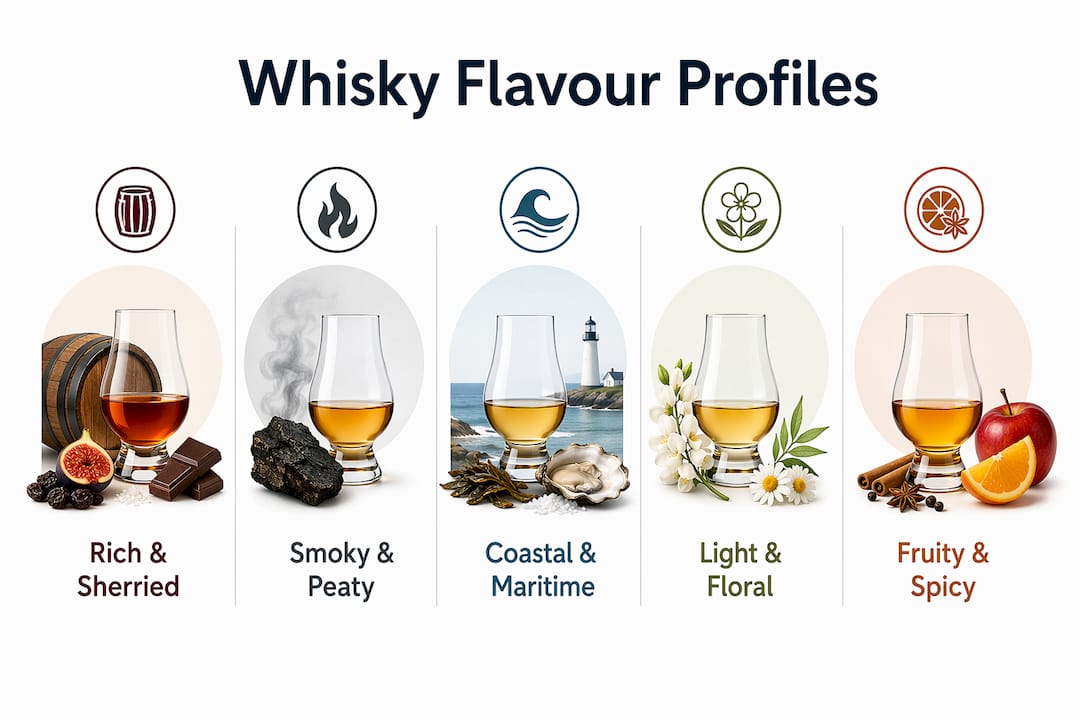
Smoky & Peaty whiskies are defined by phenolic compounds produced during peat kilning of the barley. Flavour notes range from campfire smoke and iodine to medicinal and coastal tar. The intensity varies widely. A lightly peated whisky might show just a whisper of smoke behind fruit, while a heavily peated expression can be almost overwhelmingly savoury. Islay is the most famous region for this style.
Coastal & Maritime whiskies carry brine, sea spray, and sometimes a subtle seaweed character. These notes come from maturation in warehouses exposed to sea air, which permeates the cask over time. The texture tends toward a light to medium body with a dry, mineral finish.
Light & Floral whiskies are the most approachable for beginners. Delicate notes of heather, green apple, pear, and fresh grass define this category. Column still distillation and shorter maturation periods typically produce this style. The finish is clean and short, making these whiskies easy to drink neat or with a small amount of water.
Fruity & Spicy whiskies sit in the middle of the spectrum. High ester production during fermentation creates stone fruit, citrus, and tropical notes, while spice comes from rye grain or active wood influence. Japanese whiskies frequently exhibit this profile, balancing fruit with a refined, dry spice on the finish.
Pro Tip: Use the comparison table below as a quick reference when you are standing in front of a shelf trying to decide which style suits your mood.
| Style | Dominant flavours | Cask influence | Texture | Typical regions |
|---|---|---|---|---|
| Rich & Sherried | Dark fruit, chocolate, spice | European oak sherry | Full, coating | Speyside, Highlands, Japan |
| Smoky & Peaty | Smoke, iodine, medicinal | Ex-bourbon or virgin oak | Medium to full | Islay, Campbeltown |
| Coastal & Maritime | Brine, sea spray, mineral | Ex-bourbon | Light to medium, dry | Island, coastal distilleries |
| Light & Floral | Heather, green apple, grass | Refill casks | Light, clean | Lowlands, grain distilleries |
| Fruity & Spicy | Stone fruit, citrus, pepper | Active wood, ex-bourbon | Medium, dry finish | Japan, USA, Australia |
How to taste and identify whisky flavour categories effectively
Learning how to taste whisky properly is the fastest way to connect what you read about flavour categories with what you actually experience in the glass. A structured approach removes the guesswork and builds your sensory vocabulary quickly.
-
Choose the right glass. A tulip-shaped glass concentrates aromas at the rim. A proper tasting session uses 25–30ml per dram and lasts about 5 minutes. This amount is enough to nose, taste, and assess without palate fatigue.
-
Nose before you sip. Up to 80% of flavour perception comes from smell, not taste. Take short, gentle sniffs with your mouth slightly open. This technique prevents alcohol vapour from overwhelming your olfactory receptors. Long, deep sniffs drown the aromatic compounds under ethanol impact.
-
Take your first sip as acclimatisation. The first sip prepares your palate for the alcohol. True flavour assessment begins with the second sip. On that second sip, use the Kentucky Chew: swish the whisky around your mouth to coat the tongue and cheeks. This reveals texture and flavour simultaneously.
-
Assess the finish. After swallowing, exhale gently through your nose. This retrohale technique reveals complex spices and wood notes that the palate alone misses. A long, warming finish often signals Rich & Sherried or Smoky & Peaty categories. A short, clean finish points toward Light & Floral.
-
Add water if needed. Adding 2–3 drops of room-temperature, non-chlorinated water dilutes alcohol vapour and enhances recognition of subtle aroma molecules. Water is particularly useful with high-ABV expressions, where alcohol can mask fruity or floral notes. Add drops one at a time and re-nose after each addition.
Pro Tip: Keep a small notebook during tasting sessions. Writing down three words per dram, one for aroma, one for palate, and one for finish, builds your flavour vocabulary faster than any other method.
What nuances and overlaps exist between whisky flavour categories?
Whisky flavour profiles are spectrums, not fixed bins. Over 300 flavour-active compounds are present in mature whisky, creating combinations that blur the lines between categories. This complexity is what makes whisky endlessly interesting rather than predictable.
A heavily peated whisky finished in a sherry cask will show smoke and iodine alongside dark fruit and chocolate. It belongs to Smoky & Peaty by primary character but carries clear Rich & Sherried notes. A Fruity & Spicy expression aged in an active American oak cask will show tropical fruit alongside vanilla and coconut, overlapping with Rich & Sherried sweetness. These overlaps are not flaws. They are the result of layered production decisions.
Production choices override regional expectations consistently. Two whiskies from the same town can belong to entirely different flavour profiles based on cask type and peating level. Focusing on geography as the primary guide to flavour is the most common mistake beginners make. The production story is always more reliable than the postcode.
Mouthfeel is a pivotal indicator of distillation method and helps distinguish whiskies that share similar flavour notes but feel completely different in the glass. An oily, waxy texture signals pot still distillation and heavier congener retention. A dry, crisp texture signals column still production. These textural differences help you place a whisky within its category even when the flavour notes overlap with another style.
Key nuances to watch for across categories:
- Texture: oily and waxy versus dry and crisp signals distillation method
- Finish length: long and warming versus short and clean indicates cask influence and body
- Smoke character: campfire and earthy versus iodine and medicinal indicates peat source
- Fruit type: stone fruit and citrus versus dark fruit and dried fig indicates fermentation and cask choice
- Sweetness source: vanilla and coconut from American oak versus honey and toffee from long maturation
Key takeaways
Whisky flavour categories are defined by production choices, not geography, and understanding the five core styles gives you a reliable framework for every bottle you open.
| Point | Details |
|---|---|
| Production drives flavour | Grain, fermentation, distillation, and cask choice determine flavour style more than region. |
| Five recognised styles | Rich & Sherried, Smoky & Peaty, Coastal & Maritime, Light & Floral, and Fruity & Spicy cover the full spectrum. |
| Tasting technique matters | Use a tulip glass, short sniffs, the Kentucky Chew, and the retrohale to identify flavour categories accurately. |
| Overlap is normal | Over 300 flavour-active compounds mean most whiskies show notes from more than one category. |
| Mouthfeel reveals distillation | Texture, oily versus dry, is often a more reliable category signal than flavour notes alone. |
Brendan’s take on flavour categories and what they actually teach you
The five flavour categories are a map, not a destination. When I first started tasting seriously, I treated them as fixed rules. A peated whisky was smoky, full stop. A Speyside was fruity and sweet. That thinking made me a worse taster, not a better one.
What changed my approach was paying attention to mouthfeel and texture before I reached for flavour descriptors. An oily, coating texture tells you something about the still shape and cut points that no tasting note on the label will. A dry, mineral finish tells you about cask activity and maturation length. These physical sensations are harder to fake than flavour notes, and they anchor your assessment in something real.
The other shift worth making is patience. Most people nose a whisky for ten seconds and move on. Sitting with a dram for five minutes, nosing it repeatedly as it opens in the glass, reveals layers that a quick sniff completely misses. The whisky flavour profiling process rewards the patient taster every single time.
My honest advice: use the five categories as a starting point, then let the whisky tell you where it actually sits. The most interesting bottles are always the ones that refuse to stay neatly in one box.
— Brendan
Whisky worth tasting: curated selections at Uisuki
Knowing the five flavour styles is only useful if you have bottles worth exploring across each category. Uisuki stocks a curated range of whiskies from Scotland, Japan, Australia, and the USA, selected specifically to represent the full spectrum of whisky taste profiles.

Whether you are chasing the rich, coating warmth of a sherry-matured Scotch or the delicate floral lift of a Japanese expression, Uisuki’s collection gives you the range to taste the differences for yourself. Each listing includes detailed tasting notes, ABV, and cask information so you can connect what you read in this guide directly to what is in the bottle. Uisuki also offers expert tasting guides to help you build your flavour vocabulary one dram at a time.
FAQ
What are the five main whisky flavour categories?
The five recognised whisky flavour categories are Rich & Sherried, Smoky & Peaty, Coastal & Maritime, Light & Floral, and Fruity & Spicy. Each is defined by production choices including grain base, fermentation time, distillation method, and cask type.
Does geography determine whisky flavour?
Geography is not a reliable guide to whisky flavour. Two whiskies from the same town can belong to entirely different flavour profiles based on cask choice and peating level, making production decisions a far more accurate predictor than region.
How does water affect whisky flavour?
Adding 2–3 drops of room-temperature, non-chlorinated water reduces alcohol vapour and reveals subtle aroma molecules, particularly in high-ABV expressions. Water dilution can uncover fruity, floral, or spice notes that alcohol masks at full strength.
What is the Kentucky Chew in whisky tasting?
The Kentucky Chew is a tasting technique where you swish whisky around your mouth to coat the tongue and cheeks. It reveals both flavour and texture simultaneously, and true flavour assessment begins on the second sip using this method.
Why do whisky flavour profiles overlap?
Over 300 flavour-active compounds are present in mature whisky, creating complex combinations that cross category boundaries. A peated whisky finished in a sherry cask, for example, will show both smoky and rich, fruity characteristics at the same time.