

TL;DR:
- All bourbon is a subset of American whiskey, but not all American whiskey qualifies as bourbon. Bourbon must contain at least 51% corn, be aged in new charred oak barrels, and be produced in the United States, offering a smooth, sweet flavor profile that appeals to beginners. Understanding the legal distinctions and flavor differences helps drinkers choose intentionally and explore the broader American whiskey category beyond bourbon.
All bourbon is American whiskey, but not all American whiskey is bourbon. That single fact trips up more people than you’d expect, even seasoned drinkers. When you’re exploring american whiskey vs bourbon at a bottle shop or scanning a bar menu, the distinction matters more than most realise. This article unpacks the legal definitions, flavour differences, and common myths so you walk away with the kind of knowledge that actually shapes what you pour. Whether you’re new to whiskey or looking to go deeper, this is where the confusion ends.
Table of Contents
- Key takeaways
- American whiskey vs bourbon: understanding the category
- The legal rules that define bourbon
- Flavour profiles: what bourbon actually tastes like
- Myths about bourbon worth correcting
- Choosing between bourbon and American whiskey
- My take on why this distinction matters
- Explore American whiskey at Uisuki
- FAQ
Key takeaways
| Point | Details |
|---|---|
| Bourbon is a whiskey subset | All bourbon qualifies as American whiskey, but American whiskey is a much broader category with many styles. |
| Strict legal requirements apply | Bourbon must be at least 51% corn, aged in new charred oak, and produced anywhere in the USA. |
| Flavour profiles differ clearly | Bourbon skews sweet and smooth; rye and other American whiskeys tend toward spice and dryness. |
| Kentucky is not compulsory | Bourbon can be legally produced in any US state, not just Kentucky. |
| Beginners often prefer bourbon | Bourbon’s consistent sweetness and smoothness make it the most approachable entry point for new drinkers. |
American whiskey vs bourbon: understanding the category
American whiskey is a broad category that includes bourbon, rye, wheat whiskey, Tennessee whiskey, and corn whiskey, each with distinct grain recipes, flavour profiles, and regional identities. Think of American whiskey as the entire family. Bourbon is one very well-known member of that family, but it is not the only one.
The types of American whiskey differ primarily in their mash bill, which is the mixture of grains used in fermentation. Here is a quick breakdown of the main American whiskey styles:
- Bourbon: Corn-dominant mash (at least 51%), sweet and smooth, aged in new charred oak barrels.
- Rye whiskey: At least 51% rye grain, delivers a spicier, drier, and more assertive flavour compared to bourbon.
- Wheat whiskey: At least 51% wheat, produces softer, gentler spirits with floral or honeyed notes.
- Tennessee whiskey: Similar production to bourbon but filtered through sugar maple charcoal before ageing, a process called the Lincoln County Process.
- Corn whiskey: At least 80% corn but does not require new charred oak ageing, often unaged or lightly aged.
The difference between whiskey and bourbon at a regulatory level comes down to specificity. American whiskey is the umbrella term governed by broad federal standards. Bourbon is a protected subcategory with its own strict legal requirements that go well beyond the general rules. Understanding this structure answers the common question: is bourbon a type of whiskey? Yes, without any doubt.
The legal rules that define bourbon
Bourbon’s reputation rests heavily on a framework of legally enforced production standards. These are not suggestions. They are requirements enforced under US federal law, and they are what separate bourbon from every other spirit wearing the American whiskey label.
Here are the core legal requirements, in order of how they shape the spirit:
- Grain composition: The mash bill must contain at least 51% corn. The remaining grain can be any combination of rye, wheat, or malted barley.
- Production location: Bourbon must be made in the United States. Any state qualifies. There is no requirement that it come from Kentucky.
- Distillation proof: The spirit cannot be distilled to more than 160 proof (80% ABV).
- Barrelling proof: It must enter the barrel at no more than 125 proof (62.5% ABV).
- Barrel requirements: Ageing must occur in new, charred oak containers. No used or uncharred barrels are permitted for the primary ageing.
- No additives: Colour, flavouring, and other additives are prohibited. What goes in is what comes out.
Straight bourbon carries an additional requirement. Straight bourbon must be aged for a minimum of two years in new charred oak containers and cannot contain any additives. Regular bourbon has no minimum ageing requirement beyond what is technically needed to absorb barrel character.
Here is a quick comparison showing how bourbon sits within the American whiskey family:
| Feature | Bourbon | Rye whiskey | Tennessee whiskey |
|---|---|---|---|
| Primary grain | 51%+ corn | 51%+ rye | 51%+ corn |
| Barrel type | New charred oak | New charred oak | New charred oak |
| Additional process | None required | None required | Lincoln County charcoal filtration |
| Geographic restriction | USA only | USA only | Tennessee only |
| Additives permitted | No | No | No |
The barrel rule is worth pausing on. New charred oak barrels can only be used once for bourbon ageing, which creates a thriving secondary market. Distilleries in Scotland, Ireland, and elsewhere buy those spent bourbon barrels to age their own spirits, which is why you see so many Scotch whiskies described as “bourbon cask matured.”
Flavour profiles: what bourbon actually tastes like
The difference between whiskey and bourbon becomes most obvious in the glass. Because bourbon must contain at least 51% corn and must be aged in new charred oak, it consistently produces a recognisable flavour signature. Bourbon’s sweetness comes from the corn and the new oak barrels, which impart vanilla, caramel, and butterscotch notes that other whiskeys simply do not have in the same concentration.
Common tasting notes across bourbon expressions include:
- Vanilla and caramel: Almost universal, delivered by the new oak barrel reaction during ageing.
- Toffee and brown sugar: From the corn-heavy mash interacting with charred wood.
- Oak spice and baking spices: Cinnamon, nutmeg, and clove, especially in higher rye-content bourbons.
- Dried fruit: Particularly in longer-aged expressions.
- Warm, rounded finish: Generally smooth, with less of the sharp, dry bite found in rye.
Rye whiskey sits at the opposite end of the flavour spectrum within American whiskey styles. Where bourbon is sweet, rye tends to be assertive, peppery, and dry. Wheat whiskey is softer than both. Tennessee whiskey, while close to bourbon in profile, has a subtle smoky or charcoal-filtered quality that sets it apart.
Pro Tip: If you are new to American whiskey, start with a bottle that has a relatively high corn percentage and a lower rye content in the mash bill. High-rye bourbons are excellent but can feel harsh to a palate not yet accustomed to spice. Buffalo Trace and similar expressions are widely regarded as great starting points.

Bourbon’s legal rules yield a smoother, sweeter spirit that most newcomers find easier to enjoy neat, while other American whiskeys often shine when used in specific cocktail applications. That is not a value judgement. It is simply a useful fact to carry when choosing what to pour.
Myths about bourbon worth correcting
Quite a few assumptions about bourbon do not hold up under scrutiny. Some of these are genuinely harmless. Others lead to poor purchasing decisions or awkward conversations at the bar.
Myth: Bourbon must be made in Kentucky. This is probably the most persistent misconception in the category. Bourbon production can occur anywhere in the USA. Kentucky does produce an enormous proportion of the world’s supply. Kentucky produces about 95% of the world’s bourbon, but that is the result of history, climate, and water quality, not legal requirement. Producers in Texas, Colorado, New York, and elsewhere are making genuinely excellent bourbon that meets every legal standard.
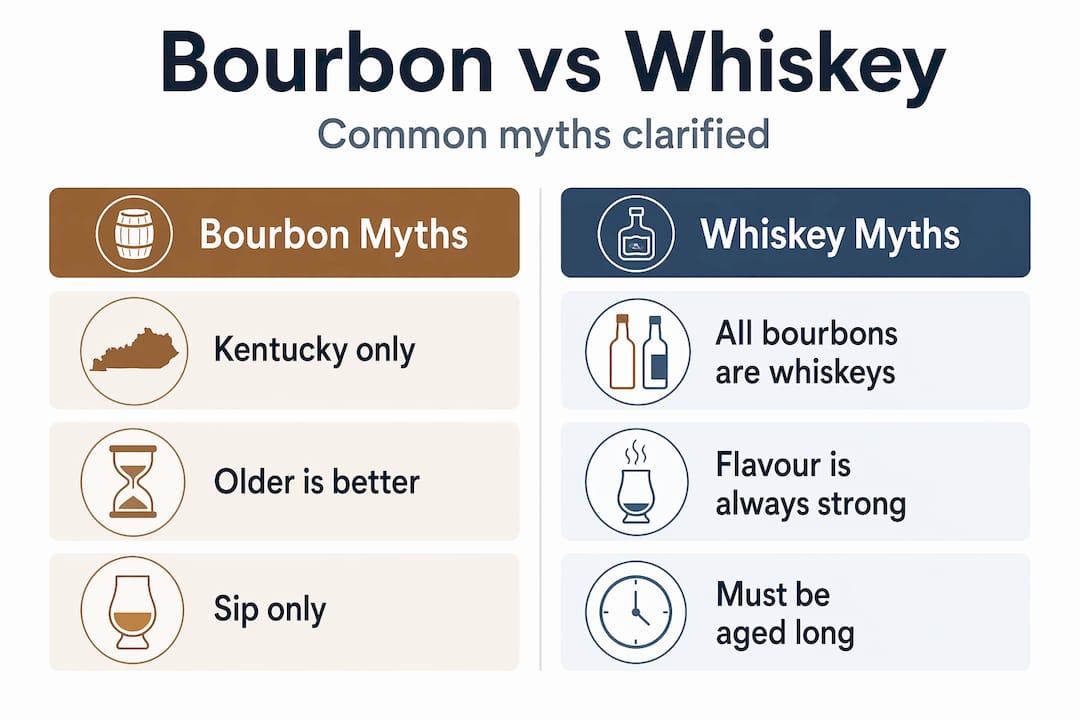
Myth: Older always means better. With bourbon, the relationship between age and quality is more complicated than it is with Scotch. Because bourbon ages in new charred oak and the climate in most American producing regions involves hot summers and cold winters, the extraction of wood character happens quickly. Over-aged bourbon can actually become too woody, losing the sweetness that defines the category.
Myth: Bourbon is only for sipping straight. Bourbon is one of the most versatile cocktail bases available. An Old Fashioned made with bourbon is a completely different experience to one made with rye, and neither is wrong. The sweeter base notes in bourbon make it the natural choice when you want the spirit to carry sweetness without adding sugar.
Pro Tip: When exploring bourbons from outside Kentucky, look for producers with access to interesting local water sources and climate variation. Texas bourbon, for example, ages faster due to intense heat, producing bold, oak-forward expressions in a fraction of the time.
Choosing between bourbon and American whiskey
Now that you understand how the category works, the practical question is: which should you be reaching for? The honest answer is that it depends entirely on what you want from the experience.
Here is a guide to common situations and what to choose:
- For sipping neat or on the rocks: Start with bourbon. Its consistent sweetness and smoothness make it forgiving and pleasurable without needing mixers.
- For a classic Manhattan: Most bartenders recommend rye as the traditional choice, since its spice balances the vermouth. Bourbon works too and produces a sweeter, rounder cocktail. The choice comes down to your preference.
- For an Old Fashioned: Either works beautifully. Bourbon gives a sweeter, fuller body. Rye adds a dry, peppery edge that some drinkers strongly prefer.
- For gifting someone new to whiskey: Bourbon is almost always the right call. Its approachability and flavour consistency make it easy to enjoy without experience.
- For adventurous exploration: Once you know bourbon well, branch into rye, wheat whiskey, or Tennessee whiskey. Each reveals something different about how grain and process shape a spirit.
For Australians exploring these American whiskey styles, it is worth knowing that a growing number of quality expressions are available through specialist retailers. If you want guidance on navigating the range of bourbons available in Australia, there are solid resources that go producer by producer. For anyone just starting out, the best whiskies for beginners guide covers bourbon-forward recommendations that are easy to find and easy to enjoy.
My take on why this distinction matters
I have spent a long time talking to whisky drinkers at every experience level, and the people who invest even a small amount of time in understanding how bourbon relates to the rest of American whiskey tend to enjoy both more. Not because knowledge makes spirits taste better in some abstract sense, but because it gives you a framework for choosing intentionally rather than defaulting to what is familiar.
In my experience, bourbon is often where the curiosity starts. It is sweet, approachable, and rarely disappoints. But I have seen a lot of bourbon drinkers who, once they understand the broader category, become genuinely excited about rye or even wheat whiskey. That transition is one of the more rewarding parts of exploring spirits. You realise that bourbon is not the destination. It is the door.
What I find particularly interesting from an Australian perspective is how the American whiskey category is growing in this market. There is real appetite here for quality expressions beyond the well-known Kentucky names, and that appetite is being met. The perceived difference between bourbon and whiskey often comes down to personal flavour preference rather than any objective quality gap. Both have their place, and the most satisfying approach is to treat them as complementary rather than competing.
If you have been drinking bourbon for a while and feel ready to widen your view, rye is the logical next step. It shares enough with bourbon to feel familiar while offering something genuinely different. Start there, and the rest of the American whiskey category opens up naturally.
— Brendan
Explore American whiskey at Uisuki

If this article has made you want to pour something worthwhile, Uisuki has the bottles to match. The Hobart Whisky Bourbon Matured Rum Finished Single Malt is a fascinating local expression that showcases exactly what bourbon barrel ageing does to a spirit, drawing out those vanilla and caramel notes that make American oak so beloved. It is a brilliant way to experience bourbon influence without committing to a full Kentucky bottle. Uisuki curates premium whisky from across the USA, Australia, Scotland, and Japan, with detailed tasting notes, ABV information, and expert guidance on every listing. Whether you are building a collection or choosing your first serious bottle, the selection is worth a look.
FAQ
Is bourbon a type of American whiskey?
Yes. Bourbon is a legally defined subcategory of American whiskey. All bourbon meets the requirements for American whiskey, but American whiskey does not have to be bourbon.
What is the main difference between whiskey and bourbon?
Bourbon must contain at least 51% corn, be aged in new charred oak barrels, and be produced in the USA. Other American whiskeys follow broader federal rules without those specific grain and barrel requirements.
Does bourbon have to come from Kentucky?
No. Bourbon can be legally produced anywhere in the United States. Kentucky dominates production historically, but Texas, New York, Colorado, and other states produce legal and high-quality bourbon.
Which is better, bourbon or whiskey?
Neither is objectively better. The choice is entirely subjective. Bourbon suits those who prefer sweeter, smoother profiles, while rye and other American whiskeys appeal to drinkers who want more spice and complexity.
What American whiskey should a beginner try first?
Bourbon is the most beginner-friendly option due to its sweetness and consistent production standards. Expressions from well-known producers are a reliable starting point before exploring the wider range of American whiskey styles.