

TL;DR:
- Small production decisions, from malting peat levels to cask type, profoundly influence whisky flavor and collectibility.
- Understanding these nuances allows collectors to evaluate bottles beyond age and brand, recognizing genuine craftsmanship.
- Production drift over time means even bottles from the same distillery can vary significantly, emphasizing the importance of detailed provenance.
Most collectors assume that two bottles from the same distillery, the same region, and the same age statement will taste broadly similar. They won’t. The differences can be dramatic, and they trace back to dozens of small decisions made across every stage of production. Understanding those decisions is not just academic curiosity. It changes how you read a label, assess a rare bottle, and ultimately build a collection that reflects genuine knowledge rather than brand recognition alone.
Table of Contents
- Breaking down the whisky-making process
- Malting and mashing: unlocking sugars and the influence of peat
- Fermentation and distillation: shaping spirit character
- Maturation: the cask’s role and the art of patience
- Collectible nuances: why tiny decisions create big differences
- Expert insights: what most guides miss about whisky production
- Explore unique whiskies shaped by production mastery
- Frequently asked questions
Key Takeaways
| Point | Details |
|---|---|
| Each step shapes flavour | From malting to maturation, every stage makes a unique impact on the final taste and character of whisky. |
| Cask selection is critical | The type, fill status, and history of a cask are major drivers of both flavour and a whisky’s collectible value. |
| Production details matter | Subtle variables such as peat levels, yeast choices, and distillation cuts are what differentiate sought-after collector bottles. |
| Not all age is equal | Age statements are only part of the story; maturation environment and micro-decisions explain why similarly-aged whiskies differ so greatly. |
Breaking down the whisky-making process
Whisky production is a sequence of interdependent stages, and each one shapes the spirit in ways that compound over time. A choice made on day one of malting will still be present in the glass a decade later. That is what makes understanding the process so rewarding for collectors.
Whisky is produced via a series of complex steps that build on each other, from grain treatment to cask selection. The major stages are malting, mashing, fermentation, distillation, and maturation. Each step has a primary purpose, but each one also creates the specific flavour compounds and structural characteristics that collectors seek out in premium and artisanal expressions. You can read more about how these stages connect to single malt whisky characteristics in our dedicated guide.
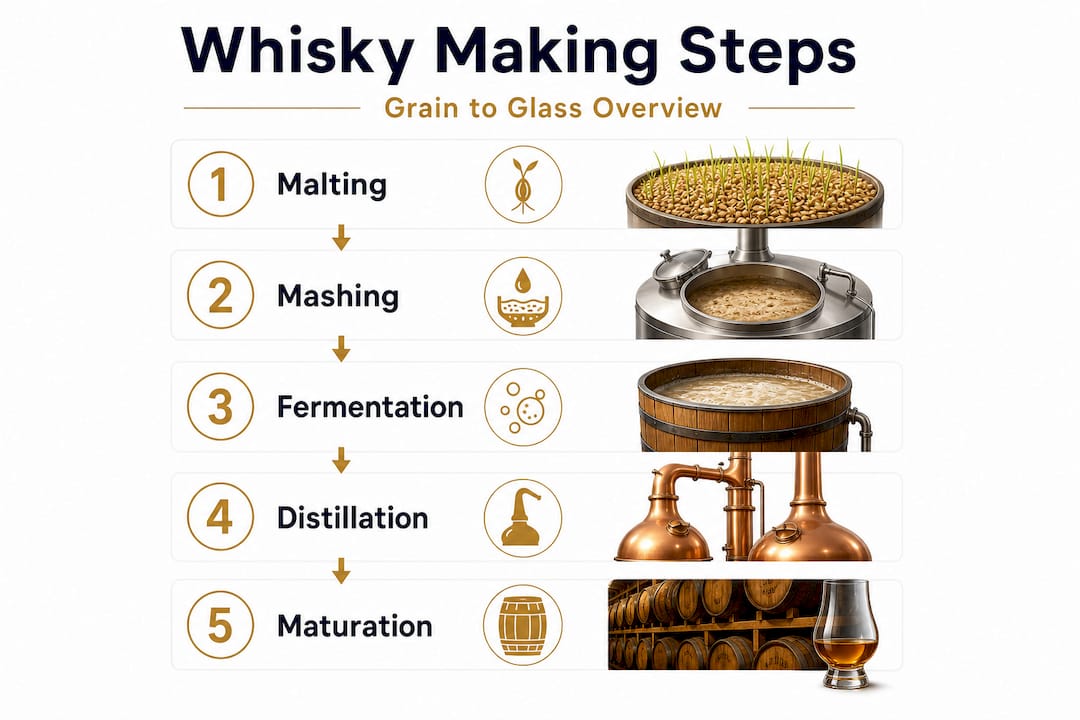
| Stage | Primary purpose | Collector relevance |
|---|---|---|
| Malting | Activate enzymes; introduce smoke | Sets smoke profile (phenol ppm), base grain character |
| Mashing | Convert starch to fermentable sugars | Affects sweetness, body, and clarity of wort |
| Fermentation | Convert sugars to alcohol and congeners | Determines fruity, floral, or sulphuric notes |
| Distillation | Concentrate and refine spirit | Cut points define richness, lightness, and overall character |
| Maturation | Develop complexity and colour via wood | Cask type, fill status, and climate shape final flavour |
Where do the biggest flavour differences emerge? Here is a quick overview:
- Peat level during kiln-drying (malting stage)
- Fermentation time and yeast strain selection
- Spirit cut decisions during distillation
- Cask type, size, and fill status during maturation
- Warehouse environment and geographic climate
Now that you understand why the process matters, let’s map out every major stage on the journey from grain to glass.
Malting and mashing: unlocking sugars and the influence of peat
With the broad steps outlined, let’s move into the foundational stages that set up all the later magic, starting with the grains themselves.
Malting begins with steeping raw barley in water for roughly two to three days. This triggers germination, during which the grain’s natural enzymes begin breaking down the kernel structure and converting starches into fermentable sugars. After about five to seven days of germination on the malting floor, the barley is kiln-dried to halt the process and lock in the enzymes. During malting, barley is steeped, germinated, and kiln-dried with peat to impart smoke, a characteristic that is quantifiable in phenol parts per million (ppm).
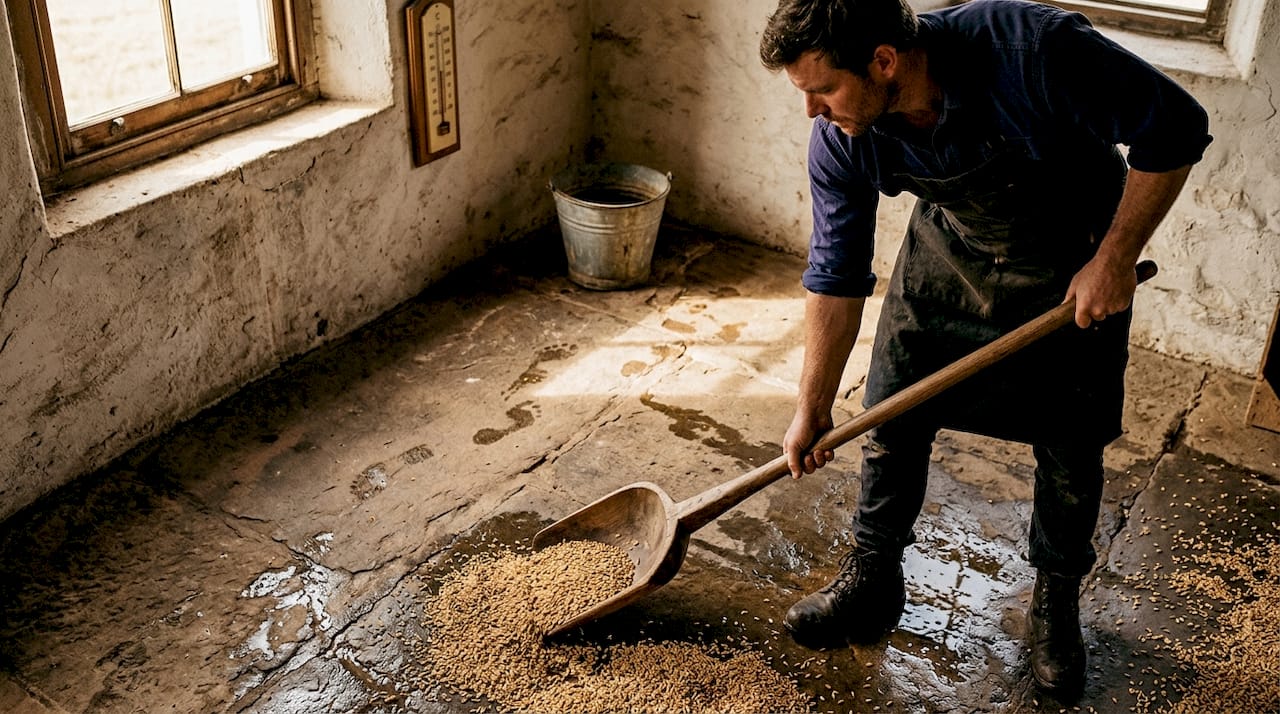
Peat is where things get particularly interesting for collectors. The kilns can burn peat as a fuel source, and the resulting smoke penetrates the moist grain. The longer and more intensively the peat burns, the higher the phenol concentration in the final malt. This is measured in phenol ppm and is one of the most transparent data points a distillery can share with consumers.
| Peat level | Typical phenol ppm | Iconic style examples |
|---|---|---|
| Unpeated | 0–2 ppm | Lowland-style, many Japanese expressions |
| Lightly peated | 2–15 ppm | Highland Park, some Speysides |
| Medium peated | 15–35 ppm | Talisker, Ben Nevis |
| Heavily peated | 35–50+ ppm | Ardbeg, Laphroaig, Octomore (up to 300+ ppm) |
Once malting is complete, the dried malt is ground into a coarse flour called grist. The grist enters the mash tun, where it is mixed with hot water in a series of staged additions. Typically, three waters are added at progressively higher temperatures, extracting fermentable sugars at each stage. Mashing converts malted grain to wort via hot water additions, and the resulting wort is then cooled before moving to fermentation. The clarity and sugar concentration of this wort plays a direct role in the texture and body of the finished spirit, which is why distilleries are exacting about their mash tun temperatures and timing.
Pro Tip: When researching a bottle, look for distillery technical sheets or independent tasting notes that cite phenol ppm. A 50 ppm malt and a 3 ppm malt from the same region will offer entirely different tasting experiences, even if the age and cask type are identical. This is useful when comparing single malt Scotch flavours across regional categories.
Fermentation and distillation: shaping spirit character
After the grain and sugars are prepared, it’s time for the transformation that separates whisky from beer: fermentation and distillation.
Fermentation is where the wort becomes a wash. Yeast is added to the cooled wort, and fermentation uses yeast to create a low-alcohol wash and key flavourful compounds known as congeners. These congeners include esters (fruity notes), aldehydes, and organic acids that will persist through distillation and maturation into the final bottle. Here is the fermentation process in sequence:
- Cooled wort is transferred into washbacks (traditionally wood, now often stainless steel)
- Yeast is pitched and fermentation begins within hours
- The wash produces CO2, heat, and rises visibly in the vessel
- Fermentation runs for 48 to 110 hours depending on distillery practice
- The resulting wash contains roughly 6–9% alcohol by volume
The length of fermentation matters enormously to collectors. Longer fermentation windows (72 hours or more) allow bacterial activity alongside yeast, producing more complex ester-forward flavours that many distilleries prize. Shorter fermentation tends to produce cleaner, more grain-forward spirit.
Distillation then concentrates the alcohol and strips away unwanted compounds. In Scotch production, pot stills are the standard for malt whisky, and most distilleries run two distillation cycles. The first run (wash still) produces a liquid called low wines at roughly 20–25% ABV. The second run (spirit still) brings this up to around 60–70% ABV, and this is where the crucial spirit cut decision is made.
“The difference between two bottles can hinge on a tiny cut decision during distillation.”
The distiller separates the spirit run into three fractions: foreshots (harsh, undesirable), the heart (the usable spirit), and feints (oily, heavy compounds). Distillation in pot stills concentrates alcohol, and cut points are vital for both flavour and ABV. A distillery that takes a very narrow heart cut collects only the purest, lightest fraction. One that takes a wider cut includes more oils and congeners, producing a heavier, more robust new-make spirit.
Pro Tip: Spirits produced with longer fermentation or particularly narrow heart cuts are frequently regarded by serious connoisseurs as more refined and age-worthy. When buying a collectible release, ask whether the distillery publishes their cut points or fermentation times. For a deeper look at how these distinctions play out in the bottle, our single malt vs grain differences article breaks this down clearly.
Maturation: the cask’s role and the art of patience
Once the base spirit is distilled, it’s cask time, where patience and wood deliver many of the flavours you seek in collectible bottles.
Maturation is where whisky earns most of its colour, a significant portion of its flavour, and its fundamental complexity. The new-make spirit goes into oak casks at no more than 63.5% ABV for Scotch whisky (by law), and the interaction between spirit, wood, and environment begins immediately. Maturation in oak, plus storage climate, shapes whisky character and produces the ‘angel’s share,’ typically a 1–2% volume loss per year.
That figure adds up fast. Over 12 years, a cask can lose 15–20% of its original volume to evaporation through the wood. This concentrates what remains, intensifying flavour and, in hot climates, accelerating the maturation process significantly. Australian and Taiwanese distilleries, for instance, mature spirit at a far faster rate than their Scottish counterparts simply due to temperature variance across seasons.
Cask provenance and fill status dramatically affect the final whisky profile. Here is what to consider:
- Cask type: Ex-bourbon (American oak) contributes vanilla, coconut, and light spice. Ex-sherry (European oak) delivers dried fruit, chocolate, and tannin. Port, Madeira, rum, and wine casks each add their own distinct character.
- First-fill vs refill: A first-fill ex-bourbon cask delivers intense wood influence because it is the first time the wood’s compounds are being extracted by whisky. Second-fill and beyond produce progressively subtler wood interaction.
- Cask size: Smaller casks (octaves, quarter casks) expose more spirit to wood surface area, accelerating maturation but also risking over-oaking if held too long.
- Warehouse style: Dunnage warehouses (traditional, low, earthen floor) maintain stable cool temperatures. Racked warehouses see more temperature swing. Both affect evaporation rate and flavour development.
- Geographic climate: A cask in coastal Islay will develop differently from an identical cask maturing inland in Speyside or on the slopes of Western Australia’s Porongurup Range.
Two “identical” new-make spirits filled into two casks with different previous contents and stored in separate warehouses will be unrecognisable as siblings within five years. This is the fascinating reality that makes single-cask expressions so coveted. Our guide to whisky cask influence digs further into how wood selection shapes what ends up in your glass.
Collectible nuances: why tiny decisions create big differences
With all the steps visible, it’s time to zero in on the expert-level decisions that separate average releases from sought-after collector’s gems.
The biggest levers of difference between expressions are distillation cuts and cask provenance and fill status. Most collectors focus on distillery name and age, but those who outperform at auction and in tasting notes tend to ask sharper questions. Here is the framework:
- What is the phenol ppm? This tells you whether smokiness is a defining character or a background note.
- How long was fermentation? Longer fermentation generally means more ester development and fruit-forward complexity.
- Where were the spirit cuts taken? Narrow cuts favour elegance and longevity; wider cuts produce richness and body.
- Is this a first-fill or refill cask? This determines how dominant the wood influence will be in the final expression.
- What was previously held in the cask? Ex-sherry vs ex-bourbon is not just a preference question, it is a fundamental flavour architecture choice.
- Where was the cask warehoused? Coastal, highland, or inland environments each leave their mark.
The collector’s mental model should be this: new-make spirit + specific cask + storage environment = a whisky unlike any other ever made. No two outcomes are perfectly identical, even within the same distillery’s releases. Age statements are a useful guide but not the complete story. A 12-year-old whisky in a first-fill oloroso sherry butt may be richer and more complex than a 25-year-old from the same distillery matured in a tired fourth-fill hogshead. Our whisky buying checklist for 2026 provides a practical framework for applying all of this at the point of purchase.
Expert insights: what most guides miss about whisky production
Most guides cover the basics reasonably well. They explain malting, mention distillation, and remind you that casks matter. What they rarely address is production drift, and this is where even experienced collectors are often caught out.
Production drift refers to the gradual and sometimes significant shifts in how a distillery operates over time. Yeast strains change. Fermentation windows shorten under commercial pressure. Still shapes are modified during refurbishments. Water sources occasionally shift. New distillery managers bring different philosophies about cut points. All of these micro-decisions accumulate, meaning a bottle from the same distillery released ten years apart may represent genuinely different production protocols, not just different maturation.
We have seen this play out with numerous well-regarded distilleries that shifted to stainless steel washbacks from wood, or changed their fermentation time to increase output volume. The spirit character shifted noticeably. Vintage releases from before these changes became more collectible, not because of age alone, but because of genuine production differences that discerning collectors identified.
The deeper insight is this: distillery name is a starting point, not a conclusion. The real work of collecting is understanding the specific batch, vintage, and production parameters behind each bottle. We cover this in detail when discussing collectible whisky factors and why some releases hold or grow in value while others plateau.
Pro Tip: Always dig for detailed bottling information beyond what appears on the front label. Independent bottlers often publish precise cask details, distillation dates, and cut information that the distillery’s own standard releases do not. These are frequently where production nuance translates directly into exceptional value.
Explore unique whiskies shaped by production mastery
Understanding how whisky is made transforms the way you browse, buy, and taste. You are no longer just choosing by region or reputation; you are reading a production story encoded in every bottle.

At Uisuki, we curate a selection of premium and artisanal whiskies from Scotland, Japan, Australia, the USA, and beyond, all chosen with exactly these production nuances in mind. Whether you are searching for a heavily peated Islay expression, a rare single-cask release with a compelling maturation story, or an Australian whisky that demonstrates what a coastal climate does to first-fill bourbon wood, we can help you find it. Browse our new arrivals and rare bottles or reach out for a personalised sourcing request. Your next great bottle has a production story worth knowing.
Frequently asked questions
What makes a whisky ‘peated’ and how is peatiness measured?
Whisky becomes ‘peated’ when peat smoke is used during the kiln-drying stage of malting, and peatiness is measured by phenol content in parts per million (ppm), with higher numbers indicating more intense smokiness.
Why do whiskies with the same age taste so different?
Even whiskies of the same age can taste very different due to variations in cask type, maturation environment, and cut points made during distillation, all of which shape flavour independently of time.
How does the ‘angel’s share’ affect whisky?
The ‘angel’s share’ refers to spirit lost through evaporation during maturation; in Scotland, this is typically 1–2% per year, concentrating and intensifying flavour in what remains inside the cask.
What is the effect of using different casks in whisky maturation?
Different casks such as ex-bourbon, sherry, or port each impart distinct flavours, and first-fill casks deliver more intense wood character than second-fill or refill casks because more of the wood’s active compounds remain available.