

TL;DR:
- Malt influence on whisky stems from malting processes that develop flavour precursors, enzymes, and phenols, shaping the spirit’s character. The malting stages—steeping, germination, and kilning—each leave distinct fingerprints that affect enzyme activity and flavor development. Peat adds phenols during kilning, influencing smokiness, but distillation and maturation reduce phenolic intensity, making malt specifications crucial in character.
Malt influence on whisky is defined as the combined effect of barley malting processes that develop flavour precursors, enzymatic activity, and phenolic compounds critical to a whisky’s final character. The term “malt influence” is widely used by enthusiasts, but the industry concept is better understood as malt modification, the degree to which malting transforms raw barley into a fermentable, flavour-ready grain. Under the Scotch Whisky Regulations 2009, Single Malt Scotch must use malted barley only, distilled in pot stills, and matured for a minimum of three years in oak casks under 700 litres. That legal framework exists because malt is not merely an ingredient. It is the engine of flavour itself.
How does the malting process shape whisky flavour?
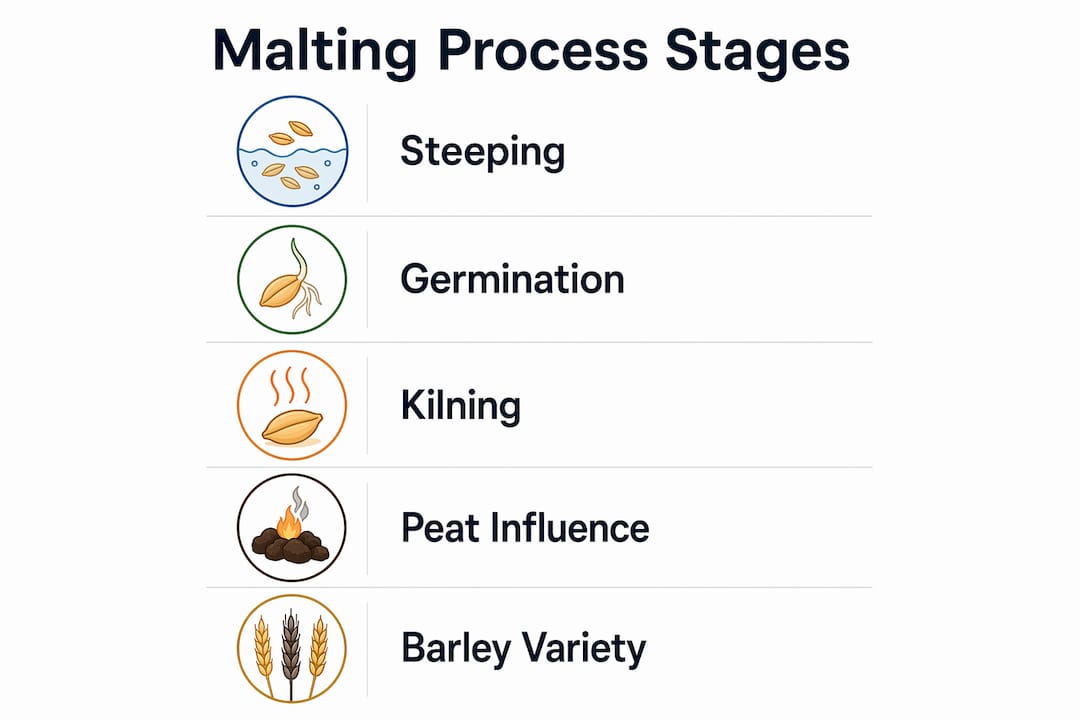
The three stages of malting, steeping, germination, and kilning, each leave a distinct fingerprint on the malt flavour profile long before a drop of spirit reaches a cask.
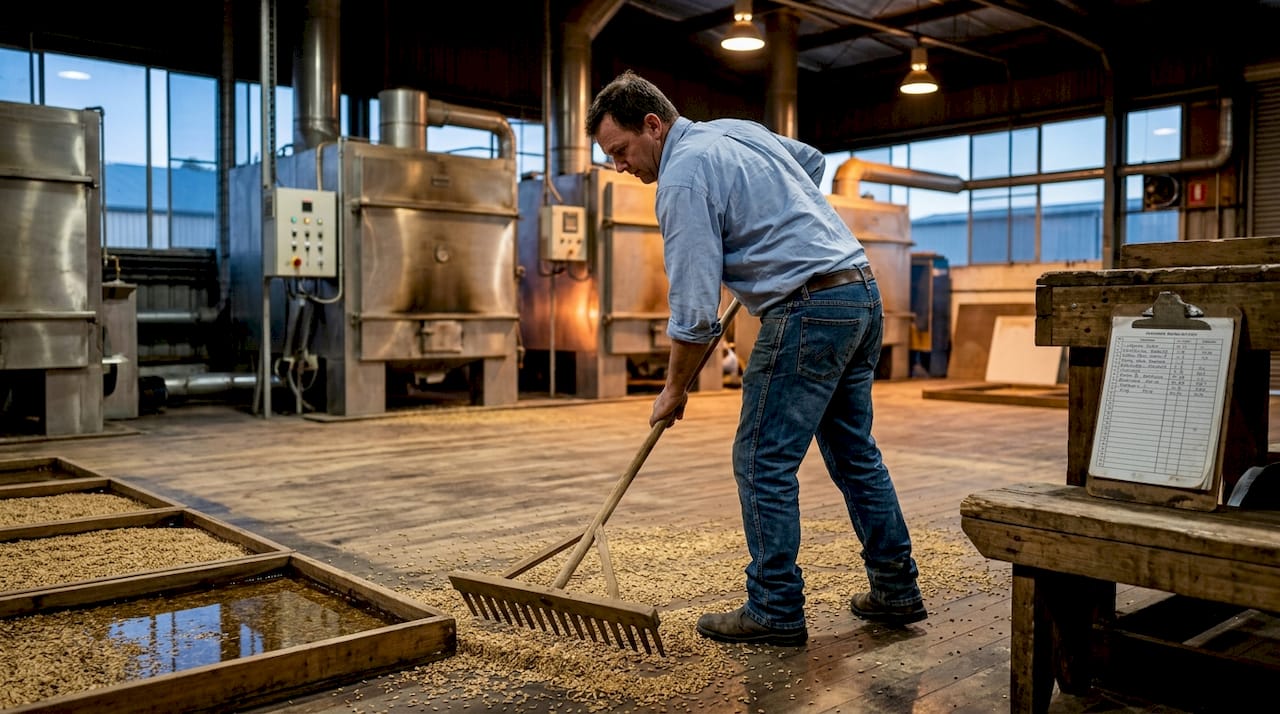
Steeping is where raw barley absorbs water over 40 to 60 hours, typically in alternating wet and dry cycles. This hydration cleans the grain and triggers the biological signals that wake the seed from dormancy. The moisture level achieved here sets the ceiling for everything that follows. Under-steeped barley produces uneven germination; over-steeped barley risks oxygen depletion and off-flavours.
Germination is where the biochemical work happens. As the grain sprouts, enzymes including alpha-amylase and beta-amylase activate and begin breaking down starch and protein structures. This process, called modification, produces the fermentable sugars and free amino nitrogen that yeast will later convert into alcohol and flavour compounds. Germination temperature and duration are the maltster’s primary controls here. A longer, cooler germination produces a more fully modified malt with greater enzyme activity.
Kilning halts germination by applying heat, locking in the enzyme levels and flavour precursors developed during germination. Temperature and moisture during kilning determine colour development through Maillard reactions, phenol absorption from any peat smoke used as fuel, and the degree to which enzymes survive for use in mashing. Research confirms that temperature-moisture gradients across the kiln bed create heterogeneity in alpha-amylase activity and starch gelatinisation temperature within a single batch. This means malt quality varies even within one production run, a fact that experienced maltsters account for through careful kiln management.
- Steeping moisture target: typically 42 to 46% for optimal germination
- Germination duration: usually 4 to 6 days depending on barley variety and target modification
- Kilning temperature: low-temperature drying preserves enzymes; higher temperatures develop colour and reduce DMS precursors
- Peat smoke introduction: applied during the early wet phase of kilning when the grain absorbs phenols most readily
Pro Tip: When reading a whisky’s tasting notes, look for descriptors like “biscuit”, “cereal”, or “nutty”. These often signal a well-modified, lightly kilned malt where Maillard browning was controlled and enzyme activity was preserved through to fermentation.
What role does peat play in malt smokiness?
Peat is not an ingredient added to whisky. It is a fuel burned beneath the malt during kilning, and its smoke carries phenolic compounds that bond to the wet grain surface. The degree of smokiness in the final spirit is measured in parts per million of phenols, commonly written as PPM.
The PPM scale classifies malt from unpeated (0 to 2 PPM) through lightly peated (around 5 to 10 PPM), medium peated (15 to 25 PPM), heavily peated (30 to 50 PPM), and super-heavily peated (50 PPM and above). Octomore expressions from Bruichladdich Distillery regularly exceed 100 PPM at the malt stage, making them the most heavily peated whiskies in commercial production. That number matters because it tells you how aggressively the maltster applied peat smoke during kilning.
| Peat level | Malt PPM range | Example style |
|---|---|---|
| Unpeated | 0 to 2 PPM | Speyside, most Lowland |
| Lightly peated | 5 to 10 PPM | Some Highland expressions |
| Medium peated | 15 to 25 PPM | Tomatin Cù Bòcan |
| Heavily peated | 30 to 50 PPM | Ardbeg, Laphroaig |
| Super-heavily peated | 50 PPM+ | Bruichladdich Octomore |
A critical nuance: malt PPM does not equal spirit PPM. Distillation and maturation both reduce phenolic intensity. A malt specified at 50 PPM may produce a spirit perceived at only 20 to 25 PPM. This is why two distilleries using identically specified malt can produce whiskies with noticeably different smoke character. The cut points during distillation and the cask type used for maturation both modulate how much phenolic character survives into the glass.
Regional peat also differs in composition. Islay peat is rich in sphagnum moss and coastal vegetation, producing medicinal, iodine-tinged phenols. Orkney peat contains more heather and grass, yielding a softer, earthier smoke. The phenolic loading in malt is influenced by peat burning duration and malt wetness, so whiskies with similar smoke intensity on the palate can carry very different PPM specifications at the malt stage.
Pro Tip: If you want to understand peat character without committing to a heavily smoked bottle, try a lightly peated expression first. The smoke sits in the background and lets you taste the malt character underneath, which is often where the real complexity lives.
Is barley variety the main driver of malt flavour?
The assumption that barley variety directly determines malt flavour is one of the most persistent myths in whisky appreciation. The reality, as maltsters explain, is that process parameters dominate over variety alone. Barley variety sets the biochemical potential, but the maltster’s decisions about moisture, germination temperature and duration, and kilning profile determine what flavour precursors actually develop.
Consider how this plays out in practice:
- Two batches of the same barley variety, germinated at different temperatures, will produce malts with different free amino nitrogen levels, directly affecting the range of flavour compounds available to yeast during fermentation.
- Kilning duration affects the reduction of S-methylmethionine, the precursor to dimethyl sulphide (DMS), a compound associated with cooked vegetable off-flavours. Longer kilning reduces SMM and thus DMS risk, but also drives more colour development and Maillard-derived flavour compounds.
- Moisture adjustment during steeping changes the rate of enzyme activation in germination, meaning the same barley variety can yield a lightly modified or fully modified malt depending on how the maltster manages water uptake.
- Malt house technology matters. Industrial drum maltings produce more consistent modification than traditional floor maltings, but floor maltings introduce natural temperature variation that some distilleries argue adds complexity to the final spirit.
The interaction between malting and fermentation is where this complexity compounds. A highly modified malt with abundant free amino nitrogen gives yeast more to work with, producing a broader range of esters and higher alcohols. A less modified malt constrains yeast activity and can produce a cleaner, more spirit-forward profile. Understanding the nature of malt in whisky production means recognising that the maltster is as influential as the distiller in shaping what ends up in the bottle.
How does malt composition affect fermentation and distillation?
Malt’s role does not end at the kiln. The composition of the finished malt, its enzyme activity, starch structure, and nitrogen content, directly governs what happens in the mash tun and washback.
The role of malt in fermentation is fundamentally enzymatic. During mashing, alpha-amylase and beta-amylase convert starch into fermentable sugars, primarily maltose. The efficiency of this conversion depends on how well those enzymes survived kilning. A malt kilned at higher temperatures to develop colour will have reduced enzyme activity, which can lower fermentable extract and affect alcohol yield. This is why heavily kilned crystal malts are rarely used as the sole grain in whisky production.
- Malt modification level determines how completely starch and protein structures have been broken down, affecting both fermentability and the range of flavour precursors available.
- Free amino nitrogen (FAN) from protein modification feeds yeast nutrition, influencing fermentation vigour and the production of esters, fusel alcohols, and other congeners that define spirit character.
- Starch gelatinisation temperature is affected by kilning conditions. Malts from different kiln layers show different gelatinisation profiles, contributing to batch variability in mash efficiency.
- Enzyme activity differences across kiln layers mean that even within a single malt batch, heterogeneity in starch properties can produce subtle variation in the wort composition that reaches the fermentation vessel.
The downstream effect on distillation is real. A wort rich in fermentable sugars and amino acids produces a wash with a complex congener profile. The distiller’s cut points then determine which congeners carry through to the new make spirit. Malt composition sets the foundation; distillation selects from it. This is why understanding whisky flavour profiles requires tracing the chain back to the malt house, not just the still room.
Key takeaways
Malt influence on whisky is determined by malting process controls, not barley variety alone, making the maltster’s decisions about moisture, germination, and kilning the primary drivers of flavour character.
| Point | Details |
|---|---|
| Malting stages drive flavour | Steeping, germination, and kilning each shape enzyme activity and flavour precursors before fermentation begins. |
| Peat PPM is a malt specification | Phenol levels are set during kilning and reduced by distillation, so malt PPM always exceeds spirit PPM. |
| Process beats variety | Maltster controls over moisture, temperature, and kilning duration matter more than barley variety in determining malt flavour. |
| Malt composition governs fermentation | Enzyme activity and free amino nitrogen in malt directly affect yeast performance and the congener profile of the spirit. |
| Regional peat differs in character | Islay, Orkney, and Highland peats produce distinct phenolic profiles that shape smokiness beyond simple PPM comparisons. |
Why malt deserves more credit than the cask gets
Most whisky conversations pivot to cask maturation within about thirty seconds. I understand why. Oak influence is dramatic, measurable, and easy to taste. But after years of working through whiskies from Scotland, Japan, and Australia, I have come to believe that malt character is the most underappreciated variable in the bottle.
Here is what I have noticed. When you taste an unpeated single malt from a distillery that uses traditional floor maltings, like Springbank or Balvenie, there is a textural richness and a cereal complexity that you simply do not get from distilleries using industrial drum-malted grain to the same specification. The malt house matters. The heterogeneity introduced by floor malting, the slight variation in modification across the bed, seems to produce a more layered base spirit that holds up better through long maturation.
The peat conversation is similarly more nuanced than PPM numbers suggest. I have tasted heavily peated whiskies that felt thin and one-dimensional because the smoke overwhelmed an underdeveloped malt base. And I have tasted lightly peated expressions where the smoke integrated so perfectly with the cereal and fruit notes that you could not separate them. That integration comes from the maltster getting the balance right between phenol loading and malt modification.
My practical advice: when you pick up a bottle, look beyond the cask finish on the label. Ask what the malt specification is. Ask whether it is peated, and if so, at what PPM. Ask whether the distillery malts its own grain. Those questions will tell you more about what is in the glass than the wood type ever will.
— Brendan
Explore malt-driven whiskies at Uisuki
Understanding malt influence changes how you shop for whisky. Once you know that a lightly peated malt from a traditional maltings produces a fundamentally different spirit than an industrial unpeated malt, you start looking at bottles differently.

At Uisuki, the selection is built around exactly this kind of malt-driven diversity. The Hobart Whisky Bourbon Matured Rum Finished Single Malt showcases how Australian malted barley expresses itself through double cask maturation, a genuine study in malt character meeting wood influence. For those drawn to blended complexity, Ichiro’s Malt and Grain demonstrates how malt and grain whiskies from multiple countries interact when the malt base is carefully chosen. Browse the full range at Uisuki.com.au and filter by region or style to find expressions that put malt character front and centre.
FAQ
What is malt influence on whisky?
Malt influence on whisky refers to the flavour, enzymatic, and structural contributions that malted barley makes to the spirit through steeping, germination, and kilning. These processes develop the fermentable sugars, flavour precursors, and phenolic compounds that define a whisky’s base character before distillation or maturation begins.
How does peat affect whisky flavour through malt?
Peat smoke bonds phenolic compounds to wet malt during kilning, measured in PPM. Distillation and maturation reduce phenolic intensity, so a malt specified at 50 PPM typically produces a spirit perceived at around 20 to 25 PPM.
Does barley variety determine malt flavour?
Barley variety sets the biochemical potential of malt, but malting process controls including moisture, germination temperature, and kilning duration are the primary determinants of malt flavour outcome. The same barley variety processed differently by two maltsters will produce meaningfully different malts.
What does malt modification mean in whisky production?
Malt modification describes how completely the malting process has broken down starch and protein structures within the barley grain. A fully modified malt provides higher fermentable extract and more free amino nitrogen, supporting vigorous yeast fermentation and a broader congener profile in the spirit.
Why do whiskies from the same region taste different if they use similar malt?
Distillation cut points, fermentation duration, yeast strain, and cask selection all modulate the malt-derived flavour compounds that reach the final spirit. Two distilleries using identically specified malt can produce whiskies with distinct characters because each of those downstream variables selects differently from the same flavour foundation.