

TL;DR:
- Irish whiskey is classified into four types—single malt, single pot still, single grain, and blended—each with unique mash bills and distillation methods. These categories determine flavor profiles, with single pot still offering spicy creaminess, while blended whiskey provides smooth, approachable complexity suitable for cocktails. Understanding production techniques helps consumers select Irish whiskeys that match their preferred taste and drinking occasion.
Irish whiskey types are defined by four legally recognised categories: single malt, single pot still, single grain, and blended, each shaped by distinct mash bills, still types, and maturation rules. All Irish whiskey must be aged at least 3 years in wooden casks and bottled at a minimum of 40% ABV. That shared foundation produces wildly different results depending on what goes into the still and how it gets there. Brands like Redbreast, Jameson, and Midleton have built their reputations on these distinctions, and understanding them is the fastest way to find a bottle you’ll actually love.
What are the main Irish whiskey types?
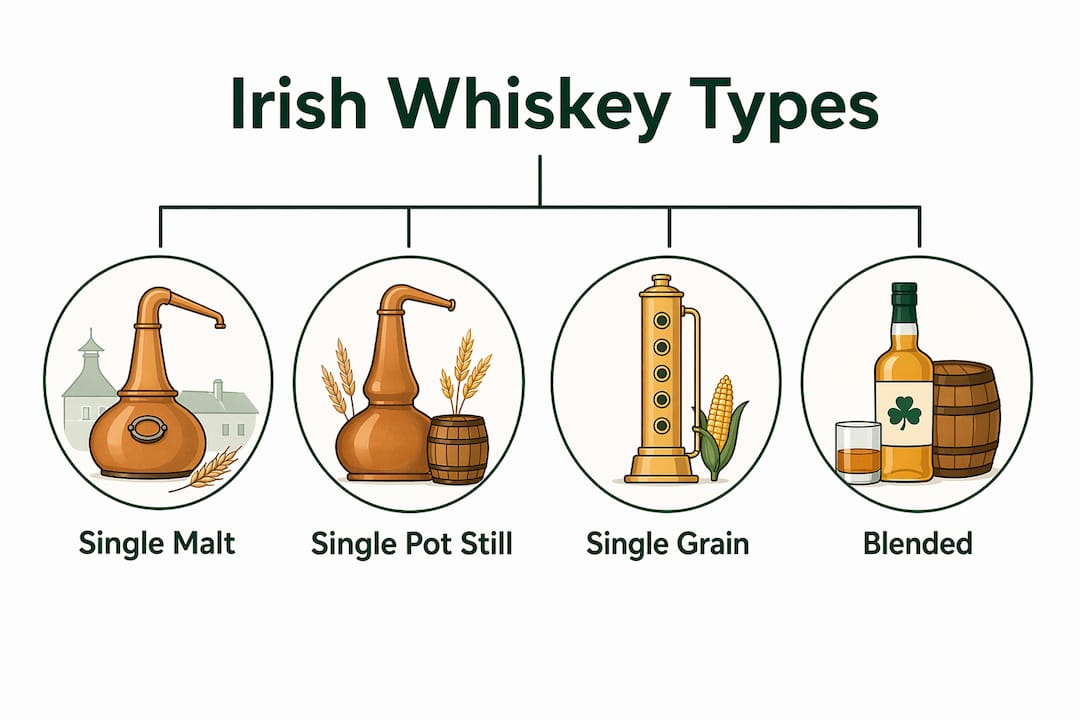
The four Irish whiskey styles map directly to production method. Single malt uses 100% malted barley in pot stills. Single pot still blends malted and unmalted barley in pot stills. Single grain uses multiple cereals in column stills. Blended whiskey combines two or more of these styles. Each category produces a recognisably different flavour profile, and production choices predict style far more reliably than any marketing language on the label.
Knowing which category a bottle belongs to tells you what to expect before you open it. A single pot still from Redbreast will be richer and spicier than a blended Jameson, not because one is better, but because their mash bills and distillation methods are fundamentally different. That distinction is worth understanding before you spend money on a bottle.
What defines single malt Irish whiskey and what flavours can you expect?
Single malt Irish whiskey is made from 100% malted barley, distilled in copper pot stills at a single distillery, and traditionally triple distilled for smoothness. Triple distillation is the key production choice that separates most Irish single malts from their Scotch counterparts, which are typically double distilled. The extra pass through the still strips out heavier congeners, producing a cleaner, lighter spirit that still carries genuine character.
The flavour profile of single malt Irish whiskey centres on focused barley sweetness, with layers of orchard fruit, gentle floral notes, and occasional spice depending on cask selection. You are not getting the peat smoke of Islay Scotch or the heavy grain weight of bourbon. The style rewards drinkers who want complexity without aggression.
Notable single malt expressions to explore:
- Bushmills 10 Year Old from County Antrim is one of the most accessible entry points, offering toasted oak, vanilla, and light fruit.
- Teeling Single Malt uses five different wine casks for finishing, adding a distinctive dried fruit and spice character.
- Knappogue Castle releases vintage-dated single malts that show how barley character evolves with extended maturation.
- The Tyrconnell from Cooley Distillery is known for its particularly fruity, approachable profile at a fair price point.
Pro Tip: When tasting a single malt Irish whiskey neat, add a few drops of still water. It opens up the barley and fruit notes without diluting the texture, which is especially useful with higher ABV expressions.
The role of malted barley in shaping these flavours is significant. Malting converts starches to fermentable sugars, and the specific barley variety, kilning temperature, and fermentation length all influence the final character. Single malt is where barley gets to speak for itself.
How does single pot still Irish whiskey differ in composition and taste?
Single pot still is the quintessentially Irish style, and it exists nowhere else in the whiskey world. The legal mash bill requires at least 30% malted barley and 30% unmalted barley, with up to 5% other unmalted cereals permitted. That unmalted barley is the defining ingredient. It creates a texture and spice character that no other whiskey category replicates.
The historical reason for using unmalted barley is genuinely interesting. The Irish preference for unmalted barley traces back to 18th-century British malt taxes, which made malted grain expensive. Irish distillers substituted raw barley to reduce costs, and the flavour it produced became so distinctive that it stuck long after the tax was abolished. What started as a workaround became a tradition.
How single pot still whiskey is made:
- The mash bill of malted and unmalted barley (plus any permitted cereals) is mashed together and fermented.
- The wash is distilled in large copper pot stills, typically three times, at a single distillery.
- The new make spirit is filled into oak casks for a minimum of three years, though premium expressions like Redbreast 15 Year Old mature considerably longer.
- The result is bottled at 40% ABV or above, often at higher strengths for cask strength releases.
The flavour profile is the most distinctive of all Irish styles. Unmalted barley contributes pronounced spice notes, a grassy freshness, and a luscious, creamy mouthfeel that feels almost oily on the palate. Redbreast 12, Powers John’s Lane, and Green Spot are the benchmark expressions. Each shows how mash bill ratios within the legal range produce meaningfully different results. Redbreast tends toward rich dried fruit and Christmas spice. Powers John’s Lane leans more savoury and peppery. Green Spot sits in between with honeyed orchard fruit and a clean, spicy finish.
“Single pot still whiskey is the style that most clearly demonstrates why Irish whiskey deserves to be taken seriously as a category in its own right. Nothing else tastes quite like it.”
Pro Tip: If you want to understand what unmalted barley actually contributes to flavour, taste a single pot still like Redbreast 15 Year Old directly alongside a single malt from the same region. The textural difference is immediately apparent, even before you register the spice.
What is single grain Irish whiskey and how does it compare?
Single grain Irish whiskey is the most misunderstood of the four types. The word “single” refers to production at a single distillery, not to a single grain ingredient. Single grain can include corn, wheat, and malted or unmalted barley, distilled in continuous column stills rather than pot stills. Column stills produce a lighter, higher-strength spirit with fewer congeners, which is why single grain whiskey tastes softer and more neutral than pot still or malt expressions.
For a direct comparison of how still type shapes flavour, the differences between malt and grain whisky come down to exactly this point. Pot stills retain more flavour compounds. Column stills strip them out for efficiency and lightness.
Single grain Irish whiskey at a glance:
- Flavour profile: Soft, light, and smooth with subtle cereal sweetness, vanilla, and gentle oak. Far less spice than pot still, far less barley intensity than single malt.
- Production: Column still distillation at a single distillery, using a multi-grain mash bill.
- Common use: Historically the backbone of blended Irish whiskeys, providing lightness and approachability to balance heavier pot still components.
- Solo expressions: Teeling Single Grain and Glendalough Double Barrel are two bottles that show what single grain can do when bottled on its own.
| Feature | Single grain | Single pot still |
|---|---|---|
| Still type | Column still | Copper pot still |
| Mash bill | Multiple grains permitted | Min. 30% malted + 30% unmalted barley |
| Texture | Light, smooth | Rich, creamy |
| Typical flavour | Vanilla, soft cereal | Spice, grass, dried fruit |
Single grain whiskey suits drinkers who find pot still or single malt too intense, and it works particularly well in long cocktails where a lighter base lets other ingredients come through.
What makes blended Irish whiskey so popular?
Blended Irish whiskey combines two or more styles, typically single malt, pot still, and grain whiskeys, often sourced from multiple distilleries. The blender’s job is to create a consistent, balanced product that delivers fruit, spice, and smoothness in a proportion that appeals to the widest possible audience. Jameson is the global benchmark, selling over 10 million cases annually and introducing more drinkers to Irish whiskey than any other brand.
Blended whiskey is not a lesser category. The craft lies in the blending itself. A master blender at Midleton Distillery works with dozens of individual casks and whiskey types to hit a consistent flavour target across every batch. The result is a whiskey that is reliably approachable, which is exactly why it dominates the category commercially.
Why blended Irish whiskey works so well:
- The grain component provides lightness and smoothness, making the whiskey easy to drink neat or on ice.
- The pot still component adds spice, body, and that distinctly Irish character.
- The malt component contributes fruit and complexity without overwhelming the blend.
- The combination is forgiving in cocktails, pairing well with ginger ale, soda water, or citrus.
Brands like Tullamore D.E.W., Slane, and Powers Gold Label all sit in the blended category, each with a slightly different balance between their component styles. Tullamore D.E.W. leans lighter and sweeter. Slane uses three different cask types for a more layered result. Powers Gold Label keeps more pot still character in the blend for a spicier finish.
How to choose the right Irish whiskey for your taste
Choosing between Irish whiskey styles comes down to two questions: how much flavour intensity do you want, and how are you planning to drink it? Mash bill and still type predict flavour better than price or age statement, so reading the label for production details is worth the effort.
Matching style to preference:
- You prefer rich, complex, and spicy: Go straight to single pot still. Redbreast 12 or Green Spot are the starting points. The Redbreast 12 Cask Strength is worth trying if you want the full intensity of the style without water dilution.
- You prefer fruity and clean: Single malt is your category. Bushmills 10 or Teeling Single Malt are reliable choices.
- You prefer light and smooth: Single grain expressions like Teeling Single Grain deliver softness without blandness.
- You want versatility for cocktails or everyday sipping: A quality blended whiskey like Jameson or Tullamore D.E.W. covers every occasion.
Pro Tip: When reading an Irish whiskey label, look for the category declaration (single malt, single pot still, single grain, or blended) rather than focusing on age statements. A younger pot still whiskey will often deliver more flavour than an older grain expression, because the mash bill matters more than time alone.
Food pairing is another useful guide. Single pot still works with aged cheddar, charcuterie, and dark chocolate. Single malt suits smoked salmon and soft cheeses. Blended whiskey pairs naturally with lighter dishes, seafood, and anything with citrus.
Key takeaways
The most reliable way to choose an Irish whiskey is to identify its category first, because mash bill and still type determine flavour more accurately than age, price, or brand reputation.
| Point | Details |
|---|---|
| Four legal categories | Irish whiskey is classified as single malt, single pot still, single grain, or blended. |
| Single pot still is uniquely Irish | Its unmalted barley mash bill produces a creamy, spicy texture found nowhere else in whiskey. |
| Mash bill predicts flavour | Reading the label for production method tells you more than the age statement or price point. |
| Blended suits most occasions | Blended whiskey balances spice, fruit, and smoothness, making it ideal for cocktails and everyday drinking. |
| Triple distillation defines smoothness | Most Irish whiskeys are triple distilled, producing a cleaner spirit than double-distilled Scotch. |
What I’ve learnt after years with Irish whiskey
The most common mistake I see from people exploring Irish whiskey for the first time is treating blended whiskey as a stepping stone to “better” categories. That framing misses the point entirely. Blended Irish whiskey is not a lesser product. It is a different craft, and a well-made blend like Jameson Black Barrel or Tullamore D.E.W. XO is genuinely impressive in its own right.
The category that consistently surprises people is single pot still. When someone who has only ever had blended Irish whiskey tries a Redbreast 15 for the first time, the reaction is almost always the same: they did not expect Irish whiskey to have that kind of texture and depth. The creamy mouthfeel and layered spice feel closer to a premium Cognac than to what most people picture when they think of Irish whiskey.
My honest recommendation for beginners is to start with a blended whiskey to understand the baseline, then move directly to a single pot still rather than single malt. The contrast is more dramatic and more instructive. Single malt is excellent, but single pot still is the style that makes Irish whiskey genuinely irreplaceable in the global spirits world.
For seasoned drinkers, cask strength single pot still expressions are where the real exploration happens. The Redbreast 12 Cask Strength at 58% ABV shows you exactly what the style is capable of without any dilution compromise.
— Brendan
Explore Irish whiskey at Uisuki
Uisuki stocks a curated selection of Irish whiskey across all four categories, sourced for quality and authenticity. Whether you are starting with a blended Jameson or ready to commit to a premium single pot still, the range covers every flavour preference and budget.

The single pot still range is particularly strong, with Redbreast expressions including the Redbreast 15 Year Old available for direct purchase with shipping across Australia. Single malt and blended options are stocked alongside rare and allocated releases that are difficult to source elsewhere. Browse the full Irish whiskey selection at Uisuki and use the product descriptions to match each bottle to your flavour preferences before you buy.
FAQ
What are the four types of Irish whiskey?
The four legally recognised Irish whiskey types are single malt, single pot still, single grain, and blended. Each is defined by its mash bill, still type, and distillation process.
What makes single pot still Irish whiskey unique?
Single pot still Irish whiskey uses a mash bill of at least 30% malted and 30% unmalted barley, distilled in copper pot stills at a single distillery. The unmalted barley creates a distinctive spicy, creamy character found in no other whiskey category.
How long must Irish whiskey be aged?
Irish whiskey must be aged for a minimum of three years in wooden casks and bottled at no less than 40% ABV. Premium expressions like Redbreast 15 Year Old mature well beyond this minimum.
Is blended Irish whiskey lower quality than single malt?
Blended Irish whiskey is not lower quality. It combines single malt, pot still, and grain whiskeys to achieve balance and consistency, and well-made blends like Jameson Black Barrel demonstrate genuine craft.
Which Irish whiskey type suits cocktails best?
Blended Irish whiskey suits cocktails best due to its balanced flavour profile and approachable smoothness. Single grain is also a strong choice for long drinks where a lighter base is preferred.