

TL;DR:
- Single malt whisky is defined by production at a single distillery, using 100% malted barley, distilled in pot stills, and matured in oak casks. Many releases marry numerous casks from the same distillery, and the label indicates origin, not quality. The best single malts now come from around the world, showcasing diverse flavors and winning international awards.
Single malt whisky is defined as whisky produced at a single distillery, made from 100% malted barley, distilled in pot stills, and matured in oak casks. That definition sounds simple, but it carries real weight. It explains why single malts taste the way they do, why they cost what they do, and why so many whisky lovers keep coming back to them. If you’ve ever wondered why choose single malt over a blend, this guide cuts through the noise and gives you straight answers.
Why choose single malt: what the definition actually means
The legal definition of single malt is precise and non-negotiable. A single malt Scotch must come from one distillery, use only malted barley as the grain, be distilled in pot stills, and age in oak casks for a minimum of three years. Every one of those requirements shapes the final flavour in the glass.
The biggest misconception is that “single” means one cask. It does not. Most standard releases are created by marrying dozens of different casks from the same distillery. The word “single” refers to the distillery, not the barrel. That distinction matters because it changes how you read a label and what you expect from a bottle.
Labels like “single malt” are legally mandated disclosures, not quality promises. A whisky can carry the single malt label and still be mediocre. Experienced drinkers look past the label to production details: the distillery’s house style, cask types used, and maturation length. The label tells you what it is. It does not tell you whether it’s good.
The 2026 World Whiskies Awards confirmed that single malt quality spans the globe. Bowmore 21 Year Old Sherry Oak Cask took the title of World’s Best Single Malt, alongside winners from Japan, Australia, India, and Taiwan. That spread shows the category is no longer a Scottish monopoly.
How is single malt whisky produced?
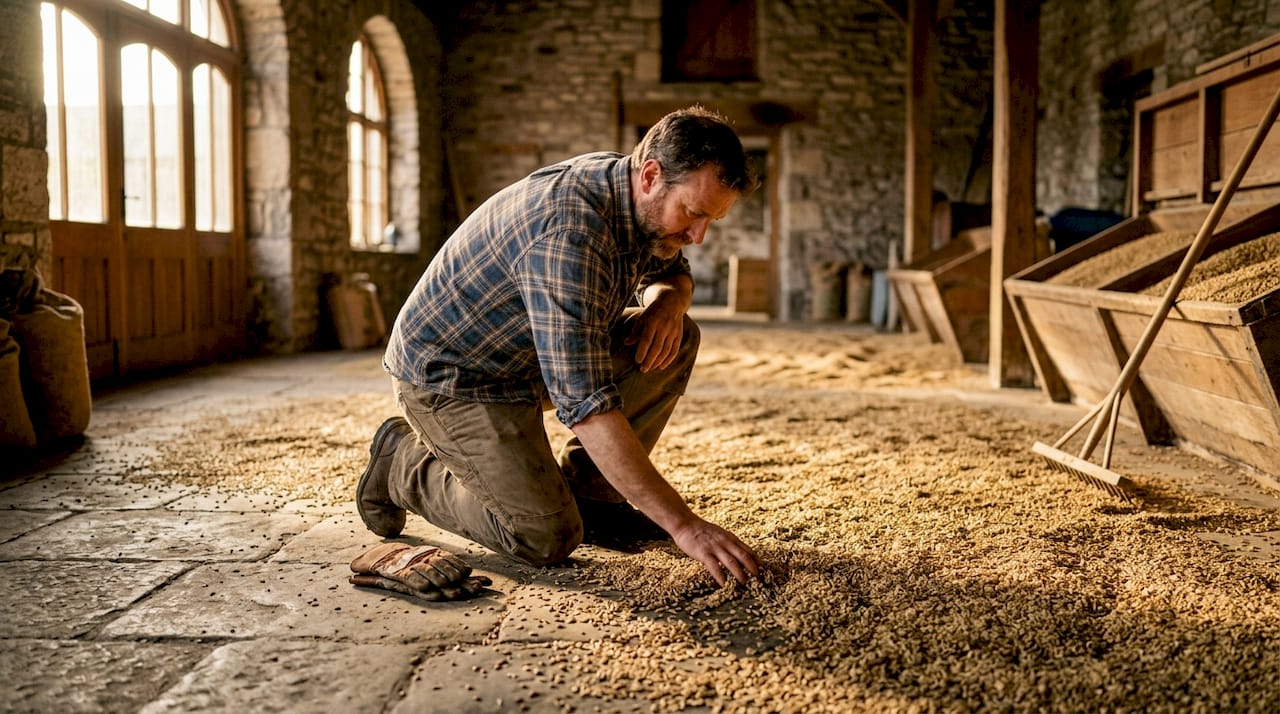
Single malt production starts with malted barley. The barley is soaked, allowed to germinate, then dried to stop the process. This releases enzymes that convert starch to sugar during mashing. The resulting liquid, called wash, ferments before distillation begins.
Distillation happens in copper pot stills, not the continuous column stills used for grain whisky. Pot stills work in batches. Each batch takes more time and attention than column distillation, and that slower process preserves more of the grain’s natural character. The shape of the still, its height, and the angle of the lyne arm all influence the final spirit’s weight and texture.
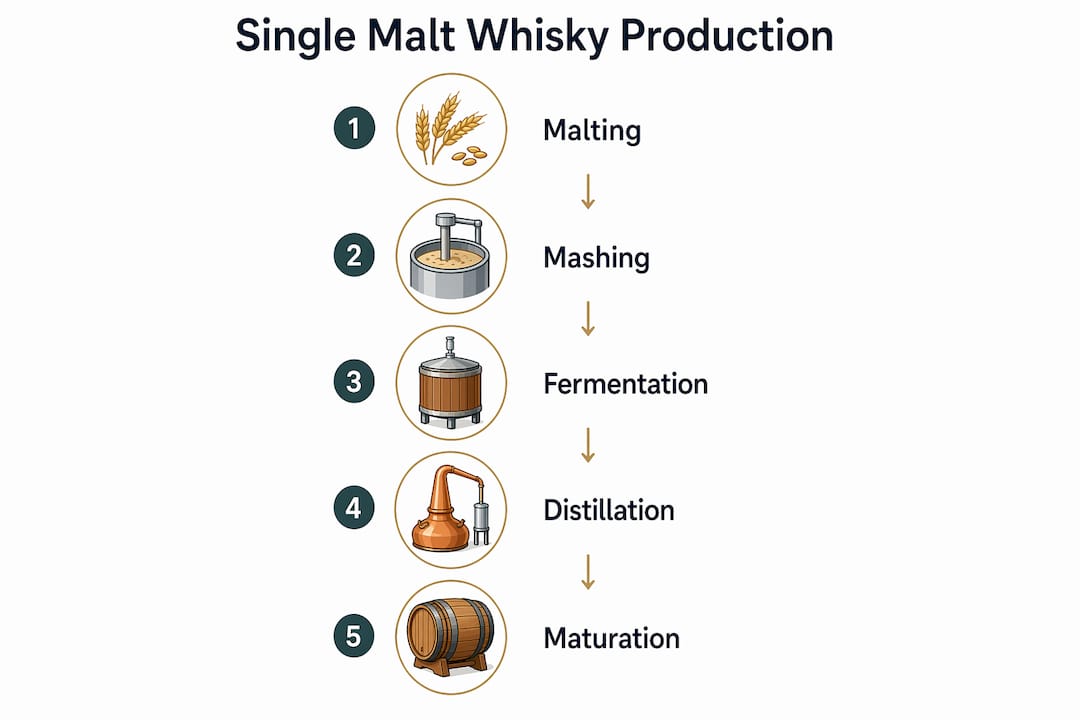
After distillation, the spirit goes into oak casks for maturation. Cask choice is where single malts diverge most dramatically from each other. A distillery might use ex-bourbon barrels from American white oak, ex-sherry butts from Spain, or port pipes from Portugal. Each vessel adds different compounds to the spirit over time. The flavour and quality of a single malt are highly influenced by cask choice and maturation conditions, making it expressive but variable.
Key steps that define single malt production:
- One distillery only: all spirit comes from the same site, preserving a consistent house style
- 100% malted barley: no wheat, corn, or unmalted grain enters the mash
- Pot still distillation: batch processing that retains grain character and complexity
- Oak maturation: legally required for a minimum of three years in Scotland
- Cask marrying: multiple barrels blended within the distillery to build the final release
Pro Tip: When a distillery marries casks from its own warehouses to create a consistent annual release, the result still qualifies as single malt. The practice is standard, not a shortcut.
Is single malt worth the price?
Single malts typically cost 2 to 4 times the price of an equivalent-aged blended Scotch. That gap is real, and it comes from several compounding factors rather than marketing alone.
Pot-still distillation is slower and more expensive than the column-still methods used for grain whisky. Longer maturation periods compound the cost further. A 12-year-old single malt has been sitting in a warehouse for over a decade, tying up capital and losing volume to evaporation (the so-called “angel’s share”) the entire time.
Branding and prestige positioning add another layer to the price. Distilleries invest in heritage storytelling, limited releases, and collector-grade packaging. Some of that cost lands on the bottle. That does not mean the premium is unjustified, but it does mean the price reflects both production reality and market positioning.
| Cost factor | Impact on price |
|---|---|
| Pot still distillation | Higher production cost per litre than column stills |
| Extended maturation | Capital tied up for years, plus evaporation losses |
| Single distillery sourcing | No ability to blend cheaper grain spirit to reduce cost |
| Prestige positioning | Marketing and packaging add to retail price |
| Limited batch sizes | Smaller volumes mean higher cost per bottle |
The term “small batch” is worth treating with scepticism. It lacks a legal definition in Scotch whisky and is often marketing language. A bottle labelled “small batch” tells you nothing specific about production scale or quality.
Why do whisky enthusiasts prefer single malts?
Single malts and blended whiskies represent different production philosophies. Single malts focus on the distinct character of one distillery. Blends focus on balance and consistency across multiple distilleries and grain sources. Neither is objectively better. They serve different purposes and different palates.
The appeal of single malts for enthusiasts comes down to specificity. When you drink a Speyside single malt, you taste the region’s soft water, the distillery’s copper stills, and the particular casks the master distiller selected. That combination is unrepeatable anywhere else. Single malt character strongly reflects the distillery’s house style and geographical region, which is exactly what collectors and curious drinkers find compelling.
Blended whiskies combine malt and grain whiskies from multiple distilleries to create consistent, approachable profiles ideal for mixing and casual drinking. That consistency is a genuine strength, not a weakness. A well-made blend delivers the same experience bottle after bottle, which is valuable for cocktails and everyday drinking.
What single malts offer that blends generally do not:
- Distillery identity: every bottle reflects one site’s water, yeast, stills, and casks
- Regional character: Islay peat, Highland fruit, Speyside honey, and Lowland floral notes are traceable to geography
- Cask expressiveness: sherry, bourbon, port, and wine cask finishes create dramatically different flavour profiles within the same distillery
- Vintage variation: releases from different years can taste noticeably different, adding a collector dimension
- Traceability: you can research the exact production conditions behind a specific bottle
The advantages of single malt are real, but so is the nuance. A great blend can outperform a mediocre single malt on every sensory measure. The category label does not guarantee the experience.
What do the 2026 award winners tell us about single malts?
The 2026 World Whiskies Awards confirmed that the best single malt whiskies now come from every corner of the globe. Bowmore 21 Year Old Sherry Oak Cask claimed the top global prize, but the full list of winners spans Scotland, Japan, Australia, India, and Taiwan. That spread is not an accident. It reflects decades of investment in craft distilling outside Scotland’s traditional heartland.
Each winning region brings a distinct flavour signature. Scottish distilleries like Bowmore draw on centuries of tradition, sherry cask expertise, and coastal peat. Japanese producers apply precision and restraint, often producing lighter, more delicate expressions. Australian distilleries work with local barley, native timber casks, and a climate that accelerates maturation. Indian single malts mature faster in tropical heat, producing rich, spiced profiles in a fraction of the time Scottish equivalents require.
| Region | Flavour profile | Notable 2026 recognition |
|---|---|---|
| Scotland | Peat, fruit, sherry, coastal brine | Bowmore 21 Year Old: World’s Best Single Malt |
| Japan | Floral, delicate, precise | Category winner |
| Australia | Bold, fruit-forward, native oak | Category winner |
| India | Rich, spiced, tropical | Category winner |
| Taiwan | Tropical fruit, lychee, light peat | Category winner |
Awards validate quality, but they also validate diversity. A whisky enthusiast in 2026 has access to a single malt tasting experience that spans continents, climates, and centuries of tradition. That range is one of the strongest arguments for exploring the category.
Pro Tip: If you want to understand regional differences quickly, buy a small pour of a Speyside, an Islay, and a Japanese single malt side by side. The contrast is immediate and educational.
Key takeaways
Single malt whisky earns its premium through legally defined production standards, distillery-specific character, and cask-driven complexity that blends cannot replicate.
| Point | Details |
|---|---|
| Legal definition matters | Single malt means one distillery, malted barley, pot stills, and oak maturation. |
| “Single” means distillery, not cask | Most releases marry dozens of casks from the same site. |
| Price reflects real costs | Pot still production and long maturation make single malts 2 to 4 times pricier than blends. |
| Flavour is distillery-specific | Regional water, stills, and cask selection create unrepeatable character. |
| Awards confirm global quality | The 2026 World Whiskies Awards recognised single malts from Scotland, Japan, Australia, India, and Taiwan. |
Brendan’s take on choosing single malt
Single malt whisky genuinely rewards curiosity. I’ve spent years tasting across Scotland, Japan, and Australia, and the thing that keeps pulling me back is specificity. Every bottle tells you exactly where it came from and how it was made. That traceability is rare in any food or drink category.
That said, I’d push back on the idea that single malt is automatically the better choice. I’ve had blends that outperformed single malts costing three times as much. The label is a production descriptor, not a quality guarantee. If you’re new to whisky, start with a well-regarded entry-level single malt from Speyside or a Japanese distillery. The flavours are approachable, and the house style is easy to identify.
For collectors, single malts offer something blends rarely do: vintage variation and distillery-specific releases that appreciate in value. A limited-run Australian single malt from a small distillery can be as compelling as any Scotch. The category is genuinely global now, and that’s exciting.
My honest advice is to keep an open mind. Drink what you enjoy. But if you want to understand what whisky can express at its most specific and traceable, single malt is where that conversation starts.
— Brendan
Premium single malts available at Uisuki
Uisuki stocks a curated range of single malts from Scotland, Japan, Australia, and beyond, including rare and hard-to-find bottles that don’t appear on standard retail shelves.

One standout is the Hobart Whisky Bourbon Matured Rum Finished Single Malt, an Australian expression that layers bourbon cask richness with rum cask sweetness at 56.4% ABV. It’s the kind of bottle that shows exactly what makes Australian single malts worth paying attention to. Uisuki also carries a range of single malt vs grain comparisons and educational resources to help you buy with confidence. Browse the full selection and find your next bottle.
FAQ
What is the legal definition of single malt whisky?
Single malt Scotch whisky must come from one distillery, be made from 100% malted barley, distilled in pot stills, and matured in oak casks for at least three years. The word “single” refers to the distillery, not a single cask.
Is single malt better than blended whisky?
Single malt and blended whisky represent different production approaches rather than a quality hierarchy. Single malts offer distillery-specific character; blends deliver consistency and approachability, often at a lower price.
Why is single malt more expensive than blended Scotch?
Single malts typically cost 2 to 4 times more than equivalent-aged blended Scotch. Pot still distillation is slower and costlier than column distillation, and longer maturation periods add further expense through evaporation losses and tied-up capital.
Does single malt mean the whisky comes from one cask?
No. Most single malt releases are created by marrying dozens of casks from the same distillery. Single cask whisky is a separate, more specific category where the entire bottling comes from one barrel.
Which countries produce award-winning single malts in 2026?
The 2026 World Whiskies Awards recognised single malts from Scotland, Japan, Australia, India, and Taiwan. Bowmore 21 Year Old Sherry Oak Cask won the top global prize, confirming that quality single malts now come from distilleries across multiple continents.