

Blends dominate global sales volume, while single malts lead growth in enthusiast demand. Blended Scotch moves roughly one billion bottles a year worldwide, yet single-malt heavyweights like Glenfiddich and The Glenlivet have each cracked the million-case mark on their own. What follows breaks down the categories, the measurement methods, the regional quirks, and how to turn any of that into a bottle you’ll actually enjoy.
TL;DR:
- Blended Scotch dominates global sales with around one billion bottles sold annually, mainly due to their consistency and affordability.
- Single malts like Glenfiddich and The Glenlivet each surpass one million cases sold, driven by scarcity, age, and storytelling in marketing.
- Enthusiast ratings favor complexity and rarity, contrasting with mass-market sales that prioritize approachability and value.
- Regional trends show Scotland’s broad stylistic range, American bourbon’s domestic popularity, and Japan’s reputation for scarcity and precision.
- Marketing and social media now heavily influence demand, especially through limited releases and online communities that shape consumer preferences.
Table of Contents
- Popular whisky categories and why they dominate
- How popularity is actually measured
- Regional trends: where different styles dominate and why
- How to pick a popular whisky that actually suits you
- Why trust this guide
- Historical trends in whisky popularity
- Cultural influences on whisky popularity
- Emerging trends: craft distilleries and limited editions
- How marketing and social media shape demand
- Enthusiast circles versus everyday drinkers
- Balancing popularity with personal taste
- Find popular whisky styles at Uisuki
- Sources
- FAQ
Popular whisky categories and why they dominate
Ask ten drinkers to name a “popular” whisky and you’ll get ten different answers, because each category earns its popularity through a different mechanism.
Blends win on volume because they’re built for consistency and mixability. A bartender pouring the same brand into a highball every night for a decade needs the flavour to taste identical every single time, and blends are engineered for exactly that. They’re also cheaper to produce at scale and distributed into more markets than any single distillery could manage alone. That’s how one brand alone, The Famous Grouse, reports 43 million bottles enjoyed annually across dozens of countries.
Single malts play a different game entirely. Their popularity comes from scarcity, age statements, and cask storytelling. A 12-year-old from a single distillery can’t be scaled the way a blend can. You either wait for the whisky to mature or you don’t have it, and that constraint is precisely what fuels collector demand. Blended malts sit in an interesting middle ground here: Monkey Shoulder saw sales growth above 30% in one recent year, proof that a well-marketed blended malt can capture both worlds at once.
Beyond Scotland, bourbon rides American drinking culture and sheer domestic volume. Japanese whisky rides premium scarcity and export prestige. Australian whisky rides awards and a fast-growing craft reputation rather than sheer output.
Price tends to track scarcity rather than quality alone:
- Everyday blends: usually priced affordably, built for mixing and high turnover.
- Entry single malts: typically in the moderate price range, approachable and widely stocked.
- Premium single malts and bourbons: tend to be higher-priced, often carrying an age statement or specific cask finish.
- Allocated and limited releases: priced at a premium, driven by rarity rather than raw production cost.
How popularity is actually measured
A “top 10” list means something different depending on what sits behind it, and mixing those measures up leads to disappointing purchases.
- Sales volume. This tells you what’s cheap, widely distributed, and easy to drink in a cocktail. It says almost nothing about complexity or critical acclaim. Trade reporting and the Malt Whisky Yearbook are the usual sources behind these sales-ranked lists, and they skew heavily toward whichever markets report the most detailed data.
- Critic and aggregated community ratings. Sites and forums that collect enthusiast scores reward complexity and distinctiveness over approachability, but small sample sizes on a niche bottle can swing a rating wildly with a handful of reviews.
- Awards and trade recognition. A gold medal at a major competition can spike demand for months, even for a distillery most casual drinkers had never heard of the week before.
Before trusting any “most popular” list, check three things: who compiled it, how recent the data is, and whether it’s measuring bottles sold or scores given. Those are three very different questions with three very different answers.
Regional trends: where different styles dominate and why
Geography shapes popularity as much as flavour does, and distribution decisions made in a boardroom often matter more than what’s in the glass.
- Scotland carries the widest stylistic range under one legal banner. Statutory rules define what can legally be called Scotch, and within that framework, Speyside delivers the fruity, accessible malts that dominate gift shelves, while Islay’s smoky, maritime style holds a smaller but fiercely loyal following.
- The United States leans almost entirely on bourbon and rye, a preference rooted in domestic culture rather than export strategy, which is why American whiskey rarely tops global lists outside its home market.
- Japan built its reputation on scarcity and precision, and demand now regularly outstrips supply for its best-known distilleries.
- Australia is the newest serious contender, climbing global award tables faster than its production volume would suggest, largely on the back of small-batch craft distilleries punching above their size.
Duty-free retail and export strategy quietly reshape all of this. A brand can dominate an airport shelf in one country and barely register in a bottle shop in another, because distribution and duty-free focus change what actually reaches shoppers far more than raw quality does.
How to pick a popular whisky that actually suits you
Popularity only helps once you translate it into a decision. Run through this three-step flow before you buy:
- Start with the occasion. A dinner party mixer calls for something different to a bottle you’re opening solo to think about.
- Set your budget band first. Decide whether you want an everyday pour (under $50), a value sipper ($60 to $100), a premium bottle ($100 to $300), or an allocated release ($300 plus), and shop within that band rather than chasing a name outside it.
- Anchor on flavour, not fame. If you like fruity and easy-drinking, look toward Speyside-style malts or a smooth bourbon. If you like smoke and salt, Islay-style malts are the obvious lane.
Once you’ve narrowed it down, check the product page for the details that actually predict what’s in the glass: ABV, cask type, age statement, and release size. A higher ABV and a sherry-finished cask usually mean more concentrated flavour; a small release size usually means the bottle won’t be there next month.
Pro Tip: If you’re unsure between two popular bottles, look for sample packs or smaller-format bottles first. It’s a far cheaper way to test your palate than committing to a full-size bottle you might not finish.
Our guide to choosing whisky for beginners walks through this decision flow in more depth, and DrinkWise’s guidance on responsible drinking is worth a look regardless of what you’re buying.
Why trust this guide
The guide is based on curated whisky selections from Scotland, Japan, Australia, and the United States, with detailed product information including batch, ABV, and cask details provided. That level of product-page detail is exactly what to check before buying any bottle, popular or obscure. Brendan, who writes much of Uisuki’s educational content, has covered topics ranging from single-malt selection to regional buying guides for Australian drinkers. For a deeper dive into specific rankings, our global brand ranking for 2026 is a natural next stop.
Historical trends in whisky popularity
Whisky popularity has never sat still. Through most of the 20th century, blends were the default pour almost everywhere whisky was sold, built for consistency at a time when refrigeration and mixed drinks were reshaping how people drank.
Single malts were a niche interest until roughly the 1980s and 1990s, when marketing began treating individual distilleries as brands worth knowing by name rather than ingredients in someone else’s blend. That shift birthed the age-statement obsession that still drives collector demand today.
The 2000s brought a genuine pressurisation wave. Drinkers who’d grown up on cheap blends started trading up, and distilleries responded with limited editions, cask-strength releases, and increasingly elaborate packaging aimed squarely at gifting and collecting. Japanese whisky’s global breakout in that same period, followed by genuine scarcity once demand caught up with limited stock, reset expectations about what “premium” whisky could look like outside Scotland.
More recently, the craft distilling boom has fragmented popularity further. Where “popular” once meant a handful of household names, it now spans hundreds of small producers each building a loyal following without ever chasing mass-market volume. That fragmentation is arguably the biggest shift in how popularity works today: it’s no longer one ladder with a handful of names at the top, but dozens of smaller ladders running in parallel.
Cultural influences on whisky popularity
Popularity in whisky has always been shaped by forces well outside the glass. Film and television have repeatedly sent specific styles into the spotlight, and whisky-focused documentaries have introduced entirely new audiences to distilleries they’d never have found on a bottle shop shelf.
Celebrity involvement matters more than most drinkers admit. When a well-known actor or musician launches or backs a brand, sales often spike almost overnight, regardless of what’s actually in the bottle. That effect tends to fade quickly unless the whisky itself holds up, but the initial bump is real and predictable.
Whisky festivals and tasting events do something subtler. Rather than creating a single spike, they build sustained enthusiasm by letting drinkers taste unfamiliar styles side by side, often shifting preference toward smaller producers who couldn’t otherwise afford broad advertising. A festival pour is frequently how someone discovers a bottle they’d never have picked off a shelf, and that discovery moment converts into genuine brand loyalty far more reliably than an advertisement does.
Whisky tasting events, in particular, have become a quiet but powerful driver of category shifts. They compress years of trial and error into an afternoon, letting a curious drinker sample smoky, sherried, and bourbon-cask styles in one sitting and walk away with a far clearer sense of what they actually like.

Emerging trends: craft distilleries and limited editions
The most interesting shift in whisky right now isn’t happening at the top of the sales charts. It’s happening in the hundreds of small distilleries that have opened over the past decade, many run by people who left careers in completely unrelated industries to chase a specific style they felt nobody else was making.
Limited editions have become a category unto themselves. Where a distillery once released a core range and left it alone for years, many now run rotating single-cask releases, finishing experiments, and collaboration bottlings specifically designed to sell out. That scarcity isn’t accidental. It’s a deliberate strategy that turns a routine release into an event worth queuing for.
Australian craft distilling deserves particular attention here. Small producers have climbed international award tables at a pace that outstrips their production volume by a wide margin, and that award recognition has done more for their popularity than any advertising budget could. Our roundup of award-winning Australian whiskies covers several producers worth watching.
Cask finishing has also become a trend in its own right, with sherry, port, and wine-cask finishes appearing across categories that never used to experiment this heavily. For enthusiasts, this fragmentation is good news: there’s more genuine variety on shelves now than at almost any point in whisky’s modern history, even if it makes any single “most popular” list harder to compile with confidence.
How marketing and social media shape demand
Modern whisky marketing rarely resembles traditional advertising anymore. A single well-shot video of a rare pour or an unboxing moment can generate more genuine interest than a print campaign ever could, and distilleries of every size have adjusted their strategies accordingly.
Social media has been particularly effective at reviving interest in styles that had fallen out of fashion. Peated whisky, once considered a niche taste, has found a much larger audience partly through online communities sharing tasting notes and recommendations that never would have reached a general audience through traditional retail marketing.
Limited-release hype cycles are now largely a social media phenomenon. A distillery announcing a small-batch release to an engaged online following can sell out in hours, purely on anticipation built through consistent content rather than paid advertising. That dynamic has changed how distilleries plan releases, often building announcement campaigns months ahead of a bottle actually reaching shelves.
None of this replaces genuine quality, though marketing can absolutely accelerate discovery. A well-marketed mediocre whisky might spike briefly, but it rarely sustains the loyalty that a genuinely good bottle builds through word of mouth. The distilleries getting this right tend to treat social media as a way to educate rather than just sell, sharing cask details, distillation notes, and genuine stories rather than pure promotion.
Enthusiast circles versus everyday drinkers
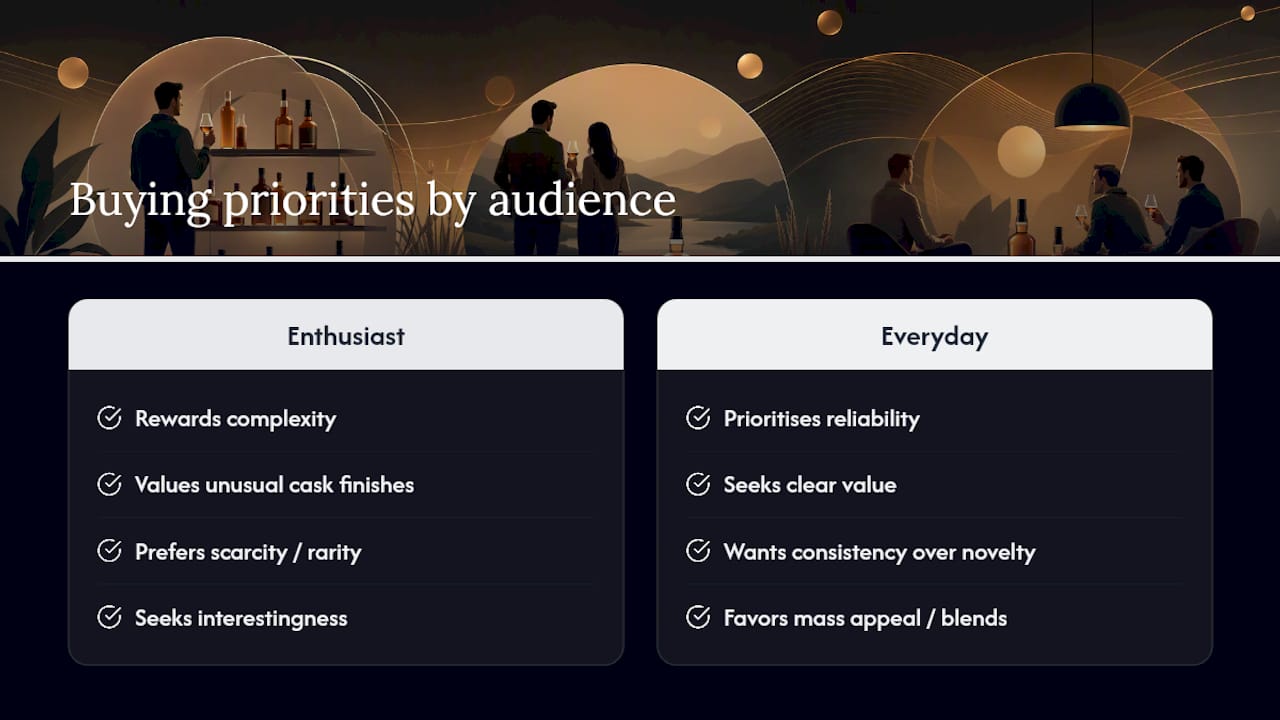
Specialist whisky communities and general consumers are, in effect, judging different products even when they’re holding the same bottle. Enthusiast forums and tasting groups tend to reward complexity, unusual cask finishes, and scarcity, often ranking a bottle highly precisely because it’s hard to find rather than because it’s easy to enjoy.
General consumers, by contrast, are usually optimising for reliability and value. They want a bottle that tastes the way they remember it tasting last time, at a price that doesn’t require justification, and that’s exactly what keeps blends dominant in overall sales figures even as enthusiast attention drifts toward single malts and limited releases.
This gap explains why a bottle can be genuinely obscure to casual drinkers while commanding serious respect, and a serious premium, within a specialist community. It also explains the reverse: some of the best-selling whiskies in the world barely register in enthusiast rankings, not because they’re poorly made, but because consistency and mass appeal simply aren’t what specialist rating systems are built to reward.
Neither group is wrong. They’re answering different questions. A specialist community is asking “what’s interesting?” while a general consumer is usually asking “what won’t let me down?” Recognising which question you’re actually asking yourself is the fastest way to stop being swayed by a “popular” label that doesn’t match what you actually want from a bottle.
Balancing popularity with personal taste
Chasing whatever’s trending is a fast way to end up with a cabinet full of bottles you don’t actually enjoy. Popularity is a useful starting point, not a destination. Match the bottle to how you actually drink, whether that’s slow sipping or gifting, rather than to whatever’s topped a list this month. If you want a curated shortcut through that noise, our Australian whisky guide is a solid place to start.
— Brendan
Find popular whisky styles at Uisuki
Uisuki curates bottles from Scotland, Japan, Australia, and the United States, so instead of guessing which “top 10” list actually matches your taste, you can compare batch, ABV, and cask details on the product page itself before you buy.

Browse the Scotch Whisky range for the blends and single malts covered throughout this guide, or head to Japanese Whisky and Australian Whisky if the regional sections above caught your eye. Bourbon and rye drinkers will find their lane in American Whiskey, while broader exploration lives under World Whiskies. If you’re not ready to commit to a full bottle, Uisuki’s sample options through the homepage let you test a style before buying, and personalised sourcing requests cover the rare or hard-to-find bottles that don’t sit on any shelf. Shipping runs locally and internationally, with details on thresholds and returns listed at checkout. Start with the collection that matches the section above and see what’s currently in stock.
Sources
- Scotch whisky exports reach record high in 2017 — Whiskycast
- The Famous Grouse - Original Whisky | The Famous Grouse
- The top 10 scotch whisky blends that dominate the global market — The Whiskey Wash
FAQ
Which whisky is most popular worldwide?
By sales volume, blended Scotch is the most popular category globally, with the sector moving roughly one billion bottles a year. By enthusiast interest and ratings, single malts and premium Japanese releases tend to top the conversation instead.
What are the top whiskies people search for?
Searches typically split between big-volume blends, premium single malts with strong age statements, bourbon staples, and Japanese releases known for scarcity. Our global ranking of popular whisky brands breaks these down by category rather than a single mixed list.
What are the most popular whiskies in Australia?
Australian drinkers gravitate toward a mix of imported Scotch blends for everyday drinking and locally made craft single malts for special occasions, with local producers gaining ground fast on award tables. Uisuki’s Australian whisky collection reflects that same split between everyday and award-winning bottles.
What are the top styles worth trying if I’m new to whisky?
Start with an approachable Speyside-style single malt or a smooth bourbon before moving into peated or cask-strength styles. Our beginner’s guide to choosing whisky walks through this progression step by step.