

Buffalo Trace Stagg comes in two forms that get confused constantly: Stagg, a barrel-proof bourbon aged roughly 7 to 9 years and released twice a year, and George T. Stagg, the 15-plus-year Antique Collection flagship released once annually. Both are bottled uncut and unfiltered at full barrel strength, and both command serious collector attention, but they sit at completely different points in Buffalo Trace’s lineup.
TL;DR:
- The aging process differs significantly, with Stagg around 7 to 9 years old and George T. Stagg typically over 15 years, impacting flavor complexity and scarcity.
- Limited annual releases and small allocations make both expressions highly sought after, with secondary prices often several times their retail value.
- Verifying provenance through receipts, seals, batch codes, and fill levels is essential to avoid counterfeit or tampered bottles on the secondary market.
- The best way to acquire these bourbons is through curated retailers who track releases and handle personalized sourcing requests for rare vintages.
Table of Contents
- What does Buffalo Trace Stagg taste like?
- How does the age statement change between Stagg and George T. Stagg?
- When are new Stagg batches and George T. Stagg vintages released?
- Why is Stagg bourbon so expensive on the secondary market?
- Where can you buy Stagg or George T. Stagg bourbon?
- What makes these claims trustworthy?
- Which one should you actually buy first?
- Get help tracking down your next bottle
- Sources
- FAQ
What does Buffalo Trace Stagg taste like?
Stagg’s flavour profile leans rich and sweet, with the official Buffalo Trace tasting notes pointing to chocolate and brown sugar up front, followed by cherries, cloves, and a smoky, spiced finish that lingers well past the last sip. Because it’s bottled straight from the barrel with no water added, that high proof pushes the spice and heat forward, especially on the first few sips before the glass opens up.

Older barrels used for George T. Stagg tell a different story. Extended time in oak strips away some of that bright fruit and replaces it with leather, dried fig, and a deeper, drier wood character. Fifteen-plus years in a Kentucky warehouse does that to a bourbon.
A few things worth knowing before you pour:
- Expect proof typically in the low 130s range depending on the batch, sometimes higher for George T. Stagg.
- A few drops of water can tame the alcohol bite without flattening the flavour.
- Use a tulip-shaped glass (a Glencairn works well) to concentrate the aroma rather than a standard tumbler.
- Let the pour sit for a couple of minutes before tasting. Barrel-proof whiskey needs a moment to breathe.
Proof range: Collector references tracking recent Stagg batch releases show proofs swinging between roughly 125.9 and 132.2 across different batches, a gap wide enough to genuinely change how the bourbon drinks from one release to the next.
How does the age statement change between Stagg and George T. Stagg?
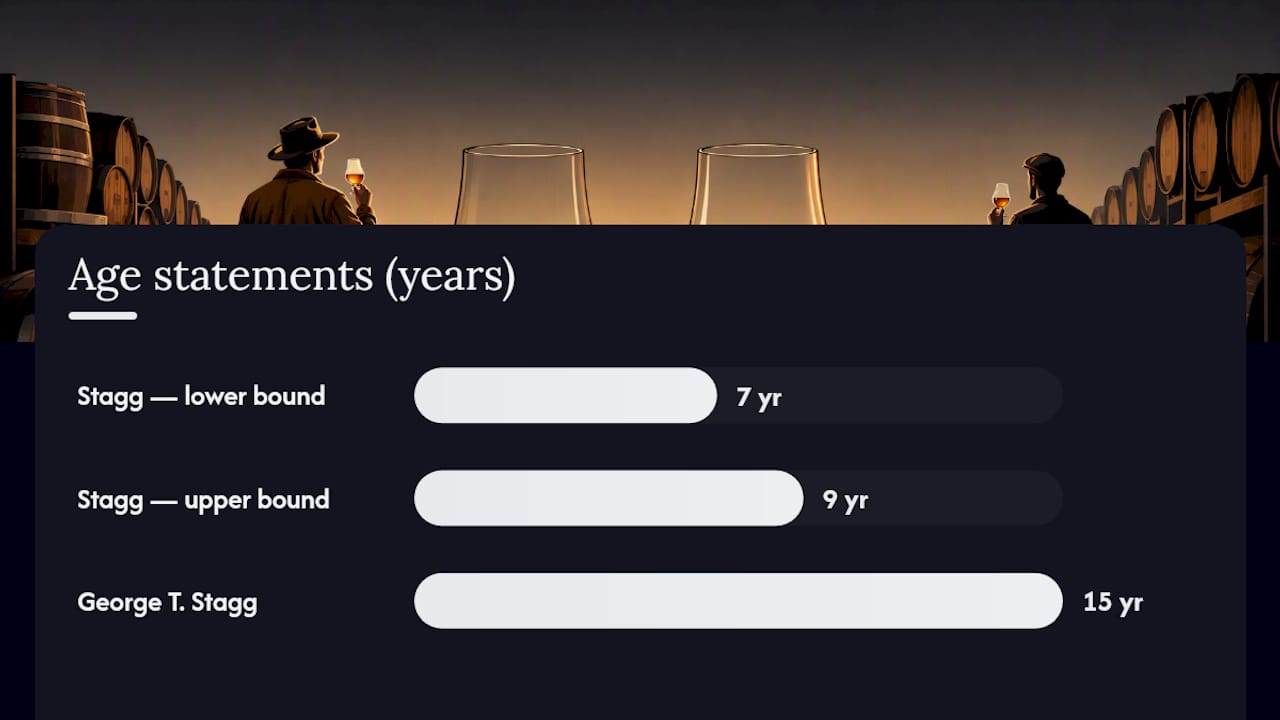
Age is the single biggest fork in the road here. George T. Stagg carries a vintage date and typically clears 15 years in the barrel, making it one of the oldest expressions Buffalo Trace produces. Stagg, by contrast, is bottled at around 7 to 9 years old, which is still substantial for a barrel-proof bourbon but nowhere near the same scale.
That age gap explains the positioning:
- Stagg functions as Buffalo Trace’s accessible, high-proof workhorse. Big flavour, released often enough that dedicated hunters can usually track one down.
- George T. Stagg sits inside the Antique Collection, the distillery’s most prestigious annual release set, alongside five other whiskeys chosen to showcase its oldest, rarest barrels.
Longer ageing means more barrels lost to evaporation and leakage, so every extra year in oak shrinks the pool of usable liquid. That scarcity is baked directly into George T. Stagg’s reputation and its price on the secondary market, which we’ll get into shortly. If age statements confuse you generally, it’s worth reading up on how whisky age statements work before you start comparing vintages.
When are new Stagg batches and George T. Stagg vintages released?
- Stagg ships in two batches most years, one in spring and one in autumn, each carrying a code combining the release year and a letter (think 23A for the first 2023 batch, 23B for the second).
- George T. Stagg arrives once a year as part of the Antique Collection’s autumn drop, alongside the other five expressions in that set.
- Each vintage of George T. Stagg draws from a different combination of barrels, so proof and flavour shift from year to year in ways that are hard to predict ahead of release.
- Stagg’s batch-to-batch shifts are smaller but still noticeable, since the barrels selected for spring and autumn releases rarely age identically.
The batch and year labelling isn’t just trivia. It’s how collector reference sites track proof and quality across releases, and it’s the first thing a serious buyer checks before paying secondary-market prices for a specific bottle.
Why is Stagg bourbon so expensive on the secondary market?
Retail pricing for both expressions rarely reflects what they actually sell for once they leave the shelf. Stagg trades up from its retail price but stays within reach for most enthusiasts willing to wait for a release. George T. Stagg is a different animal entirely: its combination of age, Antique Collection status, and genuinely limited output pushes secondary prices well beyond what most other bourbons command, often several multiples of the original retail figure.
A few checks matter more than the price tag itself:
- Provenance first. Ask for the original receipt or proof of purchase from an authorised retailer.
- Photograph the seal. An unopened bottle should show an intact factory seal with no signs of tampering or refilling.
- Match the batch code. Cross-check the label’s year and letter against known release data to confirm it’s genuine and correctly identified.
- Confirm the fill line. Evaporation over years of storage can lower the level slightly, but a bottle sitting well below the shoulder is a red flag.
Pro Tip: Chasing the lowest price on a rare bottle is how collectors end up with a fake or a bottle that’s been opened and re-sealed. Pay a bit more for a seller who can show you where the bottle came from, and you’ll sleep better than the person who saved fifty dollars on eBay.
Where can you buy Stagg or George T. Stagg bourbon?
Retail availability for both expressions is genuinely limited, and that’s by design. Buffalo Trace allocates small quantities to each market, which means most bottles never reach a store shelf at all before they’re spoken for.
Your best shot at buying either bottle comes down to a few practical steps:
- Watch official Buffalo Trace announcements and authorised retailer listings for release windows.
- Get on retailer notification lists well before the expected release date rather than searching after the fact.
- Treat any private sale with the same provenance checks outlined above: receipts, unopened packaging photos, and matching batch codes.
- Consider a curated retailer that specialises in tracking down harder-to-find bottles rather than relying on general liquor stores.
Uisuki maintains curated listings covering Buffalo Trace’s range and takes personalised sourcing requests for collectors chasing a specific batch or vintage that isn’t sitting on the shelf.
What makes these claims trustworthy?
Everything here traces back to primary sources rather than guesswork. Buffalo Trace’s own brand pages set the record straight on age statements, proof, and release structure for both Stagg and the Antique Collection it belongs to. Batch-level detail, including proof variation across recent releases, comes from dedicated collector tracking resources that log every release as it drops.
- Buffalo Trace’s own product and Antique Collection pages for age, proof, and release cadence.
- Collector reference sites for batch numbering and proof history.
- Uisuki’s product listings and editorial coverage of the Buffalo Trace range, drawn from direct product handling and market tracking.
Which one should you actually buy first?
If you’re building a cellar for the long haul, George T. Stagg is the one worth chasing. It’s rarer, older, and the vintage variation gives you something genuinely different every year. If you just want serious barrel-proof bourbon in your glass without the multi-year hunt, Stagg delivers most of the thrill twice a year. Either way, check provenance before price.
— Brendan
Get help tracking down your next bottle
Finding an allocated bourbon like Stagg or George T. Stagg usually means competing with hundreds of other buyers for a handful of bottles, and most retailers won’t tell you when a shipment is coming until it’s already gone. Rather than waiting on a general liquor store to restock, some retailers curate hard-to-find whiskies and take personalised sourcing requests for collectors chasing specific batches, vintages, or bottles not readily available on shelves.

Every listing carries the batch, ABV, and cask details you need to check provenance before you buy, which matters far more with barrel-proof bourbon than it does with standard releases. Browse the current American whiskey collection to see what’s available now, or get in touch about sourcing a specific Buffalo Trace release and let Com do the hunting for you.
Sources
- STAGG — Buffalo Trace Distillery
- Stagg (Jr.) - Complete Release Information About Each Batch — LostCargo
FAQ
How much is a bottle of Stagg worth?
Stagg’s retail price is well below what it fetches on the secondary market, where demand regularly pushes it several multiples higher. George T. Stagg commands even steeper secondary prices thanks to its age and Antique Collection status, so the actual figure depends heavily on the specific batch, vintage, and condition of the bottle.
Why is Stagg bourbon so expensive?
Limited allocation is the main driver: Buffalo Trace releases only small quantities of both Stagg and George T. Stagg each year, and demand from collectors and drinkers far outstrips supply. Age adds another layer for George T. Stagg specifically, since 15-plus years in the barrel means fewer bottles survive evaporation to reach release.
Does Buffalo Trace ever sell Stagg directly?
Buffalo Trace allocates both expressions to authorised retailers rather than selling bottles directly to consumers through its own site. Availability depends on your region and the retailer’s allocation, which is why curated retailers like Com that track Buffalo Trace’s range and take sourcing requests are often a more reliable route than waiting on general retail stock.
What is the holy grail of bourbon?
There’s no single universally agreed “holy grail,” but George T. Stagg is consistently named among the most sought-after annual releases thanks to its age, proof, and place in the Antique Collection. Other Antique Collection expressions and older Pappy Van Winkle releases are frequently mentioned in the same breath.
Is Stagg the same as Stagg Jr.?
Yes. Stagg was previously marketed as “Stagg Jr.” before Buffalo Trace dropped the “Jr.” from the name, though the bourbon itself remained a younger, barrel-proof sibling to George T. Stagg throughout that change. Collectors chasing older bottlings should check the label carefully, since “Stagg Jr.” bottles predate the current naming.